Published by Blue Grid Media • March 12, 2026 • 15 min read
The pitch sounds great on paper. "Facebook leads are $27 each. LSA leads run $55. Why would I pay double?" It is the most common question we get from contractors who are evaluating their ad options, and it makes total sense to ask. If you see two prices for the same thing, obviously you want the lower one.
The problem is, they are not the same thing. Not even close. A Facebook lead is someone who was scrolling vacation photos and clicked your ad out of curiosity. An LSA lead is someone who just typed "AC repair near me" and is standing in front of a broken unit in August. One of those people is ready to hire. The other one might be a renter, might be a bot, or might just have been bored for 30 seconds.
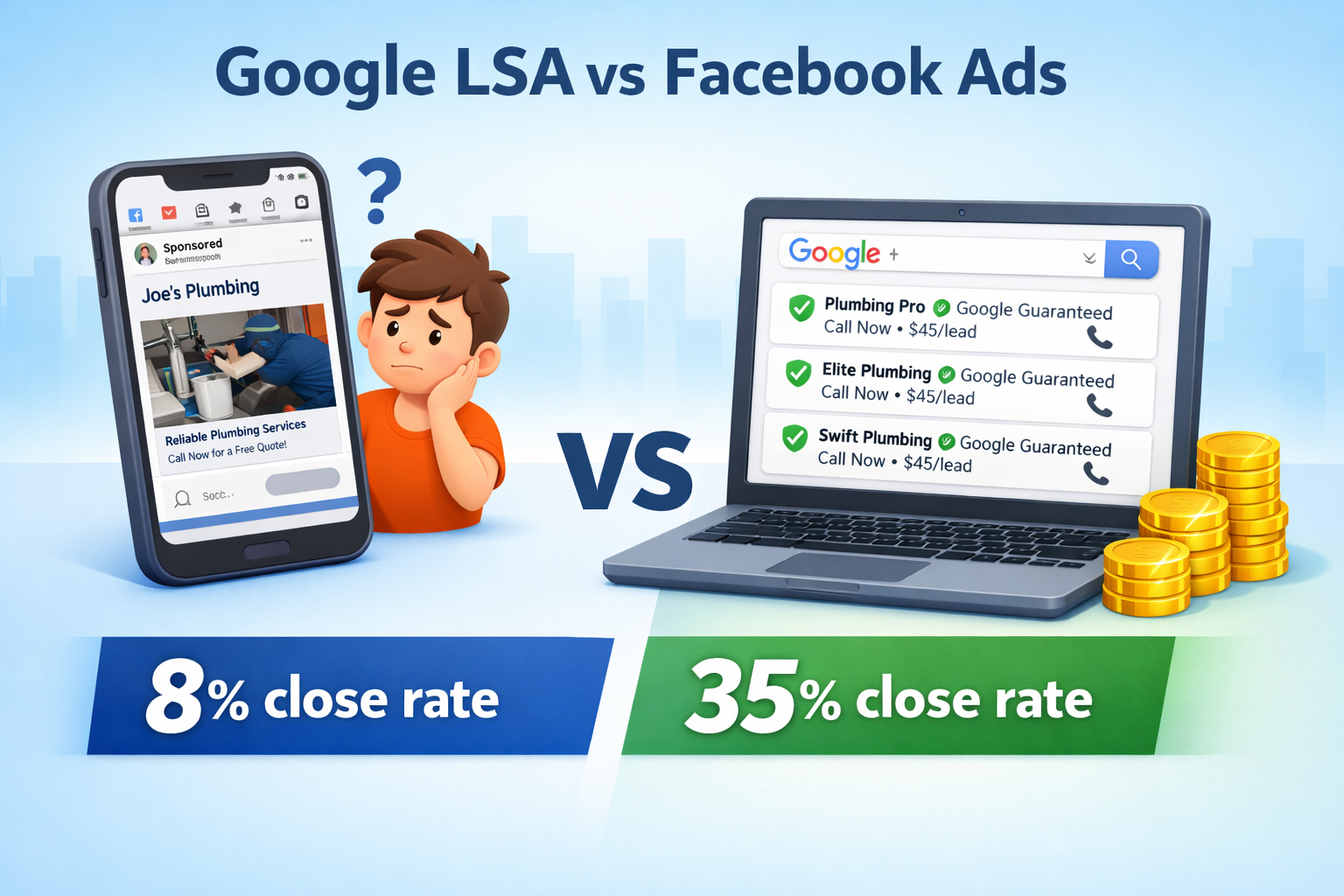
When you actually track what each lead costs you to turn into a booked job, the $27 Facebook lead often runs you $225 or more per customer. The $55 LSA lead runs around $157. Facebook's "cheap lead" ends up costing 43% more per job. That is the cheap lead fallacy, and it catches a lot of contractors off guard.
This post is not anti-Facebook. There are real things Facebook does well for home service businesses, things LSA genuinely cannot do. But understanding when each platform earns its place in your budget is how you stop leaving money on the table. Let's run the real numbers.
In This Guide
- How LSA Works: Intent-First Advertising
- How Facebook Ads Work: Interruption Marketing
- The Real Cost Comparison: CPL vs. Cost Per Booked Job
- Lead Quality: Why Facebook Leads Need Nurturing
- What Facebook Does That LSA Can't
- Budget Breakdown: What $1,000/Month Gets You
- The Combined Strategy: How Top Contractors Use Both
- Frequently Asked Questions
- The Bottom Line
How does Google LSA actually work (intent-first advertising)?
Google Local Services Ads sit at the very top of search results, above the map pack, above regular Google Ads. When someone types "plumber near me" or "emergency HVAC repair" into Google, your ad appears first. On average, 13.8% of all clicks on a search results page go to the top three LSA positions. That is premium real estate, and you are not paying for it unless someone actually calls or messages you directly through the ad.
The critical word here is intent. The person who typed that search is not browsing. They are not idly curious. They have a specific need, often an urgent one, and they are actively shopping for someone to solve it right now. That is what Google calls high-intent traffic, and it is why LSA leads have close rates between 25% and 40% for most home service contractors.
LSA has two other features that compound its effectiveness. First, the Google Verified (formerly Google Guaranteed) badge on your listing signals trust immediately. Homeowners know you passed a background check and carry insurance. Second, leads are exclusive. Unlike platforms that send your lead to three other competitors simultaneously, an LSA lead calls your number. Nobody else gets it.
The limitation is real: LSA is capped by local search volume. If only 200 people in your market search for your service this week, LSA can only give you a slice of those 200 people. You cannot manufacture more search demand. That is where Facebook comes in, but we will get to that.
The Customer Intent Spectrum: Where Each Platform Intercepts
How do Facebook Ads work for contractors (interruption marketing)?
Facebook is an interruption platform by design. Users open Facebook or Instagram to see content from friends, family, and pages they follow. Your ad appears in that feed uninvited. The person did not ask to see it, and they had no prior intention of hiring a contractor today. Your job is to interrupt them compellingly enough that they stop scrolling and act.
For home service contractors, the typical Facebook flow looks like this: you run a lead generation ad (usually offering a free estimate, seasonal special, or something else that creates a reason to click). The prospect fills out Facebook's native lead form, which is intentionally frictionless. That frictionlessness is both the feature and the bug.
When a form takes 20 seconds to fill out, it attracts people with 20 seconds of interest. Some of them are genuinely motivated homeowners. But a meaningful percentage are renters who cannot authorize work, people who forgot they clicked by the time you call, duplicate submissions, and yes, outright bots on certain audience segments. The home services industry sees Facebook close rates between 8% and 20% for exactly this reason.
One lever that helps: Facebook offers a "Higher Intent" form option that adds a review step before submission. It reduces volume but meaningfully improves lead quality. If you are running Facebook lead forms, this setting is worth testing. You will get fewer submissions but better ones.
Facebook's minimum effective budget is $500-$1,000 per month. Below that, the algorithm does not have enough data to optimize properly, and you end up wasting money on poorly targeted impressions. This is not a platform where you test the waters with $200 and expect useful results.
What is the real cost comparison between LSA and Facebook Ads for contractors?
This is the math that changes everything. Cost per lead is the metric platforms want you to focus on because it always makes them look good. Cost per booked job is the number that actually connects to your revenue.
Work out what a lead should cost you in the free CPA calculator before judging the number you are getting.
Here is how the math works for a typical home service contractor:
The True Cost Per Booked Job: Facebook vs. LSA
The gap is real, and it compounds. For every 10 jobs you book from Facebook, you would have needed to generate roughly 83 leads. For the same 10 jobs from LSA, you only need about 29 leads. At those CPL rates, that is $2,241 in Facebook spend vs. $1,595 in LSA spend for the exact same 10 booked jobs. LSA saves you $646 per 10 jobs, just from the close rate difference.
For LSA CPL context by trade: HVAC runs $45-$85, plumbing $40-$75, electrical $35-$70, roofing $50-$100, and house cleaning $15-$35. These are all higher than Facebook on a per-lead basis. They are all lower on a per-booked-job basis, usually significantly. See our detailed breakdown at /how-much-does-google-lsa-cost.
Lead Quality: Why Facebook Leads Need Nurturing and LSA Leads Need Speed
The operational demands of each platform are completely different, and this trips up contractors who try to treat both the same way.
LSA leads: speed is everything
When an LSA lead calls, you have a narrow window. That person just searched Google, your ad was at the top, they called. But if you do not answer, Google's LSA algorithm tracks that missed call, and your ranking drops. The person also moves immediately to the next result. LSA is a first-caller-wins system, and response time is one of the primary ranking factors.
The sales cycle is short: person searches, calls, gets a quote, books (or does not). In most trades, if you are not booking within 1-3 days of the initial call, the lead has gone elsewhere. No nurturing sequence saves a missed LSA call. You just lost it.
Facebook leads: nurturing is required, not optional
Facebook leads submitted through a native lead form rarely result in an immediate booking. The person was not actively shopping, so they are not ready to commit on the spot. Best practice is:
- Immediate auto-response text or email (within 5 minutes of form submission)
- Personal follow-up call within 30 minutes
- Two additional call attempts within the first 24 hours if no answer
- Email nurture sequence over 7-14 days
- Final outreach attempt at the 21-day mark
That is a real operational commitment. If you do not have a CRM, a follow-up system, or someone on your team managing it, Facebook leads will just rot in your inbox and your cost per booked job will look terrible, not because Facebook does not work, but because you did not have the infrastructure to convert it.
Lead Journey: Facebook vs. LSA from Click to Booked Job
What Facebook Does That LSA Can't
Here is the honest part. Facebook is genuinely good at several things that LSA structurally cannot do, and ignoring those strengths means leaving real money behind.
Brand awareness at scale
LSA only shows to people who are actively searching. Facebook can put your name, your face, your truck, and your reviews in front of every homeowner in your service area whether they searched for anything or not. That repeated exposure builds name recognition. When someone does eventually need an HVAC company six months from now and does a Google search, seeing a familiar brand name in the results increases click-through and close rates.
Retargeting: the combo that actually works
This is the most powerful Facebook use case for contractors. Someone searches Google, sees your LSA listing, visits your website or Google profile but does not call. Facebook retargeting lets you follow that person around the internet with your ads for the next 30 days. They see your brand on Instagram while having coffee. They see your five-star reviews while scrolling Facebook. That repeated exposure converts the fence-sitters, the people who were interested but not quite ready when they first found you.
Unlimited scalability
LSA is capped by how many people search for your service in your market. If search volume is limited, LSA budget increases hit a wall where you are just raising bids against yourself. Facebook has no such cap. You can reach millions of homeowners if your budget allows. For contractors who want to grow aggressively or expand into new service areas, Facebook's reach is an advantage LSA cannot match.
Seasonal and promotional pushes
Running a spring HVAC tune-up special? Offering a fall gutter cleaning bundle? Facebook is excellent for pushing promotional offers to a wide local audience on a specific timeline. LSA does not do promotional messaging or time-limited offers. You can use Facebook to create demand that did not exist before, then capture it with LSA when those homeowners eventually search.
Platform Scorecard: Google LSA vs. Facebook Ads for Contractors
| Factor | Google LSA | Facebook Ads |
|---|---|---|
| Lead Intent | Excellent (active search) | Low (interruption) |
| Cost Per Lead | $35-$100 (higher) | $15-$50 (lower) |
| Close Rate | 25-40% | 8-20% |
| Cost Per Booked Job | Lower (wins here) | Higher (loses here) |
| Sales Cycle | 1-3 days | 2-3 weeks |
| Brand Building | Limited | Excellent |
| Scalability | Capped by search volume | Virtually unlimited |
| Setup Difficulty | Easy (Google manages targeting) | Moderate (requires creatives) |
| ROI Predictability | High | Variable (creative-dependent) |
For a broader platform comparison across LSA, Thumbtack, and Angi, see our full breakdown at /lsa-vs-thumbtack-vs-angi-contractors.
Budget Breakdown: What $1,000/Month Gets You on Each Platform
Let's make this concrete. You have $1,000 per month to spend on paid advertising. How does it perform on each platform?
$1,000/month on LSA only
At a $55 average CPL, $1,000 buys you approximately 18 leads. At a 35% close rate, that converts to roughly 6-7 booked jobs. If your average job value is $400, that is $2,400-$2,800 in revenue from $1,000 in ad spend. A 2.4-2.8x ROAS on a platform that requires minimal creative production and no nurture infrastructure.
$1,000/month on Facebook only
At a $27 average CPL, $1,000 buys you approximately 37 leads. Sounds great. But at a 12% close rate, that converts to roughly 4-5 booked jobs. Less than LSA, from the same budget, with significantly more follow-up work required. Your ROAS is similar or lower, and you need a CRM, an automated follow-up sequence, and someone actively working the leads.
Facebook's minimum effective budget is $500-$1,000 per month. At $1,000, the algorithm is just barely getting enough data to optimize. Many Facebook campaigns do not hit their stride until month 2 or 3.
The recommended split: 70/30
For most contractors, the right answer is not either/or. It is both, with the right allocation. Our recommended starting point: 70% of your budget to LSA, 30% to Facebook. LSA is your direct revenue engine. Facebook is your brand layer and retargeting machine.
Recommended Budget Allocation for a $1,500/Month Total Budget
Once you scale past $3,000-$5,000 per month, you may find that LSA has captured most of the available search volume in your market and additional spend produces diminishing returns. At that point, increasing your Facebook allocation makes sense as a way to expand your addressable audience. But that is a later-stage problem. Most contractors are not there yet.
How do the best contractors combine LSA and Facebook Ads in one strategy?
The contractors seeing the best results from paid advertising are not choosing between LSA and Facebook. They are using them as two stages of the same funnel, each doing the job it is best suited for.
Here is how it works at its best. Your LSA captures every high-intent searcher in your market. The people who searched, saw your listing, and visited your profile but did not call, those are tracked. Facebook retargeting then shows them your ads: maybe a testimonial video, maybe a five-star review compilation, maybe a "we've helped 200 homeowners in [City] this year" ad. That second touch is often what converts the fence-sitter. They were almost ready when they searched. The Facebook retarget pushed them over the line.
Meanwhile, your Facebook awareness campaigns are running to your service area's homeowners regardless of whether they searched. When those homeowners do eventually search, your brand name is familiar. Familiar brands get more clicks and more trust on the phone, which means higher close rates even on your LSA leads.
The whole thing compounds over time in a way that neither platform can achieve alone. That is why contractors running both platforms report 43% higher total lead volume.
The LSA + Facebook Combined Funnel
non-callers
If you want to learn more about ranking in the top 3 LSA positions and maximizing the traffic that feeds this funnel, see our complete guide at our LSA ranking factors guide. And if you are comparing LSA to Google Ads (pay-per-click), that breakdown lives at /google-ads-vs-local-services-ads-contractors.
See the real numbers for your trade
Plug in your industry, budget, and close rate. Our calculator shows your projected leads, cost per booked job, and ROAS.
LSA vs Facebook Ads FAQs
The Bottom Line: Start With LSA, Layer Facebook On Top
The cheap lead fallacy is one of the most expensive mistakes in home service marketing. Chasing the lowest CPL feels like smart budgeting. It is actually the opposite of smart budgeting, because CPL is a vanity metric that tells you nothing about what you are actually paying per job.
When you run the real math, LSA wins on cost per booked job in almost every trade, usually by a significant margin. It wins because the leads come from people with active intent. It wins because leads are exclusive. It wins because the Google Verified badge creates immediate trust. And it wins because the sales cycle is short enough that you do not need complex follow-up infrastructure to convert leads into revenue.
That said, Facebook is not your enemy. It is a tool with a different job. When you use Facebook for brand awareness and retargeting, layered on top of a strong LSA foundation, you capture both the people who are ready to hire now and the people who will be ready in a few weeks. The combined funnel outperforms either platform in isolation.
The playbook is straightforward: get your LSA running first, get it producing consistent leads, then reinvest a portion of that revenue into Facebook for retargeting and awareness. Start with a 70/30 split, measure your actual cost per booked job (not CPL), and adjust from there. That is how you stop paying double for leads that produce fewer jobs.
Want Us to Run the Numbers for Your Business?
We audit LSA accounts for contractors every week. We will tell you exactly what your current cost per booked job is, where you are overpaying, and how a combined LSA and retargeting strategy could perform for your specific trade and market.
Book Your Free ConsultationMore on lead channel comparisons
Part of the BGM lead channel comparison library:
Want help running both?
Our Meta ads agency page covers how we sequence Local Services Ads, Google Ads and Meta as one system.