By Blue Grid Media • Published March 7, 2026 • 14 min read
You just got off a job. You check your phone and there are three missed calls, two spam leads you paid for, and a Google Ads invoice that looks like a car payment. Sound familiar? You are not alone. Every contractor running paid ads eventually hits that moment where they stare at their ad dashboard and wonder: am I spending money in the right place?
We get it. The choice between Google Ads and Local Services Ads feels like a gamble when you are too busy running jobs to dig through the data yourself. So we did the digging for you. We manage both platforms for contractors across the country, and the performance gap between these two channels is significant. In almost every trade we track, LSA delivers a lower cost per lead, a higher conversion rate, and a better return on ad spend than Google Ads alone. But Google Ads still has a role. It fills gaps that LSA simply cannot.
Below you will find the actual numbers: cost per lead by industry, conversion rates, ROI benchmarks, and a clear framework for deciding which channel to use, when, and how much to spend on each. No theory, no fluff. Just data and recommendations based on what we see working in 2026.
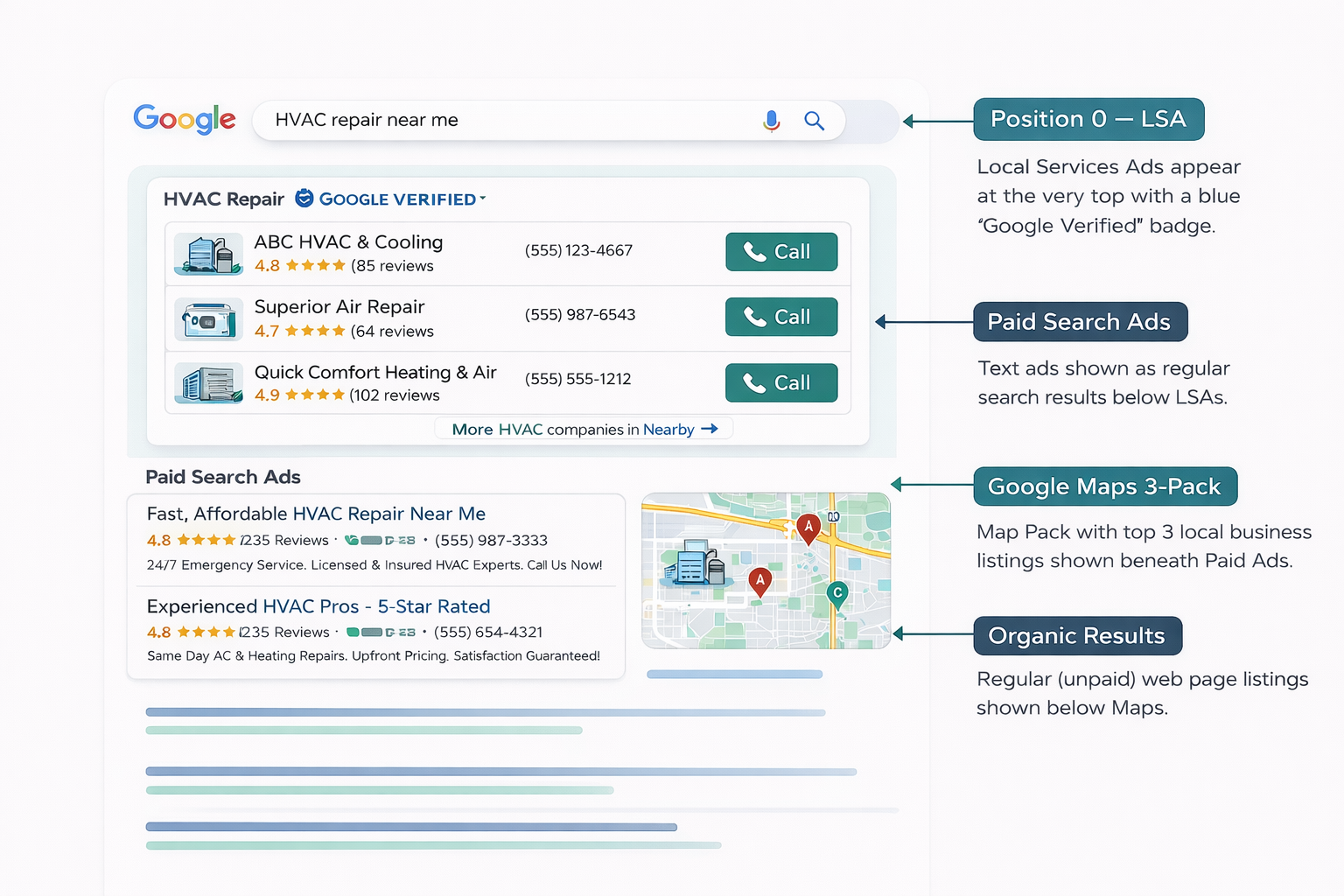
How Each Channel Works: A Quick Overview
Google Local Services Ads (LSA)
Local Services Ads appear at the very top of Google search results. Above Google Ads, above the Map Pack, above organic listings. They occupy position zero. Each ad shows your business name, review rating, years in business, and the Google Verified badge. When someone clicks or calls, you pay a flat fee per lead, not per click.
Google handles the targeting. You tell the platform which services you offer and which zip codes you serve. Google matches your profile to relevant searches in your area. There are no keywords to bid on, no ad copy to write, and no landing pages to build. Your profile, your reviews, and your responsiveness determine how often you show up and what you pay.
For a deeper look at what drives your LSA position, see our guide on Google LSA ranking factors.
Google Ads (Pay-Per-Click Search Ads)
Google Ads appear below LSA results on the search results page. You bid on specific keywords (phrases like "HVAC repair near me" or "emergency plumber") and pay every time someone clicks on your ad, whether they call you or not. Google Ads gives you a lot of control over targeting: you choose which keywords to bid on, write your own ad copy, set geographic radius, schedule ads by time of day, and direct traffic to landing pages you build.
That control comes with complexity, though. Google Ads requires ongoing management: keyword research, negative keyword maintenance, bid adjustments, landing page optimization, and conversion tracking setup. Without active management, campaigns waste budget on irrelevant clicks fast. (Ask any contractor who has left a Google Ads campaign on autopilot for three months. The stories are painful.)
How Each Channel Works
📞 Local Services Ads
- Customer searches for a service
- Sees LSA pack at top of results
- Clicks to call your business
- You pay per LEAD
🖱 Google Ads (PPC)
- Customer searches for a service
- Sees text ad in search results
- Clicks through to your website
- You pay per CLICK
How do Google Ads and Local Services Ads compare head-to-head for contractors?
Before we get into the cost data (which is where things get really interesting), here is a side-by-side comparison of the structural differences between the two platforms. Understanding these differences is the foundation for deciding where to put your hard-earned dollars.
| Feature | Google Ads (PPC) | Local Services Ads |
|---|---|---|
| Pricing Model | Pay per click | Pay per lead |
| Avg. Cost Per Click | $4.51 (range $0.11–$137+) | N/A (no clicks, only leads) |
| Avg. Cost Per Lead | ~$70 (all industries) / ~$91 (home services) | ~$23 median (range $10–$225) |
| Lead-to-Customer Rate | ~12% | ~31% |
| Ad Position on SERP | Below LSA and Map Pack | Position 0, top of results |
| Trust Signal | None built in | Google Verified badge |
| Targeting Method | Keywords, demographics, audiences | Service type + location (Google handles matching) |
| Lead Disputes | No dispute mechanism | Can rate and dispute invalid leads for credit |
| Setup Complexity | High: keywords, ad copy, landing pages, tracking | Moderate: profile, background checks, reviews |
| Ongoing Management | Heavy: daily/weekly optimization required | Light: weekly review and dispute management |
| Scalability | High: unlimited keyword and audience expansion | Limited: capped by local search volume |
The table tells a clear story. LSA wins on cost efficiency, conversion rate, trust, and ad position. Google Ads wins on control, scalability, and keyword precision. Knowing which of those advantages actually matters for your business is the difference between profitable ad spend and money down the drain.
Platform Scorecard: LSA vs. Google Ads
| Category | LSA | Google Ads |
|---|---|---|
| Cost Efficiency | ★★★★★ | ★★★★★ |
| Lead Quality | ★★★★★ | ★★★★★ |
| Trust Signal | ★★★★★ | ★★★★★ |
| Targeting Control | ★★★★★ | ★★★★★ |
| Ease of Management | ★★★★★ | ★★★★★ |
| Scalability | ★★★★★ | ★★★★★ |
Not sure which platform makes sense for your business? We'll review your market, analyze what competitors are running, and give you a clear recommendation, free.
What is the cost per lead comparison by industry (LSA vs Google Ads)?
Cost per lead is usually the first thing contractors want to know, and we do not blame you. Here is how the two platforms compare across the most common trades, using aggregated data from managed accounts and published industry benchmarks.
Cost per lead is just CPC divided by conversion rate, which the free CPA calculator will do for you.
| Industry | LSA CPL | Google Ads CPL | LSA Advantage |
|---|---|---|---|
| HVAC | $52–$80 | $127–$198 | 59–73% cheaper |
| Plumbing | $55–$69 | ~$167 | 59–67% cheaper |
| Electrical | $35–$70 | ~$163 | 57–79% cheaper |
| Roofing | $71–$162 | ~$228 | 29–69% cheaper |
| Pest Control | $20–$60 | ~$90 | 33–78% cheaper |
| Carpet Cleaning | $15–$45 | ~$75 | 40–80% cheaper |
Cost Per Lead: LSA vs. Google Ads by Industry
The pattern is consistent. Across every contractor trade, LSA delivers a lower cost per lead, often dramatically lower. The gap is most pronounced in trades with high Google Ads click costs like plumbing and HVAC, where a single click can cost $15 to $60 before any conversion happens. That is real money disappearing before anyone even picks up a phone.
But what about ROI?
Cost per lead only tells part of the story, though. Return on ad spend (ROAS) accounts for the full picture: how much revenue you generate per dollar spent. Here are the benchmarks we see across managed contractor accounts:
- Google Ads: 2–4x ROAS (you earn $2–$4 for every $1 spent)
- LSA for HVAC: 3.9:1 ROAS
- LSA for Plumbing: 2.8:1 ROAS
- LSA for Roofing: 21:1 ROAS (high ticket values make even expensive leads extremely profitable)
Roofing is the standout here. A $162 lead that turns into a $12,000 roof replacement? That is cheap advertising all day long. The trades where LSA ROI is highest are the ones where job values are large and the customer is making an urgent, one-time decision. That is exactly the scenario where LSA's position-zero placement and Google Verified badge have the most impact on conversion.
Which Platform Generates Better Leads?
If you have ever spent half your morning calling back leads that turned out to be tire-kickers, wrong numbers, or people in the next state, you already know lead quality matters. It translates directly to your booking rate, your close rate, and the amount of time your team wastes chasing dead-end inquiries. The two platforms produce fundamentally different types of leads because they attract buyers at different stages.
LSA leads: higher intent, higher conversion
LSA leads convert to paying customers at approximately 31%. That is nearly three times the Google Ads conversion rate. The reason is structural: LSA ads sit at the absolute top of the search results, carry the Google Verified badge, and display your review rating prominently. By the time someone taps "call" on your LSA listing, they have already filtered through your reviews, confirmed you serve their area, and decided to reach out. These are not casual browsers. They are homeowners with a broken furnace, a backed-up sewer line, or a roof leak, and they want someone right now.
LSA also gives you the ability to dispute invalid leads and receive credits for spam calls, wrong numbers, and out-of-area contacts. This dispute mechanism does not exist in Google Ads, where every click costs you money regardless of quality.
The Conversion Gap: LSA vs. Google Ads
Google Ads leads: broader reach, mixed quality
Google Ads leads convert to customers at approximately 12%. That is still a decent number, but it reflects the fact that Google Ads casts a much wider net. Your ads show for keyword searches that include a mix of high-intent buyers, early-stage researchers, price comparison shoppers, and occasionally irrelevant traffic from poorly matched keywords.
The broader reach of Google Ads is a feature, not a flaw. It lets you capture demand that LSA misses entirely. Homeowners searching "how much does a new AC cost" or "best roofing companies reviews" are not ready to call an LSA listing, but they are in the market and can be converted with the right landing page and follow-up sequence. The tradeoff is that you need more infrastructure (landing pages, call tracking, CRM) to convert these leads effectively.
Which Platform Is Easier to Manage?
This is where most contractors underestimate Google Ads and overestimate LSA. We get it, you are running a business, not a marketing agency. Both platforms require work, but the type and volume of work is very different.
Managing LSA: weekly effort
Once your LSA profile is verified and live, ongoing management is relatively light. The primary tasks are:
- Reviewing and disputing invalid leads every week
- Responding to reviews promptly
- Keeping your service area and job types updated
- Maintaining a high call answer rate (above 90% is ideal)
- Requesting reviews from happy customers after every job
Most of this is operational, not technical. You do not need a marketing degree or a dedicated ads manager to run LSA well. You just need a system for answering the phone and following up on every lead. If you can do that consistently, you are already ahead of half your competitors.
Managing Google Ads: daily to weekly effort
Google Ads is a different animal. A well-structured campaign requires:
- Keyword research and ongoing refinement
- Negative keyword lists to block irrelevant searches
- Multiple ad variations with continuous A/B testing
- Dedicated landing pages (not your homepage)
- Conversion tracking and call tracking setup
- Bid strategy adjustments based on performance data
- Geographic and time-of-day bid modifications
- Quality Score monitoring and improvement
Most contractors who try to manage Google Ads themselves waste 30–50% of their budget on irrelevant clicks within the first 90 days. The platform rewards expertise and punishes neglect. If you are not reviewing search term reports at least weekly and adding negatives, you are leaking money.
This does not mean Google Ads is bad. It just means the management overhead is real and should factor into your decision. If you hire a professional to manage Google Ads (and honestly, most contractors should), factor that cost into your total customer acquisition cost calculation.
Management Effort: What Each Platform Actually Requires
📞 Local Services Ads
- Setup Time
- 2–5 weeks (verification)
- Weekly Time
- 1–2 hours
- Skills Needed
- Basic: answer phone, collect reviews
- Key Tasks
- Review responses, lead disputes, photo uploads
🖱 Google Ads (PPC)
- Setup Time
- 1–2 weeks (campaign build)
- Weekly Time
- 5–10 hours (or hire agency)
- Skills Needed
- Advanced: keyword research, bid management, landing pages
- Key Tasks
- Keyword optimization, ad copy testing, bid adjustments, negative keywords
When should contractors use only Google LSA?
Not ready to juggle two platforms? Totally fair. LSA as your sole paid channel makes sense in these situations (and if you are curious about expected volume, see our breakdown of how many leads LSA actually generates):
- You are just starting with paid advertising. LSA is lower risk because you pay per lead, not per click. There is less budget waste while you learn how the platform works and build your review base.
- Your budget is under $2,000 per month. Splitting a small budget across two platforms often means neither one has enough data to optimize. Concentrate on LSA first and let it mature.
- Your business depends on emergency/urgent calls. Trades like emergency plumbing, locksmith, and water damage restoration see the strongest LSA performance because the buyer intent is immediate. LSA's position-zero placement captures these callers before they ever scroll down to Google Ads.
- You do not have landing pages or conversion tracking. Google Ads without dedicated landing pages and call tracking is like driving at night without headlights. LSA does not require either because Google handles the entire customer experience for you.
- Your team cannot commit to weekly campaign optimization. LSA forgives neglect far more than Google Ads. As long as you answer the phone and dispute bad leads, LSA will keep generating contacts at a predictable cost.
For industry-specific guidance on setting up LSA as your primary channel, see our dedicated guides for HVAC, plumbing, electricians, roofers, and pest control.
When should contractors use only Google Ads?
There are real-world scenarios where Google Ads is the better (or only) option:
- Your trade is not eligible for LSA. Not every service category is available in every market. If Google has not opened LSA for your specific trade or location, Google Ads is your primary paid search channel.
- You are targeting commercial or B2B customers. LSA is designed for residential consumers. If your contracting business primarily serves commercial properties, property managers, or general contractors, Google Ads lets you target commercial-intent keywords that LSA does not cover.
- You need to promote specific services or offers. LSA does not allow custom ad copy. If you are running a seasonal promotion, launching a new service line, or need to highlight specific differentiators, Google Ads gives you that creative control.
- You are already dominating LSA in your market. If your LSA profile is fully optimized, you are getting the maximum leads available, and you want to grow further, Google Ads is the logical expansion channel. You cannot force more volume out of LSA than the local search demand supports.
- You want to capture earlier-funnel searches. Homeowners searching "cost to replace water heater" or "how to choose a roofer" are not ready to call an LSA listing, but they are potential customers. Google Ads lets you capture this research-stage traffic and nurture it toward conversion.
If you are comparing the two platforms for a plumbing business specifically, we have a detailed breakdown in Google Ads vs. LSA for Plumbers.
When should contractors run both LSA and Google Ads together?
Here is where things get exciting. For contractors with monthly ad budgets above $3,000 and the capacity to handle more leads (the good kind of problem to have), running both channels simultaneously is the most effective approach. Here is why.
They cover different parts of the search results
LSA occupies position zero. Google Ads occupies the positions immediately below. When you run both, your business can appear twice on the same search results page. This is not a waste. It is a dominance strategy. A homeowner searching "plumber near me" sees your LSA listing at the top with the Verified badge and your Google Ads listing below with a compelling headline. You own the top of the page and crowd out your competition. Pretty satisfying, right?
They capture different buyer intents
LSA captures the homeowner who needs someone right now. Google Ads captures the homeowner who is researching, comparing, or planning a future project. Together, they cover the full customer journey from urgent need to planned improvement.
The recommended budget split
For most contractors starting a dual-channel strategy, we recommend this allocation:
- 60% to LSA, your higher-converting, lower-cost channel gets the majority
- 40% to Google Ads, your broader-reach channel fills the gaps
Recommended Budget Split: LSA vs. Google Ads
After 90 days of data, shift budget toward whichever channel delivers the lower cost per booked job. Not cost per lead, cost per booked job. That is the metric that accounts for lead quality, answer rate, and close rate in a single number. It is the one number that tells you where your money is actually working hardest.
How the math works in practice
Let us say you are an HVAC company spending $5,000 per month total:
- LSA ($3,000): At $65 per lead, that is approximately 46 leads per month. At a 31% conversion rate, that is about 14 booked jobs. Cost per booked job: $214.
- Google Ads ($2,000): At $150 per lead, that is approximately 13 leads per month. At a 12% conversion rate, that is about 1–2 booked jobs. Cost per booked job: $1,000–$2,000.
At first glance, Google Ads looks expensive. But those 1–2 booked jobs are incremental revenue you would not have captured from LSA alone. If your average HVAC job is $3,500, even one additional booked job per month from Google Ads generates positive ROI. The real power of the dual-channel approach is maximum coverage. You capture both the emergency caller and the comparison shopper.
Over time, as you refine your Google Ads keywords, build out negative keyword lists, and optimize landing pages, your Google Ads cost per booked job will decrease. Most well-managed contractor Google Ads accounts reach a 2–4x ROAS within six months of active management.
See the real numbers for your trade
Plug in your industry, budget, and close rate. Our calculator shows your projected leads, cost per booked job, and ROAS.
Google Ads vs LSA FAQs
Can I run Google Ads and Local Services Ads at the same time?
Yes, and most successful contractors do. The two platforms target different parts of the search results and different buyer intents. LSA captures high-intent callers at position zero with the Google Verified badge. Google Ads captures broader keyword searches further down the page. Running both gives you maximum visibility without the two campaigns competing against each other.
Which platform is cheaper for contractors, Google Ads or LSA?
LSA is cheaper per lead in most contractor industries. The average LSA cost per lead runs 50 to 70 percent lower than Google Ads for trades like HVAC, plumbing, and electrical. But the more meaningful metric is cost per booked job. LSA leads convert to customers at roughly 31 percent versus 12 percent for Google Ads, which makes the effective cost difference even larger. For detailed pricing by trade, see How Much Does Google LSA Cost?
Do Local Services Ads work for all types of contractors?
LSA is available for most home service trades including HVAC, plumbing, electrical, roofing, pest control, landscaping, carpet cleaning, appliance repair, tree service, water damage restoration, garage door repair, and many more. Google continues to expand the list of eligible categories. If your trade is not yet eligible, Google Ads is your primary paid search option.
How much should a contractor budget for Google Ads vs. LSA?
A reasonable starting budget for LSA is $1,500 to $3,000 per month, targeting 10 or more leads per week so the algorithm has enough data to optimize. For Google Ads, start at $2,000 to $5,000 per month depending on your market size and industry CPC. If running both, allocate roughly 60 percent to LSA and 40 percent to Google Ads initially, then shift budget toward whichever channel delivers the lower cost per booked job.
Why are my Google Ads leads lower quality than my LSA leads?
Google Ads leads often include more price shoppers, research-stage visitors, and out-of-area clicks because the platform targets keywords rather than verified service requests. To improve quality, add strong negative keyword lists, use tight location targeting with radius exclusions, send traffic to dedicated landing pages instead of your homepage, and enable call-only ads for emergency services. Conversion tracking is essential. Without it, you cannot tell Google which clicks actually turn into customers.
What happens if I pause my LSA? Will I lose my ranking?
Pausing LSA for a short period (a week or two) usually does not permanently damage your ranking. However, extended pauses of a month or more can cause your profile to lose momentum because Google's algorithm favors active profiles with consistent engagement. If you need to pause, keep your profile active and simply lower your weekly budget rather than turning it off entirely. Rankings typically recover within one to two weeks after you resume.
Bottom Line
Look, we know you did not get into contracting to become a digital marketing expert. The data is clear, though. For most contractors, Local Services Ads deliver a lower cost per lead, a higher lead-to-customer conversion rate, and a better return on every dollar spent compared to Google Ads. LSA occupies the top position on search results, carries Google's trust badge, and charges you per lead instead of per click. If you can only run one channel, run LSA.
But the contractors who grow fastest do not pick one or the other. They run both. LSA handles the urgent, high-intent callers. Google Ads captures the broader market: the homeowners researching, comparing, and planning future projects. Together, the two channels cover every stage of the customer journey and give your business maximum visibility on the most important page in local search.
Start with LSA. Get your profile verified, your reviews building, and your call answer rate above 90%. Once you are booking consistently from LSA, layer in Google Ads at 40% of your total budget with dedicated landing pages and conversion tracking. Track cost per booked job for each channel monthly. Shift budget toward the winner. That is the system.
Want to know exactly what your numbers should look like? Use our free LSA ROI calculator to estimate leads, booked jobs, and ROAS for your industry and market. And if you want someone to look at your current setup and tell you exactly where the biggest opportunities are, that is literally what we do every day.
Get a Free Google Ads & LSA Strategy Review
We will analyze your market, your current campaigns, and tell you exactly where to spend your next dollar for maximum booked jobs.
Request Your Free ReviewCPL ranges reflect aggregated data from managed accounts and published industry benchmarks as of 2025–2026. Actual costs vary by market, competition level, profile quality, and seasonal demand. Blue Grid Media specializes in LSA and Google Ads management for local service businesses.
More on lead channel comparisons
Part of the BGM lead channel comparison library: