Migration note, updated August 2026
Google has started moving Local Services Ads into Google Ads as pay-per-lead Performance Max, and the standalone LSA dashboard is being retired in phases. If your account has not migrated yet, the steps below still apply exactly as written. If it has, here is where each control now lives.
| In the old LSA dashboard | In Google Ads after migration |
|---|---|
| The LSA dashboard itself | Redirects to your campaign overview in Google Ads |
| Weekly budget | Daily average budget, your weekly figure divided by 7 |
| A bid or max cost per lead per job type | One campaign-level Target CPA for the whole campaign |
| Lead inbox | Goals, then Conversions, then Leads |
Phase 1 began August 1, 2026. Service-area businesses without a storefront are in the late 2026 wave, and everyone else follows in 2027. Read the full migration breakdown.
Published by Blue Grid Media • Updated for 2026 • 16 min read
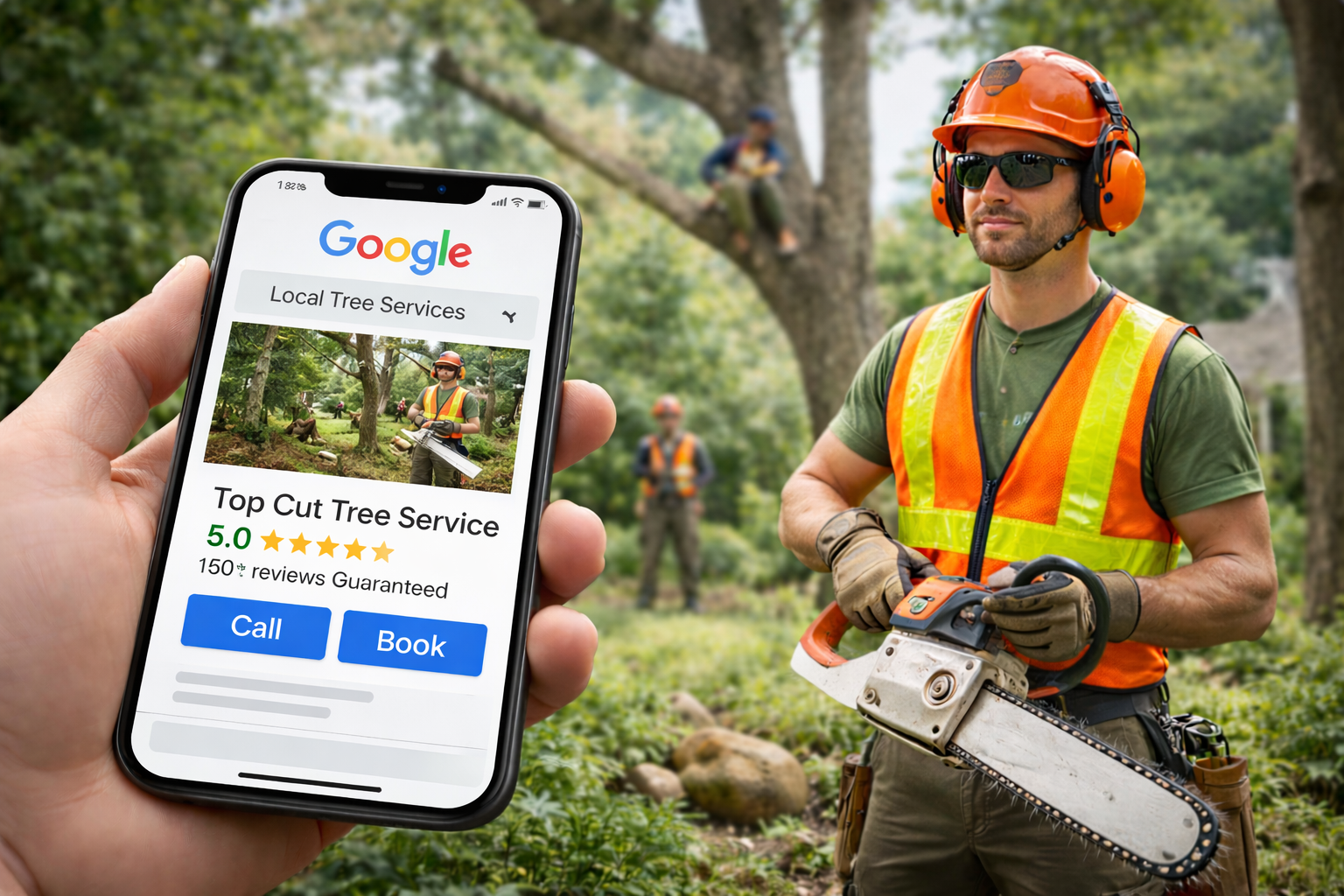
When a storm drops a 60-foot oak across a homeowner's driveway at 11pm, they're not scrolling through your website or comparing quotes. They're searching "emergency tree removal near me" on their phone and calling whoever shows up first. Google Local Services Ads puts your business at the top of that search, with your name, your star rating, and a one-tap call button. Not a link to click. A button to call.
Tree service is one of the strongest use cases for LSA in home services. The jobs are high-value, the intent is urgent, and customers searching locally are ready to commit. But most tree companies in any given market aren't running LSA at all, which means the ones that do tend to dominate their local pack. This guide covers exactly how to set it up, what it costs, how to rank above competitors, and how to build a system that generates consistent leads year-round.
Tree Service LSA Deep Dives
TL;DR: Is LSA Worth It for Tree Service?
Yes, and tree service is one of the highest-return LSA categories in home services. Here's the short version:
At a $60 average cost per lead and a 50% booking rate, you're spending roughly $120 to book one job. If that job averages $1,200 in revenue, which is conservative for tree removal, you're looking at a 10x return before repeat business and referrals. The math is compelling if your team answers the phone and follows up quickly.
A click cost and a conversion rate give you the lead cost. The free CPA calculator does that step.
The caveat: LSA alone doesn't cover every part of the funnel. It captures people who are ready to book right now. For homeowners researching trimming services three months out, or comparing bids on a large removal project, Google Search Ads extend your reach. More on running both channels below.
See the real numbers for your trade
Plug in your industry, budget, and close rate. Our calculator shows your projected leads, cost per booked job, and ROAS.
How Google LSA Works for Tree Service
Google LSA shows a row of verified local businesses at the very top of search results, above regular Google Ads, above the map pack, and above every organic listing. Each entry shows your business name, star rating, review count, years in business, and a direct call button.
You don't pay per click. You pay per lead, meaning you're charged only when a customer in your service area actually calls or messages you through the ad. If the lead is invalid (wrong number, spam, outside your area), you can dispute it and get a credit.
For tree service, this model works especially well because:
- The intent is high. Someone searching "tree removal near me" at 7pm after a storm isn't browsing, they have an urgent problem and a budget to solve it.
- Competition in LSA is thin. In most mid-size markets, fewer than five tree service companies are running LSA actively. That's far less competition than you'll find in HVAC or plumbing.
- The Google Guaranteed badge builds trust instantly. Tree work is high-stakes, cutting a large tree near a house or power line requires confidence in the contractor. The verification badge signals that Google has checked your license, insurance, and background. That matters to homeowners selecting someone for a potentially dangerous job.
- Job values are high. Even a modest lead cost produces an exceptional ROI when the average job is worth $1,000 or more.
| Feature | Local Services Ads (LSA) | Google Search Ads | Pay-Per-Lead Directories |
|---|---|---|---|
| How you pay | Per lead (call or message) | Per click | Per lead (shared) |
| Lead exclusivity | Exclusive to you | Exclusive to you | Sold to 3–5 contractors |
| Typical buyer intent | Very high, ready to book | Medium to high | Low to medium, price shopping |
| Trust signal shown | Google Verified badge | Your ad copy | Platform rating |
| Bad lead credits | Yes, disputable | No | Rarely |
| Setup time | 1–3 weeks (verification) | Days | Hours |
| Best for | Emergency removal, same-day jobs | Planned removals, installs, scale | Volume (lower quality) |
What Does Tree Service LSA Actually Cost?
Cost per lead varies by market size, local competition, and the specific services you run. Tree service is one of the more affordable LSA categories, demand is strong but the number of active LSA advertisers per market is typically low.
| Market Size | Typical CPL Range | Est. Leads / $1,000 Budget | Notes |
|---|---|---|---|
| Small market (<100k pop.) | $25–$45 | 22–40 leads | Low competition, strong ROI |
| Mid-size market (100k–500k) | $40–$65 | 15–25 leads | Most common range |
| Large metro (500k+) | $60–$90 | 11–17 leads | More competition; still strong ROI on big jobs |
| Post-storm surge | $70–$130+ | 8–14 leads | Demand spikes; job values also spike |
Key insight: A post-storm lead that costs $100 might book a $3,000 emergency removal job. The ROI on that single lead is 30x. Don't pull budget when lead costs spike after a major weather event, that's exactly when you want maximum visibility.
The economics of tree service LSA work because of job value. Here's how the math looks across typical tree service job types:
| Job Type | Avg. Revenue Range | Avg. CPL ($55) | 50% Booking Rate → Cost per Job | ROI Multiple |
|---|---|---|---|---|
| Emergency tree removal | $1,500–$5,000+ | $55 | $110 | 14x–45x |
| Large tree removal | $800–$2,500 | $55 | $110 | 7x–23x |
| Tree trimming / pruning | $300–$900 | $55 | $110 | 3x–8x |
| Stump grinding | $150–$500 | $55 | $110 | 1.4x–4.5x |
| Tree planting / landscaping | $200–$800 | $55 | $110 | 1.8x–7x |
Stump grinding on its own is the thinnest margin job in LSA. The play is to offer stump grinding as a bundle with removal, the job comes in via LSA for an emergency removal, and you upsell stump grinding at the same visit. That single phone call is worth considerably more when your team knows to package services.
Want to see what tree service LSA leads cost in your market? Run the numbers for your own market with our free tree service LSA ROI calculator.
How to Set Up Google LSA for Your Tree Service Company
Setup takes one to three weeks, with most of that time spent on verification. Here's the process step by step:
- Go to ads.google.com/local-services-ads and create your profile. Select "Tree Service" as your business type. You'll see the specific job categories and license requirements for your state.
- Define your service area. Set this to the zip codes or cities where you actually want to work, not the widest possible area. LSA uses proximity as a ranking factor, so a tighter, realistic service area improves relevance for nearby searches. You can expand later.
- Select every job type you offer. Tree trimming, tree removal, stump removal, stump grinding, emergency tree removal, tree planting, enable them all. If a job type isn't checked, Google will not show your ad for searches related to it.
- Upload your license and insurance documents. At minimum: general liability insurance (usually $1M+) and your business license. Many states also require a tree care contractor or arborist license. Your LSA dashboard will tell you exactly what's needed for your market.
- Complete background checks. Owners typically need to pass a background check through Google's verification partner. Start this first, it's the slowest step and can delay your go-live date by a week or more.
- Connect your Google Business Profile. Your GBP reviews feed directly into your LSA listing. Make sure your GBP is complete, accurate, and verified before you go live. Any gaps in your GBP (wrong address, missing category, no photos) will weaken your LSA profile.
- Add photos of your team, trucks, and completed jobs. Real photos only, no stock images. Show your crew working on an actual removal, your equipment, your branded vehicles. Google's algorithm rewards complete profiles, and customers respond better to authentic job photos than generic visuals.
- Set your budget and bid mode. Start with Maximize Leads and a weekly budget that targets roughly 10–15 leads. At $50 CPL that's a $500–$750 weekly budget. Run that for four to six weeks before making large adjustments, you need enough data to see what's actually converting.
Get a Free Tree Service LSA Setup Review
Licensing and Verification Requirements for Tree Service LSA
Tree service has some of the most variable licensing requirements of any home service category, requirements differ significantly by state and even by city. Here's what Google typically looks for and what to have ready:
| Document Type | Required By Google? | Notes |
|---|---|---|
| General liability insurance | Yes, all markets | Minimum $1M per occurrence common; verify your state's requirement in the LSA dashboard |
| Business license | Yes, all markets | State or county business registration |
| Arborist certification (ISA) | Market-dependent | Required in some states; strongly recommended everywhere for ranking and conversion |
| State tree care contractor license | Market-dependent | Required in CA, CT, MD, NJ, and others, check your state |
| Workers' compensation insurance | Market-dependent | Required in many states if you have employees; Google may ask for proof |
| Owner background check | Yes, all markets | Completed through Google's third-party verification partner; can take 5–10 days |
Pro tip: Even if your state doesn't require an ISA Certified Arborist credential, listing it on your profile is a significant trust signal. Customers hiring someone to work near their roof, power lines, or foundation want proof of expertise. An arborist certification on your LSA profile differentiates you from unlicensed competitors immediately.
How to Rank Higher in Tree Service Local Services Ads
Tree service LSA ranking is shaped by two dynamics that set it apart from other trades: the split between emergency work and planned work, and the outsized impact of storm events. Understanding both is critical to building a profile that ranks consistently, not just during peak season.
The free LSA Visibility Scanner shows which competitors are appearing above you in your own service area.
- Safety credentials are a visible differentiator. Tree work is inherently high-liability, crews work near power lines, roofs, and structures. If you carry ISA Certified Arborist credentials, $2M+ in general liability coverage, or workers' compensation insurance, feature all of it prominently in your LSA business description. Homeowners hiring someone to remove a 60-foot oak leaning over their house want proof of expertise and insurance before they call. These credentials do not change your algorithm position directly, but they dramatically improve your click-through rate, which Google tracks. For a complete list of what drives your position, see our guide to LSA ranking factors.
- Before-and-after photos of large removals are powerful conversion tools. Tree service is one of the most visual trades. A photo showing a 50-foot dead tree next to a house, followed by a clean yard with the stump ground flush, tells a homeowner everything they need to know about your capability. Upload wide shots that show the scale of the work, not tight crops that make a small limb trimming job look bigger than it was. Google rewards complete profiles with more photos, and customers click on listings with real job photos at a significantly higher rate than profiles with generic or no images.
- Enable all service types including emergency removal. Emergency tree removal, tree trimming, stump grinding, land clearing, and standard tree removal are separate job types in LSA. Many tree companies only check two or three. Every unchecked service is a category of searches you are invisible for. Enable everything you can actually deliver, including emergency services, which generate the highest-value leads in the entire category.
- Storm season preparedness determines your ranking ceiling. After a major storm, search volume for tree service can spike 5 to 10x overnight. The companies that win those leads are the ones who were already live, already had strong review profiles, and already had budget room to absorb the surge. You cannot build a ranking position during a storm, you have to build it before the storm hits and be ready to capture when demand explodes. This is why staying active year-round matters even during slow periods.
- Build review velocity from routine trimming work. Emergency removals are high-value but sporadic. Routine trimming jobs happen consistently and generate the steady stream of reviews that keeps your profile healthy between storms. After every trimming job, your crew lead should text the review link before leaving the property. Tree service customers who just watched you clean up their yard in a morning are in the perfect state of mind to leave a 5-star review. For more on why review velocity matters, see our article on how to rank #1 in LSA.
Seasonal Strategy: Storm Season, Spring, and Winter
Tree service has a more complex seasonality than most home service categories. Demand doesn't follow a single peak, it spikes around weather events and spring/fall cleanup seasons, and it drops in deep winter in cold climates. Here's how to structure your LSA budget across the year:
| Period | Demand Level | Recommended Budget Level | Focus |
|---|---|---|---|
| Spring (Mar–May) | High | Full budget, ramp up in early March | Cleanup, trimming, removal before summer growth |
| Summer (Jun–Aug) | Moderate + storm spikes | Maintain + surge after major weather events | Storm damage, hazard removal, large canopy trimming |
| Fall (Sep–Nov) | High | Full budget through October | Pre-winter trimming, dead wood removal, storm prep |
| Winter (Dec–Feb) | Low (except ice storms) | Reduced budget; surge immediately after ice/snow events | Emergency ice/snow damage, dormant pruning in mild climates |
The Storm Surge Play
No other event in tree service compares to a major storm for immediate demand. A single thunderstorm or ice event can generate two to three weeks of emergency removal work overnight. Here's how to be ready:
- Keep your budget active year-round. Storms don't announce themselves. If you've paused LSA for the winter and a February ice storm hits, you'll spend two days getting your ads back up while competitors who stayed live are already booking jobs.
- Increase your budget immediately after a storm. Log into your LSA dashboard as soon as you hear about significant weather in your area and temporarily raise your weekly budget. The surge in search volume will absorb the extra spend, and at higher job values.
- Have capacity to answer calls. There's no point in spending on LSA during a storm surge if your phones go to voicemail. Have a plan, even a live answering service that can take name, address, and describe the situation is better than missing the call entirely.
Which Tree Service Job Types Convert Best in LSA
Not all job types perform equally in LSA. The highest-converting leads tend to be the ones with the most urgency, the customer has a problem that needs solving today, not a project they're planning for next month.
| Job Type | LSA Performance | Why | Avg. Booking Rate |
|---|---|---|---|
| Emergency tree removal | Excellent | Maximum urgency; customer has no time to shop | 60–75% |
| Hazard tree removal | Excellent | Safety concern = motivated buyer | 55–70% |
| Large tree removal | Strong | High-value job; LSA callers are serious buyers | 45–60% |
| Tree trimming / pruning | Good | Regular demand; more price-sensitive than removal | 35–50% |
| Stump grinding | Moderate | Low urgency; best as an upsell with removal | 30–45% |
| Tree planting | Moderate | Planned work; customers may compare more quotes | 30–45% |
Enable all job types in your LSA profile, but understand that your highest-ROI leads will come from emergency and hazard removal. Structure your team's availability and phone coverage accordingly. When a $2,000 storm removal call comes in at 8pm, you want someone to answer it.
Common LSA Mistakes Tree Service Companies Make
- Not enabling emergency tree removal as a separate service type. "Tree removal" and "emergency tree removal" are different job types in LSA. A homeowner searching "emergency tree removal" after a storm hits is a $1,500 to $5,000 lead, and if you only have standard "tree removal" checked, you may not appear for that emergency-specific search. Go through your full job type list and make sure emergency services are explicitly enabled.
- Using photos that do not show the scale of work. Tight-cropped photos of a small branch on the ground do nothing to impress a homeowner who needs a 70-foot oak removed from next to their roof. Wide shots showing the full tree, your crew at work, the equipment in position, and the clean result afterward demonstrate capability that close-up photos cannot. Upload photos of your largest and most impressive removals, those are the images that convince customers you can handle their job.
- No storm response plan. After a major thunderstorm, ice storm, or tornado, tree service demand spikes 5 to 10x overnight. The companies that capture that surge are the ones who have a plan: budget increase ready to deploy, answering service briefed, crew availability confirmed. If you wait until the calls start coming in to figure out logistics, you will spend the first 24 hours going to voicemail while competitors with a storm plan book two weeks of work. Plan before storm season starts.
- Targeting residential only and missing commercial opportunities. HOAs, property management companies, municipalities, and commercial property owners all search for tree service on Google. If your LSA profile and description focus exclusively on residential work, you are invisible to these higher-value, recurring-revenue accounts. Mention commercial tree service, HOA maintenance, and property management in your description. A single commercial account can generate more annual revenue than dozens of residential trimming jobs. For more on how lead volume works across different customer types, see our detailed breakdown.
- Not adjusting budget seasonally. Spring trimming season (March through May) and post-storm weeks need significantly higher budgets than mid-winter. Running the same $500/week budget year-round means you are underspending during your highest-demand periods and overspending during your lowest. Scale up in spring and fall, surge after storm events, and reduce (but do not pause) during deep winter. Pausing entirely destroys the ranking history you built during busy months.
- Letting reviews go stale between seasons. A tree company with 90 reviews all posted during one busy summer will lose ground over time to a competitor steadily collecting reviews year-round. Even during slower months, every stump grinding job and every small trimming call is a review opportunity. Build the review request into every job close regardless of season. Consistent velocity beats one-time bursts every time.
If your LSA profile is live but calls aren't coming through, see our troubleshooting guide for LSA with no calls, it covers the 12 most common causes and how to fix each one.
Should Tree Service Companies Run LSA and Google Search Ads Together?
Yes, and tree service has one of the strongest cases for running both channels simultaneously because the gap between emergency work and planned work is wider than almost any other trade.
LSA captures the storm calls and hazard removals. When a tree falls on someone's fence at 8pm, they are not comparing three quotes. They are calling whoever shows up first on Google with a verified badge and enough reviews to trust. That is LSA's strongest moment in tree service, and a single storm event can generate weeks of emergency removal revenue for the company that is visible and answering calls.
Google Search Ads capture planned tree trimming, land clearing, and research traffic. A homeowner searching "tree removal cost" is planning a job weeks or months out. A construction contractor searching "land clearing service" needs a partner for development projects. A customer searching "best time to trim oak trees" is in research mode and will eventually need to hire someone. These planned-work searches represent consistent, predictable revenue, and LSA does not reach them because the intent is not immediate enough to trigger the LSA pack. For a full comparison of how the two platforms work side by side, see our guide on Google Ads vs. LSA for contractors.
The combination is especially valuable for tree companies that serve commercial accounts. Property management companies, HOAs, and municipalities searching for ongoing tree maintenance contracts are more likely to click a Google Search Ad with a detailed landing page than an LSA listing designed for emergency calls. Running both channels lets you dominate emergency search results with LSA while building a pipeline of commercial and planned-work leads through Search Ads.
Start with LSA to establish your profile, build reviews, and capture the urgent calls that generate immediate revenue. After 2 to 3 months of data, layer in Search Ads targeting your highest-value keywords, emergency tree removal, land clearing, and commercial tree service, and track your blended cost per booked job across both channels.
How to Track Your Tree Service LSA Results
Tree service tracking needs to account for the massive difference between emergency removal economics and routine trimming economics. A $3,000 emergency removal lead and a $300 trimming lead both cost roughly the same in LSA, but they have completely different impacts on your business. Here is the tracking framework that captures both.
- Separate emergency vs planned work in your tracking. Emergency tree removal jobs average $800 to $3,000 or more. Routine trimming runs $300 to $800. Stump grinding is $150 to $500. If you lump all of these together, your average cost per booked job is meaningless because a $110 CPBJ is exceptional on a $2,500 emergency removal and marginal on a $200 stump grinding job. Track each category separately so you know which services are actually driving profit from LSA.
- Monitor storm-related lead spikes and your capture rate. After a significant weather event, your LSA lead volume may increase 3 to 10x within 24 hours. Track how many of those surge leads you actually answered and booked. If your storm capture rate is below 50%, the problem is phone coverage, not lead quality. Most tree companies lose their highest-value leads of the year to voicemail during storm surges because they are already out on jobs when the calls come flooding in. An answering service during storm events pays for itself many times over. For more on understanding lead volume patterns, see our guide on how many leads LSA generates.
- Track commercial vs residential lead conversion. Commercial leads from HOAs, property managers, and municipalities have a different close process than residential, they often require a written estimate, site visit, and longer decision cycle. But they also represent higher lifetime value through recurring maintenance contracts. Track how many commercial leads come through LSA and what percentage convert to ongoing accounts, not just one-time jobs.
- Calculate CPBJ for large removal jobs separately. Large tree removals ($1,000+) are where LSA economics shine brightest. If you are paying $55 per lead, booking 50% of calls, and the average large removal is $1,800, your cost per booked job is $110 on an $1,800 job, a 16x return. Track this number specifically so you can justify increasing your budget during the periods when large removal demand is highest.
- Review velocity by season. Track how many reviews you collect per month across all seasons, not just during peak. A tree company that collects 8 reviews per month in summer but zero in winter is building a ranking liability. Aim for at least 2 to 3 reviews per month even during slower periods, every stump grinding job and small trim is an opportunity.
Tree Service LSA FAQs
What is the best storm season LSA budget strategy for tree companies?
Keep a baseline budget active year-round so your profile never goes dark. During spring trimming season (March through May) and fall cleanup (September through November), increase your budget 50 to 100% above baseline. After a major weather event, thunderstorm, ice storm, tornado, immediately surge your budget to the maximum you can support with crew availability. A single storm week can generate more revenue than an entire slow month, but only if your ads are live and your budget has headroom to absorb the demand spike. For more on budgeting strategies, see our LSA cost guide.
What is an emergency tree removal lead worth?
Emergency tree removal leads are the highest-value leads in all of tree service. A fallen tree blocking a driveway, leaning on a structure, or tangled in power lines generates jobs ranging from $800 to $5,000 or more depending on size, complexity, and urgency. Even at the highest CPL ranges ($90 to $130 during storm surges), a single booked emergency removal job can return 10 to 40x your lead cost. These leads have the highest booking rate of any tree service search because the customer has zero time to shop around.
How does insurance and bonding show up in tree service LSA?
Your general liability insurance and business license are verified during the LSA application process and contribute to earning the Google Verified badge. While the badge itself does not list your specific coverage amounts, you can and should mention your insurance, bonding, and ISA Certified Arborist credentials in your business description. Homeowners hiring for hazardous tree work near their roof or power lines actively look for these trust signals before calling. For a step-by-step guide to the verification process, see our article on getting Google Verified.
Should tree companies offer stump grinding as an add-on in LSA?
Yes, enable stump grinding as a separate service type in your LSA profile, but understand that standalone stump grinding leads have the thinnest margins in tree service ($150 to $500 average job). The real value of stump grinding is as a bundled upsell with tree removal. When a customer calls for an emergency removal, your estimator should quote stump grinding at the same visit. The incremental revenue from that upsell costs you nothing in additional lead acquisition and typically adds $200 to $400 to the job total.
How do commercial vs residential tree service leads differ in LSA?
Commercial leads. HOAs, property managers, municipalities, typically have a longer close cycle (written estimate, site visit, committee approval) but represent significantly higher lifetime value through recurring maintenance contracts. A single HOA account can generate $5,000 to $20,000+ in annual revenue. Track commercial leads separately in your CRM so you can measure their true value beyond the initial job. Mention commercial and property management services in your LSA description to attract these higher-value accounts.
Can I dispute bad leads from tree service LSA?
Yes. Log into your LSA dashboard, find the lead, and submit a dispute with a reason, wrong number, out of service area, a service you do not offer, etc. Google reviews disputes and issues credits for valid ones. There is a time window for each lead, so review your leads and dispute invalid ones at least once a week. For more on how disputes work and how to maximize your credits, see our guide on why LSA leads get disputed.
Conclusion & Next Steps
Tree service LSA success depends on two things: being the first to answer during storm events, where a single week can generate months of revenue, and building a steady review profile from routine trimming and maintenance work during calm periods. The companies that dominate their local LSA results do both consistently, not one or the other.
Storm preparedness is what separates good tree service LSA operators from great ones. Have your budget surge plan ready before storm season. Have an answering service briefed on your dispatch process. Have crew availability mapped out so you can say yes to emergency calls within minutes, not hours. The $2,500 emergency removal call that comes in at 9pm on a Saturday is going to the company that answers, not the company with the best website.
Between storms, build your foundation. Collect reviews from every trimming job and stump grinding call. Keep your profile photos current with wide-angle shots of your biggest, most impressive removals. Enable every service type including emergency removal and land clearing. Stay active year-round so that when the next weather event hits, your profile is ready to capture the surge. For more context on what drives LSA performance across all service industries, see our LSA cost guide and our article on how to rank #1 in LSA.
If you want an expert to look at your current setup, or help you get started from scratch, that is exactly what we do at Blue Grid Media.
No obligation. We'll review your setup and show you exactly where you're leaving leads on the table.
Results vary by market, competition level, and how consistently leads are followed up. Blue Grid Media specializes in LSA and Google Ads for home service businesses, book a free review and let's look at your numbers together.
More for tree service operators
Pair this with the rest of the tree service operator series: