Published by Blue Grid Media • Updated for 2026 • 19 min read
Picture this. It is a Saturday afternoon. A family opens their refrigerator and realizes nothing is cold. The food has been sitting at room temperature for who knows how long. They are not going to spend twenty minutes researching appliance repair companies. They are not going to ask their neighbor for a recommendation. They are going to pull out their phone, type "refrigerator repair near me," and call the first result that looks trustworthy. That call is worth $200 to $400 to whoever picks it up.
That is the nature of appliance repair leads. They are urgent. The customer is already frustrated before they dial. They want someone today, or at the very latest tomorrow morning. There is no comparison shopping happening and there is no long decision cycle. The only question is whether your business is the one Google puts in front of them at that exact moment.
Most appliance repair companies still rely on word of mouth, Yelp listings they set up years ago, and whatever organic traffic trickles in from their website. That can sustain a business at a certain level, but it gives you zero control over your volume. You cannot turn up referrals when you have a slow week. You cannot capture the Saturday emergency calls that go to whoever is visible on Google. And you cannot compete with the appliance repair companies in your market that are investing in their online presence while you wait for the phone to ring on its own.
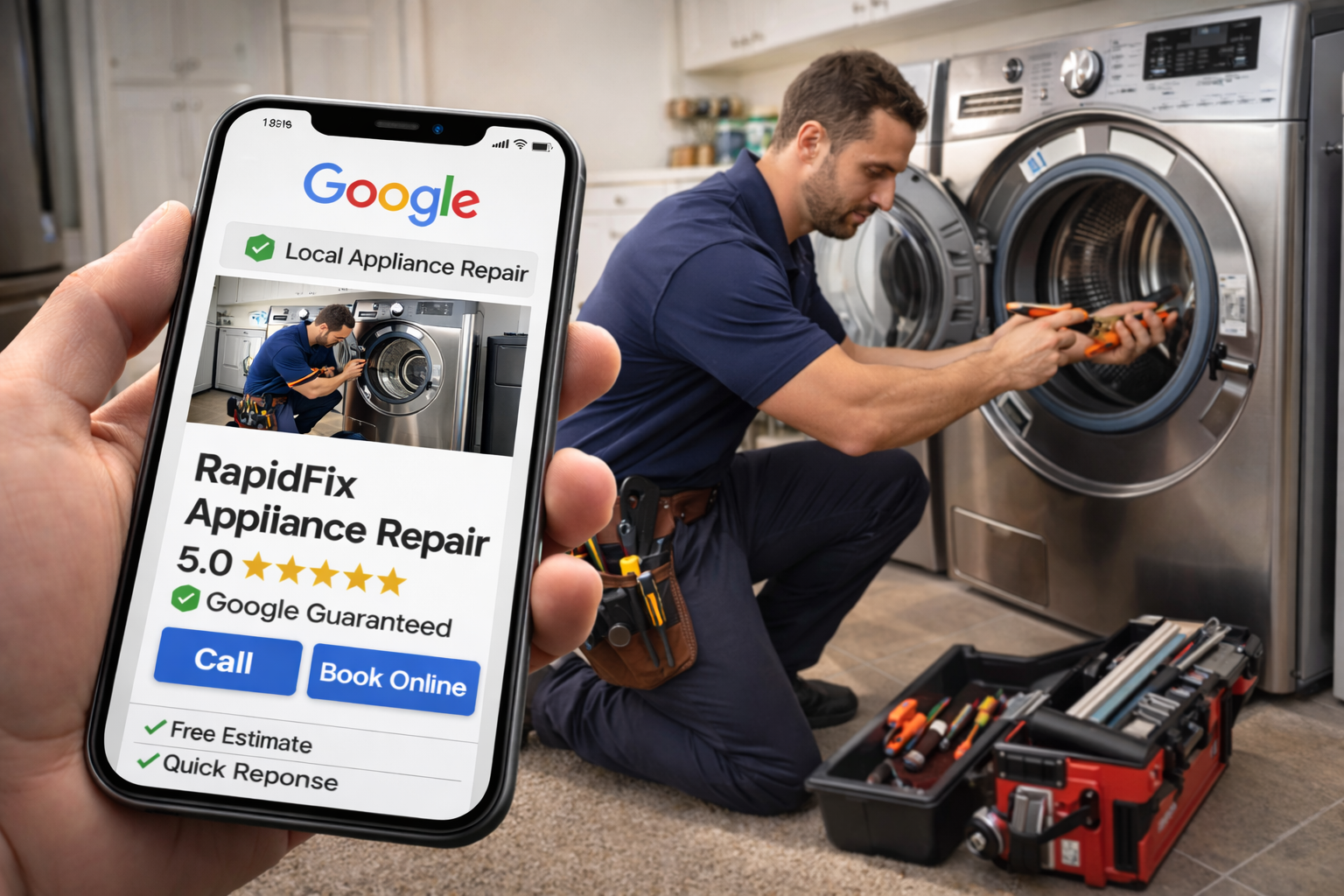
Google Local Services Ads puts your business at the very top of search results, above every paid search ad, above the map pack, above every organic listing. You pay only when a real customer contacts you. The Google Verified badge on your listing tells them upfront that your business has been screened. And in a category where customers are letting a stranger into their home to work on expensive equipment, that verification matters more than a lot of people realize.
This guide covers everything: how LSA works specifically for appliance repair, what it costs, how to rank above your competitors, which appliances to enable, how to handle the calls correctly, and what separates the repair companies that build consistent lead flow from the ones that try LSA for six weeks and wonder why it did not work.
Is Google LSA Worth It for Appliance Repair?
Yes. Appliance repair is one of the best fits for LSA of any home service category because the searches that trigger it are almost always urgent.
When a dryer stops heating or a dishwasher starts leaking under the counter, the homeowner is not in research mode. They are in fix-it-now mode. They search, they see who is at the top, and they call. The decision cycle from search to phone call can be under two minutes. That urgency is exactly what LSA is designed to capture, and it is why appliance repair leads from LSA convert at a higher rate than leads from most other advertising channels, including Yelp Ads and Facebook Ads.
The numbers work at multiple price points. An LSA lead in most markets costs $20 to $60. The average appliance repair call runs $150 to $400 depending on the appliance and the repair. Even a simple diagnostic call at $89 covers a significant portion of your lead cost. A washing machine motor replacement at $350 returns five or six times what you paid for the lead. And because customers who are happy with an appliance repair tend to call the same company when the next appliance breaks, your real return on that first lead is often much higher than the single job it produces.
The businesses that do not see results from LSA are almost always dealing with one of two problems: they are missing calls because they are on a job and the phone rings to voicemail, or their profile is incomplete and they are only showing up for two or three appliance types when they could be showing up for ten. Both of those problems are fixable, and this guide covers both.
| Feature | Local Services Ads (LSA) | Google Search Ads |
|---|---|---|
| How you pay | Pay per lead (calls and messages) | Pay per click |
| Customer intent | Very high (appliance is broken right now) | Varies from researching to urgent |
| Typical CPL for appliance repair | $20 to $60 per lead | $8 to $35 per click (varies) |
| Best for | Emergency repairs, same-day bookings | Planned repairs, commercial accounts, scale |
| Setup complexity | Moderate (verification required) | Higher (ongoing management needed) |
See the real numbers for your trade
Plug in your industry, budget, and close rate. Our calculator shows your projected leads, cost per booked job, and ROAS.
What Google LSA Looks Like for Appliance Repair
When someone searches "refrigerator repair near me," "washer repair service," "dryer not heating," or any similar phrase, Google shows Local Services Ads at the absolute top of the page. Above every regular paid ad. Above the local map pack. Above every organic search result. Your listing shows your business name, star rating, review count, years in business, and a direct click-to-call button.
On a phone screen, which is where most of these urgent searches happen, your LSA listing fills most of the visible screen before the customer scrolls at all. They see your name, your rating, your reviews, and a button to call you. The barrier to contact is as low as it can possibly be.
The Google Verified badge on your listing does real work in this category. Customers are inviting you into their home to work on equipment they depend on. A badge that tells them Google has screened your business, confirmed your insurance, and run a background check removes a hesitation that would otherwise cause some of them to scroll past and look for more information. It is the digital equivalent of showing up in a branded uniform with a truck.
There is also a competitive angle here that matters specifically for independent repair shops. Authorized service centers for Samsung, LG, Whirlpool, and GE carry built-in brand trust. When a customer searches for someone to fix their appliance, seeing "Authorized Samsung Service Center" carries credibility. An independent shop does not have that manufacturer endorsement to lean on. The Google Verified badge fills that credibility gap in a way that a Yelp listing or a well-designed website cannot, because it is sitting right on the Google search results page before the customer clicks anything. It tells them your technicians have been background checked, your insurance is on file, and Google has reviewed your business. That is a meaningful signal for someone deciding whether to let a stranger into their kitchen. A note on the name change: Google retired the "Google Guaranteed" badge in October 2025 and rebranded it as the Google Verified badge. The background check and verification requirements are the same. The customer money-back guarantee that came with the old badge has been discontinued. Any content still referencing "Google Guaranteed" for appliance repair companies is using outdated terminology.
Setting Up Google LSA for Your Appliance Repair Business
The verification process takes real time, especially the background check step. Plan for it and do not try to rush through it. A properly set up profile will generate significantly better results than one that cuts corners on the setup.
- Create your profile at ads.google.com. Navigate to Local Services Ads and start a new account. Add your business name, service area, hours, and a description. Write the description in plain language. "Independent appliance repair serving the greater Phoenix area, refrigerators, washers, dryers, dishwashers, ovens, and most major brands including Samsung, LG, GE, and Whirlpool" is far more effective than a paragraph about professional appliance solutions and quality service. Customers scan descriptions quickly. Tell them exactly what you fix and where you work.
- Enable every appliance type you actually service. Appliance repair has the most granular job type list of any trade in LSA: refrigerator repair, washer repair, dryer repair, dishwasher repair, oven and stove repair, microwave repair, garbage disposal repair, freezer repair, ice maker repair, wine cooler repair, and more. Most shops enable four or five and stop there. The ones they most commonly leave off are wine cooler repair and ice maker repair, both of which have very low competition in LSA and attract customers who own expensive appliances and have a high willingness to pay for repair over replacement. Go through the full list and enable everything your techs can actually fix. This is covered in more detail in the next section.
- Upload your insurance documentation. Google requires proof of general liability insurance for appliance repair businesses. Some states also require a technician certification or business license. Have your documents ready in digital format and upload everything at once. Doing it piecemeal drags out verification.
- Start background checks immediately. Background checks for the owner and any technicians who go on-site are required and they are consistently the slowest step in the whole process. In some markets they take over a week. Start them before you do anything else. While those are processing, you can be working on your profile setup, photos, and GBP.
- Connect your Google Business Profile. Your GBP is directly linked to your LSA listing. The reviews on your GBP show up on your LSA ad. If your GBP has wrong hours, an outdated address, or no photos, that weakness carries straight into your LSA profile. Take an hour to clean it up before going live. Accurate hours, a complete description that mentions the brands and appliances you service, and real photos of your work and truck will make your LSA profile stronger from day one.
- Set your budget using Maximize Leads. Start with Maximize Leads bidding and a weekly budget that targets around 10 to 15 leads per week based on expected lead costs in your market. Setting a tight Max Per Lead cap too early will cut off your delivery before your profile builds enough history to compete. Give it room to run for the first 60 days.
- Add real photos. Your service van or truck with your branding. Your technician working on an appliance. Before and after photos of a repair when you have the opportunity. Real images of your actual business build trust in a way that no stock photo does.
Get a Free Appliance Repair LSA Audit
Complete Appliance Job Type Checklist
Appliance repair has the most granular job type list in LSA. That is actually an advantage if you use it correctly, because most of your competitors are not. The shops that enable every applicable category show up for searches that your under-configured competitors are completely invisible for.
The categories most commonly skipped are wine cooler repair, ice maker repair, and trash compactor repair. These searches have far fewer competing LSA profiles than washer or refrigerator repair, which means your cost per lead is lower and your ranking potential is higher. The customers searching for wine cooler repair or ice maker repair typically own higher-end appliances and are more motivated to repair than replace, which means the jobs close at better rates. Enable everything you can actually deliver.
Appliance Repair LSA Job Types to Enable
- Refrigerator repair
- Washing machine repair
- Dryer repair
- Dishwasher repair
- Oven and range repair
- Cooktop repair
- Microwave repair
- Freezer repair
- Ice maker repair
- Garbage disposal repair
- Trash compactor repair
- Wine cooler repair
- Commercial appliance repair
- Appliance installation
Log into your LSA dashboard and count how many of those you have checked. If the number is under eight and you service all those appliance types, you are invisible for searches you should be winning. The fix takes ten minutes. Do it today and you will likely see an increase in impressions within a few days.
A note on brand-specific searches
A common question is whether you can target specific brands in LSA. You cannot target brands directly through job type settings, but you can mention the brands you work on in your business description. A homeowner searching "Samsung refrigerator repair near me" can still see your listing if your profile is fully optimized and refrigerator repair is enabled. The more complete your profile is overall, the better your chances of surfacing for those specific searches.
What Does LSA Cost for Appliance Repair?
In most US markets, appliance repair leads on LSA run $20 to $60 each. Larger metro areas and highly competitive markets push toward the higher end. Smaller cities and markets with fewer active LSA competitors come in lower.
The metric that matters is cost per booked job, not cost per lead. Take your total LSA spend for the month, divide it by the number of jobs you actually completed from those leads, and that gives you your real acquisition cost. If you are paying $40 per lead, answering 80% of calls, and booking 70% of conversations, your cost per booked job is roughly $71. On a $280 dryer repair, that is a solid margin. On a $400 refrigerator repair, it is even better. On a customer who calls you back six months later when their dishwasher breaks, you already paid the acquisition cost last time.
Repeat business is significant in appliance repair and it changes the economics of your lead cost entirely. A customer who books with you once and has a good experience will almost always call you the next time something breaks. They already know you showed up, did good work, and did not try to oversell them on a replacement they did not need. That trust is worth far more than one repair job. Your real cost per customer, not just per job, is the number that should drive your budget decisions.
When your costs will be higher
Holiday periods, particularly Thanksgiving through New Year and the summer months when air conditioning and refrigeration are working harder, tend to drive higher search volume and higher lead costs. Having an established profile with reviews before those peaks hit means you enter them with better ranking than a competitor who has been running LSA for two months. The profile you build in February pays dividends in July.
To see where you actually sit in the LSA pack right now, run the free LSA Visibility Scanner.
Want to see what appliance repair LSA leads cost in your market? Run the numbers for your own market with our free appliance repair LSA ROI calculator.
How to Rank Higher in Appliance Repair LSA
Appliance repair has a unique advantage in LSA: high job volume. A busy technician completes 4 to 6 jobs per day, which means more opportunities to collect reviews, faster profile growth, and a quicker path to outranking competitors who do fewer jobs per week. Here is how to leverage that volume into ranking dominance.
The free contractor hourly rate calculator works out how many hours you can genuinely sell in a year, and what each one has to earn.
- Leverage brand-specific expertise as a trust signal. If you are a Samsung authorized service center, a Whirlpool certified technician, or an LG preferred repair provider, mention it prominently in your LSA business description. Homeowners searching for brand-specific repairs gravitate toward listings that signal expertise with their exact appliance. Authorized service status builds trust before the customer even calls and directly improves your click-through rate, which feeds your LSA ranking.
- Same-day response is not optional. A broken refrigerator is a ticking clock, food spoiling, families disrupted. A flooded washing machine is an active emergency. Appliance repair customers expect same-day service, and Google's algorithm rewards businesses that answer and book quickly. If your average response time is over 30 minutes, you are losing leads to the competitor who picks up in two rings and offers a slot this afternoon. Speed of response is the single biggest differentiator in this category.
- Enable every appliance type you service. This point is covered in detail above, but it directly impacts ranking too. The more job types you have enabled, the more searches you are eligible to appear for. More impressions mean more calls, more calls mean more reviews, and more reviews push your ranking higher. A technician who fixes washers, dryers, refrigerators, dishwashers, ovens, microwaves, and garbage disposals but only has three of those enabled is competing with one hand tied behind their back.
- Collect reviews from your high job volume. Appliance repair techs complete more individual jobs per week than almost any other trade. A roofer might do 2 jobs a week; you might do 25. That is 25 review opportunities. Send a text review link from the driveway after every single job. Even a 20% response rate on 25 weekly jobs gives you 5 new reviews per week, that is review velocity most competitors cannot match. For context on how this affects your position, see our guide to ranking #1 in LSA.
- Mention parts availability in your profile. Homeowners want the repair done in one visit, not a callback next week when parts arrive. If you stock common parts on your truck for major brands, say so in your description. "Most repairs completed same-visit with parts on the truck" is a conversion driver that also reduces callbacks and increases review likelihood from satisfied one-visit customers.
- Use Maximize Leads bidding. A manual Max Per Lead cap restricts your delivery before your profile builds enough history to rank on quality alone. Maximize Leads lets Google's algorithm allocate your budget toward the leads most likely to convert. Given the high volume and relatively low CPL in appliance repair, this mode typically outperforms manual bidding for the first 90 days.
For a full breakdown of every ranking signal, see our complete guide to LSA ranking factors.
How to Handle Appliance Repair LSA Calls
This section exists because the call itself is where a significant percentage of appliance repair leads die after the advertising does its job. An appliance repair customer calling from an LSA listing is already sold on calling you. They picked up the phone. The only question is whether your call handling converts them into a booked appointment.
Here is what separates the companies that convert 70% of their calls from the ones that convert 40%.
- Answer within two rings. Every ring beyond that is a reason for an already-frustrated customer to hang up. Appliance repair customers are often stressed when they call. A fast answer immediately tells them they found someone who is actually running a business.
- Identify the appliance and the issue in the first 60 seconds. Ask what appliance it is, what brand and model if they know it, and what the problem is. This gives you what you need to schedule appropriately and quote a diagnostic range. It also demonstrates competence immediately. A technician who asks smart diagnostic questions in the first minute earns more trust than one who immediately asks for an address.
- Give a diagnostic fee and ballpark repair range upfront. Customers hate feeling like they cannot get even a rough number before someone shows up. You do not need to commit to a final price over the phone. But saying "our diagnostic fee is $89 and most dryer heating issues run $120 to $250 in parts and labor after that" gives them enough to make a decision. Refusing to give any number is a conversion killer.
- Offer a specific appointment time before you hang up. "I have a slot tomorrow morning between 9 and 11 or Thursday afternoon between 1 and 3, which works better?" is far more likely to close than "we will follow up to schedule." Have your calendar accessible when you are taking calls. Letting a customer hang up without a confirmed appointment means half of them will have found someone else by the time you call back.
- Confirm the appointment with a text. A text confirmation with the time and your technician's name reduces no-shows and gives the customer your contact information in their messages without them having to look for it.
Common LSA Mistakes Appliance Repair Companies Make
- Not enabling all appliance types. This is the most expensive mistake in appliance repair LSA by a wide margin. A technician who repairs washers almost certainly repairs dryers too, but if "dryer repair" is not checked in your LSA profile, you do not appear for dryer searches. The same applies to dishwashers, garbage disposals, microwaves, freezers, ice makers, and cooktops. Every unchecked category is an invisible wall between you and calls you should be getting. Log in today and check every single appliance type you can actually service.
- Not mentioning brand expertise in your profile. If you are an authorized Samsung service center, a Whirlpool certified technician, or trained on LG refrigerator compressor systems, that information needs to be in your LSA business description. Authorized service status is a massive trust signal that separates you from generic "we fix everything" competitors. Homeowners with a $3,000 Samsung refrigerator want someone who specifically knows that appliance, not a generalist.
- Targeting too large a service area. Appliance repair customers expect same-day, often same-morning service. If your service area covers a 45-minute drive radius, you cannot realistically offer that. Leads from far-away zip codes cost you the same but convert at a fraction of the rate because you cannot get there fast enough. Tighten your area to where you can arrive within 30 minutes and your booking rate will increase measurably.
- Not training dispatchers to qualify by appliance type and brand. When an LSA call comes in, your dispatcher needs to ask what appliance it is and what brand within the first 15 seconds. This determines whether you have parts on the truck, how long the repair is likely to take, and whether the job fits your schedule. Dispatchers who skip this step book jobs they cannot complete on the first visit, which leads to negative reviews and lower ranking. For more on why leads go wrong and how to dispute them, see our detailed guide.
- Running the same budget on weekdays and weekends. Weekend demand for appliance repair is significantly higher than weekday demand. The dishwasher that has been acting up all week becomes urgent when the homeowner is home on Saturday and has time to deal with it. Refrigerator emergencies spike on weekends when families are home and cooking more. If your weekend budget is the same as Tuesday, you are underinvesting during your highest-value hours.
- Ignoring first-visit fix rate. Completing the repair on the first visit is the single biggest driver of positive reviews in appliance repair. Customers who have to wait for parts and schedule a second visit are dramatically less likely to leave a review, and when they do, the rating tends to be lower. Stock common parts on your truck, and if a part needs to be ordered, set expectations clearly so the customer is not surprised.
If your appliance repair LSA is live but quiet, it's usually a combination of service area being too broad (covering zip codes you can't realistically serve same-day) and job types not fully enabled. Our LSA troubleshooting guide walks through both of those fixes and more.
Should Appliance Repair Companies Run LSA and Google Ads Together?
Yes, and for appliance repair specifically, the two channels cover very different customer types that both represent real revenue.
LSA catches the urgent "my appliance is broken right now" searches: "refrigerator repair near me," "washer leaking," "dryer not heating." These customers have already decided to hire someone. They are calling whoever shows up first. That is LSA's wheelhouse and it generates the bulk of same-day bookings for most appliance repair companies.
Google Search Ads capture a different and equally valuable segment. Someone searching "Samsung refrigerator repair cost" is researching a specific brand repair and may have a higher-value job. "Should I repair or replace my dishwasher" is an informational query where your ad can position you as the expert who helps them decide, and if they choose repair, you are already top of mind. Property managers searching for a reliable appliance repair vendor for their rental portfolio represent recurring commercial revenue that LSA rarely surfaces. And "commercial kitchen equipment repair" is a keyword that can open up restaurant and hospitality accounts with significantly higher average tickets.
An average ticket is revenue, not profit. The free contractor profit margin calculator shows what actually survives labor burden and overhead on a job that size.
The combination works particularly well in appliance repair because the repeat customer dynamic amplifies both channels. A homeowner who finds you through a Google Ad for a planned oven repair becomes a future LSA customer when their washing machine breaks six months later. A property manager who discovers you through Search Ads sends you their next 10 tenant appliance calls directly. Your customer acquisition cost on the first touchpoint funds a relationship worth multiples of that initial job. For a deeper comparison of how both platforms perform side by side, see our guide on Google Ads vs. LSA for contractors.
Start with LSA to build your review base and capture high-intent emergency calls. Once your profile is strong and your operations can handle more volume, layer in Google Ads to capture brand-specific searches, commercial accounts, and the "repair vs replace" research traffic that LSA cannot reach.
How to Track Your Appliance Repair LSA Results
Appliance repair tracking should go deeper than the standard cost-per-lead report. The economics of this industry are shaped by appliance type, first-visit completion, and repeat customers, all of which change your real ROI significantly.
- Track by appliance type. Refrigerator repair leads and washer repair leads have different average ticket values. A straightforward dryer belt replacement is $150 to $200. A refrigerator compressor job is $800 or more. Knowing which appliance types your LSA leads are generating tells you where to focus your enabled job types and whether your CPL makes sense against actual revenue by category. If 60% of your leads are for low-ticket microwave repairs at $40 per lead, that is a different equation than if they are for refrigerator compressor work.
- Monitor same-day booking rate. What percentage of LSA calls result in a same-day appointment? In appliance repair, same-day bookings convert at a much higher rate than next-day or later. If your same-day booking rate is below 50%, the bottleneck is usually scheduling capacity, not lead quality. Consider staggering your technician schedules to always have a slot available for incoming LSA calls. For more on how lead volume works in practice, see our article on how many leads LSA actually generates.
- Track first-visit fix rate. This is the metric most appliance repair companies ignore but should not. Completing the repair on the first visit does three things: it makes the customer happy enough to leave a review, it eliminates the cost of a return trip, and it boosts your average revenue per job because you are collecting payment on the spot instead of chasing a follow-up appointment. Track this weekly. If it drops below 70%, you need to stock more parts on your truck.
- Calculate average ticket per appliance. Know your numbers by category. Refrigerator repairs average $250 to $400 for common issues, $800+ for compressor work. Washer and dryer repairs run $150 to $300. Dishwasher repairs are typically $175 to $350. Oven and range repairs can hit $300 to $500 for control board issues. These numbers tell you which appliance types generate the highest return on your LSA spend.
- Repeat customer rate. This is the hidden ROI multiplier in appliance repair. The average American household has 6 to 8 major appliances. A customer who calls you for a washer repair today will call you again when their refrigerator, dishwasher, or oven breaks, if you did good work the first time. Track how many of your jobs come from previous LSA customers. Most appliance repair companies find that 15 to 25% of their annual revenue comes from repeat customers who originally found them through paid advertising.
Appliance Repair LSA FAQs
Does being a brand-authorized service center affect my LSA ranking?
Being an authorized service center for brands like Samsung, LG, or Whirlpool does not directly change your LSA ranking algorithm position. However, it significantly improves your click-through rate and booking rate when you mention it in your business description. Homeowners with a $2,500 Samsung refrigerator actively look for authorized techs, and a higher engagement rate on your listing does feed back into how Google scores your profile over time. If you have any brand authorizations, make them visible. For details on what drives your position, see our guide on getting Google Verified.
What same-day response rate should appliance repair companies target?
Aim for offering same-day service on at least 70% of incoming LSA calls. A broken refrigerator or a leaking washing machine is a genuine household emergency, food is spoiling, water is spreading. Customers calling from LSA expect someone today, not tomorrow. The companies that consistently offer same-day slots book at double the rate of those that schedule 24 to 48 hours out. Stagger your technicians' schedules so you always have at least one open slot for incoming urgent calls.
Which appliances generate the highest-value LSA leads?
Refrigerator repairs consistently produce the highest average ticket, especially compressor replacements ($800+) and sealed system work. Oven and range repairs with control board issues run $300 to $500. Washer and dryer repairs are the highest volume but lower per-job value ($150 to $300 typical). The sweet spot is having all appliance types enabled so you capture the full mix, the high-volume dryer and dishwasher calls build your review count fast, while the refrigerator and oven calls deliver the margin.
How should I handle "repair vs replace" calls from LSA?
About 15 to 20% of appliance repair LSA calls involve a customer who is not sure whether to repair their current appliance or buy a new one. Train your dispatchers and technicians to handle these honestly. Give them a diagnostic fee and a repair estimate on-site, and if the repair cost exceeds 50% of replacement value, say so. Customers who feel you gave them an honest recommendation, even if it means not doing the repair, leave better reviews and refer you to neighbors. That trust is worth more than one oversold repair job.
How important are parts availability and first-visit fix rates?
Completing the repair on the first visit is one of the strongest predictors of whether a customer leaves a positive review. Stock common parts on your truck, capacitors, thermostats, belts, heating elements, water inlet valves, and door gaskets for the top 5 brands you service. A first-visit fix rate above 75% will generate significantly more reviews than a company that has to order parts and come back. More reviews means better ranking, which means more leads. It is a compounding cycle.
How do I dispute a bad LSA lead as an appliance repair company?
Log into your LSA dashboard, find the lead, and submit a dispute with a reason such as wrong number, out of service area, or an appliance you do not service. Google reviews disputes and issues credits for valid ones. Set a weekly reminder to review your leads and dispute any that do not qualify before the time window closes. For more on what qualifies as a valid dispute and how to maximize your credits, see our guide on why LSA leads get disputed.
Weighing LSA against other channels? See our full appliance repair leads channel comparison, with real 2026 CPLs for LSA, Google Ads, GBP, brand-authorized warranty work, pay-per-call services like ResultCalls, and shared lead aggregators like Angi.
Conclusion & Next Steps
Appliance repair thrives on LSA because of a combination that few other trades can match: high emergency intent, frequent repeat customers, and a job volume that builds your review profile faster than almost any other service category. The average American household has 6 to 8 major appliances, and every one of them will eventually need service. A single LSA customer acquired today can generate 3 to 5 additional jobs over the next several years, without you spending another dollar to acquire them.
The appliance repair companies that dominate LSA in their markets are the ones that enable every appliance type they service, stock common parts for same-visit completion, collect reviews after every single job, and answer the phone within two rings. They treat their LSA profile like a living asset, updating it with new brand certifications, fresh job photos, and accurate service hours. They build review velocity that competitors cannot match because they complete more jobs per week and ask for reviews on every one.
Get your profile verified and fully built out now, before the next seasonal demand spike hits. If you want an expert to walk through your current LSA setup and tell you what is leaving leads on the table, that is exactly what we do at Blue Grid Media. For more on what makes LSA work across all service industries, explore our LSA cost breakdown by industry and our guide on how many leads LSA actually generates.
No obligation. We will look at your setup and tell you exactly what is working and what is not.
Results vary by market, competition, and how consistently you follow up on leads. Blue Grid Media specializes in LSA and Google Ads for local service businesses. Book a free review and let us look at your numbers together.
More for appliance repair operators
Pair this with the rest of the appliance repair operator series: