Published by Blue Grid Media • Updated for 2026 • 14 min read
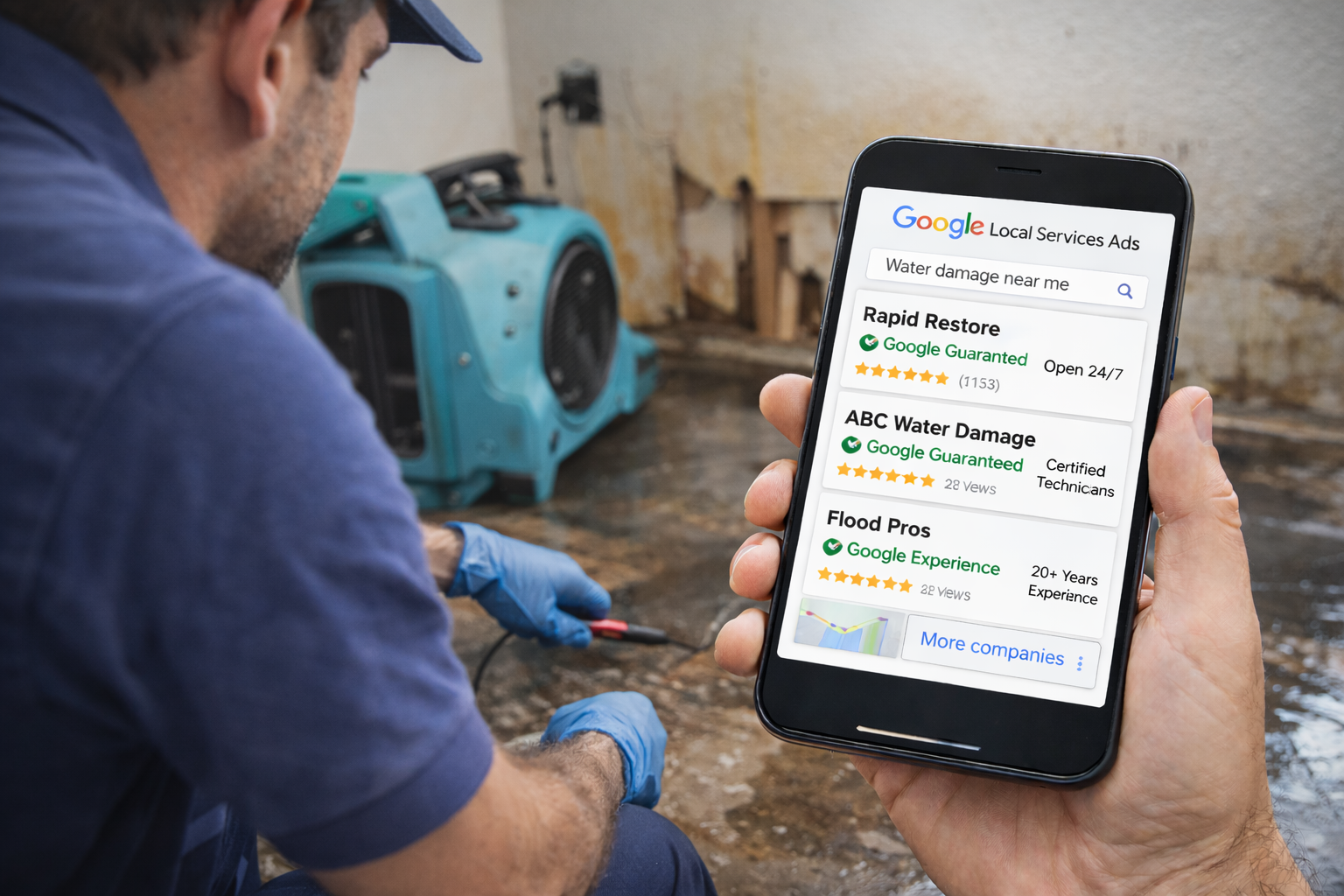
A pipe just burst in a homeowner's basement at 11pm. Water is spreading across the floor. They're not reading reviews or filling out contact forms. They're grabbing their phone, typing "water damage restoration near me," and calling whoever shows up first with a verified badge and enough reviews to trust.
If your restoration company isn't showing up in Google's Local Services Ads pack right now, that job, and every emergency job like it, is going to a competitor. Not because they're better. Because they showed up first.
The water damage restoration industry runs on urgency. Customers don't comparison shop when their house is flooding. They hire the first company that looks credible and answers the phone. That's exactly the scenario Google LSA was built for, and it's why restoration companies that run it properly see some of the best lead economics in any service trade.
This guide covers everything you need to know: how to set up LSA for a restoration business, what it costs, how to rank higher than your local competition, and how to build a setup that consistently captures emergency calls before your competitors do.
Water Damage Restoration LSA Deep Dives
Is Google LSA Worth It for Water Damage Restoration?
Yes, and the numbers are hard to argue with.
Water damage jobs are among the highest-value jobs in all of home services. An insurance-driven restoration project routinely runs $5,000 to $15,000 or more depending on scope. Even a smaller emergency call, a localized pipe burst or appliance leak, might be a $1,500 to $3,000 job. When your cost per lead runs $50 to $180, a single $5,000 insurance job covers the cost of 28 to 100 leads, so you only need to book one job out of every 28 to 100 leads to break even. In practice, businesses with solid profiles and responsive operations book a much higher percentage than that.
Work out what a lead should cost you in the free CPA calculator before judging the number you are getting.
The other thing that makes LSA uniquely powerful for restoration is the nature of the search itself. Nobody searches "water damage restoration near me" because they're casually curious. They search it because something is wrong right now. That makes LSA traffic as high-intent as advertising gets. You're not convincing anyone they need your service, they already know they do. You just have to show up first and answer the phone.
What Google LSA Looks Like for Restoration Companies
When someone in your service area searches "water damage cleanup near me," "emergency flood restoration," "burst pipe cleanup," or any similar query, Google serves a row of Local Services Ads at the top of the page. Not below regular Google Ads. Not in the map pack. At the very top, the first thing they see.
Your listing shows your business name, star rating, review count, years in business, and a direct click-to-call button. On mobile, it takes up most of the visible screen before the user scrolls. For an emergency search at midnight, that's everything. The homeowner is calling whoever is at the top and has the most convincing listing.
The Google Verified badge on your listing tells the customer that Google has verified your licenses, insurance, and IICRC certification. It removes the trust barrier that would otherwise make a panicking homeowner hesitate. They see the badge, they see 80 reviews averaging 4.9 stars, and they call. That's the conversion flow.
One important note: Google retired the old "Google Guaranteed" badge in October 2025 and replaced it with the unified Google Verified badge. If you're reading older guides that still reference "Google Guaranteed" for restoration companies, that terminology is outdated. The screening requirements haven't changed, the money-back guarantee for customers was the only thing discontinued.
Setting Up Google LSA for Your Water Damage Restoration Business
Verification for restoration companies is slightly more involved than other trades because of the IICRC certification requirement. Plan for this upfront and the process goes smoothly.
Create your LSA profile
Go to ads.google.com and navigate to Local Services Ads. Set up your business profile with your name, service areas, hours, and a description. Write the description in plain language. "24/7 water damage restoration serving the greater Denver metro, emergency flood cleanup, sewage removal, structural drying, mold remediation" beats generic corporate copy every time. Keep it specific to what customers in your area are actually searching for.
Enable every relevant job type
This is where most restoration companies leave leads on the table. Google only shows your ad for services you've explicitly turned on. It doesn't infer from your website or guess. Go through every available job type and enable everything you can deliver: water damage restoration, flood cleanup, sewage cleanup, storm damage repair, mold remediation, carpet and floor drying, and any others that apply. If "sewage cleanup" isn't checked, you don't appear for sewage calls. Check the full list carefully, this step alone can double your lead volume.
Upload your documentation
Restoration companies need to submit: general liability insurance certificate, IICRC Water Damage Restoration Technician (WRT) certification or equivalent, and your contractor license if your state requires one. Have digital copies ready before you start. If your IICRC certification is close to expiring, renew it before applying, an expiring cert can pause your ads mid-campaign.
Complete background checks
Google requires background checks for business owners and technicians who enter customers' homes. Restoration companies fall under an urgent services category, so this typically includes anyone on your dispatch list. This is the slowest part of the process, some markets take a week or more. Start it first, not last.
Connect your Google Business Profile
Your GBP feeds directly into your LSA listing. Reviews from your GBP show on your LSA ad. If your profile is incomplete, has outdated hours, or is missing photos, it hurts your LSA performance from day one. Clean it up before you go live. The same GBP fundamentals that apply to HVAC companies and electricians apply here too, consistent info, recent photos, active response to reviews.
Set your budget and bid mode
Start with Maximize Leads bid mode and set a weekly budget that targets roughly 8 to 12 leads per week based on your expected CPL range. Don't set a low Max Per Lead cap, in competitive restoration markets it will throttle your visibility before you see what LSA can actually produce. Give it two to four weeks on Maximize Leads before making budget adjustments.
Add real photos
Before-and-after photos from actual restoration jobs. Branded trucks and vans. Team in uniform. Equipment like air movers and dehumidifiers set up at a job site. Real images from your actual business consistently outperform stock photos in both click rate and customer trust. Upload at least 10 to 15 before going live.
Get a Free Restoration LSA Audit
What Does LSA Cost for Water Damage Restoration?
Most US markets run $50 to $180 per lead for water damage restoration, with the national median sitting around $85. High-competition metros and emergency-specific searches push toward the higher end. Smaller markets and less saturated areas come in lower. For a full breakdown of restoration CPL benchmarks alongside other trades, see our guide to Google LSA pricing by industry.
The number that actually matters is cost per booked job, not cost per lead. Here's a realistic model for a mid-market restoration company:
- You pay $85/lead (the national median)
- You answer 75% of calls (some miss during active jobs)
- You book 50% of answered calls
- That works out to roughly $227 per booked job
- Average job value: $6,000 to $8,000
- Return on ad spend: 26x to 35x before materials
The restoration companies that struggle with LSA economics are almost always dealing with one of two problems: a low call answer rate (phones going to voicemail during active jobs) or no outcome tracking so they don't know if the leads are actually converting. Fix those two things and the numbers almost always work out.
How to Rank Higher in Water Damage Restoration LSA
Water damage restoration operates in one of the most extreme CPL environments in all of LSA, $50 to $180 per lead in most markets with a median near $85, and the top of that range is where major metros and storm-event surges land. But with average job values of $5,000 to $15,000, every answered call is potentially worth hundreds of dollars in revenue. Here is what actually drives your position in restoration LSA results.
An average ticket is revenue, not profit. The free contractor profit margin calculator shows what actually survives labor burden and overhead on a job that size.
24/7 immediate response is THE dominant factor
Water damage gets worse by the hour. Every minute water sits on hardwood floors, seeps into drywall, or pools under cabinets, the scope of the job grows. Homeowners know this instinctively, which is why they call until someone answers. Google tracks your call answer rate directly and restoration companies with after-hours coverage consistently outrank those without it. If you are not answering calls at 2am, you are handing your highest-value leads to competitors who are. Set up a true 24/7 answering solution, not voicemail, not a callback system. A live voice that can confirm dispatch. For more on why responsiveness drives ranking, see our guide to ranking #1 in LSA.
IICRC certification display builds instant trust
IICRC certification (Water Damage Restoration Technician, Applied Structural Drying, or equivalent) is both a Google requirement and a powerful trust signal. Mention your specific IICRC certifications in your business description, not just "certified" but the actual credential names. Homeowners dealing with a $10,000 insurance claim want to know their restoration company has industry-recognized training. This improves your click-through rate, which feeds back into your ranking over time.
Enable all restoration types, each is a separate high-value service
Water extraction, mold remediation, fire damage restoration, sewage cleanup, structural drying, and storm damage are each separate job types in LSA. Many restoration companies only enable water damage and miss the rest. Mold remediation alone can generate $3,000 to $8,000 jobs. Fire damage restoration is $10,000+. Every unchecked category is an entire revenue stream you are invisible for. Go through your full job type list and enable everything you can legitimately deliver.
Insurance relationship keywords in your profile
A significant percentage of restoration revenue flows through insurance claims. Mention in your description that you work directly with insurance companies, assist with the claims process, and can provide detailed documentation for adjusters. Homeowners managing a stressful water damage situation want a company that handles the insurance side, it removes friction and makes you the obvious choice over competitors who do not mention it.
For a complete breakdown of every signal Google factors into your LSA ranking, see our guide to LSA ranking factors.
Check your current position before you change anything with the free LSA Visibility Scanner.
Common LSA Mistakes Restoration Companies Make
Not having true 24/7 phone coverage
Water damage calls peak at nights and weekends, a pipe bursts at 11pm, a sump pump fails during a Saturday rainstorm, a water heater ruptures on a holiday. If your phones go to voicemail outside of 8-to-5 business hours, you are missing the majority of your highest-value emergency leads. A homeowner with water spreading across their basement floor is not leaving a message and waiting until morning. They are calling the next company on the list. Set up a live answering service with dispatch authority for after-hours calls, the cost is a fraction of the jobs you are losing.
Not enabling mold remediation and fire damage
Mold remediation and fire damage restoration are common crossover services for water damage companies, but many forget to enable them in their LSA profile. Mold remediation alone generates $3,000 to $8,000 jobs. Fire and smoke damage restoration is $10,000+. If your crews are trained and certified for these services and the job types are not checked in your LSA dashboard, you are invisible for every mold and fire search in your market. Check your full job type list today.
Not training intake staff to capture insurance information on the first call
The majority of water damage restoration revenue flows through insurance claims. If your intake staff does not ask for the homeowner's insurance carrier, policy number, and adjuster contact on the first call, you are slowing down the claim process and making it harder to book the job. The restoration company that tells the homeowner "we will handle the insurance paperwork for you" and starts the process on call one books the job over the competitor who says "we will send someone out to look at it." Speed through the insurance process is a conversion advantage. For more on maximizing value from every lead, see our guide on how many leads LSA generates.
Setting budget caps that limit visibility during storm events
A tight weekly budget cap makes sense during normal periods, but storms and cold snaps create sudden demand spikes where your budget exhausts before noon on day one. During these events, every lead you miss goes to a competitor. Monitor weather forecasts in your service area and temporarily increase your budget before or immediately after significant events. The $85 to $180 you spend per lead during a surge is generating calls for $5,000 to $15,000 jobs, the ROI on storm-surge leads is extraordinary.
Not following up with insurance adjusters after initial contact
Many restoration companies lose jobs between initial customer contact and insurance approval. The homeowner calls, you do the initial assessment and extraction, but then the insurance adjuster takes three days to respond and momentum dies. Train your team to follow up proactively with adjusters within 24 hours of the initial assessment. Companies that manage the adjuster relationship actively close significantly more of their insurance-related LSA leads than companies that wait passively for approval.
Letting IICRC certification expire
If your IICRC cert expires, your LSA ads stop running, often without an obvious notification. The calls simply stop. Set a calendar alert 60 days before your renewal date and upload the updated cert to your LSA account immediately upon renewal. This catches most restoration companies off guard at least once, and the revenue lost during even a few days of downtime can be substantial.
If your LSA profile is live but calls aren't coming through at the volume you expect, our LSA no-calls troubleshooting guide covers the 12 most common causes and the exact fix for each one.
LSA vs. Google Ads for Water Damage Restoration
Restoration is one of the few industries where the gap between LSA and Google Ads is dramatic enough that running both is almost always the right move. Here is how each channel serves a completely different customer moment.
LSA catches "water damage restoration near me" emergency searches. These are homeowners with active flooding, burst pipes, or sewage backups who need someone dispatched now. They are not reading landing pages or comparing three bids. They are calling whoever appears first with a Google Verified badge and enough reviews to trust. LSA is built for exactly this moment, and it is where the majority of your emergency bookings will come from. The CPL is $50 to $180 in most markets, but on a $6,000 to $15,000 insurance job, even a $180 lead is extraordinarily profitable.
Google Search Ads capture mold testing research, insurance claim process queries, commercial water damage keywords, and seasonal informational searches. A homeowner searching "mold inspection near me" is not in emergency mode, they suspect a problem and want an assessment. That is a Google Ads opportunity, not an LSA one. A property manager searching "commercial water damage contractor" is looking for a vendor relationship, not a one-time emergency call. And during rainy seasons, "basement flooding prevention" informational queries put your name in front of homeowners who will remember you when the next storm actually floods their basement. For a full breakdown of how both platforms compare, see our Google Ads vs. LSA guide for contractors.
See the real numbers for your trade
Plug in your industry, budget, and close rate. Our calculator shows your projected leads, cost per booked job, and ROAS.
Start with LSA to capture the emergency calls that are happening in your market right now. The pay-per-lead model limits your risk, the IICRC verification builds customer trust, and the lead quality for emergency restoration searches is the highest of any advertising channel available. Once your LSA volume is consistent and your 24/7 operations are dialed in, layer in Google Search Ads to capture mold inspection leads, commercial restoration contracts, and the insurance-process research traffic that LSA does not reach on its own.
The same LSA model that works for water damage restoration applies across other home service trades. If you run multiple service lines or want to compare the economics, we cover HVAC, electrical, roofing, and pest control in separate guides.
How to Track Your Restoration LSA Results
Restoration tracking needs to reflect the unique economics of this industry: high CPL, very high job values, insurance vs cash-pay split, and the critical importance of after-hours lead capture. Here is what to actually measure.
Track by damage type
Water extraction, mold remediation, fire damage, and sewage cleanup are each different services with different average job values. Water extraction and structural drying jobs average $3,000 to $8,000. Mold remediation runs $3,000 to $10,000 depending on scope. Fire damage restoration is $10,000+. Sewage cleanup is $2,000 to $7,000. Knowing which damage types your LSA is generating tells you whether your enabled job types are optimized and helps you forecast revenue accurately.
Revenue per lead, not just cost per lead
Restoration CPL is high, $50 to $180 in most markets with a median around $85, and the top of the range during storm surges. But this number means nothing in isolation. What matters is revenue per lead. If you pay $85 per lead, answer 75% of calls, book 50% of those, and the average job is $7,000, your revenue per lead is roughly $2,625. That makes an $85 CPL look very different than it does in a vacuum. Track revenue per lead monthly to maintain perspective on your true ROI. For benchmarks across other industries, see our LSA cost guide.
Insurance claim conversion rate vs cash-pay rate
Insurance jobs and cash-pay jobs follow different conversion paths. Insurance leads often require adjuster approval before the full scope of work is authorized, which means a longer close cycle but a much higher average job value. Cash-pay leads (small leaks, dehumidifier-only jobs) close faster but at lower revenue. Track your conversion rate for each segment separately. If your insurance claim conversion rate is below 60%, the issue is likely follow-up with adjusters, not lead quality.
Average time from first call to job start
In restoration, speed of response directly correlates with close rate. Companies that arrive on-site within 2 hours of the initial call book at significantly higher rates than those that take 6 to 12 hours. Track the time between the LSA call coming in and your crew arriving on-site. This metric tells you whether your dispatch process is competitive, because the homeowner who called you also called two other companies, and whoever shows up first usually gets the job.
After-hours lead volume and conversion
Water damage emergencies disproportionately happen at night and on weekends. Track what percentage of your LSA leads come in after 6pm and on weekends, and what your conversion rate is on those leads compared to business-hours calls. If after-hours conversion is significantly lower, your answering solution is the bottleneck. This single metric can justify the cost of upgrading from voicemail to a live 24/7 answering service.
Water Damage LSA FAQs
Why is water damage restoration CPL the highest in LSA, and why is it still profitable?
Restoration CPL runs $50 to $180 in most markets with a median near $85, among the highest in all of LSA. But the math still works overwhelmingly in your favor because average job values are $5,000 to $15,000 for insurance-driven projects. Even at $180 per lead, the top of the range, with a 35% lead-to-job conversion rate, your cost per booked job is roughly $515 on a $7,000 job. That is still a 13x return before materials. Few advertising channels in any industry deliver that kind of ROI. For full CPL benchmarks, see our LSA cost guide.
What are the IICRC certification requirements for restoration LSA?
Google requires IICRC Water Damage Restoration Technician (WRT) certification or an equivalent state-recognized credential. If you also offer mold remediation, having IICRC AMRT (Applied Microbial Remediation Technician) certification strengthens your profile. Upload digital copies during your application and set a renewal reminder 60 days before expiration, an expired cert pauses your ads without warning, and even a few days of downtime during a busy period can cost you thousands in lost jobs.
How do insurance company leads differ from homeowner leads in restoration LSA?
Insurance-driven leads typically result in larger jobs ($5,000 to $15,000+) but have a longer close cycle because they require adjuster approval. Homeowner cash-pay leads are smaller ($1,500 to $3,000) but close faster because there is no third-party approval process. Train your intake team to identify which type of lead they are handling on the first call, insurance leads need carrier and policy information captured immediately, while cash-pay leads need a clear price range and same-day dispatch commitment. For more on lead qualification, see our article on why LSA leads get disputed.
How much mold remediation lead volume can LSA generate?
Mold remediation lead volume through LSA depends on your market's climate and housing stock. Humid markets (Southeast, Gulf Coast, Pacific Northwest) see consistent year-round mold search volume. In drier markets, mold searches spike after water damage events and during spring thaw. If mold remediation is enabled in your LSA profile, expect it to generate 15 to 25% of your total restoration lead volume in humid markets, and each mold remediation job averages $3,000 to $8,000.
How should restoration companies set up 24/7 dispatch for LSA?
The minimum viable setup is a live answering service with a script that captures the caller's name, address, nature of the damage, and insurance carrier, then dispatches your on-call technician via text and phone. More advanced setups use a CRM with automated dispatch routing based on technician availability and location. The key requirement is that a live person answers every call, not an auto-attendant, not voicemail. Water damage homeowners calling at midnight will hang up after 3 rings and call the next company. A live voice that says "we can have someone there within 2 hours" books the job.
Should restoration companies run LSA during slower seasons?
Yes. Water damage is not fully seasonal, pipe bursts spike in winter, flooding peaks in spring, storms hit year-round, and mold issues surface in any month with humidity. Turning off LSA during slower periods hands ranking ground to competitors who stay active. Run a lower budget rather than going dark entirely. The ranking history you build during quiet months directly benefits your visibility when the next demand spike hits.
Bottom Line
Water damage restoration is one of the highest-ROI industries for Google LSA despite having one of the highest cost-per-lead ranges in the entire platform. The math is simple: when average insurance-driven job values run $5,000 to $15,000, even a $180 lead that converts to a booked job at a 35% rate generates a return that most advertising channels cannot touch. The companies that dominate restoration LSA are the ones that answer at 2am, dispatch within the hour, and follow up with the insurance adjuster before the homeowner has to ask.
Your competitive advantage in restoration LSA is built on three pillars: 24/7 live answering with real dispatch authority, IICRC credentials prominently displayed, and every restoration service type enabled in your profile, water extraction, mold remediation, fire damage, sewage cleanup, structural drying. Miss any one of these and you are handing job categories to competitors who checked the boxes you did not. For more on what drives LSA success across all industries, see our guides on ranking #1 in LSA and how many leads LSA generates.
Start with LSA to capture the emergency calls happening in your area right now. Layer in Google Search Ads when you are ready to reach homeowners before an emergency hits, mold inspection leads, commercial restoration contracts, and insurance-process research traffic. And if you want someone to walk through your current setup and identify exactly where you are leaving emergency calls on the table, that is what we do at Blue Grid Media.
Get a Free Restoration LSA Audit
We'll look at your current setup, identify what's holding back your lead volume, and tell you exactly what to fix, no pitch, no pressure.
Book Your Free ConsultationResults vary by market, competition, and how consistently you follow up on leads. Blue Grid Media specializes in LSA and Google Ads for home service businesses. Book a free review and let's look at your numbers together.
More for water damage restoration operators
Pair this with the rest of the water damage operator series: