Migration note, updated August 2026
Google has started moving Local Services Ads into Google Ads as pay-per-lead Performance Max, and the standalone LSA dashboard is being retired in phases. If your account has not migrated yet, the steps below still apply exactly as written. If it has, here is where each control now lives.
| In the old LSA dashboard | In Google Ads after migration |
|---|---|
| The LSA dashboard itself | Redirects to your campaign overview in Google Ads |
| Weekly budget | Daily average budget, your weekly figure divided by 7 |
| A bid or max cost per lead per job type | One campaign-level Target CPA for the whole campaign |
| Lead inbox | Goals, then Conversions, then Leads |
Phase 1 began August 1, 2026. Service-area businesses without a storefront are in the late 2026 wave, and everyone else follows in 2027. Read the full migration breakdown.
Published by Blue Grid Media • Updated for 2026 • 21 min read
Every spring, there are landscaping companies in your area that fill their schedules in the first two weeks of the season. They are not necessarily better than you. They do not have bigger crews or fancier equipment. They just show up at the top of Google when homeowners and property managers start searching, and those customers call whoever is there first.
Meanwhile, a lot of really good landscaping companies are still waiting on referrals that trickle in slowly, door hangers that get tossed without a second look, and word of mouth that is impossible to predict or scale. The quality of work is great. The customers who find them love the results. But the phone is not ringing consistently, and that is a real problem when you have a crew to keep busy, equipment to pay for, and overhead that does not pause for the slow season.
Google Local Services Ads puts your business at the very top of local search results. Above every regular Google Ad, above the map pack, above every organic result. You only pay when a real customer contacts you. The Google Verified badge on your listing signals to homeowners and property managers that your business has been screened before they even call. And in an industry where you are asking people to let you onto their property, that trust signal is worth more than people realize.
This is the most complete guide to running Google LSA for landscaping companies. It covers setup, costs, ranking, seasonal strategy, job type configuration, residential and commercial leads, and exactly what separates the landscaping companies that consistently win with LSA from the ones that try it for a month and give up.
Landscaping LSA Deep Dive Series
This guide covers every core topic at the right depth for getting started. For operational detail, benchmarks, and decision frameworks, each section below links to a dedicated deep-dive guide.
Is Google LSA Worth It for Landscapers?
Yes. Especially if your current pipeline depends on referrals and you want something more predictable and scalable.
Think about the specific moments LSA captures that word of mouth never will. A homeowner moves into a new neighborhood and does not know anyone to ask for a referral yet. A renter becomes a homeowner and needs lawn care for the first time. A property manager takes over a new HOA account and needs a landscaping vendor by next week. A business owner is embarrassed by the state of their parking lot landscaping and wants someone today. In every single one of those situations, the customer goes straight to Google. LSA puts you at the top of that search.
The economics make sense at multiple price points. Landscaping LSA leads typically run $20 to $55 in most markets. A single lawn care contract at $180 per month pays back your lead cost in the first visit. A landscape installation at $3,000 to $8,000 covers dozens of leads. A commercial maintenance contract worth $1,500 per month is a return you will feel for years. And because you pay per lead rather than per click, you are not losing budget on people who browse and bounce without ever calling.
Here is a realistic example. If your leads cost $35 each and you book 6 out of every 10 calls, your cost per booked job is roughly $58. On a one-time cleanup at $400 that is an easy return. On a customer who signs a weekly mowing agreement and stays with you for three seasons, you made that $58 back in the first week. The landscaping companies that struggle with LSA economics are almost never dealing with a bad advertising channel. They are dealing with missed calls and low phone close rates. Fix those two things and the advertising almost always works.
| Feature | Local Services Ads (LSA) | Google Search Ads |
|---|---|---|
| How you pay | Pay per lead (calls and messages) | Pay per click |
| Lead intent | Very high (ready to hire now) | Varies from browsing to ready |
| Typical CPL for landscaping | $20 to $55 per lead | $5 to $30 per click (varies) |
| Best for | New residential clients, installs, cleanups | Commercial contracts, design projects, scale |
| Setup complexity | Moderate (verification required) | Higher (ongoing campaign management) |
See the real numbers for your trade
Plug in your industry, budget, and close rate. Our calculator shows your projected leads, cost per booked job, and ROAS.
What Google LSA Looks Like for Landscaping
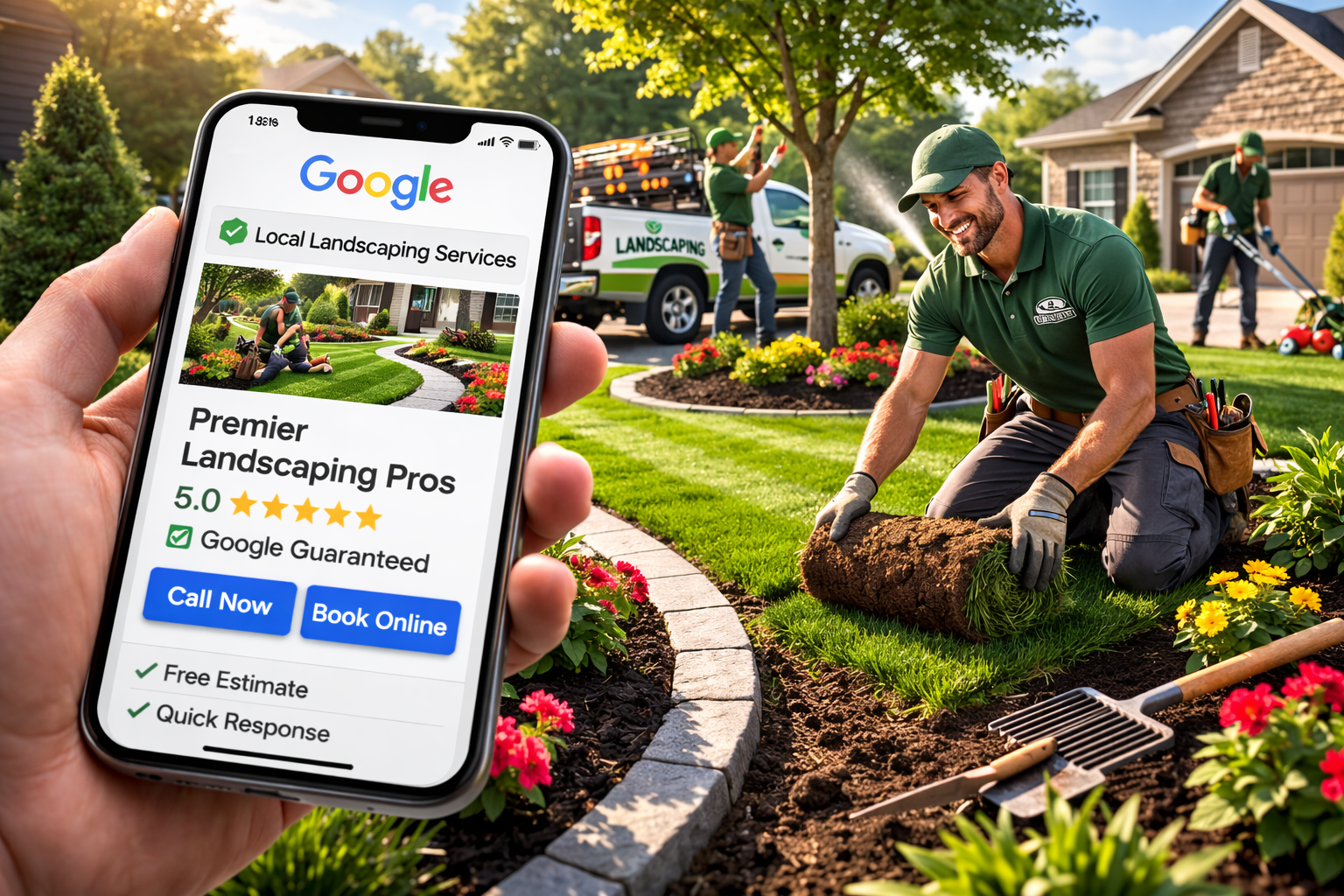
When someone searches "landscaper near me," "lawn care service," "yard cleanup," "sod installation," or any similar phrase, Google shows Local Services Ads at the very top of the results page. Above every paid search ad. Above the map pack. Above every organic listing. Your listing shows your business name, star rating, review count, years in business, and a direct click-to-call button.
On a phone screen, which is where the overwhelming majority of landscaping searches happen, your listing takes up most of the visible screen before the person scrolls at all. You do not have to compete with every other result on the page to get the call. You just have to be there.
The Google Verified badge matters more in landscaping than people give it credit for. When a homeowner is deciding who to let onto their property and around their family, trust is the first filter they apply, even before price. The badge tells them Google has run a background check and confirmed your insurance. They do not have to wonder whether you are legitimate. That removes a real friction point that causes customers to hesitate before calling, and it is one reason LSA listings tend to convert at a higher rate than standard Google Ads.
Quick note on terminology: Google retired the old Google Guaranteed badge in October 2025 and replaced it with the Google Verified badge. The verification requirements did not change. What changed is that the customer money-back guarantee was discontinued. If you see older articles still referencing "Google Guaranteed" for landscapers, that language is out of date.
Residential vs. Commercial Landscaping on LSA
LSA works for both, but the dynamics are different and knowing that upfront will save you frustration.
Residential landscaping leads
Residential leads are higher volume and faster to convert. A homeowner searching "lawn care near me" is usually ready to book within a day or two. They want a quick quote, a clear price, and someone who will show up when they say they will. The average residential job value ranges from a $200 cleanup to a $6,000 landscape install, with recurring maintenance contracts in between. These customers convert fast and they often stay for years if you do the work right.
Commercial landscaping leads
Commercial leads come in at lower volume through LSA but the contract values are significantly higher. Property managers, HOA boards, office park owners, and retail centers all search for landscaping vendors and LSA surfaces your business to them. The sales cycle is longer since commercial clients often want multiple quotes and go through an approval process. But landing a single commercial maintenance contract at $1,200 per month more than justifies the slower close. Make sure "commercial property maintenance" is enabled in your job types and write your business description in a way that speaks to commercial clients, not just homeowners.
Running both at once
Most landscaping businesses do both residential and commercial, and you should have both enabled in LSA. The key is making sure your service area, job types, and profile description are written broadly enough to speak to both audiences. If your description only says "residential lawn care" you are telling commercial prospects this is not for them before they even call.
Setting Up Google LSA for Your Landscaping Business
The setup takes real time upfront, especially the verification steps. Do not rush it and do not skip any of the pieces below. A profile set up properly from the start will outperform a profile that cuts corners, every time.
- Create your profile at ads.google.com. Go to the Local Services Ads section and start a new profile. Add your business name, service areas, hours, and a description. Write the description like a person talking to another person. "Family-owned landscaping company serving the greater Denver area, lawn care, cleanups, mulching, commercial maintenance, and irrigation" outperforms anything that starts with "We are a professional landscaping company dedicated to exceeding your expectations." Nobody talks like that and no customer reads it.
- Set your service area to match where you actually want to work. This is not just about coverage. It directly affects your lead quality. Too broad and you get calls from an hour away that you cannot profitably service. Too narrow and you miss jobs right at the edge of your normal territory. Start with the zip codes or cities you genuinely serve and adjust after you see where leads are coming from.
- Enable every job type you can deliver. This step gets its own full section below because it is where most landscaping companies leave the most money on the table. Google does not infer your services from your website or your description. If it is not checked in your job type settings, you are invisible for that search.
- Upload your insurance and licensing documents. Google requires proof of general liability insurance. Some states also require a landscaping license or a pesticide applicator license if you offer lawn treatments. Have digital copies of everything ready before you start and upload them all at once to avoid going back and forth with verification.
- Complete background checks immediately. This is the step everyone underestimates. Background checks for owners and field employees are required and they are the slowest part of the whole process. In some markets they take more than a week. Start them on day one, before you do anything else.
- Connect your Google Business Profile. Your GBP reviews show up directly on your LSA listing. If your GBP has outdated hours, missing service areas, or no photos, that weakness carries over into LSA. Spend an hour cleaning up your GBP before you go live. Accurate hours, updated photos, correct service area, and a complete description will make your LSA profile stronger from the moment it goes live.
- Set your budget to Maximize Leads. Start with Maximize Leads bidding and a weekly budget that targets around 10 to 15 leads per week based on expected cost per lead in your market. Do not set a low Max Per Lead cap when you are starting out. In competitive markets it will throttle your delivery before you ever see what LSA is capable of producing.
- Add real photos of your actual work. Before and after shots of lawns and installs. Your crew in uniform. Your equipment. Finished commercial properties. Real images from jobs you have done. Customers look at photos before they call. Stock photos are obvious and they do not build trust. Your actual work does.
Get a Free Landscaping LSA Audit
Complete Job Type Checklist for Landscapers
This section exists because it is the single most common reason landscaping LSA profiles underperform. Most companies enable three or four services and miss a dozen others they could be getting paid for. Google will only show your ad for job types you have explicitly enabled. It will not guess based on your description or your website.
Go through this list and enable everything you can actually deliver:
Landscaping LSA Job Types to Enable
- Lawn care and mowing
- Landscaping design
- Mulching and top dressing
- Sod installation
- Seeding and overseeding
- Fertilization and weed control
- Irrigation system installation
- Irrigation repair and maintenance
- Tree trimming and pruning
- Shrub trimming
- Leaf removal and fall cleanup
- Spring cleanup
- Yard cleanup (general)
- Edging and dethatching
- Retaining walls
- Patio and hardscape installation
- Planting (flowers, shrubs, trees)
- Snow removal
- Commercial property maintenance
- HOA and common area maintenance
If you are a full-service landscaping company and only had 5 or 6 of those checked, you were invisible for all the rest. Log into your LSA dashboard, go through the full list, and enable everything that applies. Do it today. Every day you are not showing up for those searches is a lead going to a competitor.
What Does LSA Cost for Landscapers?
In most US markets, landscaping LSA leads run between $20 and $55 each. Larger metros and areas with heavy competition push toward the higher end. Smaller markets and less saturated areas come in well below that range.
But cost per lead is not the metric to optimize. Cost per booked job is. Here is how to calculate it: take everything you spent on LSA in a month, divide it by the number of jobs you actually completed from those leads. That is your real acquisition cost per job. Run that number against your average job value and you will know immediately whether the math works.
Work out what a lead should cost you in the free CPA calculator before judging the number you are getting.
A realistic example: you spend $600 on LSA in a month. You receive 18 leads. You answer 16 of them. You book 10. Your cost per booked job is $60. If your average job is a $350 cleanup, you cleared $290 per job after the lead cost. If half of those customers become recurring monthly clients at $180 per month, you will make that $60 back in the first month and collect revenue from them for years.
The businesses that struggle with LSA economics almost always share the same two problems. They are missing too many calls because everyone is out in the field, or their close rate on the phone is low because nobody on the team has been given any guidance on how to handle an inbound lead. The advertising is rarely the issue. Fix the operations and the numbers almost always turn positive.
How seasonality affects your LSA cost
Lead costs in landscaping are not flat throughout the year. When spring hits and every homeowner in your market suddenly wants their yard done, more landscaping companies activate their budgets and competition increases. Cost per lead goes up. The companies that entered spring with established profiles and 80 or 100 reviews will outrank a newer profile at the same or even higher budget.
This is the exact reason you want to be running LSA in the off-season, not just when work slows down. Every review you collect in November and every call you answer in January builds the profile strength you will need to compete in April. A profile that is nine months old with steady review velocity will outperform a brand new profile every single time, even in a hot spring market.
Deep Dive: CPL by month, market size, and job type with break-even calculatorWant to see what landscaping LSA leads cost in your market? Run the numbers for your own market with our free landscaping LSA ROI calculator.
How to Rank Higher in Landscaping LSA
Landscaping is the most visual trade in home services, and that gives you a ranking advantage most landscaping companies never use. Google's algorithm cares about profile quality, responsiveness, and relevance, but for landscaping specifically, the visual presentation of your work is a differentiator that directly affects click-through rates and, in turn, your ranking position. Here is what actually determines where you show up.
- Your project photos are your most powerful ranking tool. Landscaping is the trade where photos matter most. A customer looking for a new patio, a landscape design, or a full yard transformation wants to see what you can do before they call. Upload real before-and-after photos from your best projects, not five photos from the same job, but a portfolio that shows range. Lawn care, hardscaping, plantings, irrigation installs, commercial properties. Google profiles with 15+ real project photos consistently outperform profiles with stock images or no photos at all. Update your photos monthly with recent work. The visual quality of your profile directly affects how many searchers click "call" vs. scrolling to the next listing.
- Adjust your services seasonally to match what people are actually searching for. In spring, customers are searching for yard cleanup, mulching, and new plantings. In summer, they want lawn maintenance and irrigation. In fall, leaf removal and aeration. In winter, snow removal. If your profile still says "spring cleanup" in October, you look out of touch. Update your business description and featured services every season. This signals to both Google and customers that you are active, relevant, and handling the work people need right now. Profiles that change with the seasons maintain stronger rankings year-round than profiles that stay static.
- Enable hardscaping, irrigation, and tree services if you offer them. Most landscaping companies check "lawn care" and maybe "landscaping design" and stop there. If you also do patio installation, retaining walls, irrigation systems, tree trimming, or snow removal, those categories need to be enabled in your job type settings. A $6,000 patio install or a $2,500 irrigation system from a single LSA lead completely changes your ROI math, but if the category isn't checked, you never see those leads. Go through the full list today.
- Target affluent neighborhoods where landscaping budgets are highest. Not all service areas produce equal returns. Zip codes with higher median home values consistently produce higher-value landscaping jobs, larger properties, design-build projects, hardscaping, and ongoing maintenance contracts. After 60-90 days of data, review your lead quality by geography. If certain zip codes are producing mostly $150 mow-and-blow calls while others generate $5,000 landscape installs, adjust your service area to weight toward the high-value zones. Your total lead volume may decrease slightly but your revenue per lead will increase significantly.
- Keep your service area tight to your actual coverage. Landscapers are one of the trades that complain most about out-of-area leads. If your crews operate within a 20-mile radius but your service area covers a 40-mile range, you will get calls you cannot profitably serve. Tighten the area to match where you actually want to work. Better to get 12 leads in your territory than 20 leads where half are an hour drive away.
For the full breakdown of every factor Google uses to determine LSA rankings, read our complete guide to LSA ranking factors. For a step-by-step approach to reaching the top spot, see our guide to ranking #1 in Google LSA.
Deep Dive: Review velocity targets, photo protocols, job type checklist, and service area math for landscapersBuilding a Review System That Actually Works
Reviews are not something you do on the side. For a landscaping company running LSA, they are a core business function that directly determines how many calls you get. Here is a system that works.
Step one: get the review immediately after the job, not a week later. The window when a customer is most likely to leave a review is the same day or the day after their job is completed and they are happy. Satisfaction fades fast. Waiting three days means half of them have moved on mentally.
Step two: send a text, not an email. Text open rates are around 90%. Email open rates in home services are under 25%. Send a text that says something like: "Thanks for having us out today. If you were happy with the work, it would mean a lot to us if you left us a quick Google review. Here is the link: [your review link]." Keep it short. Do not ask for a five star review. Just ask for an honest one. They come in five stars on their own.
Step three: build it into your close process, not your memory. The companies that collect reviews consistently have a system. The ones that ask whenever they remember end up with a review flatline after the first few months. Set up a simple text template in your phone. Have whoever closes out the job send it before they leave the property. If you have a crew, make it one person's responsibility on every job.
Step four: respond to every review, positive and negative. Your responses to reviews are visible to every future customer who looks at your profile. A thoughtful response to a negative review shows more professionalism than the review itself. A quick thank you on a positive review shows you actually pay attention to your customers after the job is done.
Handling LSA Calls for Landscaping
This section exists because the call is where a lot of landscaping companies lose leads they already paid for. You can have a perfect LSA setup, a strong profile, great reviews, and still convert poorly if nobody on your team knows how to handle an inbound lead.
LSA customers have already decided they want a landscaper. They are not calling to research. They want a price, an availability date, and confidence that you will show up. Here is what good call handling looks like for landscaping.
- Answer within the first two rings if you can. Every additional ring is a reason for the customer to hang up and call the next result. If you genuinely cannot answer, have someone designated who can.
- Get the job details and address quickly. Do not spend five minutes on small talk before finding out what they actually need. Ask what service they are looking for, where the property is, and roughly what size or scope they are dealing with. You need that information to quote them and schedule them.
- Give a price range on the call if you can. Customers who get a ballpark range on the first call convert at a much higher rate than customers who are told someone will come out to quote them. Even a wide range like "most lawn cleanups in that size range run $150 to $300" gives them enough to decide. Refusing to give any number creates friction and often kills the job.
- Offer a specific appointment time before you hang up. "Let me put you on the schedule for Thursday between 8 and 10" is more likely to close than "we'll call you back to schedule." Have your calendar accessible when you are taking calls.
- Mark every lead in your LSA dashboard. Booked job, no answer, wrong number, out of area. This data feeds directly back into Google's algorithm and influences the quality of future leads. Businesses that mark outcomes consistently get better leads over time.
Seasonal LSA Strategy for Landscapers
Landscaping is one of the most seasonal businesses out there, and most advice on LSA ignores that completely. Here is how to run LSA through the full year in a way that actually makes sense for a landscaping company.
Pre-season (January through February)
This is the most important period in your entire LSA year and most landscapers are either off or running a tiny budget. The customers searching for landscapers right now are planning projects: spring cleanups, new sod, patio installs, irrigation systems, commercial contracts that start in March. These are often higher-ticket jobs from customers who are not in a rush, which means your close rate is higher and the competition for those leads is lower because everyone else is asleep. Run a moderate budget, collect reviews from any jobs you are doing, and enter spring with a profile that has momentum.
Peak season (March through June)
Increase your budget as search volume rises. Your profile will already have a ranking advantage over competitors launching fresh in spring. Focus heavily on answering every call and collecting reviews after every new job. Competition is at its highest and so is your opportunity. Do not cap your budget too tightly during this window or you will miss the volume spike that justifies everything you spent in the slow months.
Summer maintenance (July through August)
If you are in a hot climate, this period can be quieter for new installs but strong for maintenance contracts and irrigation calls. If you are in a cooler market, this is still strong. Keep your budget steady and focus on converting new maintenance contract customers from leads, not just one-time jobs. A customer who books a weekly mowing contract in July generates recurring revenue through the season.
Fall push (September through October)
This is the second peak of the year in most markets. Fall cleanups, aerating, overseeding, final mows, and leaf removal all drive search volume back up. Customers who were happy with your spring work will often come back without being asked. Customers who found you on LSA for the first time now are often looking to establish a relationship going into the next year. Run a strong budget and treat it like a mini spring.
Off-season (November through December)
Do not turn off LSA. Keep a lower budget running to maintain profile activity and capture snow removal calls if that applies to your market. Every review you collect in November counts toward your spring ranking. Every call you answer in December is a call your competitors missed. Stay active.
Deep Dive: Exact dollar amounts for every month by company size, plus spring surge and fall push protocolsCommon LSA Mistakes Landscaping Companies Make
- Not updating seasonal services in their profile. A landscaping company that still has "spring cleanup" listed as a featured service in October is telling both Google and customers that their profile is stale. Landscaping is one of the most seasonal businesses in home services, and your LSA profile needs to reflect what people are actually searching for right now. Update your description and highlighted services at least four times a year: spring cleanup and planting in March, maintenance and irrigation in June, leaf removal and aeration in September, snow removal in November. Companies that update seasonally maintain stronger rankings than those that set their profile once and forget it.
- Using stock photos instead of real project photos. Landscaping is the most visual trade on LSA. A homeowner deciding between three landscapers on Google is going to click on the one whose photos show beautiful finished projects, not generic stock images of a perfectly manicured lawn that could be from anywhere. Upload real before-and-after shots from your own jobs: patios, retaining walls, lawn transformations, commercial properties. Update them monthly with your latest work. Stock photos are obvious and they kill trust before a customer even calls.
- Targeting too wide a service area. Landscaping customers want a crew that is local and can show up reliably. If your service area covers a 50-mile radius but your crews work within 15 miles of your shop, you will get leads from locations you cannot profitably serve. Every out-of-area call is money wasted. Tighten your service area to the zones where you actually want to work and can dispatch a crew within a reasonable timeframe. Your lead volume may drop but your cost per booked job will improve dramatically.
- Not enabling hardscape and irrigation services. A landscaping company that only has "lawn care" and "landscaping design" enabled in their job types is missing the highest-value leads on the platform. Hardscaping jobs (patios, retaining walls, walkways) run $3,000-$15,000. Irrigation system installs run $2,000-$5,000. If those categories aren't checked in your profile, you're invisible for every one of those searches. Enable everything you offer, the revenue difference between a $150 mowing lead and a $8,000 hardscaping lead justifies the effort.
- Setting the same budget year-round instead of scaling with seasonal demand. Landscaping search volume can swing 4-5x between January and April. Running the same weekly budget all year means you're overspending in slow months when fewer quality leads are available and underspending during the spring and fall peaks when your competitors are spending aggressively. Scale your budget to match demand: increase 40-60% from March through June, maintain through summer, bump again in September through October, then reduce for winter. For more on understanding LSA cost dynamics, see our pricing guide.
If your profile is live and you are not getting the call volume you expected, our LSA no-calls troubleshooting guide covers the 12 most common causes and the exact fix for each one.
Deep Dive: All 12 landscaping LSA mistakes with severity ratings, diagnosis signs, and step-by-step fixesShould Landscapers Run LSA and Google Ads Together?
Yes, and for landscaping specifically, the split between the two platforms aligns naturally with the two types of landscaping customers you want to reach.
LSA catches the "landscaper near me" searches, homeowners who need a yard cleanup this week, a property manager who wants a quote for a new account by Friday, someone who just moved in and needs lawn care set up immediately. These customers are ready to call and book. They're not comparing four companies or requesting proposals. They want someone credible who shows up. That's exactly what LSA delivers.
Google Ads captures the research and design-stage traffic that LSA doesn't reach. Homeowners browsing landscape design inspiration, comparing patio materials and costs, researching irrigation system options, or looking at "best landscapers in [city]" review roundups. Commercial property managers putting together bid lists for the next quarter. HOA boards evaluating whether to switch landscaping vendors. These searches represent your highest-value projects, $5,000 to $15,000+ design-build installs, multi-year commercial maintenance contracts, but they don't convert through a click-to-call LSA listing. They convert through a targeted landing page with project galleries, testimonials, and a quote request form. For a detailed comparison, see our Google Ads vs. LSA guide for contractors.
The seasonal angle makes both channels essential. In spring when every homeowner simultaneously needs a landscaper, LSA delivers the volume. In the off-season when search volume drops, Google Ads targeting "landscape design" and "hardscaping contractors" keeps your pipeline active with higher-value project inquiries. Running both channels year-round smooths the revenue curve that makes landscaping businesses so feast-or-famine.
Start with LSA if you're new to paid advertising. It's simpler, lower cost to enter, and the leads are ready to book. Once your crews can handle more volume and you want to attract the design-build and commercial customers that drive the biggest revenue, layer in Google Ads with strong project photography on your landing pages.
How to Track Your Landscaping LSA Results
Landscaping has one of the widest revenue spreads of any trade on LSA, a $150 mowing lead and a $8,000 patio install are fundamentally different businesses. Your tracking needs to reflect that difference, or you will make bad decisions based on incomplete data.
- Track by service type: maintenance vs. design/install vs. seasonal cleanup. Tag every lead by category. Maintenance leads (weekly mowing, monthly service contracts) have lower individual job values but produce recurring revenue at $200-$400 per month. Design/install leads (patios, retaining walls, full landscape redesigns) are one-time but run $2,000-$15,000. Seasonal cleanup leads (spring/fall) are mid-range at $200-$600. When you know your CPL and close rate for each category, you can adjust your job type settings and budget allocation to attract more of the leads that produce the best returns for your business.
- Compare recurring maintenance client value vs. one-time project value. A maintenance contract customer paying $250 per month who stays for two years is worth $6,000, more than many one-time install projects. Track how many of your LSA leads convert to ongoing maintenance agreements. If the conversion rate is low, the problem is on the phone or during the first visit, not in the advertising. Target a 20-30% conversion rate from one-time leads to recurring maintenance clients and your LSA economics improve dramatically over time.
- Monitor photo quality impact on click-through rates. Landscaping is the most visual trade on LSA. If you update your profile photos with strong before-and-after project shots and see an increase in lead volume without any budget change, that's the photo quality working. Track your lead volume before and after photo updates. If you haven't updated your photos in three months, the lack of fresh visual content is almost certainly costing you clicks. See our lead volume guide for benchmarks on what to expect.
- Track which neighborhoods produce the highest-value projects. After 60-90 days of data, you'll see clear patterns: certain zip codes consistently produce $300 cleanup calls while others generate $5,000-$10,000 design-build inquiries. Use this data to refine your service area. Tightening toward the high-value neighborhoods may reduce total lead volume but will increase your average revenue per lead significantly. Some landscaping companies double their revenue per LSA dollar by eliminating low-value zones from their service area.
Landscaping LSA FAQs
How should I adjust my landscaping LSA profile for different seasons?
Update your profile at least four times per year to match what customers are actually searching for. In March, highlight spring cleanup, mulching, and new plantings. In June, feature lawn maintenance and irrigation. In September, promote fall cleanup, aeration, and leaf removal. In November, add snow removal if you offer it. Update your business description, add recent seasonal project photos, and make sure the right job types are enabled for the current season. Companies that make these seasonal adjustments maintain stronger rankings year-round because Google's algorithm rewards active, relevant profiles.
How do hardscaping leads compare to maintenance leads in value?
The difference is dramatic. A lawn maintenance lead typically books at $150-$400 per visit or $200-$400 per month on contract. A hardscaping lead, patios, retaining walls, walkways, outdoor living spaces, books at $3,000-$15,000 per project. Related outdoor trades like fencing contractors see similar large-ticket economics. Even if hardscaping leads cost more per lead and convert at a lower rate, the revenue per converted lead can be 20-50x higher than a mowing call. Make sure patio installation, retaining walls, and hardscape categories are enabled in your job types. The $55 lead that becomes a $10,000 patio project justifies your entire month of LSA spend.
How do project photos affect my landscaping LSA ranking?
Project photos have a measurable impact on click-through rates for landscaping LSA listings, which in turn affects your ranking. Landscaping is inherently visual, a customer deciding between three landscapers will click on the listing that shows beautiful finished work. Upload at least 15 real project photos showing a range of services: lawn transformations, patio installs, plantings, commercial properties. Add new photos monthly from recent jobs. Companies that regularly update their photo galleries see higher click rates and stronger ranking performance than those using a handful of old images or stock photography.
How do I get commercial landscaping leads through LSA?
Enable "commercial property maintenance" and "HOA/common area maintenance" in your job type settings. Update your business description to mention commercial capabilities, property managers scanning LSA listings skip over descriptions that only mention residential lawn care. Commercial leads come in at lower volume but single contracts can be worth $1,000-$3,000 per month. Even three commercial contracts from LSA in a year can represent $36,000-$108,000 in annual revenue.
When is the best time to increase my landscaping LSA budget?
Start increasing your budget in late February before spring search volume ramps up. By March and April, landscaping searches spike 3-5x compared to winter, and the companies with established profiles and larger budgets take the top positions. Maintain a strong budget through June, keep it steady through summer, bump it again in September for the fall cleanup push, then reduce for winter. The worst time to increase budget is after spring has already started, by then your competitors already have ranking momentum and fresh reviews from the early season jobs you missed.
Should I keep my landscaping LSA running in winter?
Yes, reduce your budget but do not pause. If you offer snow removal, winter is actually a productive LSA season. Even without snow removal, maintaining a low budget through December and January keeps your profile active, preserves your ranking history, and captures the early-bird homeowners who plan spring projects ahead of time. Companies that pause LSA in November and restart in March lose their ranking position and spend the first several weeks of spring rebuilding what they gave away. For more on managing LSA costs throughout the year, see our pricing guide.
Conclusion & Next Steps
Landscaping LSA success depends more heavily on visual presentation and seasonal adaptability than any other trade on the platform. The companies that consistently win are the ones posting real project photos every month, updating their services to match what customers are actually searching for each season, and enabling the high-value categories, hardscaping, irrigation, commercial maintenance, that most competitors leave unchecked.
The highest ROI in landscaping LSA comes from design/install projects sourced through strong review profiles. A single $8,000 patio install from LSA can cover months of ad spend. A commercial maintenance contract at $1,500/month acquired through a $40 lead is the kind of return that builds a business. These are the leads that flow to companies with 100+ reviews, complete job type coverage, and a profile that looks active and professional.
Start building your profile now, not when spring hits and everyone is competing for the same leads. Upload your best project photos this week. Enable every job type you offer. Set a seasonal calendar to update your description and services quarterly. And if you want someone to look at your current setup and tell you exactly which leads you are missing and where your competitors are outranking you, that is what we do at Blue Grid Media.
No obligation. We will look at your setup and tell you exactly what is working and what is not.
Results vary by market, competition, and how consistently you follow up on leads. Blue Grid Media specializes in LSA and Google Ads for local service businesses. Book a free review and let us look at your numbers together.
More for landscaping operators
Pair this with the rest of the landscaping operator series. Each guide covers a different angle on growing a landscaping company through paid search:
Want this run for you?
Our landscaping marketing agency page covers how we structure Google Ads and LSA for landscapers by job value, with published monthly pricing.