Migration note, updated August 2026
Google has started moving Local Services Ads into Google Ads as pay-per-lead Performance Max, and the standalone LSA dashboard is being retired in phases. If your account has not migrated yet, the steps below still apply exactly as written. If it has, here is where each control now lives.
| In the old LSA dashboard | In Google Ads after migration |
|---|---|
| The LSA dashboard itself | Redirects to your campaign overview in Google Ads |
| Weekly budget | Daily average budget, your weekly figure divided by 7 |
| A bid or max cost per lead per job type | One campaign-level Target CPA for the whole campaign |
| Lead inbox | Goals, then Conversions, then Leads |
Phase 1 began August 1, 2026. Service-area businesses without a storefront are in the late 2026 wave, and everyone else follows in 2027. Read the full migration breakdown.
Published by Blue Grid Media • Updated for 2026 • 15 min read
Most roofing contractors are paying too much for shared leads from pay-per-lead directories like HomeAdvisor, where the same homeowner gets called by four other contractors who all paid for the same job. Google Local Services Ads is a different model: your listing appears at the very top of local search results above every competitor, customers in your service area contact you directly, and you only pay for that exclusive lead. There's no bidding war over who reaches the homeowner first, you're already there.
This guide covers how LSA works for roofers specifically, what it costs, how to rank higher than your competitors in local search results, and how to build a setup that consistently turns storm seasons and everyday wear-and-tear searches into booked jobs.
Roofing LSA Deep Dive Series
This guide covers the full roofing LSA playbook from setup to storm strategy. For deeper analysis on specific topics, each page below focuses on one angle that would take too long to cover here:
Roofing LSA Resources
Is Google LSA Worth It for Roofers?
Yes, and the numbers are hard to argue with. Roofing has some of the highest job values of any home service trade. A single roof replacement can run $8,000 to $15,000 or more depending on your market and the size of the home. Even a repair call that starts as a lead gen job often turns into a full replacement conversation once you're on-site and the homeowner sees what they're actually dealing with.
The math on LSA works in your favor as a roofer more than almost any other trade. You're paying per lead, not per click. A $70 lead that converts into a $10,000 replacement job is a return most advertising channels can't touch. Even at a conservative close rate, roofing LSA economics are strong, as long as your team follows up fast and shows up when they say they will.
The bigger question for most roofers isn't whether LSA is worth it. It's whether their profile and operations are set up to actually convert the leads that come in.
| Feature | Local Services Ads (LSA) | Google Search Ads |
|---|---|---|
| How you pay | Pay per lead (calls/messages) | Pay per click |
| Lead intent | Very high (ready to hire now) | Varies (research to urgent) |
| Typical CPL (roofing) | $50–$100 per lead | $20–$60 per click (varies) |
| Best for | Emergency repairs, storm damage, replacements | Commercial, planned replacements, scale |
| Setup difficulty | Moderate (verification required) | Higher (ongoing campaign management) |
See the real numbers for your trade
Plug in your industry, budget, and close rate. Our calculator shows your projected leads, cost per booked job, and ROAS.
What does Google LSA actually look like for roofers?
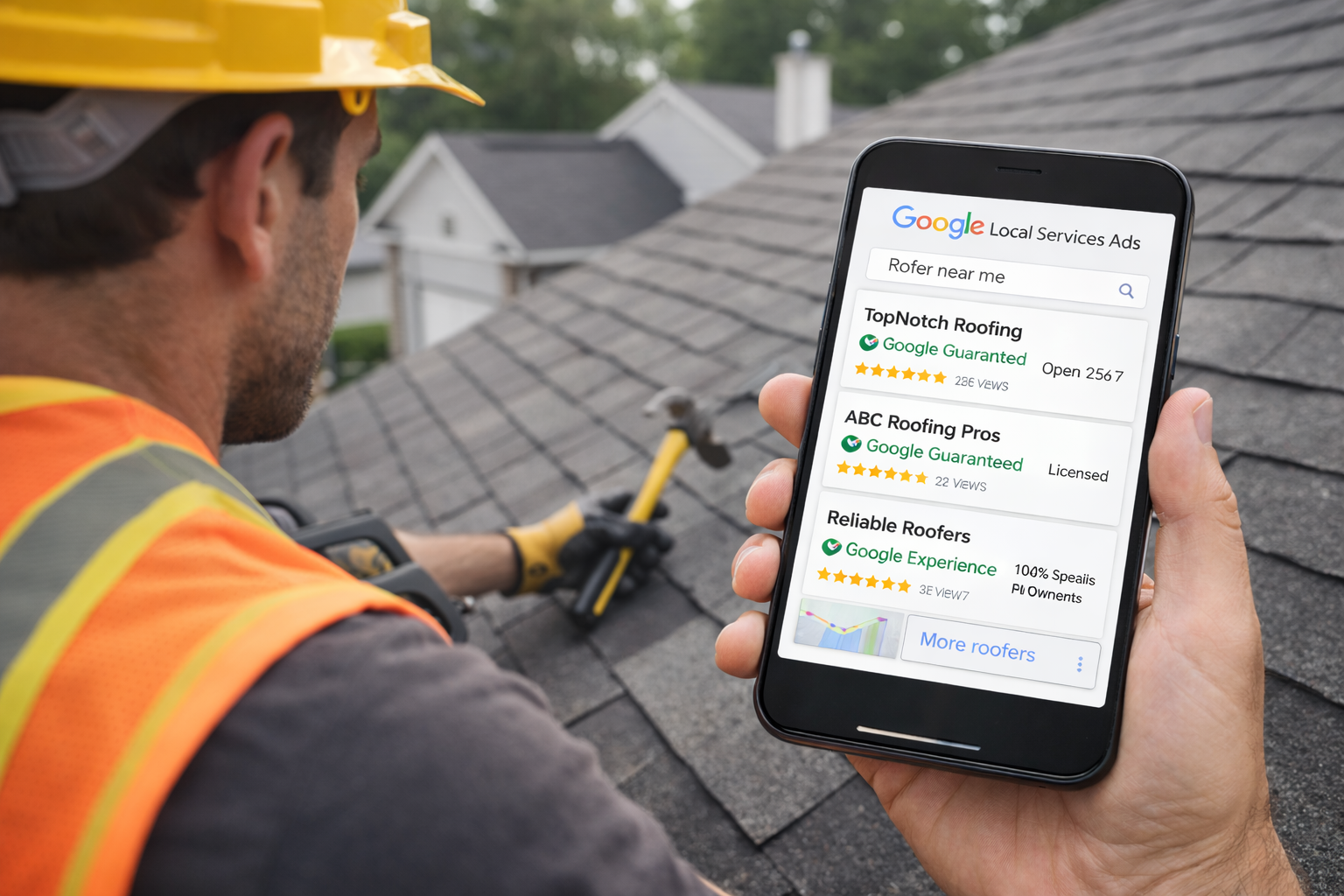
When a homeowner searches "roof repair near me," "emergency roofer," "roof leak fix," or similar queries, Google surfaces a row of Local Services Ads at the very top of the page, above standard Google Ads, above the map pack, above every organic result. On mobile, which is where the majority of these searches happen, your listing takes up most of the visible screen before the user scrolls.
Each listing shows your business name, star rating, review count, years in business, hours, and a click-to-call button. Fast, simple, and built for someone who needs help now.
Your listing also carries the Google Verified badge, and in roofing that badge carries more weight than in almost any other trade. Here is why: after every major storm, a wave of out-of-state and unverified contractors floods local markets. They show up with magnetic truck signs, offer suspiciously fast estimates, collect deposits, and in some cases disappear before the work is done. Homeowners know this happens. They have heard the horror stories from neighbors. That background of distrust means that when a customer sees a Google Verified badge next to your name, it does real filtering work. You are not just another contractor who showed up. You are a background-checked, licensed, insured business that Google has reviewed. That distinction closes leads.
On the terminology: Google retired the "Google Guaranteed" badge in October 2025 and replaced it with the Google Verified badge across all service categories. The screening and verification process is identical. The customer money-back guarantee that used to come with the old badge has been discontinued. If you see older content still referencing "Google Guaranteed" for roofers, that language is out of date.
How to Set Up Google LSA for Your Roofing Company
Getting verified takes some paperwork upfront, but the ongoing management is lighter than running traditional Google Ads. Here's the process:
- Create your LSA profile. Go to ads.google.com and navigate to the Local Services Ads section. Add your business name, service areas, hours, and a business description. Keep the description specific, mention what you actually do, who you serve, and anything that sets you apart. "Licensed roofing contractor serving the greater Denver metro. Residential and commercial roof repairs, replacements, storm damage, and inspections" beats generic filler every time.
- Select your job types. This is the most consequential setup decision you will make. Google's roofing job type list includes roof repair, roof installation, roof inspection, flat roof repair, skylight repair and installation, gutter cleaning, gutter installation, and fascia and soffit repair. Most roofers check off "roof repair" and "roof installation" and call it done. What they miss is gutter cleaning, which generates consistent year-round call volume and keeps the profile active during slow roofing months when replacement and repair searches drop. Roof inspection is also commonly left off, even though inspection is how many homeowners start the buying journey before committing to a full replacement. Enable every job type that reflects what your crews can actually deliver. If it is not checked, you are not competing for those searches.
- Upload licensing and insurance. Roofing license requirements vary by state, but Google will require whatever your state mandates. General liability insurance is standard. Have digital copies ready. The documents need to be current and the business name must match what you're advertising with.
- Complete background checks. Roofing contractors go through background checks as part of the Google Verified process. Depending on your market, this may apply to owners and field staff. Start this early, it's the step that takes the longest and can delay your go-live date by a week or more.
- Connect your Google Business Profile. Your GBP feeds directly into your LSA listing. Reviews, photos, and business details from your GBP show up on your ad. Before you go live, make sure your GBP is fully filled out, has real photos of completed jobs, and is actively collecting reviews. A bare GBP hurts your LSA performance from day one.
- Set your budget and bid mode. Start with Maximize Leads and a weekly budget you're comfortable sustaining for at least 30 days. Give the algorithm time to learn before you start adjusting. Roofing is seasonal, so build your budget timing around your peak windows, more on that below.
- Add photos. Real job photos matter. Before-and-after shots of completed roofs, your team on the job, branded trucks on site. Google rewards complete profiles and homeowners actually look at photos before calling. Don't skip this step.
What Does LSA Cost for Roofers?
Roofing leads through LSA typically run in the $50 to $100 range depending on your market, the season, and competition in your area. Storm-heavy periods and major weather events drive lead costs up because every roofer in your local market is competing for the same surge in demand. For a full breakdown of roofing CPL benchmarks alongside other trades, see our guide to Google LSA pricing by industry.
Here's the key reframe though: roofing has some of the highest average job values in home services. A $75 lead that turns into a $12,000 replacement job is an exceptional return. Even repair calls that average $500 to $1,500 can still pencil out well if your close rate and follow-up are solid. Run the numbers for your market with our free LSA ROI Calculator.
What you keep from that ticket matters more than the ticket. Run one through the free contractor profit margin calculator.
The roofers who struggle with LSA economics usually have one of two problems: they're not following up fast enough on leads, or they're not tracking which leads actually turned into booked jobs. Neither is an LSA problem, both are operations problems. Fix the follow-up process first, then worry about optimizing your bid settings.
For a full breakdown of roofing CPL by season, market size, and job type, including a dispute decision framework and audit process, see our Roofing LSA Cost Per Lead deep dive.
Cost per lead is just CPC divided by conversion rate, which the free CPA calculator will do for you.
Want to see what roofing LSA leads cost in your market? Run the numbers for your own market with our free roofing LSA ROI calculator.
Roofing Seasonality and LSA: How to Budget Around It
Roofing is one of the most weather-driven trades in home services. Your LSA strategy needs to reflect that or you'll either overspend during slow periods or get caught flat-footed when demand spikes.
Storm season: This is when LSA earns its money for roofers. After a significant hail event, wind storm, or heavy rain, search volume for roofing services spikes dramatically in the affected area. Homeowners are searching urgently, they're motivated to book quickly, and job values are high because storm damage often means full replacements. The roofers who capture this surge are the ones who had their LSA profiles dialed in before the storm hit, not the ones scrambling to turn on ads the morning after.
Get ahead of your regional storm season. If you're in the Midwest or South, that typically means late spring through early fall. Ramp up your LSA budget before peak season, make sure your team is staffed to handle increased call volume, and have a clear process for turning storm damage leads into on-site inspections quickly.
Spring and fall: These are your best shoulder seasons for scheduled work, replacements, inspections, gutter work. Homeowners in your service area are motivated by the weather change and thinking about home maintenance before winter or summer. Keep LSA running and budget appropriately. Don't let competitors take all the scheduled replacement jobs while you're only thinking about emergencies.
Winter and off-peak: Lower volume, but don't shut off completely. There's still repair work happening, especially after freeze-thaw cycles and ice damming in cold climates. Running a reduced budget keeps your profile active and your review velocity steady. Competitors who go dark in the off-season lose ranking ground that takes months to recover.
For specific weekly dollar amounts by company size, storm event protocols with exact spend triggers, and a month-by-month budget calendar, see our Roofing LSA Budget Guide.
How do roofers rank higher in Google LSA?
LSA is an auction that weighs more than just your bid. Google factors in profile quality, review strength, response behavior, and how likely a specific customer searching near you is to contact your business. Here's what actually moves the needle for roofers:
- Prepare for storm season before it arrives. Enable emergency tarp service, emergency leak repair, and storm damage assessment as separate job types in your LSA profile before your region's severe weather season. When a hailstorm hits, homeowners search these exact terms, and the roofers who already have them enabled capture the surge while competitors scramble to update their profiles after the fact. Being ready before the storm is worth more than any bid increase after it.
- Build review volume to stand out from storm chasers. After major weather events, out-of-town contractors flood local markets knocking on doors. Homeowners are skeptical, and rightfully so. A roofing LSA profile with 200+ local reviews from real customers in your area is your most powerful weapon against storm chasers who show up with zero local presence. Review volume proves you're established, trusted, and not going anywhere. Make review collection a non-negotiable step in every job close, year-round, so you're stacked before the next storm hits.
- Use before-and-after photos to stand out visually. Roofing is inherently visual. A homeowner comparing three LSA profiles will click on the one that shows clean before-and-after shots of actual completed roofs in their area. Stripped deck to finished architectural shingles. Damaged flat roof to sealed and coated. Water-stained ceiling to dry interior. Build a library of these photos from every job and rotate new ones into your profile monthly. Generic truck photos don't convert, completed work does.
- Adjust your bidding strategy during hail season. When a major storm event hits, CPL for roofing can spike from $65 to $120+ overnight as every roofer in your market competes for the same surge in demand. If you're running a manual Max Per Lead cap of $70, your ads disappear exactly when lead volume is highest. Switch to Maximize Leads with a weekly budget you can sustain through a two-week storm response period. The leads cost more per unit, but the job values ($8,000–$15,000 replacements) make the math work easily.
- Respond to every call within one ring. Roofing LSA leads, especially post-storm, are some of the most time-sensitive in home services. A homeowner with an active leak is calling the first three roofers in the LSA pack and booking whoever answers and can show up fastest. If you send them to voicemail, that $10,000 replacement job goes to the competitor who picked up. Staff your phones or use a live answering service, especially during weather events and weekends.
For a full breakdown of every signal Google factors into the LSA auction, see our complete guide to LSA ranking factors and our guide on how to rank #1 in Google LSA. For roofing-specific operational depth on each factor, job type completeness checklist, GBP category selection, review velocity targets, and seasonal pause recovery timelines, see our Roofing LSA Ranking Factors guide.
To see where you actually sit in the LSA pack right now, run the free LSA Visibility Scanner.
What are the most common LSA mistakes roofing contractors make?
- Only running LSA during storm season. This is the most expensive mistake roofers make. If you turn off LSA from October to April, you miss the entire planned replacement market, homeowners whose roof is aging, has visible wear, or failed an inspection. These aren't emergency calls, but they're $8,000–$15,000 jobs with higher margins because there's no storm-damage urgency. Keep LSA running year-round at a lower off-season budget and you'll capture the replacement market your storm-chaser competitors are ignoring entirely.
- No system for handling insurance and adjuster calls. A significant percentage of post-storm roofing leads involve insurance claims. If your team doesn't know how to walk a homeowner through the claims process, schedule an adjuster meeting, or provide a proper scope of damage report, you're losing those jobs to the contractor who does. Train your sales team on insurance claim language, and mention in your LSA profile that you work with all major insurance carriers. That one line in your description can be the difference between getting the call or losing it.
- Only posting "before" photos with no "after" shots. A stripped deck or a pile of damaged shingles tells a homeowner nothing about the quality of your work. They want to see the finished product, clean ridge lines, proper flashing, neat gutter integration, and a roof that looks better than the one they currently have. Before-only photos are worse than no photos at all because they show damage without resolution. Always pair them with a completed shot from the same angle.
- Not disputing leads from homeowners who are just price-shopping for insurance quotes. Some homeowners call multiple roofers with no intention of hiring, they just need three written estimates to submit to their insurance company. If they never intended to book and were only collecting paperwork, that's a disputeable lead. Same with callers who are clearly outside your service area or asking about non-roofing services. Dispute aggressively and save $200–$500/month in wasted spend.
- Setting budget too low during hail season. When a major storm hits and roofing searches spike 5x in your market, a $400/week budget runs out by Tuesday. Meanwhile your competitors with $1,500/week budgets are capturing leads all week long. Set your storm-season weekly budget to at least 2–3x your normal spend, and make sure your team is staffed to handle the increased call volume. You can always reduce budget after the surge, but you can't get those missed leads back.
If you're running LSA but not seeing call volume that matches storm season demand in your area, the issue is almost always profile-level, whether that's budget caps, service area limits, or review counts holding you back. Our LSA troubleshooting guide covers the most common causes and what to fix first. For a deeper look at all 12 common roofing LSA mistakes, with severity ratings, root cause diagnosis, and step-by-step fix protocols, see the Roofing LSA Mistakes guide.
Should Roofers Run LSA and Google Ads Together?
Yes, and roofing has a unique reason to run both that most other trades don't share. LSA is your storm-damage and emergency channel. When a homeowner has an active leak, missing shingles after a windstorm, or visible ceiling damage, they're searching "roof repair near me" and calling whoever's at the top of the LSA pack. That's urgent, high-converting traffic. LSA handles it perfectly.
But the planned replacement market, homeowners whose roof is 18 years old and showing wear, families who just bought a house and know the roof needs attention within two years, property managers scheduling commercial re-roofing, those people aren't searching with urgency. They're typing "roof replacement cost," "how much does a new roof cost in [city]," and "best roofing material for my climate." Google Ads with keyword-targeted campaigns and dedicated landing pages is exactly how you capture that early-research traffic that LSA doesn't reach. These leads take longer to close but they're your $10,000–$20,000 replacement jobs.
One thing worth knowing: roofing Google Ads have some of the highest CPCs in home services, $15–$50 per click in competitive markets. That sounds expensive until you consider that a single closed replacement job covers months of ad spend. The key is building campaigns around high-intent keywords like "roof replacement [city]" and "insurance roof claim contractor" rather than broad terms like "roofer" that waste budget on low-quality clicks. Target the searches where the homeowner is already partway through their decision process.
Google Ads also gives you a second channel during storm surges when your LSA weekly budget caps out. Running both means you stay visible even after your LSA budget is exhausted for the week, which can happen by Wednesday during a major hail event. For a side-by-side comparison of when each channel is strongest, see our Google Ads vs. LSA breakdown for contractors.
The same LSA model that works for roofing also applies across other home service trades. If you manage multiple service lines or are curious how the economics compare, we cover HVAC, electrical, pest control, and water damage restoration in separate guides.
How to Track Roofing LSA Performance
Roofing has some of the highest job values and widest variance in home services. A $350 repair and a $14,000 full replacement are both "roofing jobs," but they require completely different tracking. Here's how to measure what actually matters:
- Track by lead type: storm damage vs. planned replacement vs. repair. These three categories have completely different economics. Storm damage leads convert fast but often involve insurance claim timelines. Planned replacement leads take longer to close but are your highest-margin work. Repair leads close quickly at lower ticket values. Break out your cost per booked job for each category, you'll almost certainly find that one type is 3–5x more profitable than the others, and that should drive how you allocate your LSA budget.
- Monitor insurance claim conversion rate. In storm-heavy markets, 40–60% of your roofing leads involve insurance claims. Track how many insurance-related leads actually convert to completed jobs (not just inspections). If your close rate on insurance leads is below 30%, the bottleneck is usually your team's ability to navigate the adjuster process and present a proper scope of damage, not the lead quality itself.
- Calculate CPBJ per roof type. A shingle replacement, a metal roof installation, a flat roof repair, and a tile roof job all have different price points and different profit margins. If your LSA is sending you mostly shingle repair leads at $400–$800 average ticket, but you're paying $75/lead, the margin is thin. If those same leads are converting to $10,000 metal roof installations at even a 15% rate, the economics are exceptional. You can't know which reality you're living in without tracking by roof type.
- Track seasonal budget efficiency. Compare your cost per booked job in Q2 (pre-storm season) vs. Q3 (peak storm) vs. Q4 (fall shoulder). Most roofers find that their Q2 leads are actually more profitable per dollar spent because competition is lower and homeowners are planning proactive replacements rather than reacting to damage. That data should inform when you invest more heavily, which is often earlier than you think.
- Dispute aggressively and track monthly savings. Roofing LSA generates a higher-than-average rate of disputeable leads, price-shopping callers, out-of-area contacts, and people who called multiple contractors for insurance estimate paperwork with no intent to hire. Dispute every one. Most roofing companies that track disputes save $250–$600/month in wasted spend. Set a weekly calendar reminder and clear them out before the dispute window closes.
Roofing LSA FAQs
What's the best LSA strategy during storm season for roofers?
Get ahead of it. Before your region's severe weather season starts, enable emergency tarp service, storm damage repair, and emergency leak repair as separate job types. Set your weekly budget to 2–3x your normal spend so Google can scale delivery when searches spike. Staff your phones with additional coverage. The roofers who capture the post-storm surge are the ones who were ready before the first hailstone fell, not the ones turning on LSA the morning after.
Are insurance claim leads from LSA good quality?
They can be excellent, but they require a different sales process than cash-pay jobs. Insurance leads often involve an adjuster inspection, scope of damage documentation, and a longer close timeline. The roofers who convert insurance leads at a high rate are the ones whose sales teams can walk the homeowner through the entire claims process and schedule the adjuster meeting on that first call. If your team just shows up, provides an estimate, and hopes for the best, you'll lose those leads to the contractor who held the homeowner's hand through the process.
How should I handle "free estimate" leads from LSA?
Every LSA roofing lead is essentially a free estimate request, the homeowner expects you to come look at their roof before they commit. The key is converting that inspection into a signed contract on-site. The most effective roofers bring a tablet with before-and-after photos of similar jobs, explain the scope clearly, present a written estimate on the spot, and offer to handle insurance paperwork if applicable. Speed matters too, the roofer who can schedule the inspection for tomorrow beats the one who says "we'll get out there sometime next week."
How much do roofing LSA leads cost during hail season vs. normal periods?
In normal periods, roofing LSA leads typically run $50–$80 in most markets. During and immediately after a significant hail event, CPL can spike to $100–$150 as every roofer in the area competes for the surge. The higher cost per lead is usually still very profitable because storm-damage leads convert to full replacements ($8,000–$15,000) at a much higher rate than normal repair leads. Don't pull back budget during the spike, that's when the highest-value jobs are being won.
How do review photos impact roofing LSA ranking?
Google factors profile completeness into LSA ranking, and photos are a major component of that. But beyond ranking, photos directly impact your click-through rate, the percentage of searchers who actually tap your listing and call. Roofing profiles with real before-and-after job photos get significantly more clicks than profiles with generic truck photos or no images at all. Upload photos from every completed job: stripped deck to finished roof, damaged areas to sealed and restored, interior water damage to dry ceiling. Visual proof of your work quality converts browsers into callers faster than any description can.
How do I differentiate from storm chasers in my LSA profile?
Three things set established local roofers apart from fly-by-night storm chasers: review volume from local customers, years in business listed on your profile, and photos of completed jobs in your actual service area. Storm chasers show up with zero local reviews, no established presence, and generic marketing. Your LSA profile should lead with "15+ years serving [your city]" or similar, have 100+ reviews from homeowners in your area, and show photos that are clearly from local neighborhoods. The Google Verified badge reinforces your legitimacy, but local trust signals are what actually win the click.
Conclusion & Next Steps
The roofing companies that dominate LSA share three things: they're ready before the storm hits, they've built trust through review volume that no storm chaser can match, and they have a system for converting insurance-related leads that most competitors fumble. Storm readiness means your budget is scaled up, your emergency job types are enabled, and your phones are staffed before severe weather arrives, not after. Review volume means collecting reviews after every single job, including the $400 repair calls that most roofers don't bother asking for feedback on. And insurance claim handling means your sales team can walk a homeowner through the adjuster process confidently, because that's what separates the roofer who gets the $12,000 replacement from the one who just did the free inspection.
Get your LSA profile fully optimized with every roofing service type enabled, real before-and-after job photos, and a review collection process that runs year-round. Layer in Google Ads when you're ready to capture the planned replacement market and insurance claim keywords that LSA doesn't reach. And if you want someone who understands roofing advertising to audit your current setup and tell you exactly where you're leaving jobs on the table, that's what we do at Blue Grid Media.
No obligation. We'll look at your setup and tell you what's working and what isn't.
Results vary by market, competition, season, and how quickly you follow up on leads. Blue Grid Media specializes in LSA and Google Ads for home service businesses. Book a free review and let's look at your numbers together.
More for roofing operators
Pair this with the rest of the roofing operator series. Each guide tackles a different angle on growing a roofing company through paid search: