Before you price against these numbers
A break-even figure is only as good as the job cost behind it, and most are understated because labor burden and overhead never make it into the maths. The contractor profit margin calculator costs a job properly and returns the gross and net margin you actually keep. If you sell time rather than jobs, the hourly rate calculator sets the rate first, including the hours you pay for but cannot invoice.
Published by Blue Grid Media • March 2026 • Updated July 27, 2026 • 14 min read
In This Guide
- How roofing LSA ROI works
- ROI for repair-focused roofers
- ROI for replacement-focused roofers
- ROI for insurance-claim roofers
- What a repair customer is worth
- Break-even CPL by company type
- What ROAS to expect
- How ROI changes by season
- Cost per booked job by lead type
- LSA vs Google Ads vs Angi
- Rural vs metro market ROI
- FAQ
Ask ten roofers what their LSA ROI is and you will get ten completely different answers, even if they all have the same cost per lead. That is not a coincidence. Roofing has three fundamentally different business models operating under the same trade category, and each one has its own ROI math.
A repair-focused company averaging $1,100 per job sees the world very differently from a storm chaser doing $16,000 insurance claim replacements. Same Google platform, same monthly spend, but the returns, close timelines, and break-even thresholds are completely different. This guide breaks down all three models with full worked numbers, so you know exactly what benchmarks to hold yourself to.
For LSA setup fundamentals and ranking tactics, see the full Roofing LSA Guide. For CPL benchmarks by market and season, check Roofing LSA Cost Per Lead. For monthly budget planning, see Roofing LSA Budget Guide.
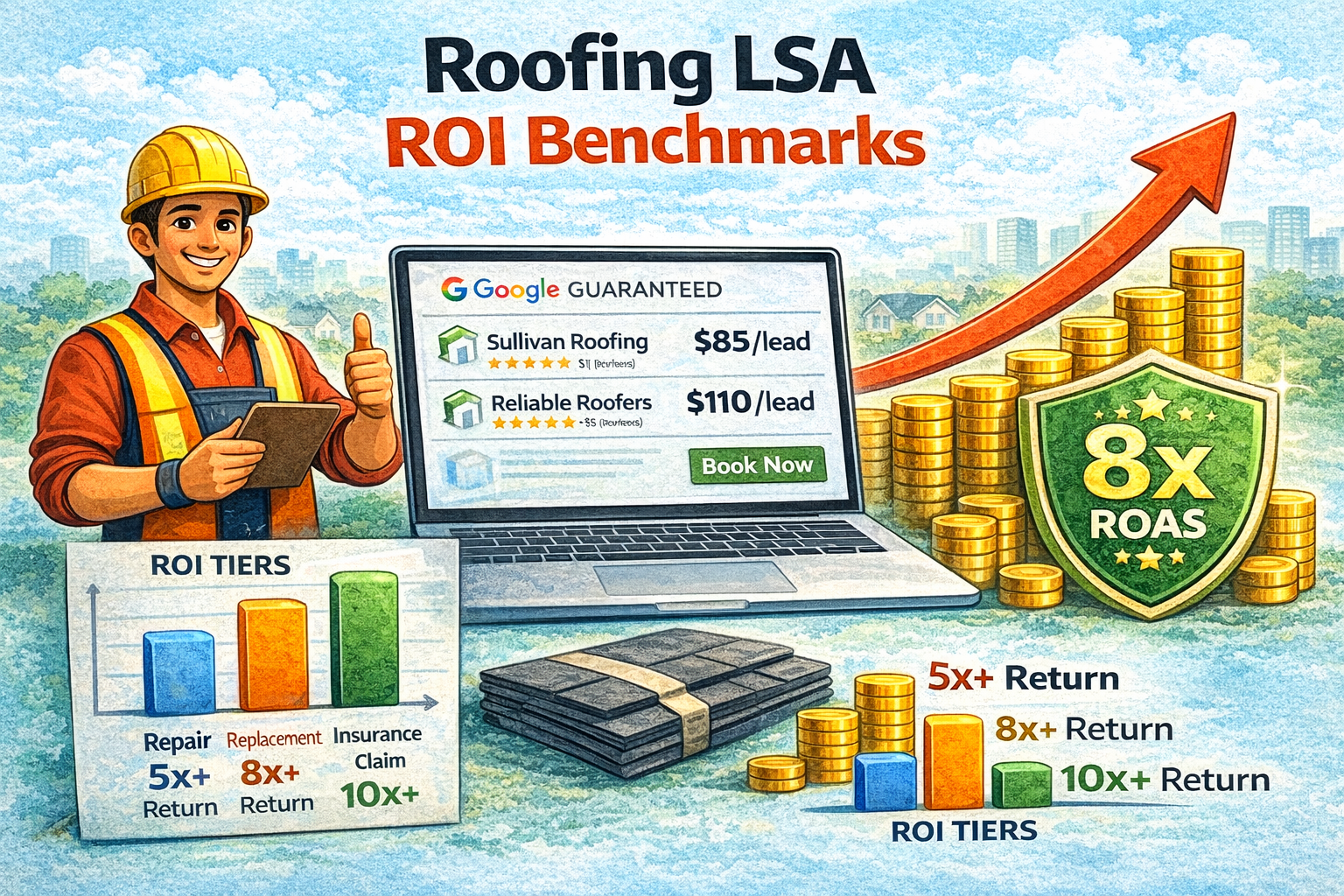
Quick answer: Roofing has the widest gap between cost per lead and job value of any home service trade, which is why the channel has so much headroom. Roofing LSA cost per lead typically runs $65 to $160, while break-even CPL sits around $260 for a repair-focused company and can exceed $2,100 for a replacement-focused one. Repair-focused roofers see lower CPL ($35 to $55) against smaller tickets ($7,500 to $10,000); replacement and insurance work carries higher CPL ($90 to $140) against tickets of $12,000 to $22,000. Because a repair customer often returns for a full replacement, true lifetime return on ad spend can exceed 40x. The scenarios below model each company type separately.
How does roofing LSA ROI actually work?
Before you can benchmark your results, you need a consistent formula. Roofing ROI has more variables than most trades because of inspection-to-close pipelines, insurance timelines, and supplement potential. Here is the framework:
One important note specific to roofing: unlike HVAC or plumbing where a job completes in hours, roofing inspections generate a proposal, which then requires a decision. Your "close" happens days or weeks after the lead came in. Track your pipeline through to final invoice, not just to inspection, or your LSA ROI will always look worse than it actually is.
What is LSA ROI for a repair-focused roofing company?
Meet Summit Roofing, a 2-truck repair-focused company in suburban Denver. They handle leaks, flashing failures, missing shingles, gutters, and small patch jobs. They do full replacements when they find them on site, but repairs drive their volume.
Summit Roofing (Repair-Focused, Suburban Denver)
High volume, lower average ticket. Core revenue from repair calls, leak stops, and emergency patches. Full replacements happen but are not the primary lead type being targeted.
Full Worked Model: Summit Roofing
Break-even at $45 CPL for Summit Roofing (meaning they could pay up to $45 per lead and still hit 1x on profit). Their actual CPL of $75 puts them well into positive territory. At $65 CPL, they hit approximately 3.9x true ROAS. At $85 CPL, they are at roughly 2.6x. Both numbers are strong for a high-volume repair company.
Check any of these against your own break-even in the free ROAS calculator.
What is LSA ROI for a replacement-focused roofing company?
Meet Ridge Line Roofing, a 5-truck full replacement company in the Phoenix metro. They do some repairs but actively market for replacement leads through LSA. Architectural shingles, TPO flat roofs, and tile systems. Average ticket around $12,000.
Ridge Line Roofing (Replacement-Focused, Phoenix Metro)
Lower volume per day, but much higher average ticket. Targets homeowners whose roofs are 15 to 20 years old, or who just got a home inspection flagging deterioration. Competition for these leads is fierce.
Full Worked Model: Ridge Line Roofing
Break-even for Ridge Line Roofing sits at approximately $130 CPL at current metrics. Their actual CPL range of $95 to $140 means they occasionally push near the edge during storm season when competition spikes. But at 13x true ROAS at $110 CPL, there is enormous room before LSA becomes a concern.
What is LSA ROI for an insurance claim-focused roofer?
Meet Apex Storm Roofing, a 10-truck company in Dallas that specializes in hail and wind damage claims. They work primarily through adjuster meetings, supplements, and insurance-approved replacement scopes. Highest average ticket, longest close timeline.
Apex Storm Roofing (Insurance Claim-Focused, Dallas)
Highest ticket values but longest cycle time. Lead comes in, inspection happens, claim is filed, adjuster visits, scope is approved (and often supplemented), then the job gets scheduled. Cash flow arrives 3 to 8 weeks after the original lead.
Full Worked Model: Apex Storm Roofing
The other variable unique to insurance claims is supplement potential. In 60 to 70% of claims, the initial adjuster scope misses line items: ice and water shield, ridge cap squares, starter strip, drip edge, permits. A trained supplement specialist adds $2,000 to $7,000 to the approved scope in most cases. Companies that skip supplementing are leaving 15 to 40% of their revenue on the table.
How much is a roofing repair customer worth long term?
Repair leads look modest on a per-job basis. An $800 repair job at $160 cost per booked job generates about 4x gross revenue ROAS. Reasonable, but not exciting. The problem with that framing is that it treats a repair call as a one-time transaction.
Here is what actually happens with repair customers over 12 months. The technician is on the roof. They see things. A 15-year-old architectural shingle system with granule loss and a couple of soft spots. They document it, show the homeowner the photos, and note that a full replacement will be needed within 2 to 3 years. That customer has your phone number saved and your name in their head when they are ready to move forward.
At $3,260 effective LTV and $173 cost per booked job (from the Summit Roofing example), true lifetime ROAS is over 18x, not 4x. The companies that understand this number invest in the follow-up system: photos from every inspection documented and sent to the homeowner, a reminder call at 6 months and 12 months, a price estimate on file. Those touchpoints convert the 22% conversion rate into 28 to 30%.
What is your break-even cost per lead by company type?
Break-even CPL is the maximum CPL at which LSA still generates positive return at a 3x gross revenue ROAS threshold. The formula: break-even CPL = average ticket x gross margin x (booking rate x close rate) / 3.
| Company Type | Avg Ticket | Gross Margin | Booking x Close | Break-Even CPL (3x) | Typical Actual CPL |
|---|---|---|---|---|---|
| Repair-focused | $1,100 | 48% | 43% | $75 | $65-$85 |
| Mixed repair + replacement | $5,500 blended | 43% | 38% | $297 | $80-$120 |
| Replacement-focused | $11,500 | 42% | 30% | $483 | $95-$140 |
| Insurance claim specialist (initial scope) | $14,000 | 39% | 29% | $528 | $100-$160 |
| Insurance claim specialist (with supplement) | $17,500 | 39% | 29% | $660 | $100-$160 |
Sensitivity Analysis: What Happens When Numbers Move
| Scenario | Base ROAS (at typical CPL) | +10% Higher CPL | -10% Lower Close Rate | Both Factors Combined |
|---|---|---|---|---|
| Repair-focused ($75 CPL, 6.4x) | 6.4x gross ROAS | 5.8x (absorbs fine) | 5.7x (absorbs fine) | 5.2x (still very solid) |
| Replacement-focused ($110 CPL, 31x) | 31.3x gross ROAS | 28.4x (no issue) | 28.4x (no issue) | 25.8x (still exceptional) |
| Insurance claim ($130 CPL, 39x) | 39.2x gross ROAS | 35.6x (no issue) | 35.6x (no issue) | 32.4x (still exceptional) |
Want to calculate your own roofing LSA break-even numbers? Run the numbers for your own market with our free roofing LSA ROI calculator.
What ROAS should a roofing company expect?
These are the gross revenue ROAS tiers for each roofing company model. "Gross" means revenue divided by cost per booked job, before applying margin. True profit ROAS will be 38 to 50% of the gross figure depending on your margins.
| Company Type | Good ROAS | Great ROAS | Exceptional ROAS | Primary Lever to Improve |
|---|---|---|---|---|
| Repair-focused | 3-4x | 5-6x | 7x+ | Faster response time, higher close rate on-site |
| Mixed repair + replacement | 5-7x | 8-12x | 15x+ | Shift job type mix toward replacement, LTV tracking |
| Replacement-focused | 6-8x | 10-14x | 16x+ | Premium material upsells, faster quote turnaround |
| Insurance claim specialist | 8-10x | 12-16x | 20x+ | Trained supplement specialist, tighter adjuster process |
Mixed companies often plateau in the middle tier because they have not committed to being primarily one model or the other. The move toward "exceptional" ROAS almost always involves either building a deliberate pipeline toward replacement (for repair companies) or building a claims processing capability (for replacement companies that want to go after insurance work).
How does roofing LSA ROI change by season?
No trade has bigger seasonal ROI swings than roofing. A hail event in May can generate more revenue in a week than a normal month. A mild winter in a northern market can mean crickets for lead volume. Here is how the math changes across three distinct seasonal conditions:
| Season / Condition | CPL Range | Dominant Job Type | Avg Ticket | Booking Rate | Gross Revenue ROAS |
|---|---|---|---|---|---|
| Storm season (hail event) | $100-$160 | Full replacement (insurance claim) | $14,000-$22,000 | 55-65% | 25-45x |
| Shoulder season (spring/fall) | $65-$90 | Planned replacement, inspection | $9,500-$14,000 | 62-72% | 18-38x |
| Peak summer (non-storm) | $80-$110 | Mixed repair + replacement | $3,000-$12,000 blended | 60-70% | 8-25x blended |
| Winter (northern markets) | $40-$65 | Emergency repair, leak stop | $500-$1,800 | 68-78% | 3-9x |
| Winter (southern/warm markets) | $55-$85 | Inspection + repair + flat roof | $800-$5,000 | 63-72% | 5-15x blended |
What does a booked roofing job cost by lead type?
This is the number that actually determines profitability, not CPL. Two companies with identical $100 CPL can have dramatically different results depending on their booking and close rates.
| Lead / Job Type | CPL | Booking Rate | Close Rate | Cost Per Booked Job | Avg Ticket | Gross Margin | Net ROI Per Job |
|---|---|---|---|---|---|---|---|
| Emergency repair | $70 | 72% | 65% | $149 | $900 | 48% | $283 |
| Repair (non-emergency) | $75 | 65% | 60% | $192 | $1,100 | 48% | $336 |
| Inspection (roof age) | $90 | 62% | 50% | $290 | $10,500 | 42% | $4,120 |
| Cash-pay replacement | $105 | 64% | 46% | $356 | $11,000 | 42% | $4,262 |
| Insurance claim (storm) | $135 | 60% | 46% | $489 | $17,500 | 39% | $6,336 |
How does roofing LSA compare to Google Ads and Angi?
| Factor | Google LSA | Google Ads (Search) | Angi / HomeAdvisor |
|---|---|---|---|
| Typical CPL (roofing) | $65-$160 | $90-$220 (varies by keyword) | $35-$85 per lead |
| Lead exclusivity | Exclusive to your listing when they call | Exclusive (your landing page) | Shared with 3-5 other contractors simultaneously |
| Lead quality / intent | High. Google-verified business, inspection-ready | High for buying-stage keywords, variable overall | Mixed. Many price-shoppers and low-intent inquiries |
| Inspection booking rate | 60-75% | 45-65% (depends on landing page) | 20-35% (shared lead competition) |
| Cost per booked job (replacement) | $290-$540 | $350-$650 | $500-$1,100+ |
| Management complexity | Low to moderate (bid, review, respond) | High (keywords, bids, ad copy, landing pages, Quality Score) | Low (set-and-forget, but low returns) |
| Google Verified badge | Yes (boosts trust, improves close rate) | No | No |
| Best for | Most roofing companies as primary channel | Supplement to LSA for branded and storm keywords | Companies with low review counts needing volume; rarely recommended as primary |
The cost per booked job tells the story. LSA's exclusive lead model means the homeowner is calling only you. When you add shared-lead competition from Angi or HomeAdvisor, booking rates drop from 60-75% to 20-35% because the homeowner is calling 3 to 5 contractors at once. That drops your CPL-to-booking conversion so far that even a "cheaper" CPL on paper becomes 2 to 3x more expensive per booked job.
Google Ads (search) can be a strong supplement to LSA, particularly for storm keywords after a hail event when you want maximum coverage, or for branded search protection. But for most roofing companies running under $5,000 per month in ad spend, LSA delivers better ROI per dollar with significantly less management time.
One important note on protecting your LSA ROI: disputing invalid leads is a real lever. A homeowner who called for a service you do not offer, or a competitor calling to check your pricing, is a lead credit waiting to be claimed. For the full process, see Why LSA Leads Get Disputed. For a complete breakdown of what roofing LSA costs across different markets, see How Much Does Google LSA Cost. To see real-world results from campaigns we have managed, the Blue Grid Media Case Studies page covers ROI outcomes in detail.
How does roofing LSA ROI differ in rural vs metro markets?
Geography affects roofing LSA ROI in two directions at once: CPL goes up in metros, but so do average tickets. The question is whether the ticket premium outpaces the CPL premium.
Rural Market (e.g., Central Ohio, Rural Texas)
Major Metro (e.g., Dallas, Denver, Chicago)
On a pure ROI per lead dollar, rural markets often win because CPL is so low relative to ticket. A $45 CPL on a $8,500 replacement at 30% combined conversion produces a cost per booked job of $150 and a gross revenue ROAS of 57x. That is hard to beat.
But metro companies win on absolute profit per month because volume is 3 to 5x higher and the ticket premium is real. A Denver roofer running $5,000 per month in LSA at $115 CPL and closing $13,500 average tickets at 30% conversion is generating roughly 43 booked jobs and approximately $160,000 in revenue per month from LSA. A rural Ohio roofer running the same spend would generate roughly 111 leads at $45 CPL but with lower ticket values and much lower volume potential.
For a deeper dive into CPL by specific market and how to budget based on your market type, see Roofing LSA Cost Per Lead and Roofing LSA Budget Guide. For a real-world example of LSA ROI transformation, see the Blue Grid Media HVAC Case Study for benchmarks on how strategic LSA management changes ROI over 12 weeks. The same principles apply in roofing. You can also run your own numbers with the LSA ROI Calculator.
Roofing LSA ROI FAQs
Get a Free Roofing LSA ROI Audit
We will run the actual numbers for your market, your average ticket, and your current CPL and tell you exactly where your ROI stands and where it should be.
Book Your Free ConsultationSee the real numbers for your trade
Plug in your industry, budget, and close rate. Our calculator shows your projected leads, cost per booked job, and ROAS.
More for roofing operators
Pair this with the rest of the roofing operator series. Each guide tackles a different angle on growing a roofing company through paid search: