Migration note, updated August 2026
Google has started moving Local Services Ads into Google Ads as pay-per-lead Performance Max, and the standalone LSA dashboard is being retired in phases. If your account has not migrated yet, the steps below still apply exactly as written. If it has, here is where each control now lives.
| In the old LSA dashboard | In Google Ads after migration |
|---|---|
| The LSA dashboard itself | Redirects to your campaign overview in Google Ads |
| Weekly budget | Daily average budget, your weekly figure divided by 7 |
| A bid or max cost per lead per job type | One campaign-level Target CPA for the whole campaign |
| Lead inbox | Goals, then Conversions, then Leads |
Phase 1 began August 1, 2026. Service-area businesses without a storefront are in the late 2026 wave, and everyone else follows in 2027. Read the full migration breakdown.
Published by Blue Grid Media • March 2026 • 13 min read
In This Guide
- Job Type Completeness Checklist (All 13 Types)
- Review Velocity Protocol for Roofers
- Emergency Response and Storm Staffing Protocol
- Profile Photo Optimization
- Service Area Optimization
- GBP Connection and Category Selection
- Bid Mode Impact on Ranking
- Seasonal Pause Recovery Timeline
- Defending Against Storm Chasers
- Frequently Asked Questions
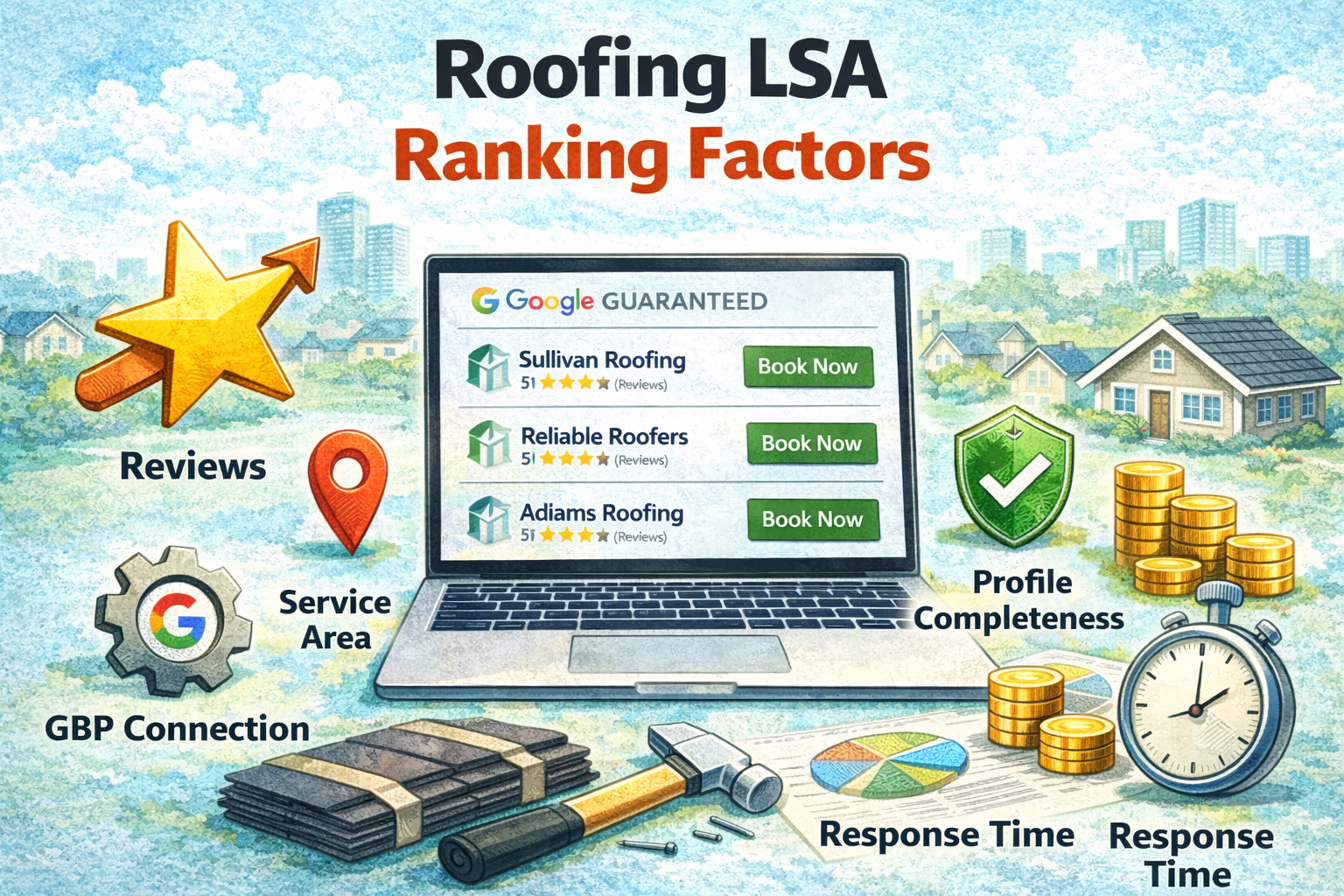
The general LSA ranking factors guide gives you the framework. Reviews, response time, job type completeness, profile quality, bid strategy. Good foundation. But roofing has dynamics that the general guide cannot account for, and if you apply generic tactics to a roofing LSA profile you will leave ranking signal on the table.
Roofing is one of the most seasonal, storm-dependent, and storm-chaser-contested verticals in all of LSA. A hail event can triple your call volume in 48 hours. A 3-month winter pause can cost you position 1 when the first spring storm hits. And a storm chaser with a fresh profile can temporarily outrank a 10-year local company during surge conditions. None of that is in the generic guide.
This page is the operational layer. The Roofing LSA Hub covers what to do at a high level. This guide covers how to actually execute each factor with roofing-specific data, protocols, and benchmarks. If you want to understand mistakes to avoid alongside these tactics, see Roofing LSA Mistakes.
1. Job Type Completeness Checklist (All 13 Roofing Types)
Job type completeness is one of the most directly controllable ranking signals on your LSA profile. Every job type you enable is a set of search queries where your listing can appear. Most roofing companies enable 5 or 6 types when they set up their profile and never come back to it. Top-ranked roofing profiles in competitive markets typically have 11 or more enabled.
The types marked "Common Miss" below are the ones most frequently left off profiles by roofers who did a quick setup and moved on. Some of them, particularly storm damage assessment and emergency tarp service, are critical to enable before storm season starts.
| Job Type | Status | Search Volume | Notes |
|---|---|---|---|
| Roof repair | Common | High year-round | Every roofer has this. The baseline. Missing it means a profile was not completed. |
| Roof installation / replacement | Common | High, storm-surge spikes | Your highest-ticket job type. Average job value $8,000 to $18,000. Usually enabled. |
| Roof inspection | Common Miss | Medium, strong funnel entry | Homeowners search for inspections before deciding on replacement. High-intent top-of-funnel. Often missed because roofers think of it as a free service, not a lead type. |
| Storm damage assessment | Critical Miss | Very high post-storm | The single most important type to enable before spring. This is the first search a homeowner makes after hail or wind damage. Roofers who do not have this enabled miss the top of the funnel entirely. |
| Emergency tarp service | Common Miss | High post-storm, moderate otherwise | After a major storm, homeowners need immediate protection before a full repair can be scheduled. Enabling this captures urgent post-storm calls that turn into replacement jobs. |
| Flat / low-slope roof repair | Common Miss | Medium, commercial segment | Opens up commercial leads. Many residential roofers skip this even when they service commercial properties. Separate from standard roof repair in the LSA system. |
| Flat roof installation | Common Miss | Medium, commercial and industrial | Enables commercial replacement leads. Lower competition than residential. If you have a TPO, EPDM, or modified bitumen crew, this is worth enabling. |
| Skylight repair | Common Miss | Low-medium, low competition | Niche but almost no competition at the LSA level. Easy wins. Average ticket $300 to $800. Often leads to a larger roof repair conversation. |
| Skylight installation | Common Miss | Low, low competition | Same logic as skylight repair. If you install them, enable it. You may be the only roofer in your area with this type active. |
| Gutter cleaning | Common Miss | High, year-round in most markets | This is the ranking hack most roofers ignore. Gutter cleaning calls keep your profile active and generating bookings during slow roofing months. Consistent bookings in winter prevent ranking decay. See note below. |
| Gutter installation / replacement | Common Miss | Medium, year-round | Natural upsell after roof replacement. Enabling this lets you capture gutter replacement searches as well. |
| Fascia and soffit repair | Common Miss | Low-medium | Often needed alongside roof work. Low competition at the LSA level. Enabling this increases your profile completeness score and captures searches your competitors miss entirely. |
| Leak detection / diagnosis | Common Miss | Medium, high urgency | Homeowners searching for leak detection have an immediate, urgent problem. High booking rate. Not the same as roof repair in the search index. Enable it separately. |
2. Review Velocity Protocol for Roofers
Reviews are the #1 ranking factor in LSA, and roofing has a built-in challenge that high-frequency trades like plumbing do not have: you complete fewer jobs per week. A busy plumber might finish 6 jobs in a day. A roofing crew finishes 1 or 2. That means every review request matters more, and your system for collecting them needs to be more deliberate.
When to Ask: The 2-3 Day Post-Install Window
The highest-converting review request timing for roofing is 2 to 3 days after installation is complete. Not the same day, and not a week later. Here is why that window works: on the day of installation, the homeowner is tired, possibly stressed about cleanup, and processing a large expense. Two to three days later, the anxiety has settled, the roof looks great, they have mentally closed the chapter, and the relief is still fresh. That is when their emotional baseline is most favorable for leaving a review.
Send the request via text message. Email has lower open rates for this kind of follow-up. A simple SMS with a direct Google review link converts at 2 to 3 times the rate of an email for roofing customers.
Shoulder Season Velocity Targets
March and April are the most important review-building months for roofers in most U.S. markets. Storm season typically begins in April or May, and the ranking positions for that surge are largely determined by who built their review bank during the preceding weeks. Here is the target benchmark: 3 to 5 new reviews per week in March and April. If you can hit that going into storm season, you will have a meaningful ranking advantage over competitors who collect reviews inconsistently.
Do not only ask after full replacements. The $400 repair call review matters. Roof repairs happen year-round, in all weather conditions, and in all markets. If you are skipping review requests on service calls because the job was "too small," you are throwing away ranking signals that add up over a season. That said, repair reviews and replacement reviews are not equal in customer perception. Ask for both. Just do not skip the repairs.
For a full review collection system with copy-paste templates and the mechanics of review velocity strategy, see LSA Review Strategy.
3. Emergency Response and Storm Staffing Protocol
Response time is one of Google's most directly tracked LSA signals. The algorithm observes whether you answer calls, how quickly, and whether missed calls get returned promptly. For roofing, the challenge is not just daily call volume, it is the surge. After a major hail or wind event, your call volume can jump 3 to 8 times your normal daily average within the first 48 hours. If your phone setup is not ready for that, you will miss a significant portion of those calls, which hurts your ranking at exactly the moment leads are most valuable.
Answering Service: Cost vs. ROI
A live answering service costs roughly $200 to $400 per month. For a roofing company, that expense is justified many times over during even a single moderate storm event. Here is the math: if an answering service saves you from missing 5 post-storm calls over the course of a month, and your average replacement job is $12,000, the first saved call more than pays for 3 years of answering service costs.
The more important ROI, though, is the ranking protection. Every call Google registers as answered is a positive signal. Every call that goes to voicemail or rings out is a negative one. During storm surge, when your call volume is spiking, this signal compounds quickly in either direction.
Storm Staffing Protocol
For named storms and major hail events tracked by weather services, you can often see 24 to 48 hours ahead that a significant event is coming. Here is how to pre-staff for it:
- 48 hours before impact: Notify your answering service or office staff that call volume will spike. If you use a virtual answering service, coordinate to ensure additional call capacity is available.
- Night-of and immediate post-storm: Set up after-hours call routing so that storm damage calls hit a live person, not voicemail. The first 12 to 24 hours after a storm event are when the sharpest homeowners call. These are often your best leads.
- First 48 hours post-storm: Expect 3 to 8 times your normal daily call volume depending on storm severity and your market size. Have a system ready to triage calls into immediate storm assessments versus follow-up scheduling.
- After-hours call routing: If you cannot staff a live person overnight, at minimum set up a forwarding number to a personal cell or answering service. A call that gets answered at 10 PM after a hail storm converts at a high rate. The homeowner is stressed and calling everyone on the list. Be the one who picks up.
4. Profile Photo Optimization
Photos serve two functions on an LSA profile: they affect click-through rate (customers decide based on what they see), and they signal profile completeness to the algorithm. Stale profiles with no new photos for 6 or more months see a gradual decline in profile quality score. Google treats an active, regularly updated profile differently than a set-it-and-forget-it one.
Minimum photo target: 10 photos. Aim for 15 to 20 if you can. Upload at least 2 to 3 new photos each month. Here is what performs best for roofing profiles specifically:
Photo Types That Rank and Convert
- Before and after from the same angle: This is the most compelling photo format for roofing. A stripped deck showing damaged decking next to the finished installation shot from the same position on the ground. It proves scope of work and shows competence in a single visual. Customers share these. Ask your crew to take the "after" shot from the same spot where you took the "before."
- Crew on a high-slope roof in progress: This is a trust signal. Homeowners want to see that you are not a fly-by-night operation. Real workers, real equipment, real job. Safety gear visible is a bonus. It signals professionalism.
- Aerial shot showing full roof scale: Drone or elevated shots that show the full footprint of a completed replacement communicate scope and quality in a way that ground-level photos cannot. If you have a drone or access to one, use it for large replacement jobs.
- Hail damage documentation: Photos of damaged shingles, dented vents, and spatter marks on gutters serve two purposes. They educate homeowners on what storm damage looks like (building trust) and they signal to Google that you handle storm work, which is the highest-value query type in the roofing vertical.
- Insurance adjuster documentation shots: If you work insurance claims, show it. A photo of your crew doing an adjuster walkthrough or a close-up of a properly documented damage report signals to insurance-job leads that you know the process. These customers are specifically looking for someone with that experience.
- Branded truck on job site: A professional truck with your logo, parked in front of an active job site, is one of the highest-converting single photos for a roofing profile. It checks multiple trust boxes at once: real company, real presence, professional appearance.
What to avoid: Stock photos, manufacturer photos, or any image that was not taken at one of your actual jobs. Google processes engagement data on photos and customers notice when images do not look genuine. One real before-and-after photo of an actual replacement job outperforms six stock images every time.
5. Service Area Optimization
Your service area setting directly affects your proximity score, which is one of the factors that determines how prominently you appear in searches from different locations within your market. The tension for roofers is that your operational coverage may shift significantly between normal seasons and storm events.
Local Market-Only Roofer
If your business model is serving a defined local market and you do not travel for storm work, the right strategy is a tight, well-performing service area. Set your radius to cover your core market: the areas where you book at least 80% of your jobs. For most local roofers, that is a 15 to 25 mile radius centered on your office or service base.
Overlapping adjacent suburbs works better than a single large city boundary. When you define your area as, say, five specific zip codes that overlap slightly rather than one big circle around the city center, your proximity score in those specific areas is stronger. You show up more often for searches from those exact communities, and your booking rate in your coverage zone stays high.
Storm-Chase Operations
Roofers who travel to storm-affected markets face a trade-off. Expanding your service area to cover a new geography will lower your proximity score in that area because you are a new entrant without a track record there. You will often rank below local roofers in the storm-affected market who have existing review and booking history there.
The risk of a too-wide service area is showing up for leads in areas you cannot profitably serve. A replacement job 45 miles from your nearest crew is not worth the drive time at most ticket prices. If you are declining leads or booking poorly in your outer zones, Google registers those low booking rates and adjusts your visibility accordingly.
6. GBP Connection and Category Selection
Your Google Business Profile and your LSA listing share data, and the connection between them is a significant ranking amplifier. The most common silent ranking issue we see for roofing companies is a GBP that is not properly connected to the LSA profile, or one that has the wrong primary category.
Correct Primary GBP Category
Your primary Google Business Profile category should be "Roofing Contractor." Not "General Contractor." Not "Roofing Supply Store." Not "Construction Company." Roofing Contractor is the category Google uses to match your profile to roofing-specific search queries. A mismatched primary category is one of the most common causes of an otherwise well-set-up LSA profile that still underperforms.
Secondary categories that strengthen your profile, if they apply to your service lines:
- Gutter Cleaning Service
- Gutter Installation Service
- Siding Contractor (if you offer siding)
- Skylight Installation Service
- Building Restoration Service (for commercial work)
How GBP Review Photos Feed Your LSA Listing
When customers leave reviews on your Google Business Profile and include photos, those photos can appear in your LSA listing. This is one of the strongest reasons to specifically ask customers to include a photo with their review. A review with a photo of your completed work showing up in your LSA listing is a quality signal that most competitors are not actively building.
Fixing a Disconnected GBP
If your GBP and LSA are not connected, your LSA listing is essentially running without the benefit of your review history from GBP. To connect them, go to your LSA dashboard, navigate to your profile settings, and look for the Google Business Profile connection option. You will need to verify that you are the owner of both accounts. Once connected, your GBP reviews and profile data populate into your LSA ranking inputs. This is one of the highest-leverage fixes for a roofer who has built up GBP reviews but is not seeing LSA traction.
The free LSA Visibility Scanner shows which competitors are appearing above you in your own service area.
For a full GBP optimization walkthrough, see GBP Optimization for Contractors.
7. Bid Mode Impact on Ranking
Your bid mode setting affects how aggressively Google enters your listing in the ad auction and how often you appear for high-value queries. There are two primary options in LSA: Maximize Leads and Maximum Per Lead (with a cap). Each has a different impact on visibility, and the choice matters a lot during storm surge.
Maximize Leads
Google automatically bids to win as many leads as possible within your weekly budget. You give Google full control over how much to spend per lead. This mode tends to perform well during normal conditions for established profiles with strong performance signals, because the algorithm optimizes toward your historical booking patterns.
Maximum Per Lead (with a cap)
You set a ceiling on how much you are willing to pay per lead. This gives you cost control but introduces a critical risk for roofing companies: a low cap during storm surge will make your ads disappear exactly when replacement jobs are most available.
Here is the scenario: you set a $60 max per lead cap. A hail storm hits your market. Every roofing company in the area has their budget cranked up, Maximize Leads mode enabled, or both. The CPL for storm-related queries spikes to $90 to $120 during the surge. Your capped bid at $60 cannot win those auctions. Your competitors, who are bidding higher or using Maximize Leads, take every replacement job that comes through while you are essentially invisible.
8. Seasonal Pause Recovery Timeline
This section may be the most important in the guide for roofers in cold-weather markets. Pausing LSA for 3 or more months during winter is one of the most common and most damaging mistakes roofing companies make. When you pause, your ranking does not stay in place waiting for you to come back. It decays, and the recovery is slow enough that you are often still climbing back when the most valuable leads of the year are being distributed.
Here is what the recovery timeline looks like based on a 3-plus month pause:
| Pause Length | Estimated Recovery Time | Impact |
|---|---|---|
| 2 to 3 weeks | 1 to 2 weeks | Minor. Profile stays mostly warm. Quick recovery with active spending. |
| 1 to 2 months | 3 to 5 weeks | Moderate. Will miss 3 to 5 weeks of peak-position visibility during recovery. |
| 3 months | 6 to 8 weeks | Significant. Recovery overlaps with early storm season in most markets. Competitors who stayed active dominate this period. |
| 4 months or more | 8 to 10+ weeks | Severe. In competitive storm markets, 8 to 10 weeks of recovery during peak season is a significant revenue loss. CPL is also elevated during recovery. |
The right strategy for slow months is not to pause. It is to reduce your weekly budget to a shoulder minimum of $300 to $500 per week, keep the listing active, and use that period to collect reviews and ensure your profile is fully optimized for storm season. By the time the first hail event hits, you are at full ranking strength and you can spike your budget to capture the surge from position 1.
9. Defending Your Position Against Storm Chasers
Roofing is unique among home service trades in that it has an entire class of competitor who does not exist in any other vertical: the storm chaser. These are companies that follow weather events, set up temporary LSA profiles in affected markets, and aggressively compete for replacement jobs during the immediate post-storm window. Some are legitimate operations. Many are not. Either way, they temporarily displace established local roofers who should be the natural choice for homeowners in their own market.
Why Storm Chasers Can Outrank You Temporarily
Google applies a freshness signal to LSA rankings. A profile that is suddenly very active, answering calls instantly, getting reviews quickly, and bidding aggressively, can temporarily appear above established profiles. This is by design: Google is trying to surface providers who are ready and available right now. A storm chaser who sets up a profile specifically for your market and is responding to every call within 30 seconds exploits that freshness signal.
The effect is usually temporary. Within a few weeks, the algorithm re-weights toward sustained performance history. But "a few weeks" after a major hail event is exactly when the most replacement jobs are being distributed. Losing position 1 for even 10 days during a major storm event can mean 20 to 40 lost replacement job leads at $10,000 to $18,000 each.
The Antidote: Review Volume You Cannot Fake
The most reliable defense against storm chaser outranking is a review base that is mathematically difficult to compete with on short notice. A roofer with 100 or more verified reviews at 4.8 stars or higher has a ranking buffer that a new entrant cannot overcome during a short-term surge, regardless of their bid aggressiveness or call response speed.
A storm chaser setting up in your market can collect 10 to 15 reviews during a 3-week campaign. They cannot collect 100. And the algorithm knows the difference between 100 reviews built over 3 years of local operation and 15 reviews collected in 3 weeks. The sustained trust signal wins.
This is the most practical reason to build your review base continuously throughout the year, including in slow months. The 30 reviews you collect in January and February are not helping you rank for winter repair queries. They are the buffer that keeps a storm chaser from outranking you in April.
Roofing LSA Ranking FAQs
How many reviews does a roofing company need to rank well in LSA?
In most markets, 50 reviews at 4.8 stars or higher puts you in the competitive tier. Reaching 100 reviews pushes you toward market dominance. The catch for roofers is that review volume is harder to build than for high-frequency trades like plumbing or carpet cleaning. You complete fewer jobs per week, so each review request matters more. Aim for 3 to 5 new reviews per week during shoulder seasons like March and April to build your bank before storm season hits.
Should I pause my roofing LSA during winter?
No, and this is especially important for roofers. Storm season often begins in March or April in many U.S. markets, and the roofers who dominate the first 30 days of storm season are the ones who stayed active all winter. A full pause causes a 6 to 10 week recovery period. When the first hail event hits, you will be invisible while competitors who never paused are getting all the replacement leads. Drop your budget to a shoulder minimum of $300 to $500 per week in slow months, but keep the profile active.
What is the most important job type to enable before storm season?
Storm damage assessment is the single most important job type to have enabled before the spring storm season. It is the exact search query homeowners use after a major hail or wind event when they are not yet sure if they need a full replacement. Roofers who have this type enabled show up for that first moment of contact, while competitors who only have roof replacement enabled miss the top of the funnel entirely.
Why do new storm chasers sometimes outrank established local roofers right after a hail event?
Google applies a freshness signal that temporarily boosts profiles with recent activity spikes. A storm chaser who just set up an LSA profile and is responding to every call instantly can briefly appear above an established local roofer. The antidote is volume. Roofers with 100 or more reviews at 4.8 stars have a ranking buffer that is very difficult for a new entrant to overcome, even temporarily. Building that review base before storm season is the most reliable defense against storm chasers taking your top positions.
How do I set up my service area if my company travels for storm work?
For storm chasers or companies that expand coverage after major events, the trade-off is proximity score versus coverage. A wide radius means you will show up for leads far from your address, but your proximity score suffers and you will rank below local competitors in each market you enter. Keep your home market service area tight and only temporarily expand your radius when you have active crews on the ground in a new location. Your home market ranking is a long-term asset worth protecting.
Want a Professional Audit of Your Roofing LSA Profile?
We identify the job type gaps, ranking issues, and storm-readiness problems that cost roofing companies replacement leads every season.
Book Your Free ConsultationSee the real numbers for your trade
Plug in your industry, budget, and close rate. Our calculator shows your projected leads, cost per booked job, and ROAS.
More for roofing operators
Pair this with the rest of the roofing operator series. Each guide tackles a different angle on growing a roofing company through paid search: