Published by Blue Grid Media • March 12, 2026 • 16 min read
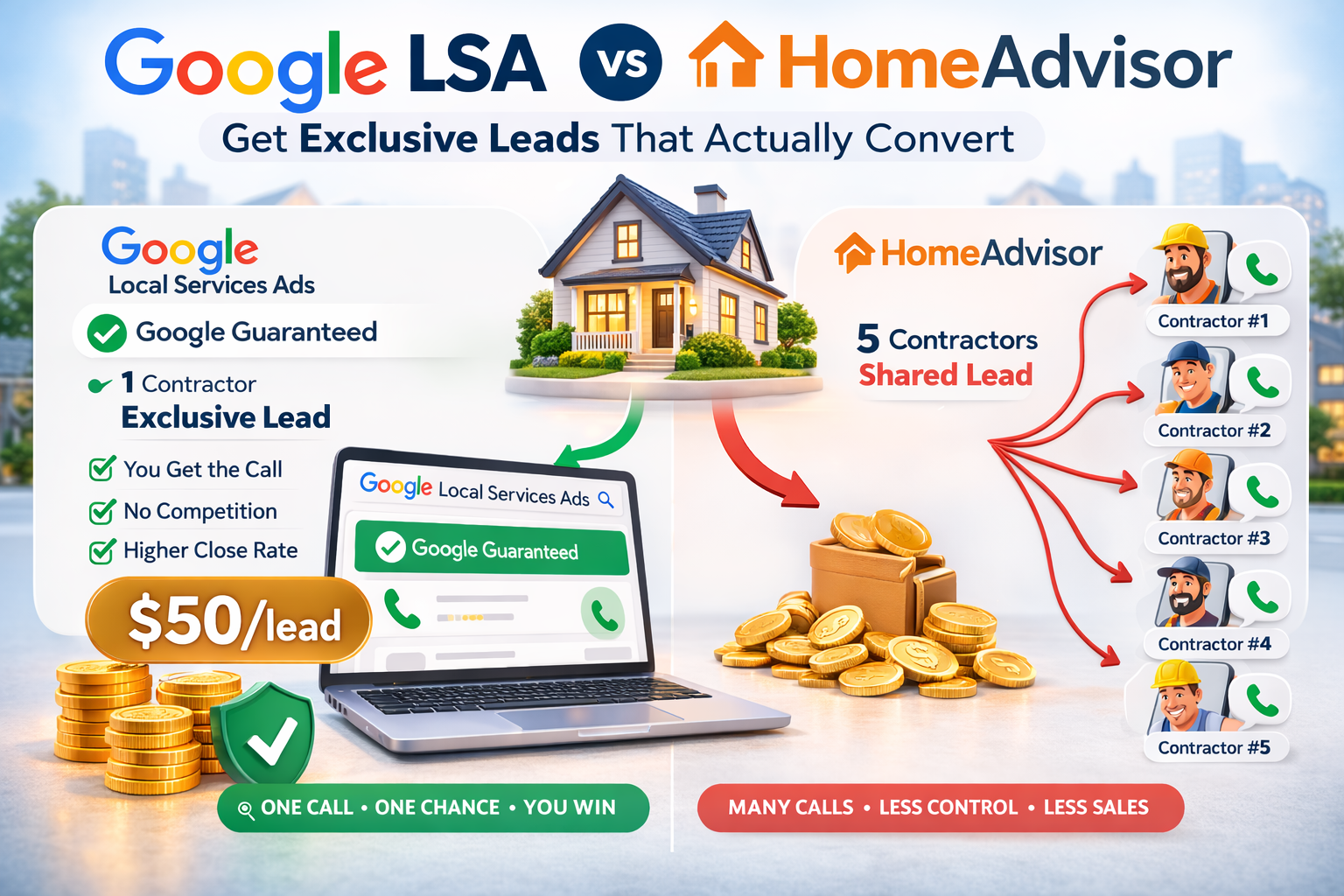
Somewhere right now, a homeowner in your market just searched "HVAC repair near me," filled out a form on HomeAdvisor, and submitted a service request. Within 60 seconds, that same request landed in the inbox of you and four of your competitors. All five of you are being charged a lead fee. Only one of you will book the job.
We hear this story every week. A contractor signs up for HomeAdvisor (now rebranded as Angi Leads), spends a few hundred dollars, gets a handful of leads, books maybe two or three jobs, and wonders why the math never seems to work out. The problem is not that the leads are necessarily terrible. The problem is that the "$50 lead" is not a $50 lead once you account for the four other contractors competing for the same phone call.
Google Local Services Ads work differently. When a homeowner clicks your LSA listing and calls your number, that call comes to you and only you. No other contractor gets that lead. You pay a flat fee per contact, you can dispute invalid leads for a credit, and there is no annual membership fee or long-term contract locking you in. That structural difference changes the entire unit economics of lead generation for contractors.
This guide breaks down both platforms honestly, including the January 2025 improvements HomeAdvisor made that are worth acknowledging, and gives you the data to decide where your budget actually belongs.
How does HomeAdvisor (now Angi Leads) actually work in 2026?
Quick housekeeping: HomeAdvisor and Angie's List merged under the Angi brand, and the lead-generation side of the business is now called Angi Leads. For this article, we'll use "HomeAdvisor" and "Angi Leads" interchangeably since many contractors still recognize the original name, and the underlying mechanics are the same platform.
The basic model: homeowners visit Angi or HomeAdvisor, describe a project (or search for a contractor and submit a contact request), and the platform matches them with local contractors. You, as a contractor, pay to be in that matching pool. When you receive a match, you are charged a lead fee regardless of whether the homeowner answers their phone or ever hires you.
Here is the part that gets contractors: that same lead is simultaneously sent to multiple other contractors in your area. HomeAdvisor's standard practice is to send leads to 3 to 8 contractors, with 4 to 5 being most common depending on your trade and market density. You all receive the same contact information at the same time. The race begins the moment the lead hits your inbox.
Speed of response is not just helpful on HomeAdvisor, it is the entire game. Research shows that 35 to 50 percent of all lead-generated sales go to the contractor who makes first contact. If you do not call back within five minutes, your odds drop dramatically. This creates an operational reality where your business essentially needs to be on-call at all times to make the economics work.
One contractor we spoke with summarized the experience well: "$3,500 spent in four months, 16 leads, nine had bad phone numbers." That is not an isolated story. It comes up constantly. The leads vary widely in quality, and unlike LSA, there is no straightforward dispute process to recover charges for leads that turn out to be invalid or outside your service area.
The Shared Lead Problem: How HomeAdvisor Distributes One Request
HomeAdvisor / Angi Leads
"Need an HVAC technician for AC repair"
Google Local Services Ads
HomeAdvisor distributes leads to multiple contractors simultaneously. LSA leads go to one business.
What is the real HomeAdvisor cost (the shared lead math)?
The advertised cost per lead is almost never the real cost per booked job. Here is the math that HomeAdvisor's marketing material does not show you.
Say you pay $50 per lead on HomeAdvisor, and that lead is shared with four other contractors. With five of you competing for the same job, a realistic close rate is around 13 to 20 percent, meaning you book roughly one out of every five leads. To book one job, you need to pay for roughly five leads at $50 each. That is $250 for one booked customer, before accounting for the annual membership fee, your time spent calling leads back, and any leads with disconnected numbers or no real project.
Now compare that to LSA. The average CPL on LSA is $35 to $100 depending on your trade, with most trades landing somewhere in the $50 to $80 range. Because the lead is exclusive to you, close rates run 25 to 40 percent for responsive contractors. At $65 CPL and a 35 percent close rate, you need roughly 3 leads to book one job. That is $195 per booked job, with no membership fee and no minimum spend requirement.
True Cost Per Booked Job: HomeAdvisor vs. Google LSA
Estimates based on industry averages. Your results will vary by trade, market, and response time.
How does Google LSA work (and why is it structurally different)?
Google Local Services Ads appear at the very top of Google search results, above the paid ads, above the Map Pack, and above organic listings. On mobile devices, which account for 76 percent of local search traffic, LSA listings are the first thing a homeowner sees. Position 1 in LSA gets roughly twice the clicks of positions 2 and 3.
The customer sees your business name, star rating, review count, years in business, and the Google Verified badge. If they want to contact you, they call directly through the ad or send a message. That contact comes only to you. Google does not share your lead with anyone else.
You pay per lead, not per click. If nobody contacts you, you pay nothing. If a lead turns out to be invalid (a wrong number, an area outside your service zone, a non-covered service), you can dispute it for a credit. There is no annual membership fee, no minimum spend, and no long-term contract. You can pause, reduce, or stop your LSA budget at any time.
Your ranking within LSA depends on your review count and rating, how quickly you respond to inquiries, your profile completeness, how closely your service area matches the searcher's location, and your bid. The Google Verified badge (the replacement for the old Google Guaranteed badge after the October 2025 rebrand) signals to homeowners that Google has verified your business credentials, which builds trust before they even dial.
Typical CPL ranges: HVAC $45 to $85, Plumbing $40 to $75, Electrical $35 to $70, Roofing $50 to $100. For a deeper breakdown, see our guide on how much Google LSA costs by trade.
The Legal Record: $17 Million in Settlements
HomeAdvisor and Angi have accumulated a significant legal track record over the past few years. We are not sharing this to sensationalize. The numbers speak for themselves and they are relevant when you are deciding whether to lock yourself into a 12-month contract with these platforms.
HomeAdvisor / Angi Legal History (2023-2025)
The Federal Trade Commission found that HomeAdvisor misrepresented lead quality to contractors. Many leads were sourced from third-party affiliates, not from homeowners who had actively sought out service professionals. Contractors paid for leads that were not what the platform claimed they were.
The SF DA found false advertising around background checks. Angi's marketing implied that all service professionals in their network were screened and background-checked, when in reality only business owners, not employees or subcontractors, were verified. Homeowners were misled about the safety guarantees the platform offered.
Angi Services (a separate gig-worker segment of the platform) settled claims related to inflated earnings representations to workers and undisclosed fees. The settlement covered workers who were misled about their expected income on the platform.
Additionally, the BBB has logged 2,281 complaints against Angi in a 3-year period and has flagged a "Pattern of Complaints" that is under active evaluation.
The FTC settlement in particular is worth understanding as a contractor. The core finding was that leads were being sourced from affiliate networks, not from homeowners who specifically sought out a professional for a project. You were paying for contacts that were not what the platform represented. That context is useful when weighing whether the platform's newer practices have genuinely changed.
Contract Terms: What You Are Agreeing To
This is one of the starkest differences between HomeAdvisor and LSA, and it is one that contractors consistently underestimate until they try to leave.
When you sign up for HomeAdvisor / Angi Leads, you are typically agreeing to a 12-month contract. Cancellation requires 60 days written notice. Early cancellation penalties range from 30 to 35 percent of the remaining contract value, and fees can reach $1,200 or more depending on your plan tier. Contractors frequently report minimum monthly spend requirements of $400 or more embedded in their agreements.
Many contractors also report pressure from Angi sales representatives to upgrade plans or increase budgets, even when current leads are not converting well. The structure of the contract makes it difficult to reduce spend when performance is poor.
Google LSA has no contract. There is no minimum spend, no cancellation penalty, and no required notice period. You can log in today and pause your campaigns. If business slows down, you reduce budget. If you want to stop entirely, you stop. That flexibility has real dollar value, especially for seasonal businesses.
The January 2025 Changes: Is HomeAdvisor Better Now?
Fair is fair: Angi made a meaningful change to its platform in January 2025, and it is worth acknowledging honestly rather than pretending nothing improved.
Before January 2025, the default model was that Angi would automatically distribute leads to contractors without homeowners proactively choosing who to contact. The platform sent leads to matched contractors based on its own algorithm. This meant homeowners were sometimes surprised to receive calls from contractors they had not specifically reached out to.
In January 2025, Angi shifted the model so that homeowners actively choose which contractors to initiate contact with, rather than having leads auto-distributed. Homeowners browse contractor profiles, read reviews, and choose to reach out. The result was an 11-point improvement in homeowner NPS (net promoter score) and contractor-reported win rates increased by 60 percent or more compared to the auto-distribution model.
If you tried HomeAdvisor two or three years ago and had a terrible experience, the current platform operates somewhat differently. But the fundamental economics of shared leads versus exclusive leads have not changed.
Side-by-Side Comparison
Google LSA vs. HomeAdvisor: Platform Scorecard
| Factor | Google LSA | HomeAdvisor (Angi) |
|---|---|---|
| Lead Exclusivity | Exclusive to you | Shared with 3-8 contractors |
| Average CPL | $35-$100 | $15-$400+ |
| Cost Per Booked Job | ~$186 avg. | ~$250+ avg. |
| Contract Terms | No contract, cancel anytime | 12-month term, 60 days notice |
| Membership / Setup Fee | None | ~$300/year membership |
| Lead Close Rate | 25-40% (exclusive) | 13-20% (shared) |
| Dispute / Credit Process | Yes, credit for invalid leads | Limited, inconsistent |
| Trust Badge | Google Verified (free) | Angi Verified (included) |
| Search Placement | Top of Google (above all ads) | Angi platform only |
| Platform Legal Record | No major settlements | $17M in settlements (2023-2025) |
Scorecard reflects general platform characteristics. Individual results vary by market, trade, and account management.
HomeAdvisor Lead Win Rate vs. Response Time
On shared leads, speed of response is the primary competitive variable. Here is what the data shows:
Estimates based on contractor-reported win rates and industry studies on lead response time.
When does HomeAdvisor still make sense for contractors?
We would be doing you a disservice if we said HomeAdvisor is never worth it. There are genuinely specific situations where it can make sense, usually as a tactical supplement rather than a primary strategy.
You are brand new with zero reviews
Google LSA rankings depend heavily on review count and quality. If you are a new contractor with no reviews, you will start at the bottom of the LSA stack. HomeAdvisor does not weight your profile ranking the same way, so new contractors can get visible leads faster. The trade-off is worse economics, but if you need any job to start building your portfolio and reputation, HomeAdvisor can provide volume in the short term.
Your trade is not yet LSA-eligible in your market
Google LSA is not available for every trade in every market. If you are a chimney sweep, an irrigation contractor, or a siding specialist in a smaller market where LSA has not rolled out, platforms like HomeAdvisor or Thumbtack may be your only options for paid digital lead generation.
You need a short-term calendar filler during a slow period
Some contractors use HomeAdvisor specifically during their slowest months to fill gaps in the schedule. If you enter with strict ROI rules (set a maximum monthly spend, track cost per booked job, and stop if the math does not work), it can serve as a useful short-term supplement. The key is treating it as a tactical experiment, not a long-term commitment. Given the contract terms, you need to plan this carefully before signing up.
ROI Comparison Over 12 Months
Let's run a concrete comparison. Same budget, same trade (plumbing), same market. One contractor puts $600 per month into HomeAdvisor (the $300 annual membership fee amortized to $25/month plus $575/month in leads). The other puts $600 per month entirely into LSA. Here is what the 12-month math looks like.
12-Month ROI Comparison: $600/Month Budget (Plumbing Example)
$300 membership + $575/mo in leads
$600/mo, no membership fee
Illustrative example based on industry averages. Job values, CPL, and close rates vary by trade, market, and contractor responsiveness. LSA results also depend on review count and ranking position.
The numbers above are illustrative, but they reflect the mechanics accurately. The gap between the two platforms in cost per booked job compounds over time. A contractor who spends two years on HomeAdvisor while their LSA reviews are growing from 10 to 80 is leaving significant revenue on the table compared to a contractor who built their LSA presence from the start.
For a more detailed breakdown of LSA costs and how to optimize your budget, see our guide on how to lower your Google LSA cost per lead. And if you are trying to understand how LSA compares to other platforms like Thumbtack in addition to HomeAdvisor, check out the full LSA vs. Thumbtack vs. Angi comparison.
Cost per lead is just CPC divided by conversion rate, which the free CPA calculator will do for you.
See What LSA Can Do for Your Business
We audit LSA accounts and compare them against what contractors are spending on HomeAdvisor and Thumbtack. Most contractors we work with see their cost per booked job drop within the first 30 days of switching focus to LSA.
Book Your Free ConsultationLSA vs HomeAdvisor FAQs
Does HomeAdvisor really share my lead with other contractors?
Yes. HomeAdvisor (now Angi Leads) sends each homeowner request to 3 to 8 contractors simultaneously, with 4 to 5 being most common. Every contractor who receives that lead pays the same per-lead fee. You and four competitors all have the customer's phone number at the same time, and the first person to call has the best chance of booking the job. Google LSA leads are exclusive to your business. No other contractor receives the same lead from your LSA profile.
What is the true cost per booked job on HomeAdvisor vs. LSA?
On HomeAdvisor, if you pay $50 per lead and that lead is shared with 4 other contractors, your effective win rate is roughly 20 percent. That means you pay for 5 leads before booking one job, making your true cost per booked job around $250. On Google LSA, leads are exclusive and convert at 25 to 40 percent depending on your trade and response time. At a $65 average CPL and a 35 percent close rate, your cost per booked job is approximately $186. LSA delivers a meaningfully lower cost per customer acquired for most contractors.
Can I cancel HomeAdvisor or Angi Leads at any time?
Generally, no. HomeAdvisor and Angi Leads typically require 12-month contracts with 60 days written notice to cancel. Early cancellation penalties range from 30 to 35 percent of the remaining contract value, and cancellation fees can reach $1,200 or more depending on your plan. This is one of the sharpest contrasts with Google LSA, which has no contract and lets you pause, reduce, or stop spending at any time with no penalty.
Did the January 2025 changes make HomeAdvisor better?
Yes, meaningfully. In January 2025, Angi shifted from auto-distributing leads to a model where homeowners actively choose which contractors to contact. This improved homeowner satisfaction scores by 11 points and contractor-reported win rates by 60 percent or more. The platform is better than it was in 2023 and 2024. That said, leads are still shared, contracts are still long-term, and the cost structure still makes it harder to compete with the economics of exclusive LSA leads.
Is there any situation where HomeAdvisor makes sense over LSA?
Yes, a few. If you are a brand-new contractor with zero reviews and need any job to start building your portfolio, HomeAdvisor can provide volume while you establish your LSA presence. If your trade is not yet eligible for Google LSA in your market, HomeAdvisor or Thumbtack may be your best option temporarily. Some contractors also use HomeAdvisor as a short-term calendar filler during slow seasons while keeping LSA as their primary lead source. The key is treating it as a tactical supplement, not a long-term strategy.
How do I get started with Google Local Services Ads?
You need to become Google Verified (formerly Google Guaranteed) by passing a background check, providing insurance and licensing, and setting up a Google Business Profile. The full process takes 7 to 14 days. See our complete Google Verified setup guide for the step-by-step walkthrough.
Bottom Line
The shared lead model is not a scam. It is just bad math for most contractors. Paying $50 for a 20 percent chance at a job is a $250 cost per booked customer, and that is before you factor in the annual membership fee, minimum spend requirements, or the operational cost of needing to drop everything the moment a lead comes in.
HomeAdvisor has improved since January 2025, and we acknowledge that genuinely. But the platform still routes your leads to multiple competitors, still requires a long-term contract, and still has a legal track record that warrants scrutiny before you commit to a 12-month agreement.
Google LSA gives you exclusive leads, no contract, dispute credits for bad leads, and top-of-Google placement on the most high-intent searches in your market. The per-lead cost is sometimes higher on paper, but the cost per booked job is consistently lower because you are not splitting the customer with four other contractors.
If you are currently spending on HomeAdvisor and want to see how that budget would perform on LSA, we can run the numbers for your specific trade and market. For more context on how to rank higher in LSA, or how LSA compares to Google Ads for contractors, those guides go deep on both topics.
See the real numbers for your trade
Plug in your industry, budget, and close rate. Our calculator shows your projected leads, cost per booked job, and ROAS.
More on lead channel comparisons
Part of the BGM lead channel comparison library: