Published by Blue Grid Media • March 12, 2026 • 14 min read
Here is the thing nobody in your Yelp sales rep's pitch tells you: every time someone clicks on your Yelp ad to read your reviews and then leaves without calling, you still pay. Every time a homeowner clicks to see your photos and moves on to the next profile, you pay. Every time a competitor's customer randomly stumbles onto your listing and bounces in 10 seconds, you pay. Yelp is pay-per-click. You are paying for attention, not for leads.
Google Local Services Ads work completely differently. You only pay when a homeowner calls or messages your business directly through the ad. Not for impressions. Not for profile views. Not for clicks that go nowhere. An actual contact from a real person who found you on Google and wanted to hire someone in your trade. That billing model difference sounds simple, but it changes everything about how much you actually spend per booked job.
We have managed LSA campaigns for hundreds of contractors. We talk to business owners every week who are spending $800 to $2,000 a month on Yelp and struggling to point to more than a handful of booked jobs. The math usually falls apart when you look at it honestly. This guide breaks down exactly where the money goes on each platform, who wins on cost per booked job, and when (if ever) Yelp makes sense as part of your ad mix.
Fair warning: this is not a both-platforms-are-equally-valid comparison. The data has a clear winner for most contractors. But we will show you the situations where Yelp can make sense, because being useful matters more than being diplomatic.
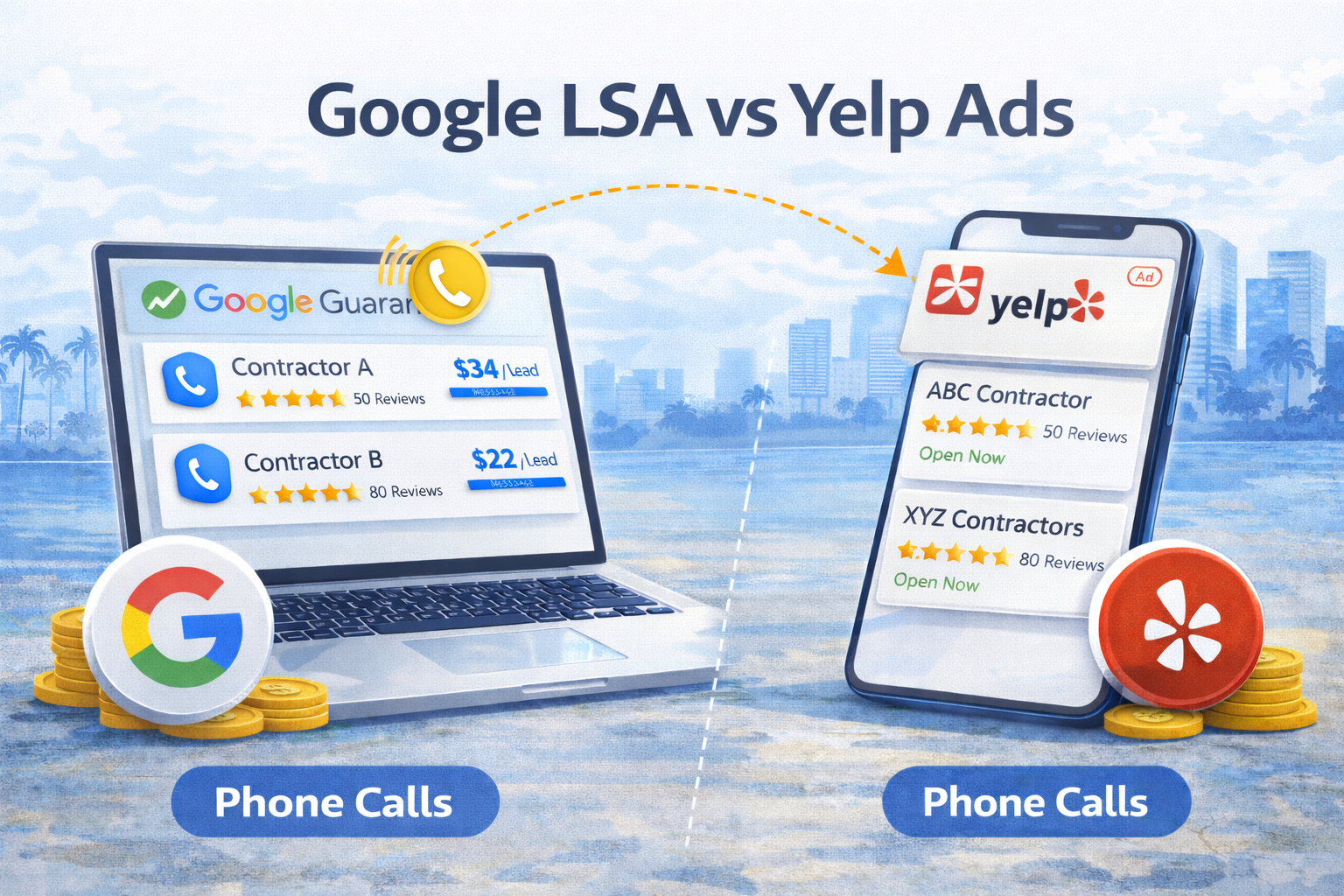
How does each platform actually work (and why is the billing model the whole story)?
Before we get into numbers, you need to understand what you are actually buying on each platform. Because the billing model is not a footnote. It is the core product.
Yelp Ads: You Buy Clicks
When you run Yelp ads, your listing appears in search results and on competitor profile pages within the Yelp app and website. Someone searches "HVAC repair near me" on Yelp. Your ad shows up. They click. You get charged, typically $2 to $20 per click for most home service categories, with highly competitive trades in major markets running $30 to $40 per click.
Here is what Yelp does not prominently advertise: "a click" includes someone who reads your reviews and leaves, someone who looks at your photos and moves on, someone who checks your hours and decides to call a different contractor, and someone who was actually looking for a competitor but clicked your ad by mistake. All of those are billable clicks. Yelp's CPC model is not optimized for your outcomes, it is optimized for Yelp's revenue.
The free CPC calculator solves for spend, clicks or cost per click, whichever you are missing.
On top of click charges, Yelp's sales team aggressively upsells enhanced profiles ($100-$200/month), CTA (call-to-action) buttons ($50-$100/month), competitor ad suppression from your profile ($100+/month), and other features. A contractor who starts with "just $300/month" often sees bills of $600 to $800 before they understand what happened. Yelp sales reps are incentivized to upsell, and they call repeatedly. Business owners report being contacted up to four times per day.
Google LSA: You Buy Leads
Google Local Services Ads appear at the very top of Google search results, above everything: above Google Ads, above the Map Pack, above organic results. A homeowner searches "emergency plumber" or "furnace repair near me." They see your profile with your name, review rating, years in business, and the Google Verified badge. They call or message you directly.
You pay only when that contact happens. Not for impressions. Not for profile views. Not for clicks. A lead. And every LSA lead is exclusive, meaning no other contractor receives that same call. If the lead turns out to be invalid, you can dispute it for a credit. Google's billing model is fundamentally aligned with what you actually want: paying for customers, not for browsing.
What is the real cost comparison: Yelp CPC vs Google LSA CPL?
Let us put some actual numbers to this. One business owner reported spending $4,000 per month on Yelp, generating 498 views, at an average CPC of about $16. That works out to 250 clicks at $16 each. If a generous 20% of those clicks turn into a phone call or message, that is 50 contacts. If 25% of contacts book, that is about 12-13 booked jobs. Cost per booked job: over $300, from a platform where you share the user's attention with multiple competitors simultaneously.
Now look at the same $500 scenario on each platform. This is the math that matters.
And that's on a good month. Review score swings, competitor profile suppression, and Yelp upsells can push the real number much higher.
Similar booked jobs, but with reliable lead volume, disputable bad leads, and a floor that doesn't collapse when a bad review comes in.
The headline numbers look close, but the key difference is consistency. LSA gives you 8 real contacts you can track, record, dispute if invalid, and improve upon. Yelp gives you 50 clicks and you have to guess how many turned into actual conversations. When you cannot measure it, you cannot improve it.
For more on how to size your LSA budget properly and what CPL ranges to expect by trade, see our guide to LSA cost by industry.
Lead Intent: Who's Searching on Yelp vs. Google?
This is probably the most underappreciated difference between the two platforms. It is not just about the billing model. It is about what the person on the other end of that click actually wants.
Yelp's own data shows that 82% of Yelp users plan to make a purchase when they visit, and 92% actually make a purchase after their visit. Those numbers sound great until you realize the purchase is often from one of the five contractors they compared on Yelp, not necessarily you. Yelp is a research and comparison platform. Users arrive with a general intent to find someone, not a specific intent to call you right now. They read three profiles, compare reviews, look at photos, maybe check a fourth profile, and then decide.
Google LSA captures an entirely different moment. Someone's furnace breaks at 10 PM. Someone's pipe bursts. Someone needs an electrician before a home inspection. These are urgent, high-intent searchers on the world's biggest search engine. They are not browsing. They are calling the first trusted contractor they see at the top of the results. That is why LSA close rates run 25-40%, while Yelp close rates are generally lower and much more variable.
Yelp itself acknowledges that 97.7% of home services searches on the platform are unbranded, meaning users are not searching for a specific company. They are searching for a category: "plumber," "electrician," "roofer." That is an opportunity for discovery, but it also means you are competing for attention against every other contractor in your category, all on the same page, at the same time.
What You Actually Control on Each Platform
A lot of contractors assume that because both platforms charge for advertising, they offer roughly the same level of control. They don't. The gap in targeting precision between LSA and Yelp is significant, and it affects your ability to optimize spend over time.
On LSA, you control your service categories, which directly determines which searches trigger your listing. You can add or remove job types to exclude leads you don't want. You control your service area down to the zip code. You can set a weekly budget cap that Google will not exceed. You can dispute individual leads you believe are invalid. You have no long-term contract requirement. And your ranking improves as you optimize reviews, response time, and profile completeness, all things you can actively work on.
Yelp gives you category and location targeting only. There is no keyword targeting, which means if you are a plumber who only does residential work, Yelp cannot prevent your ad from showing to someone searching for commercial plumbing services. You cannot exclude irrelevant searches. You cannot dispute individual clicks. And Yelp has been known to lock contractors into auto-renewing contracts that are difficult to cancel.
The lack of a dispute system on Yelp is particularly frustrating for contractors. If you pay $15 for a click from someone who was clearly not a serious prospect, that money is gone. LSA's dispute system means that if a lead comes in for a service outside your area, a wrong number, or an irrelevant call type, you can flag it and Google will often credit it back. Over a year, those credits add up.
For a deeper look at what drives LSA performance, read our breakdown of the 7 ranking factors that determine your position in LSA.
Why is Yelp Ads ROI so unpredictable for contractors?
If there is one thing that makes Yelp advertising uniquely risky for contractors, it is this: your ROI is almost entirely dependent on your review score, and Yelp's review filtering algorithm can hurt you even when your real customers are leaving positive reviews.
Yelp's "recommendation software" is designed to surface reviews that Yelp deems "trustworthy" based on factors like reviewer account activity, social connections, and other signals. In practice, this means that genuine positive reviews from loyal customers who don't use Yelp regularly can get buried in the "not recommended" section, while negative reviews from more active Yelp users stay prominently displayed. Yelp has faced multiple lawsuits alleging that this system creates leverage for their sales team, though all cases were dismissed before trial.
The practical impact: two contractors spending the same amount on Yelp ads, in the same market, same trade, can see completely different results purely based on their review profile and how Yelp's algorithm treats those reviews. That makes Yelp ROI inherently unpredictable in a way that LSA is not.
LSA has a performance floor that holds even with fewer reviews. Yelp ROI collapses below 4.0 stars and depends heavily on review filtering behavior.
LSA is not immune to review impact. A strong review profile and a high rating absolutely help you rank higher and convert more leads on LSA. But LSA has a floor: even a newer contractor with 15-20 reviews at 4.5 stars can generate consistent leads. On Yelp, if your reviews are filtered or you slip below 4.0, you are essentially paying to appear in a context where homeowners will choose someone else.
For context on how to build a review strategy that helps on both platforms, see our LSA review strategy guide, which also covers how reviews factor into your ranking.
Side-by-Side: When Does Each Platform Win?
This is where we stop being theoretical and get practical. There are genuine scenarios where Yelp makes sense, and we would be doing you a disservice if we pretended otherwise.
When Google LSA Wins (Most Situations)
- Your trade is eligible for LSA (HVAC, plumbing, electrical, roofing, pest control, carpet cleaning, painting, handyman, etc.)
- You primarily serve residential customers with urgent service needs
- You are in a competitive market where being at position zero on Google matters
- You want predictable, measurable cost per lead that you can optimize over time
- You do not have a massive Yelp review advantage over local competitors
- You are starting fresh and need lead volume quickly without betting everything on review score
When Yelp Can Work (Specific Circumstances)
- You have 50-plus Yelp reviews at 4.5 stars or higher, and local competitors have fewer
- You serve commercial clients or property managers who actively use Yelp for vendor research
- Your trade is not yet eligible for LSA in your area
- You are in a market where Yelp has unusually strong consumer brand recognition
- You are using Yelp to supplement LSA, not as your primary channel
The Budget Conversation: What $500/Month Actually Looks Like
We touched on the math earlier, but let us be even more concrete. Many contractors come to us having already spent months on Yelp with $300 to $800 monthly budgets and mixed results. Here is what a realistic month looks like on each platform at common contractor spending levels.
Yelp at $500/Month
At $500/month, you are buying roughly 25-50 clicks depending on your market and trade. That sounds like a lot of people looking at your business. But remember: "looking" is not "calling." If your CPC is $15 and you get 33 clicks, you need to ask: how many of those 33 people compared your profile to three other contractors on Yelp and chose someone else? How many were on Yelp with a general curiosity and no immediate need? How many were existing customers checking your hours?
In competitive markets like Los Angeles, Phoenix, or Dallas, CPC can run $20 to $35 for HVAC and plumbing, bringing your click count down to 15-25 per month. At that volume, even a 30% contact rate gets you 5-7 actual conversations, which at a 25% close rate means 1-2 booked jobs. That is $250-$500 per booked job.
LSA at $500/Month
At $500/month, a plumber can expect 6-10 exclusive leads at an average CPL of $50-$80. An HVAC contractor might see 5-8 leads at $60-$90. Every single one of those is a person who found your LSA profile at the top of Google search and called your business directly. No comparison shopping. No profile-browsing. A call.
At a 30% close rate, 8 leads becomes 2.4 booked jobs. At $500 spent, that is $208 per booked job. But here is what changes month over month: as your LSA ranking improves through better reviews, faster response time, and profile optimization, your lead volume increases without your budget going up. Yelp has no equivalent compounding benefit.
Thinking About $2,000+/Month
At higher budgets, LSA scales cleanly. More budget means more lead volume within your service area, and you can adjust weekly caps without renegotiating anything. For a comparison of LSA against other major platforms at higher budgets, including a full ROI breakdown, see our LSA vs. Thumbtack vs. Angi comparison.
Yelp at $2,000+/month can generate meaningful click volume, but your cost per booked job at that scale depends almost entirely on factors outside your direct control: your current review score, whether Yelp's algorithm is treating your reviews favorably that month, and how many competing profiles are appearing on your Yelp page. Those variables make Yelp a poor choice as a primary channel for most contractors at any budget level.
See What LSA Can Do for Your Business
We manage Google Local Services Ads for contractors who are tired of paying for clicks that go nowhere. Get a free audit and we will show you exactly what LSA should be producing for your trade and market.
Book Your Free ConsultationLSA vs Yelp Ads FAQs
Bottom Line
Yelp and LSA are not equivalent options with different price points. They are fundamentally different products built on fundamentally different business models. Yelp sells you attention. LSA sells you contacts. For most contractors in LSA-eligible trades, that difference is measured in hundreds of dollars per booked job.
The case for LSA is simple: you pay only when someone calls. The lead is exclusive to you. The lead comes from a Google searcher with high intent. You can dispute invalid leads. Your performance compounds as you improve your profile. There is no long-term contract. And LSA sits at position zero on the world's most-used search engine, above everything else.
The case for Yelp is narrower: if you already have a dominant review profile on Yelp, running ads can help you capture the consumers who are actively using that platform for home service research. But Yelp is not where you build a lead generation program from scratch, and it is not a fair fight when your ROI depends on how Yelp's filter treats your reviews that month.
If you are currently spending money on Yelp and wondering why the results feel unpredictable, the answer is usually in the math above. Put that budget into LSA, track your cost per lead and cost per booked job, and give it 60 days. The numbers will tell you the rest.
Ready to Switch to Pay-Per-Lead?
We set up and manage Google Local Services Ads for contractors across the country. Free audit. No obligation. We will tell you exactly what your trade and market should be producing on LSA.
Book Your Free ConsultationSee the real numbers for your trade
Plug in your industry, budget, and close rate. Our calculator shows your projected leads, cost per booked job, and ROAS.
More on lead channel comparisons
Part of the BGM lead channel comparison library: