Published by Blue Grid Media • Updated for 2026 • 18 min read
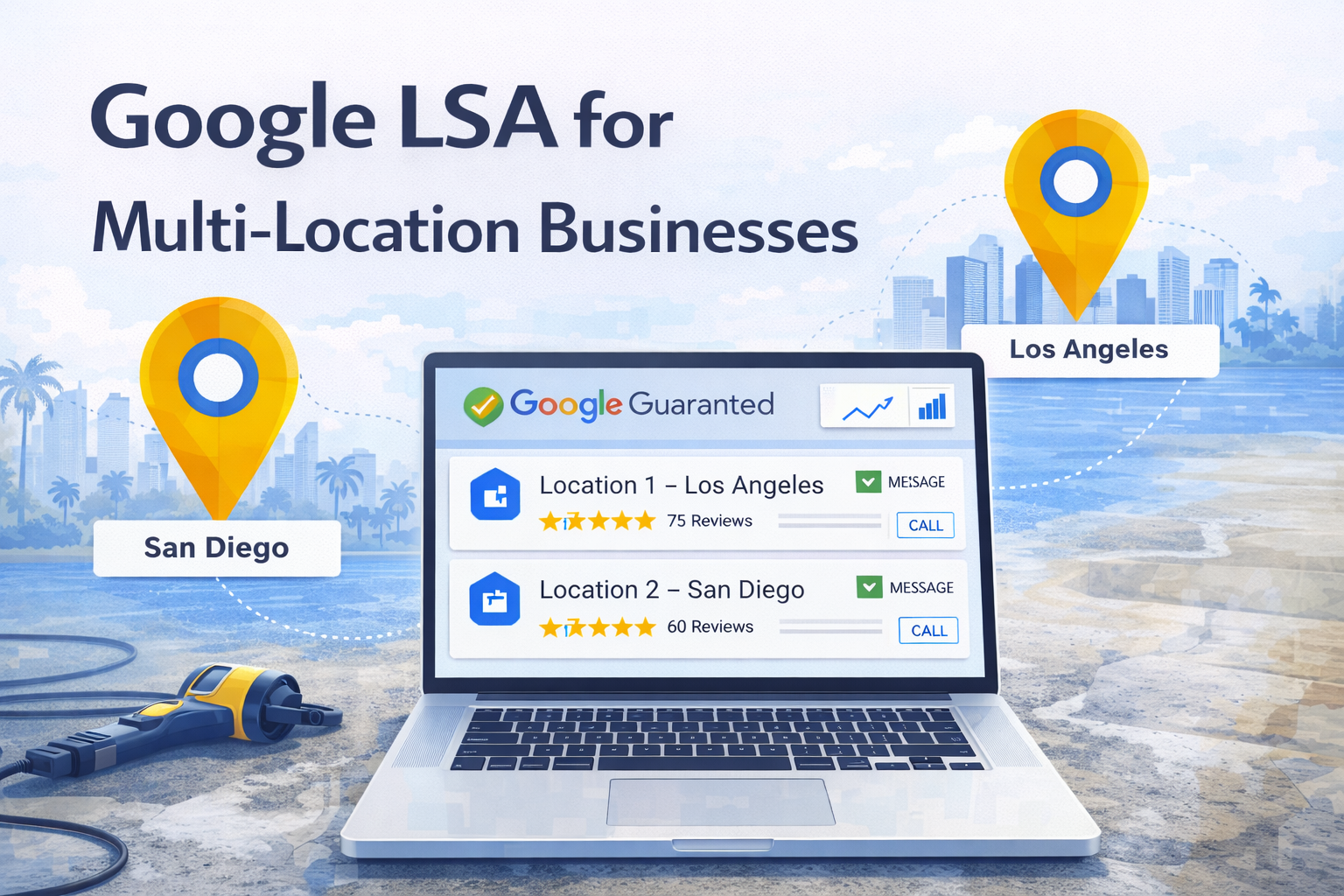
One location, one LSA profile. Reviews come in, calls come in, you answer the phone and book jobs. The system works. You know your cost per lead. You know your close rate. Things feel manageable. So you open a second location. Then a third. And somewhere around location two or three, the clean picture you had starts to blur.
Reviews are scattered across profiles. Budget is getting spent in three markets but you have no idea which one is actually profitable. One location gets a flood of calls and another gets almost nothing, and you cannot figure out why. A customer in your newer market leaves a five-star review on your original location profile because that is the one they found by searching your business name. Your CPL in Dallas is 8 and your CPL in Atlanta is 1, and you are putting equal money into both. The numbers do not make sense, and now managing LSA feels like a part-time job you did not sign up for.
This is not a scaling problem. This is a structure problem. Multi-location LSA is fundamentally different from single-location LSA, and the contractors who get it right treat it that way from the beginning. This guide covers exactly how to do that: the profile architecture, the budget logic, the review strategy, and the performance tracking system that keeps multiple markets profitable without consuming your entire week.
Why Multi-Location LSA Is a Different Animal
When you have one location, everything about LSA is simple. You set a weekly budget, Google charges you per verified lead, you answer calls, and you track how many jobs you close. The feedback loop is tight. You can see your CPL and adjust your budget within the same week.
Add a second location and the feedback loop doubles. Add a third and you now have three separate lead pipelines, three sets of reviews, three service areas with different competition levels, and three potentially different CPLs. What works in one market may not work in another. And the mistakes that are easy to make with one profile become three times as expensive.
The three pain points that break multi-location LSA
Pain point 1: Weak proximity signals when one profile tries to cover everything. Google's LSA algorithm prioritizes geographic proximity. A listing that is physically close to the searcher ranks higher than one that is far away. If you create a single LSA profile and expand the service area to cover three cities that are 30 to 50 miles apart, you are not creating a strong presence in any of them. You are creating a weak presence across all three. A competitor with a dedicated profile in each city will outrank you in their own backyard every single time.
Pain point 2: Budget disappears without attribution. When you are spending across three markets from a single account view, it is easy to miss the fact that 70% of your budget is going to one market while the other two starve. Or worse, that budget is split equally across all three even though one market has a CPL of 8 and another has a CPL of 5. Without market-level performance data, you are flying blind and writing checks you cannot justify.
Pain point 3: Reviews are diluted and misdirected. Your strongest location might have 65 reviews. Your newer location has 8. The 8-review location ranks poorly, gets fewer impressions, and generates fewer leads. Meanwhile, customers who worked with your new-market crew keep leaving reviews on your original GBP because that is what shows up when they search your business name. The reviews go to the profile that needs them least, and the new location keeps underperforming for exactly that reason.
None of this is unfixable. But it requires a deliberate multi-location strategy, not just a single-profile setup with expanded geography. Start with the most important structural decision you will make.
The Golden Rule: One LSA Profile Per Physical Location
Every physical location needs its own LSA profile, tied to its own verified Google Business Profile. This is not optional if you want to rank well across multiple markets. It is the foundation of everything else in this guide.
A single LSA profile with an expanded service area covering multiple cities will rank poorly in all of them. Google's proximity algorithm gives a significant ranking advantage to listings that are geographically close to the searcher. A profile based out of your main office in Chicago does not get strong proximity signals for searches in Naperville, Aurora, or Joliet, even if those cities are within your stated service area.
The fix: one LSA profile per physical location, each with its own verified GBP, its own local phone number, its own reviews, and its own dedicated budget. This is how you build genuine local presence in each market you serve, not the illusion of coverage from a distant profile.
What one profile per location actually means in practice
Each location profile needs to be a complete, independent listing. Not a copy of your main profile with the address changed. Here is what each profile requires:
- Its own verified Google Business Profile with the physical location address
- A unique local phone number (not a shared main line routed to HQ)
- A tailored business description referencing the local service area
- Location-specific photos where possible: crews, trucks, jobs completed in that market
- Its own dedicated review velocity strategy (more on this below)
- Its own weekly LSA budget based on that market's CPL and lead volume goals
Some contractors resist this because it feels like more work. It is more work upfront. But the alternative, one profile trying to cover everything, is more expensive in the long run because you are paying for a setup that loses to local competitors in every market you enter.
What about businesses without a physical office in a new city?
LSA requires a verified physical address. If you are expanding into a market where you do not have an office yet, you have a few options: a manager or crew leader's home address (Google allows this for service-area businesses, but audits it), a registered virtual office with a real street address, or a shared office space or coworking address. What Google does not allow: P.O. boxes, UPS store addresses, or addresses that are clearly not staffed by your business. Fake addresses get flagged during verification and can result in suspension of the profile. Use a real, auditable address in the new market before launching LSA there.
Setting Up Google Business Profiles for Each Location
Your LSA profile and your Google Business Profile are linked. The reviews on your GBP show up directly in your LSA ad. Your GBP's verification status, category selection, and NAP consistency all influence how Google treats your LSA listing. Getting each location's GBP right before launching LSA in that market is not a nice-to-have. It is the prerequisite.
For the complete GBP optimization playbook, see our GBP optimization guide for contractors. Here is the multi-location-specific checklist:
How to Allocate Budget Across Multiple Markets
Equal budget splits across all locations are the most common and most expensive mistake multi-location businesses make with LSA. Putting $1,500 per month into each of your five markets sounds fair. It is not good strategy. Some markets are more competitive. Some have higher CPLs. Some are in their first 60 days and still building ranking. Some are performing at 4x ROAS and deserve more investment. Treating them all the same means you are subsidizing your worst markets at the expense of your best ones.
A target ROAS only means something next to your margin, which the free ROAS calculator factors in.
The two-phase approach to multi-market budgeting
Phase 1: Test budget for new markets. When you enter a new market, you do not have performance data yet. You do not know your CPL in that city, you do not know the competition density, and you do not know what close rate you will achieve with leads from that area. Do not commit a large budget before you know these numbers. Start every new market with a test budget: $800 to $1,500 per month for the first 60 days. That gives you enough lead volume to calculate real CPL and close rate without over-committing to an unknown market.
Phase 2: Performance-based allocation. After 60 to 90 days in a market, you have real data. Now you can score each market and allocate budget accordingly. The scoring formula is straightforward:
Market Score = Revenue Generated / Ad Spend
(this is your ROAS per location)
# Reallocation rules:
CPL < 0 AND close rate > 30% → Scale up budget 20-40%
CPL 0-5 AND close rate 20-30% → Hold budget, optimize
CPL > 0 AND close rate < 20% → Reduce budget, diagnose
# Sort all markets by ROAS, reallocate quarterly
Top 20% of markets often generate 60-70% of total revenue
Review every market's ROAS quarterly, not monthly. Month-to-month CPL can swing 20 to 40% due to seasonal variation, algorithm fluctuations, and lead volume randomness. Quarterly averages give you a cleaner signal about which markets are structurally profitable versus which ones just had a good or bad four weeks.
Budget allocation in practice: a three-market example
| Market | Monthly Spend | CPL | Close Rate | ROAS | Recommendation |
|---|---|---|---|---|---|
| Dallas, TX (Month 8) | $1,800 | $62 | 34% | 4.8x | Scale to $2,400–$3,800 |
| Austin, TX (Month 4) | $1,200 | $71 | 26% | 2.9x | Hold, optimize response time |
| Houston, TX (Month 2) | $1,000 | $98 | 18% | 1.4x | Diagnose before scaling |
In this example, Dallas is a clear winner: low CPL, strong close rate, nearly 5x ROAS. That market deserves more money, not equal treatment with Houston which is still early and underperforming. Austin is fine but has room to improve, likely through faster response time. Houston at month two is too early to cut, but the data suggests either a competitive market issue or an operational problem worth investigating before pouring more budget in.
Use our free LSA ROI Calculator to model each market's numbers independently. Running the calculator per location, rather than as an aggregate, gives you the per-market ROAS clarity that drives smarter budget decisions.
Managing Reviews Across Multiple Locations
Reviews are the single highest-impact ranking factor in LSA, and they are the part of multi-location management that most businesses get wrong. The problem is not that contractors do not ask for reviews. The problem is that customers leave reviews in the wrong place, and nobody notices until a new location has been live for six months with 11 reviews while the original location has 94.
The misdirected review problem
When a customer wants to leave a Google review, most of them search your business name. If you have five locations and your main location has been established for four years, that original profile dominates the search results. The customer finds it, leaves the review there, and your Phoenix location's profile stays stuck at 12 reviews while your Chicago profile climbs past 100. The Phoenix team did great work. They just got credit for it in the wrong city.
The fix is simple but requires consistency: every post-job review request needs to include a direct link to that specific location's GBP. Not a generic request to leave a review. A specific link. Here is the link to our Phoenix Google listing. A review there means a lot to our local team. This routes the review to the right profile every single time, regardless of which location the customer might find by searching your name.
Setting review velocity targets per location
Do not think about reviews as a total company number. Think about them as a per-location ranking factor. Each location competes independently for ranking in its own market. A location with 8 reviews is going to rank poorly in a market where the top competitor has 70, regardless of how many reviews your other locations have. Set a minimum review target for each location and track it monthly:
- New location (first 90 days): target 20+ reviews before scaling LSA budget
- Established location: maintain at least 4 new reviews per month to signal activity
- Ranking goal: reach 50+ reviews with 4.7+ stars to compete in most markets
- Dominant position: 100+ reviews at 4.8+ stars, which very few competitors reach
For the complete review collection system, including SMS templates, timing strategy, and how to handle negative reviews without tanking your rating, see our LSA review strategy guide. The same principles apply to each location independently.
When one location has 80 reviews and another has 12
This is the most common review imbalance in multi-location businesses, and it is almost always caused by either misdirected review requests or a newer location that has not built its pipeline yet. The 12-review location will rank poorly until it catches up. There is no shortcut here. You cannot transfer reviews from one profile to another, and you cannot inflate a profile's count artificially without risking suspension.
The practical approach: assign one person at the underperforming location the specific responsibility of sending review requests after every completed job. Give them the location-specific review link, a simple text template, and a weekly target (aim for 3 to 5 new reviews per week until you hit 50). This is the fastest legitimate path to closing the review gap.
Choosing Which Markets to Expand Into With LSA
Not every city is a good LSA market for your business. Competition density, average CPL, and your operational capacity to service the area within Google's response time requirements all determine whether a new market is worth entering. Launching blind, without researching these variables, is how businesses end up with an underperforming market that bleeds budget for six months while the team debates whether to cut it or give it more time.
Pre-launch market research checklist
Brand Consistency vs. Local Relevance
This tension comes up for every multi-location business: how much should each location's LSA profile and GBP reflect local specifics versus maintaining a consistent brand experience across all markets? The short answer is that brand consistency and local relevance are not actually in conflict if you approach them correctly.
What should be consistent across all locations
- Business name (exact same spelling and format on every profile)
- Logo and visual identity in photos
- Core services offered (enable the same job types in each market where you can deliver them)
- Response time standards (answer calls fast, everywhere)
- Review request process (same system, same templates, location-specific links)
- Pricing philosophy (even if actual prices vary by market, the structure should be consistent)
What should be localized per location
- Business description (reference the local city, neighborhoods, and service area)
- Local phone number (unique per location)
- Hours of operation (if different by location)
- GBP photos (local crews, local completed jobs, local landmarks where relevant)
- Service area size and configuration (each market has different geography)
The franchise consideration
If you operate a franchise or license your brand to owner-operators in different markets, the profile structure question becomes more nuanced. In most franchise setups, each franchisee should have their own independent GBP and LSA profile because each is a separate legal entity with its own address, staff, and license. The franchisor can provide templates, review request systems, and training, but the profiles themselves belong to each location. Trying to run franchise locations under a single corporate LSA account creates attribution problems and limits each franchisee's ability to build local ranking independently.
How to Track Multi-Location LSA Performance
Managing multiple markets without a structured tracking system is how budget gets wasted for months before anyone notices. You need a simple dashboard that shows the key performance indicators for each location side by side, updated at least monthly. This does not require expensive software. A simple spreadsheet works fine if you update it consistently.
The five metrics that matter per location
| Metric | How to Track It | Target (Healthy Market) |
|---|---|---|
| Cost per lead (CPL) | LSA dashboard per profile | Under 5 for most trades |
| Lead volume | LSA dashboard per profile | Consistent monthly, not wildly variable |
| Close rate | CRM or manual tracking per location | 25% minimum, 35%+ is strong |
| Revenue per location | Job management software | 10x+ monthly ad spend |
| ROAS (return on ad spend) | Revenue / ad spend per location | 3x minimum, 5x+ is excellent |
Review this dashboard monthly. Flag any location where CPL is trending up two months in a row, close rate is declining, or ROAS drops below 3x. Those are early warning signs of either a competitive shift in the market, an operational issue (response times slipping), or a profile problem (reviews stagnating, service area mismatch).
Call tracking per location
If budget allows, set up unique call tracking numbers per location that route to the local team. This gives you data beyond what LSA's own dashboard shows: call duration, call answer rate, missed calls, and call recordings you can review for quality. Missed calls from LSA are particularly expensive because each missed call was a charged lead. Knowing which locations have the highest missed call rates tells you where operational attention is needed most.
The 80/20 of multi-location performance
In virtually every multi-location LSA setup, 20% of your markets will drive 60 to 70% of your revenue. Identifying those top performers and investing aggressively in them while cutting back on chronic underperformers is the highest-leverage decision you can make with your advertising budget. Review your market-level ROAS quarterly, sort from best to worst, and reallocate accordingly. This is not giving up on weaker markets. It is acknowledging that capital should flow toward proven performance and away from speculative spending. For a deeper look at why LSA rankings vary by market and what drives them, see our complete LSA ranking factors guide.
To see where you actually sit in the LSA pack right now, run the free LSA Visibility Scanner.
The 6 Biggest Multi-Location LSA Mistakes
Mistake 1: One profile for all locations
This is the foundational error that makes every other problem worse. A single profile trying to cover three or five or ten cities will rank poorly in all of them because Google's proximity algorithm rewards listings near the searcher. One profile, one service area, one geographic center point. Everything beyond a reasonable radius around that point ranks below a local competitor with a dedicated profile. The fix is the golden rule above: one profile per physical location, no exceptions.
Mistake 2: Equal budget split without performance data
Splitting budget equally across all locations feels administratively simple and strategically fair. It is neither. Markets have different CPLs, different competition densities, and different close rates. Allocating equal budgets to a 4.8x ROAS market and a 1.3x ROAS market means you are subsidizing underperformance at the expense of a proven winner. Let the ROAS data drive allocation. Quarterly rebalancing based on market scores is the right cadence.
Mistake 3: Ignoring review velocity per location
Thinking about reviews as a company-wide total misses the point. Each location competes independently in its local market. A location with 10 reviews competes against local competitors with 60 and loses, regardless of what the company's aggregate review count looks like. Track reviews per location, set targets per location, and send review requests using location-specific links. This is the only way to build the per-market review base that actually drives ranking.
Mistake 4: Expanding too fast before existing markets are profitable
There is a temptation, especially after early success in a first or second market, to expand aggressively into new cities. Resist this until your existing markets meet the minimum thresholds: CPL under 5, close rate above 30%, ROAS above 3x, and lead volume that consistently fills your operational capacity. Expanding before existing markets are stable splits management attention, dilutes review-building focus, and often results in two or three mediocre markets instead of one excellent one. Grow from strength.
Mistake 5: Shared phone numbers across all locations
Using a single main number for all LSA profiles hurts in two ways. First, it sends weak local relevance signals to Google's ranking algorithm, which prefers local phone numbers that match the location's area code and geography. Second, it makes call tracking and attribution impossible. You cannot know which market is generating calls, which locations have missed call problems, or which crews are answering at the right speed. A unique local number per location takes a few minutes to set up and immediately improves both ranking signals and performance visibility.
Mistake 6: No location-specific call handling protocol
A customer in Phoenix calling your Phoenix LSA number and reaching your main office in Dallas, where nobody knows the Phoenix market, Phoenix neighborhoods, or Phoenix pricing, is a bad experience that reduces close rates. Each location needs a defined call handling protocol: who answers calls from that market, what script they use, how they set expectations about service area and scheduling, and how they route calls when the primary contact is unavailable. Consistent call quality in each market is what converts the lead that LSA delivered. The ad got the phone to ring. The call handling determines whether that call becomes a booked job.
When to Hire a Multi-Location LSA Manager
Managing two LSA profiles yourself is reasonable. You log in to the dashboard, review leads, adjust budgets, and check in on reviews once a week. It takes maybe two to three hours per month. Manageable.
Managing five or more locations yourself is a part-time job. And most owner-operators do not have a part-time job worth of hours available for advertising management when they are also running crews, handling customer calls, doing estimates, and dealing with everything else that comes with operating a service business across multiple cities.
The time math per location
At three or more locations, the monthly time commitment for LSA management includes: reviewing lead quality and disputing invalid leads (see our guide on LSA lead disputes), adjusting bids and weekly budgets per location, monitoring review velocity and sending requests per location, managing verification renewals annually, auditing call response rates per location, and reviewing performance dashboards and reallocating budget quarterly. Realistically, that is 6 to 10 hours per month per location for someone doing it attentively. At five locations, that is 30 to 50 hours per month. At ten locations, it is effectively a full-time position.
The question is not whether to hire help. It is when the cost of your own time managing LSA exceeds what you would pay someone with actual LSA expertise to do it better. For most multi-location contractors, that threshold hits at three to five locations.
What to look for in a multi-location LSA manager
Not every LSA agency understands multi-location management. The challenges are structurally different from single-location management, and experience with one does not automatically translate to the other. When evaluating an agency, ask specifically: Have they managed LSA profiles across five or more locations simultaneously? Can they show market-level ROAS tracking from previous clients? Do they have a defined budget reallocation process based on per-market performance data? Do they have a review collection system that works at the location level? Those are the questions that reveal whether an agency has real multi-location experience or is just scaling its single-location approach across more profiles.
For reference, the LSA ranking principles that govern single-location performance apply equally at scale. The difference is the management overhead and the strategic complexity of allocating resources across markets. See our guide to ranking number one in LSA for the core optimization framework that each location needs to execute independently.
Multi-Location LSA FAQs
Can I run one LSA profile for a business that operates in multiple cities?
Technically yes, but it will hurt your ranking in all of them. Google's proximity algorithm heavily favors listings that are physically near the searcher. A single profile trying to cover multiple markets will rank poorly everywhere. The right setup is one profile per physical location, each tied to its own Google Business Profile. This is the single most important structural decision in multi-location LSA. For more on how ranking works, see our LSA ranking factors guide.
How do I handle LSA for a service-area business with no physical office in a city?
LSA requires a verified business address. If you are expanding into a city where you do not have a physical office, you will need either a registered business address (a real address, not a P.O. box) or a virtual office with a street address. Some service-area businesses use a manager's home address for new-market verification. Google does audit these. Fake addresses get flagged and can result in profile suspension, so use a real, auditable address in every new market before launching LSA there. For a full overview of the verification process, see our Google Verified badge guide.
What's a realistic budget for a business launching LSA in a new market?
Start with $800 to $1,500 per month per new market for the first 60 days. This gives you enough data to calculate CPL and close rate before committing larger spend. Do not judge a new market in the first two weeks. The algorithm needs time to optimize and your ranking takes time to build. Only scale budget after you have 60 to 90 days of performance data showing a CPL under $75 and a close rate above 25%. For a full breakdown of what LSA costs by trade, see our LSA cost guide.
How do I prevent customers from leaving reviews on the wrong location's profile?
Send a direct review link specific to the local GBP. Do not just say leave us a Google review. Say here is the direct link to our [City] Google listing. We would love a review there. This routes the review to the correct location profile every time, regardless of which profile comes up when the customer searches your business name. Build location-specific review links into your post-job follow-up system and this problem essentially disappears. See our LSA review strategy guide for templates and a complete collection system.
Should each location have a separate phone number for LSA?
Yes. A unique local phone number per location helps with call tracking and attribution, and also signals local relevance to Google's ranking algorithm. Using the same number across all locations makes it impossible to track which market is generating calls and can confuse Google's proximity signals. A unique local number per location takes a few minutes to set up through a service like Google Voice, RingCentral, or CallRail and immediately improves both your ranking signals and your ability to identify which locations have call handling issues.
How do I know when a new market isn't working and I should pull back?
If after 90 days a market has a CPL above 0 and a close rate below 20%, it is underperforming. Before cutting budget, diagnose the root cause: poor reviews at that location? Slow response time? Wrong service area size? Too many competitors already dominant with 80+ reviews? If the fundamentals look solid and performance is still weak, the market may be structurally over-competitive or undersized for your trade. Reduce budget to a minimum maintenance level and reassess after another 60 days. If it still does not improve, reallocate that budget to your top-performing markets where the return is proven.
Bottom Line
Multi-location LSA is not complicated. But it does require treating each market as an independent business unit with its own profile, its own budget, its own review strategy, and its own performance targets. The contractors who struggle with it are the ones who try to manage five cities the way they managed one: one profile, equal budgets, reviews wherever they land, and a single view of performance that masks which markets are winning and which are dragging.
The ones who get it right build the structure first. Separate GBPs, separate LSA profiles, separate local numbers. They let performance data drive budget allocation instead of splitting it equally. They send location-specific review links after every job so reviews build in the right place. And they review per-market ROAS quarterly so they know exactly which markets deserve more investment and which need attention before they get more money.
At two locations, you can probably manage this yourself with a couple of hours a month. At five or more, the management complexity is real, and an experienced LSA agency pays for itself quickly in recovered CPL efficiency and market-level optimization that is hard to do manually across many profiles. If your multi-location setup feels chaotic right now, it does not have to stay that way.
Managing Multiple Locations? Let's Audit Your Setup.
We'll review each location's profile, CPL, review velocity, and budget allocation and tell you exactly what needs to change to improve performance across all your markets.
Get My Free Multi-Location AuditResults vary by market, competition density, and how consistently each location follows response time and review standards. Blue Grid Media specializes in LSA and Google Ads for local service businesses across single and multi-location setups.
More on Google Local Services Ads
Part of the BGM Local Services Ads library. Pair this with the master pillar and the deep-dive guides: