Published April 18, 2026 | Data sources: WordStream (Facebook Ads Benchmarks 2025), LocaliQ (Home Services Advertising Benchmarks), Focus Digital (138 Meta campaigns, Mar-Jun 2025), AdAmigo (Meta CPL Benchmarks 2026), LeadSync, ForwardFirst Media, ImproveAndGrow, Invoca
Three changes since publish: (1) Meta CPMs for home services in BGM's managed portfolio rose 14-22% between Q4 2025 and Q2 2026, driven primarily by Advantage+ Shopping Campaigns expanding into local lead generation and increasing auction density. (2) Lead Form Ads continue to outperform website conversion ads on absolute CPL ($28-$42 vs $52-$78) but the gap is narrowing as iOS 17.6+ attribution improvements restore signal to off-platform conversion tracking. (3) The Advantage+ Audiences setting (replacing detailed targeting in 2025) is now the default for new home-service campaigns; operators who do not exclude existing customers from prospecting see Meta optimize to retargeting their own customer base, inflating CPL by 30-45%.
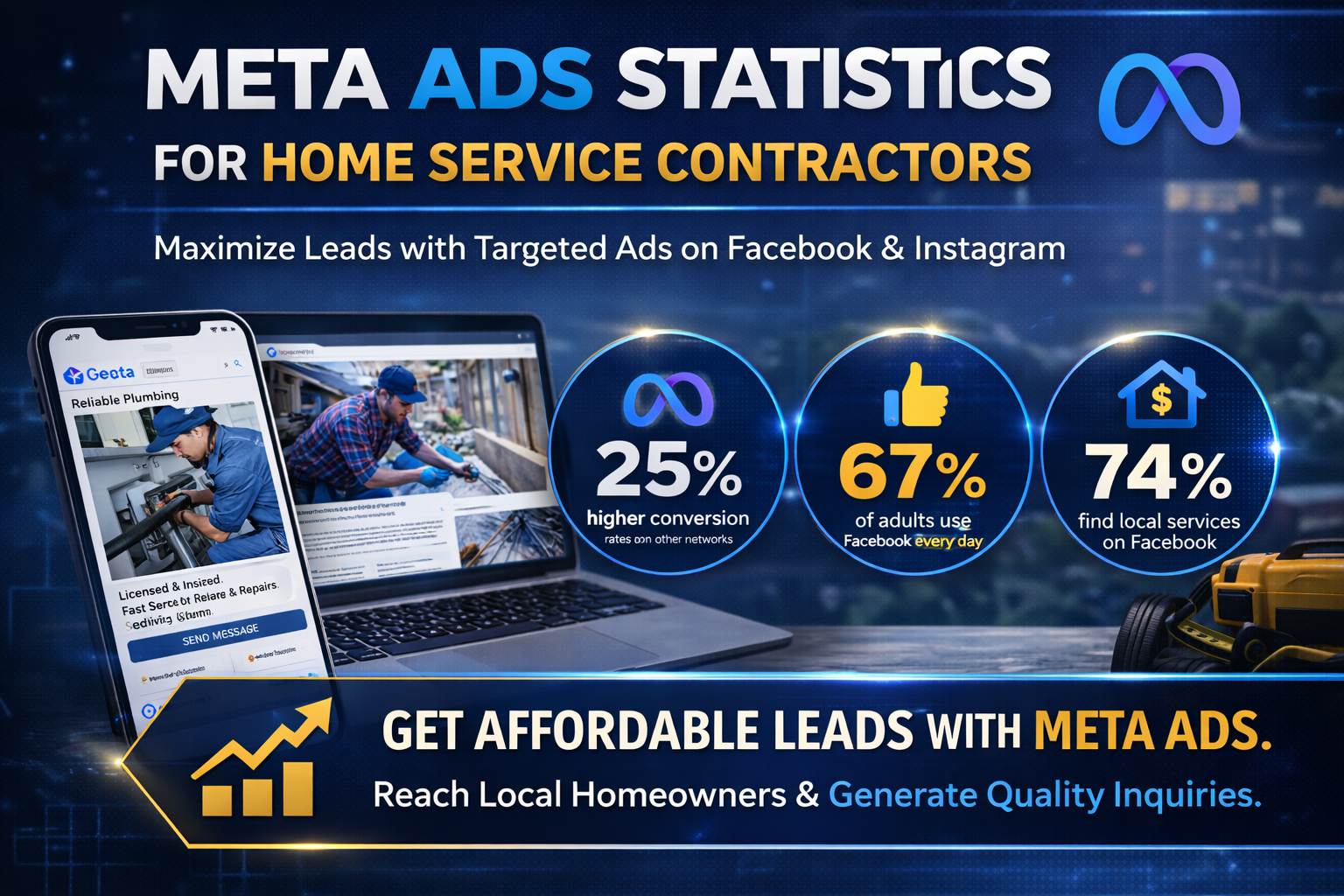
What does the Meta advertising landscape look like for home services in 2026?
Meta is not Google. That is the most important sentence in this article. The people seeing your Facebook or Instagram ads were not searching for a plumber, a roofer, or an AC tech. They were scrolling through their feed, watching a video, or catching up with family photos when your ad interrupted them. That "cold interrupt" dynamic changes everything: it changes the CPL you should expect, the close rate you will achieve, the creative you need to produce, and, most importantly, who should actually use Meta as a lead channel. Articles that present Facebook CPL figures without this context are setting contractors up to misallocate budgets. This section is the framing those articles skip.
That said, Meta's scale is undeniable. Over 2 billion people use Meta platforms daily. The majority of US homeowners are on Facebook. Reaching them with a compelling offer before they need you builds brand recognition that converts at higher rates when urgency strikes. Understanding where Meta fits versus where it does not is the difference between a channel that reliably generates high-ticket jobs and one that eats budget and produces tire-kickers.
The audience scale that justifies the channel despite lower intent than search. No other advertising platform outside of Google reaches this many people daily. For home service contractors, this means the addressable market is enormous even after filtering to a single metro area.
Source: WordStream Facebook Ads Benchmarks 2025The platform-wide CPL baseline has risen 21% year over year as more advertisers compete for the same inventory. Home services consistently runs above the cross-industry average due to competitive local markets and higher-value lead targets. Costs are rising. That makes creative quality and audience precision more decisive every year.
Source: WordStream Facebook Ads Benchmarks 2025WordStream's industry-specific benchmark for the Home and Home Improvement category, using the Leads campaign objective. This is the most widely cited verified benchmark in the space and represents the best available median across thousands of accounts. Trades with higher average job values (roofing, HVAC installs) typically run above this figure. Trades with high volume and lower ticket items (landscaping maintenance, pest control) can run below.
Source: WordStream Facebook Ads Benchmarks 2025More contractors are running Facebook Ads, competition for ad inventory has intensified, and CPMs have risen. The result: the same ad spend generates fewer conversions than it did a year ago in this category. This trend makes creative differentiation, tight audience targeting, and fast lead follow-up more decisive every year for home service advertisers.
Source: WordStream Facebook Ads Benchmarks 2025Choosing the right campaign objective changes your cost base before a single lead comes in. Awareness campaigns run at roughly one-third the CPM of lead generation campaigns. Contractors who use awareness campaigns year-round at $5-$10/day for brand building and then switch to lead gen campaigns during peak season get the most efficient cost structure on the platform.
Source: ForwardFirst Media HVAC Facebook Ads benchmarksThe cost-per-click range across home service trades is tighter than CPL, which varies more by trade. This reflects Meta's auction dynamics: while conversion rates differ dramatically by trade and creative quality, the underlying click cost is compressed within a narrower band. Low CPC alone does not indicate an efficient campaign. A $1.50 CPC with a 1% lead form conversion rate yields a $150 CPL.
Source: LocaliQ Home Services Advertising Benchmarks 2025What is the average Meta ads cost per lead by contractor trade?
LocaliQ's benchmark data is the most methodologically sound available for trade-level CPL on Meta. It is drawn from actual campaign spend across thousands of accounts, not survey estimates or self-reported figures. The table below consolidates LocaliQ's verified medians alongside directional ranges from LeadSync, ImproveAndGrow, and ForwardFirst Media. Where multiple sources agree directionally, the range is included. Where only one source covers a trade, that figure is shown alone. No trade-specific benchmark data means the cell is blank.
| Trade | CPL (LocaliQ verified) | CPL (range, multiple sources) | Avg Monthly Budget | CTR |
|---|---|---|---|---|
| AC Services (repair/service) | $62.80 | $30-$75 | $500 | 1.28% |
| AC Sales (installation) | $116.75 | $40-$120 | $500 | 0.96% |
| Heating & Furnaces | $72.97 | $40-$90 | $500 | 1.22% |
| Plumbing | $72.97 | $40-$80 | $600 | 1.11% |
| Roofing & Gutters | $116.75 | $50-$150 | $1,000 | 1.25% |
| Pest & Rodent Control | $70.11 | $20-$50 | $350 | 1.51% |
| Landscaping | $58.56 | $25-$60 | $750 | 1.79% |
| Pools & Spas | $70.11 | $40-$80 | $300 | 1.31% |
| Electrical | - | $35-$70 | - | - |
| Pressure Washing | - | $15-$40 | - | - |
| General Contractor / Remodeling | - | $100-$200 | - | - |
| Painting | - | $35-$75 | - | - |
| Handyman | - | $30-$65 | - | - |
Consistently the lowest CPL format across home services. Instant forms remove the friction of a website click and a landing page load, which is why volume is higher. The trade-off is lead quality: someone who filled out a pre-populated Facebook form while scrolling may not remember doing so an hour later. Volume is high; follow-up discipline determines whether that volume converts.
Source: Focus Digital, 138 Meta campaigns, March-June 2025The blended average across 138 campaigns covering both Lead Form and website-destination formats. This is the most realistic planning number for a contractor running a mixed campaign strategy, which is the recommended approach for most trades with both service-repair and installation volume.
Source: Focus Digital, 138 Meta campaigns, March-June 2025The Instant Experience format loads a full-screen mobile landing page within the Facebook app. It produces higher intent signals than basic Lead Form Ads because the prospect spends more time engaging with your content before submitting. The higher CPL relative to basic Lead Form Ads reflects this: fewer, better-qualified submissions per dollar.
Source: Focus Digital, 138 Meta campaigns, March-June 2025The Metric That Actually Matters: Cost Per Booked Job
Every CPL figure in the previous section is only half the story. What contractors actually spend money to get is a booked job, not a form fill. Facebook leads close at lower rates than Google leads because they come from people who were not actively searching. Factor in your trade-specific close rate and the economics look very different. The table below builds the full model: CPL to cost-per-booked-job to implied ROAS, using conservative and aggressive close rate estimates for Facebook-generated leads.
| Trade | Meta CPL | Est. Close Rate (Facebook leads) | Cost Per Booked Job | Avg Job Value | Implied ROAS |
|---|---|---|---|---|---|
| AC Repair / Service | $63 | 15-25% | $252-$420 | $350-$600 | 1.4-2.4x |
| AC Installation | $117 | 12-20% | $585-$975 | $4,500-$8,000 | 4.6-13.7x |
| Heating & Furnaces | $73 | 12-20% | $365-$608 | $3,500-$7,000 | 5.8-19.2x |
| Plumbing | $73 | 15-22% | $332-$487 | $300-$800 | 0.6-2.4x |
| Roofing | $117 | 8-15% | $780-$1,463 | $8,000-$18,000 | 5.5-23.1x |
| Landscaping | $59 | 20-30% | $197-$295 | $800-$3,000 | 2.7-15.2x |
| Pest Control | $70 | 25-35% | $200-$280 | $150-$350 | 0.5-1.8x |
| Pools & Spas | $70 | 15-25% | $280-$467 | $3,000-$8,000 | 6.4-28.6x |
Get a free audit and find out whether Meta, Google Ads, or LSA fits your job mix and budget.
How does Meta compare to Google Ads and Local Services Ads for contractors?
No other article in the contractor marketing space has built this comparison in a single table. Most "Facebook vs. Google" content ignores LSA entirely, despite it being the dominant paid channel for most home service trades. Here is all three channels, by trade, using the best available verified data for each. The goal is cost-per-booked-job, not CPL, because CPL alone does not tell you which channel is actually cheaper.
| Trade | Meta CPL | Meta CpBJ | Google Ads CPL | Google Ads CpBJ | LSA CPL | LSA CpBJ |
|---|---|---|---|---|---|---|
| HVAC (service) | $63 | $252-$420 | $128 | $366-$640 | $50-$80 | $125-$267 |
| HVAC (install) | $117 | $585-$975 | $128 | $366-$427 | $60-$100 | $150-$333 |
| Plumbing | $73 | $332-$487 | $129 | $369-$516 | $50-$90 | $111-$257 |
| Roofing | $117 | $780-$1,463 | $228 | $1,140-$2,280 | $80-$150 | $229-$600 |
| Landscaping | $59 | $197-$295 | $65 | $260-$433 | $35-$60 | $100-$240 |
| Pest Control | $70 | $200-$280 | $75 | $214-$300 | $30-$55 | $86-$220 |
| Electrician | $53 est. | $212-$353 | $94 | $269-$627 | $40-$70 | $114-$280 |
Google Ads CPL data from LocaliQ 2025. LSA CPL ranges from BlueGridMedia internal benchmarks across managed accounts. Meta CPL from LocaliQ and Focus Digital. CpBJ calculated using trade-specific close rate estimates.
Ad Format Performance for Home Service Ads
The format of your ad determines as much of your CPL as your budget does. Video, static image, and carousel each perform differently by trade, and the pattern is predictable once you understand the urgency dimension. High-urgency service trades (emergency plumbing, HVAC repair) favor simple, fast-reading static ads. High-ticket visual trades (roofing, landscaping, painting) favor before/after video and carousel formats that can demonstrate transformation. The format mismatch is one of the most common reasons contractor Meta campaigns underperform.
The first 15 seconds determines whether your video ad runs or gets skipped. A contractor testimonial video that starts with a homeowner describing the problem and ends with the result in 12 seconds outperforms a 45-second explainer almost every time. Edit for mobile, assume the sound is off, and put the core message in the first 3 seconds.
Source: TheEEDigital Facebook Ads Benchmarks 2025Multiple images let contractors show project variety or step-by-step process in a single ad unit. A landscaping contractor can show five before/after transformations. A roofer can show the inspection, the damage, the install, and the finished result. Carousel format benefits disproportionately from contractors who have an existing photo library of job sites.
Source: LocaliQ Home Services Advertising Benchmarks 2025The 35% ROI improvement reflects both the higher CTR of carousel format and the stronger post-click intent signals from prospects who engage with multiple cards. Contractors switching from single static images to carousel for portfolio-heavy trades typically see CPL drop within 2-3 weeks as Meta's algorithm learns which card combinations generate leads.
Source: ImproveAndGrow contractor Facebook Ads study| Trade Type | Best Lead Gen Format | Best Brand Format | Why |
|---|---|---|---|
| Emergency services (plumbing, HVAC repair) | Static image: price + phone number | Short video (15s) urgency angle | Speed matters; viewers are not in consideration mode |
| High-ticket installs (AC, furnace, roofing) | Video: before/after or testimonial | Carousel: project portfolio | Longer consideration window; visual proof drives intent |
| Visual trades (painting, landscaping, pressure washing) | Before/after video or carousel | Carousel: project gallery | Visual transformation is the product |
| Recurring services (pest control, pool service, lawn care) | Static image: offer/discount | Video: explainer or guarantee | Price and trust are the decision drivers |
| Remodeling / GC | Carousel: project showcase | Video: process walkthrough | High ticket, long consideration; portfolio matters most |
Facebook vs. Instagram: Placement Performance
Significantly higher engagement than Instagram for direct-response local service ads. Facebook's older demographic skews heavily toward the 35-65 homeowner bracket that makes most contracting purchase decisions. The feed format gives enough context for a service ad to land: image, headline, description, and CTA button all visible before any interaction.
Source: TheEEDigital Meta placement CTR benchmarks 20254.5x lower than Facebook for local service businesses. Instagram's audience skews younger (18-34) and the platform's visual content norms make service-based ads feel more interruptive than on Facebook. Direct-response local service ads consistently underperform on Instagram Feed relative to Facebook Feed for almost all trade categories.
Source: TheEEDigital Meta placement CTR benchmarks 2025Instagram costs roughly double per click compared to Facebook for home service ads. Combined with the lower CTR, Instagram produces significantly fewer leads per dollar for most contractor categories. The exception is high-visual trades targeting homeowners 25-45 (interior design, luxury landscaping, custom painting, pool renovations) where Instagram's visual format and demographic align better.
Source: LocaliQ Home Services Benchmarks 2025Your ad creative, landing page, and lead form must be built for a phone screen, not a desktop. A contractor whose website is not mobile-optimized or whose lead form has six fields and loads slowly is losing leads after a click that already cost $1.50-$3.35. Mobile-first is not a best practice for Meta advertising. It is the minimum viable approach.
Source: WordStream Facebook Ads Benchmarks 2025Lead Form Ads vs. Website Conversion Ads
Facebook's native Lead Form Ads (instant forms that open inside the app) versus sending traffic to your website: this is the highest-impact decision most contractors get wrong. The instinct is to minimize CPL, which points toward Lead Form Ads every time. But lower CPL does not mean better ROI when the leads that come through a website are demonstrably higher quality. The data tells both sides of this trade-off clearly.
The lowest CPL available on Meta for home services, but with a significant catch: pre-populated fields (Facebook auto-fills name and email) mean lower friction for the prospect, which also means lower commitment. A portion of Lead Form Ad submissions come from people who tapped a pre-filled button without fully intending to request a service. Speed-to-lead response is the primary lever for converting this volume.
Source: Focus Digital, 138 campaigns, March-June 2025Higher CPL, but leads that click through to your site are demonstrating stronger intent. They saw your ad, chose to leave the Facebook app, waited for your site to load, reviewed your content or reviews, and then submitted a form. That is a significantly higher intent signal than a pre-populated instant form. For high-ticket work, the higher-quality website lead often converts to a booked job at 2x the rate of an instant form lead.
Source: Focus Digital, 138 campaigns, March-June 2025Keep lead forms to 3 fields maximum (name, phone, service needed) for volume-focused campaigns. Each additional field drops completions by 10-15%. A 6-field form asking for address, preferred service date, property type, and budget range will produce roughly half the completions of a 3-field form at the same budget. Add qualifying questions only if you have a specific lead quality problem you are solving for.
Source: LeadSync contractor lead gen analysisAdding a single qualifying question ("Do you own your home?" or "Is this an emergency?") reduces unqualified submissions by 20-30%. The CPL goes up, but cost-per-booked-job can go down. This is the right approach when your lead-to-appointment conversion is the bottleneck, not lead volume. For most trades, this is the smarter optimization once a campaign is generating 30+ leads per month.
Source: LeadSync / ImproveAndGrow lead form optimization data| Scenario | Recommended Format | Reason |
|---|---|---|
| Emergency services (burst pipe, no AC) | Lead Form (3-field max) | Fastest path to phone call; urgency means they will convert with follow-up |
| High-ticket elective (roofing, AC install) | Website Conversion | Portfolio, reviews, and trust signals on your site close more jobs |
| Recurring service intro offer (pest control, lawn care) | Lead Form with qualifying question | Volume matters; qualify for homeownership to cut junk leads |
| Remodeling / large GC projects | Website Conversion | Consideration phase; your website is your best salesperson |
| Retargeting past website visitors | Either: test both | Already warm; either format can close with the right offer |
What is the real lead quality on Meta ads (close rates and speed-to-lead)?
The reason Facebook Ads have a reputation for "bad leads" is not the platform. It is the mismatch between cold-interrupt intent and warm-search intent. A homeowner who filled out a Facebook form while scrolling Instagram at 8pm is a fundamentally different lead than someone who searched "emergency plumber near me" at 11pm. Both can be converted, but they require different follow-up: faster response, a warmer opener, and a call that educates rather than assumes. Every contractor who says Facebook leads are bad is usually running the same follow-up process they use for Google leads. The process is the problem, not the lead source.
Compared to 15-30% for Google Ads and 25-40% for Google LSA. The spread reflects the intent gap: Facebook leads were not in the market when they saw your ad. They were interrupted. A well-run Facebook campaign with fast response can push close rates to the upper end of the 20% range. Poor follow-up keeps rates at 8-10% even on good creative.
Source: BaaDigi Facebook vs. Google Ads for home service contractorsSpeed-to-lead is more critical for Facebook leads than any other channel because intent decays faster. A Google LSA lead who called you is still in a high-intent state 30 minutes later. A Facebook form submission who was scrolling casually may have moved on, forgotten they submitted, or already called someone else. The 5-minute window is not a best practice. It is the performance threshold.
Source: LeadSync / MIT speed-to-lead researchApplies to all channels but is especially decisive for Facebook leads that did not initiate a high-urgency search. A homeowner who submitted a form for a roof inspection is comparing you to the other two contractors they also submitted forms to. Whoever calls first, sounds professional, and gives them a next step wins the job in most cases.
Source: Invoca home services consumer dataThe qualification rate (lead converts to a booked appointment) falls by roughly 5x from a 5-minute call-back to a 30-minute call-back. This is not a soft correlation. The window to reach a Facebook lead is narrow, and it closes fast. Contractors who automate their first-contact SMS ("We saw your request, calling you now") and immediately call see dramatically better results from the same lead volume as contractors who call back an hour later.
Source: LeadSync contractor lead gen analysisCampaigns without disciplined lead follow-up routinely see ROAS under 2x. The same budget, same creative, same targeting, but with an automated SMS-plus-call response system within 5 minutes, can reach 5-15x ROAS. The difference is not the advertising. It is the follow-up. Meta lead generation is a front-end acquisition tool. Your conversion process is the back-end that determines whether it profits.
A target ROAS only means something next to your margin, which the free ROAS calculator factors in.
Source: LeadSync / ImproveAndGrow campaign dataWordStream's 2025 benchmark report flagged a 36% year-over-year drop in conversion rate for the Home and Home Improvement category on Meta. More contractors are running Facebook Ads, CPMs are rising, and the same ad spend is generating fewer conversions. This trend makes creative quality, audience specificity, and post-click speed more decisive every year. Contractors who ran the same campaigns in 2024 and expected the same results in 2025 saw their CPL climb significantly without changing a single setting.
Seasonal Meta Ads Patterns for Contractors
Unlike Google search, Meta demand is shaped by the advertiser: you choose when to run, how much to spend, and what message to show. But your audience's behavior is still seasonal. Homeowners think about HVAC upgrades in the spring, landscaping in March, roofing after a hail storm, and pest control when they see something crawl across their kitchen floor in April. Aligning your Meta ad activity to trade seasonality is one of the most underdiscussed levers in contractor marketing. The contractors who do it best run year-round at low spend during the off-season and then scale aggressively when their trade's demand cycle turns.
| Trade | Winter | Spring | Summer | Fall |
|---|---|---|---|---|
| HVAC (cooling) | Awareness/brand | Ramp up (pre-season offers) | Peak: max spend | Wind down |
| HVAC (heating) | Peak: max spend | Wind down | Awareness/brand | Ramp up aggressively |
| Roofing | Low | Heavy (storm prep, hail season) | Heavy (peak demand) | Moderate |
| Plumbing | Freeze-event campaigns | Moderate | Summer emergency | Moderate |
| Landscaping | Near-zero | Heavy (spring planning) | Moderate (maintenance) | Light (cleanup offers) |
| Pest Control | Near-zero | Heavy (spring emergence) | Peak | Declining |
| Pressure Washing | Near-zero | Ramp up | Peak | Light |
| Pool Service | Near-zero | Ramp up (opening) | Peak | Light (closing) |
For HVAC, the seasonal timing of Meta is especially valuable for planned replacement work. A homeowner with a 12-year-old AC unit who sees your brand in April, then again in May, then submits a lead form in June when their unit starts struggling has been pre-sold. That lead closes at a materially higher rate than a cold lead from a competitor they never heard of. Meta's frequency-based exposure over 60-90 days before peak season is the most efficient way to build that pre-sell pipeline.
Audience and Targeting Data
The addressable market for home service contractors on Meta. This is a behavioral and demographic segment Meta derives from platform data, third-party data partners, and self-reported housing status. Not every homeowner in this segment is reachable in your service area, but the data confirms that the vast majority of your target audience is on Meta platforms and targetable by homeownership status alone.
Source: HookAgency homeowner targeting analysisThe primary target demographic for most home service trades. This age bracket represents homeowners past the first-purchase phase who are more likely to hire contractors than attempt DIY repairs, more likely to have established budgets for home improvement, and more likely to be on Facebook (vs. Instagram-skewing younger users). Narrowing age targeting to 30-60 typically improves CPL by 15-20% vs. running all ages.
Source: Statista, Social Media AdvertisingMeta's income targeting lets you filter for the segment most likely to actually hire. Homeowners at $75K+ household income hire out significantly more work than lower income brackets. For high-ticket trades (roofing, HVAC replacement, remodeling), targeting $100K+ narrows volume but improves lead-to-booked-job rates. Test both thresholds before committing to one.
Source: LocaliQ Facebook Advertising BenchmarksYour past customer list is your most valuable Meta asset. A 1% lookalike audience built from 1,000+ past customers consistently outperforms interest-based targeting by 3x on ROAS. Meta finds users who match the behavioral and demographic profile of your actual customers, which is a stronger signal than general interests like "home improvement" or "HVAC." If you have not uploaded your customer list to Meta, this is the highest-ROI change available to you right now.
Source: Meta for Business, Insights & Trends500 is the technical minimum but yields poor lookalike quality. With fewer than 1,000 records, Meta does not have enough signal to find strong matches. Contractors who do not yet have 1,000 customer records should prioritize building their list (CRM, past invoices, email signups) before investing heavily in Meta advertising. An interest-based campaign while building the list is the transitional approach.
Source: Meta for Business, Lead Ads Best PracticesWebsite visitors who saw your service pages are the highest-value retargeting segment. Someone who visited your HVAC installation page, spent 90 seconds, and left without converting is a warm prospect who had intent but needed more time. Retargeting them with a testimonial video or a financing offer closes the loop that the initial cold ad opened. Retargeting budgets should be 15-25% of total Meta spend for most trades.
Source: WordStream Facebook Advertising BenchmarksFAQ
What is the average cost per lead for Facebook Ads in home services?
The verified average is $45.50 across home services categories (Focus Digital, 138 campaigns, 2025). Trade-specific: AC services $62.80, plumbing $72.97, roofing $116.75, landscaping $58.56, pest control $70.11 (LocaliQ). Lead Form Ads deliver the lowest CPL at $34.10, while website conversion campaigns average $42-$50. WordStream's Home and Home Improvement benchmark is $41.26 for the Leads objective.
Are Facebook Ads worth it for home service contractors?
Depends on the trade and job type. High-ticket planned work (roofing, AC installation, furnace replacement, pool service, remodeling) has the strongest ROAS case on Meta. A single booked job can cover weeks of ad spend even at an 8-15% close rate. Emergency repair services (plumbing service calls, HVAC repair) have a weaker case because low job values combined with Facebook's lower close rates (8-20%) make cost-per-booked-job economics thin. For most contractors, Meta works best as a secondary channel alongside Google LSA or Google Ads, not as a standalone lead source.
How does Facebook Ads CPL compare to Google LSA for contractors?
Meta CPL is often lower on a per-lead basis ($45-$117 depending on trade) vs. Google LSA ($40-$150). But LSA leads close at 25-40% vs. Facebook leads at 8-20%. On a cost-per-booked-job basis, LSA consistently wins for high-urgency service calls. For high-ticket installs and planned projects, Meta becomes competitive. The three-channel comparison table in this article shows the full breakdown trade by trade.
What ad format works best for home service contractors on Facebook?
Static image ads with a clear price and phone number work best for emergency and service trades. Before/after video under 15 seconds drives the best results for visual trades (painting, landscaping, roofing). Carousel formats work well for contractors with a portfolio to show. Reels are best for brand awareness, not direct lead generation. Lead Form Ads deliver the lowest CPL overall but should be limited to 3 fields max to preserve volume.
How quickly should you respond to Facebook Ads leads?
Within 5 minutes or the lead quality drops dramatically. Leads contacted in under 5 minutes are 100x more likely to qualify vs. leads contacted after 30 minutes. Facebook leads have lower initial intent than search leads, so follow-up speed is the primary lever for improving close rate. Automated SMS or call-back within 60 seconds is the benchmark for high-performing contractor campaigns. Any Facebook Ads program without an automated first-touch response system is running at a significant disadvantage.
What budget should a contractor start with on Facebook Ads?
Testing budget: $600-$1,500/month to gather enough data (aim for 50+ conversions before optimizing). Full campaign budget by trade: HVAC $500-$2,000/month, Roofing $1,000-$3,000/month, Plumbing $600-$1,500/month, Landscaping $750-$2,000/month. Meta's algorithm needs at least 50 conversion events to exit the learning phase. Spending below the threshold stalls performance. If your monthly budget cannot support 50 conversions at the trade's average CPL, you are likely better off starting with Google LSA first and adding Meta when revenue allows a higher testing budget.
See If Meta Ads Fit Your Trade
Not sure whether Facebook Ads make sense for your job mix and budget? Get a free channel audit and find out where your next dollar of ad spend should go.
Book Your Free ConsultationMore contractor marketing data
Part of the BGM contractor marketing statistics library. Pair this with the other data deep-dives:
Want this run for you?
Our Meta ads agency page for contractors covers which trades should not run Meta at all, the lead quality fixes, and published pricing.