Every garage door operator faces the same strategic question, usually within the first six months of trying to grow: rent leads from a pay-per-call service, or build the channels that produce leads under your own account? Both work. They cost different amounts. They produce different kinds of leads. And one of them leaves you with an asset at the end of the year while the other leaves you with nothing.
This guide compares every channel that produces garage door repair leads in 2026, with real cost-per-lead numbers from our own data and the major published industry studies. Google Local Services Ads. Google Ads. Google Business Profile and local SEO. Pay-per-call services like ResultCalls and Service Direct. Shared lead aggregators like Angi and HomeAdvisor. The full picture, no marketing copy, no upsell pressure.
If you are weighing pay-per-call against building your own Google Ads or LSA account, this is the document that will give you the math to decide. The short answer at the bottom: pay-per-call makes sense in three specific scenarios and is a money loser in every other one. We will get to why.
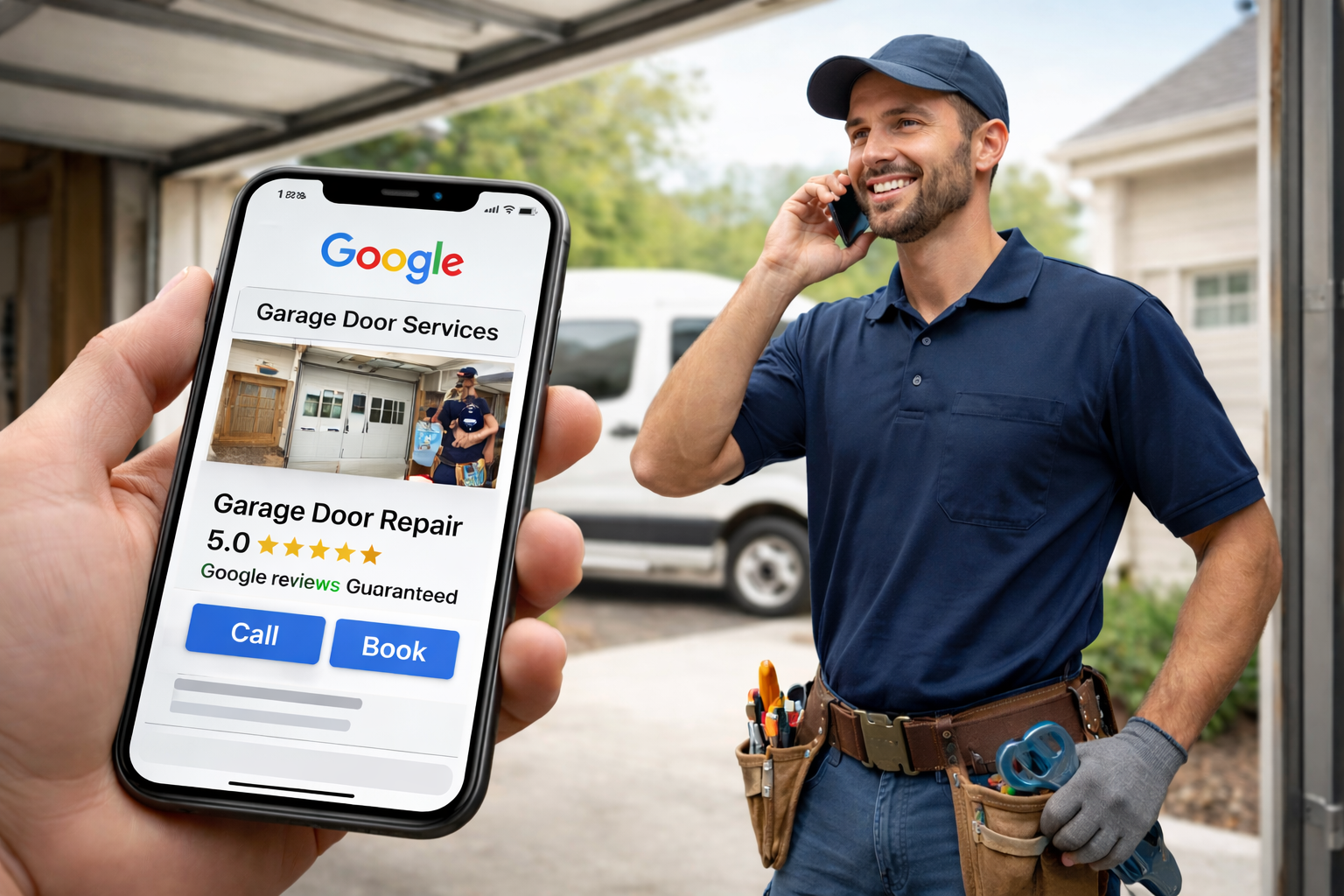
The 6 ways garage door companies get repair leads in 2026
Almost every garage door company we talk to uses some combination of these six channels. The ratio between them is what determines whether you have a cost-controlled, scalable lead system or a treadmill of expensive rented leads with no end in sight.
- Google Local Services Ads (LSA). Pay-per-lead at the top of Google search, Google Verified badge. The single highest-intent channel for emergency repair calls.
- Google Ads (PPC). Pay-per-click for search and Performance Max. Best for install jobs and broader keyword coverage.
- Google Business Profile and local SEO. The cheapest lead source long-term. Effectively free per lead, but takes months to mature.
- Pay-per-call lead services. ResultCalls, Service Direct, Networx, others. Rent leads at $24 to $45 per call, no setup required.
- Shared lead aggregators. Angi, HomeAdvisor, Thumbtack. Leads sold to multiple companies simultaneously.
- Direct mail, Nextdoor, Facebook. Lower volume, niche channels that fill specific gaps.
The first three are channels you own. The next two are channels you rent. The sixth is mixed. The framing throughout this guide is built around that distinction, because it is the single most important variable in your lead economics over a 12 to 24 month horizon.
Channel 1: Google Local Services Ads
Cost per lead: $20 to $75 in most US markets. Larger metros and emergency-keyword bidding push to the high end. Smaller markets and steadier residential repair work come in lower.
Cost per lead is just CPC divided by conversion rate, which the free CPA calculator will do for you.
LSA puts your business at the very top of Google search results, above every Google Ad, above the map pack, above every organic listing. You pay only when a homeowner contacts you directly through the listing, never per click or per impression. The Google Verified badge on your listing tells the homeowner that Google has already vetted your license, insurance, and background, which is a real competitive advantage in an industry with a documented FTC consumer-protection history against deceptive operators.
Why it wins for garage door repair specifically: emergency intent. Broken springs, doors off the track, and openers that died overnight do not get comparison-shopped. The homeowner calls the first listing on Google that looks legitimate. LSA is built for that exact moment.
Pros: pay-per-lead model, top-of-SERP placement, Google Verified trust signal, lead dispute system that recovers spend on bad leads, profile-based ranking with no campaign management overhead once set up.
Cons: 2 to 6 week verification timeline, requires background check, lead dispute filing takes consistent weekly time, job-type setup mistakes can silently kill volume.
For the full setup walkthrough including job-type strategy, ranking factors, and the dispute workflow, see our dedicated Google LSA for Garage Door Companies guide.
Channel 2: Google Ads
Cost per lead: $45 to $90 in most markets at a healthy 10 to 15% conversion rate. Bad accounts with no negative keywords, weak landing pages, and set-and-forget bidding run $120 to $180. Well-run accounts can hit $40 to $65.
Google Ads gives you control LSA cannot: specific keyword targeting, custom landing pages per job type, ad copy that speaks to your differentiation, branded campaigns that defend your name from competitors bidding on it. Where LSA wins on intent, Google Ads wins on coverage and control. Note that garage door is a restricted business under Google Ads policy, so Advanced Verification must complete before search campaigns launch.
Why it wins for garage door installs and commercial work: install searches like "new garage door installation" and "double car garage door cost," and commercial searches like "commercial garage door repair" or "rolling steel door" have higher ticket value but more research-mode behavior. Google Ads can run a dedicated install landing page with financing offers, brand comparisons, and warranty details that LSA cannot.
Pros: full keyword and audience control, custom landing pages, branded defense, broader geo coverage, performance scales with budget.
Cons: higher CPL than LSA, requires real account hygiene to keep CPL low, pay-per-click means you pay for tire-kickers without ongoing optimization.
For the campaign structure, keyword tiers, and 8 common mistakes that kill garage door Google Ads accounts, see our Google Ads for Garage Door Companies playbook.
Channel 3: Google Business Profile + Local SEO
Cost per lead: $5 to $30 at maturity. This is the cheapest lead source long-term but takes 3 to 6 months to start producing meaningful volume and 9 to 12 months to fully mature.
Google Business Profile drives the map pack, the local 3-pack at the top of search results for "garage door repair near me" and similar queries. A well-optimized GBP with current photos, regular posts, verified services, and 80+ reviews can produce 20 to 60 inbound calls per month at essentially zero per-lead cost. The investment is in profile management and review collection, not per-call payments. Think With Google data shows "near me" searches have grown over 900% in the last decade, and BrightLocal's annual consumer review survey documents that 87% of consumers read online reviews for local businesses before calling, which is why review count and freshness are the highest-leverage GBP signals.
Why every operator should be doing this in parallel with paid channels: GBP is a compounding asset. The reviews you collect this year still produce leads three years from now. The ranking position you build through consistent activity does not disappear when you stop spending. Paid channels go quiet the day you turn them off. Organic does not.
Pros: lowest CPL at maturity, compounding asset value, organic trust from review count, no per-lead spend, leads convert at a higher rate than paid because the customer chose to call you specifically.
Cons: 3 to 6 month ramp before first meaningful leads, ongoing time investment in posts and reviews, competitive saturation in large metros, no ability to scale volume on demand.
See our GBP optimization playbook for contractors for the full setup checklist.
Channel 4: Pay-per-call lead services
Cost per call: $24 to $45 per call. Major vendors include ResultCalls, Service Direct, Networx, HomeAdvisor's pay-per-call program, and smaller regional operators. Pricing pages and rate cards published on each vendor's site are the most current source.
Pay-per-call services run their own paid ad campaigns and route inbound calls to contractors who have signed up for that geo. You pay per call, the vendor handles ad spend, targeting, and campaign management. From your side, the only thing you do is answer the phone.
What that actually looks like in practice: the vendor runs Google Ads targeting your zip code, the homeowner clicks an ad, calls a tracked phone number, the vendor's IVR briefly qualifies the call, and the call routes to your line. You pay per call regardless of whether you book the job. Most vendors charge in advance via prepay credits or invoice you weekly.
Pros: zero setup, leads start within 24 to 72 hours, no campaign management, no Google Verified background check required, works without a website.
Cons: permanent rental cost, no asset ownership, lead disputes harder to win than LSA disputes, "exclusive" usually means one company per call but the same geo is sold to multiple companies, calls are pre-qualified by the vendor (which can filter out high-intent emergency callers), per-call cost stays flat over time and does not get cheaper as you build history.
The "exclusive" definition is worth pausing on. Most pay-per-call vendors define exclusivity as one company per call, not one company per geographic territory. A homeowner three doors down from your last customer might get routed to a competitor using the same vendor. True geographic exclusivity in residential garage door is rare and significantly more expensive than the headline rates suggest.
Channel 5: Shared lead aggregators
Cost per lead: $15 to $60 per shared lead, $40 to $120 per exclusive lead. The largest aggregators in residential home services are Angi (formerly Angi's List), HomeAdvisor (both owned by parent company Angi Inc.), Thumbtack, and Networx. The financial filings published by Angi Inc. document the shared-lead distribution model and the per-lead margin economics that drive how aggressively each lead is resold.
Aggregators collect lead intake forms through their own marketing, then sell each lead to multiple contractors simultaneously, typically 3 to 4 per shared lead. The contractor who responds fastest usually wins the job, which creates a race-to-the-phone dynamic that benefits whoever is sitting at their desk that minute.
The economics math nobody runs: a $30 shared lead sold to 4 contractors only converts for one of them. The other three paid $30 each for nothing. Aggregators usually do not offer credits for those losses. So the real CPL for a contractor running on aggregator leads is closer to $90 to $120 when you account for the leads you paid for and lost, not just the ones you booked.
Pros: instant volume, no setup, works as a slow-season capacity filler.
Cons: shared with 3 to 4 competitors per lead by default, dispute friction is high, brand dilution because you appear on their platform and not your own, no asset ownership, race-to-the-phone dynamics, lead quality declines over time as the aggregator scales.
Aggregators are a defensible choice as a slow-season gap filler. They are a money loser as a primary lead channel.
Channel 6: Direct mail, Nextdoor, Facebook
Cost per lead: highly variable, $20 to $80+ depending on channel and execution.
Direct mail. Postcards to specific zip codes, often with a seasonal offer (spring tune-up, opener inspection). Works for established operators with a known brand in a defined service area. Slow to produce results, harder to track, but generates pre-qualified leads that have your physical card in hand.
Nextdoor. Sponsored posts and neighborhood-targeted ads. Underused by garage door companies. Works particularly well for opener installation and new door inquiries because Nextdoor users are typically homeowners actively engaged in neighborhood discussions. See our Nextdoor ads for contractors guide for the targeting playbook.
Facebook and Instagram. Effective for install and replacement leads through lead-gen ads with images of completed projects. Less effective for emergency repair because intent on social platforms is low. Best used as a top-of-funnel channel that feeds into your retargeting and email follow-up.
The 6-channel cost comparison table
All six channels side by side. CPL ranges are based on Blue Grid Media's 2026 contractor data and the major published industry studies.
| Channel | CPL range | Time to first lead | Asset ownership | Best for |
|---|---|---|---|---|
| Google LSA | $20 to $75 | 14 to 42 days (after verification) | Yours | Emergency repair, residential service |
| Google Ads | $45 to $90 | 3 to 14 days | Yours | Install jobs, commercial, branded defense |
| GBP + Local SEO | $5 to $30 (at maturity) | 3 to 6 months | Yours (compounding) | Every operator, run in parallel |
| Pay-per-call services | $24 to $45 per call | 1 to 3 days | Rented (zero) | Brand new operators, capacity ramp |
| Lead aggregators | $15 to $60 shared, $40 to $120 exclusive | 1 to 3 days | Rented (zero) | Slow-season filler only |
| Direct mail / Nextdoor / Facebook | $20 to $80+ (varies) | 2 to 6 weeks | Mixed | Niche channels, install promotion, retargeting |
The columns that matter most are asset ownership and time to first lead. Owned channels (LSA, Google Ads, GBP) have higher upfront friction but accumulate value over time. Rented channels (pay-per-call, aggregators) produce instant flow but stop the day you stop paying and never produce an asset you can sell, hand off, or scale independently of the vendor.
Rent or own: the math that decides for you
Take a single hypothetical garage door operator targeting 100 leads per month. Here is what the two paths look like.
Year 1, pay-per-call only: 100 leads/month at $35 average per call across 12 months equals $42,000. At the end of year 1, the operator owns zero assets. If they stop paying, lead flow drops to zero within 24 hours.
Year 1, owned channels (LSA + Google Ads + GBP, professionally managed): roughly $3,000 to $4,000 per month in ad spend split across the channels, plus management fee. Total year-1 cost is roughly $40,000 to $48,000. CPL averages drop month over month as the account matures, ending the year around $35 to $45 per lead. At the end of year 1, the operator owns three active accounts with built-up history, a reviewed GBP, and a Google Verified LSA profile worth approximately $10,000 to $15,000 in transferable value.
Year 2: the rented model stays flat at $42,000. The per-call rate does not decrease. The owned model drops to roughly $30,000 to $36,000 because GBP is producing 30 to 40% of leads at near-zero cost, LSA disputes are recovering 10 to 15% of spend, and the Google Ads account hygiene has stabilized.
Year 3 and beyond: the gap widens. The rented model never gets cheaper. The owned model continues to compound as GBP ranking improves and review velocity builds.
The math always favors ownership beyond the first 90 days. The only question is whether you have the patience to ride the first 90 days through to the payoff.
When pay-per-call actually makes sense
There are three scenarios where pay-per-call is the right call. Outside of these, it is a money loser.
- Brand new operator with no GBP, no website, no time to build accounts. First 30 to 60 days, you need cash flow. Pay-per-call delivers leads within 72 hours. Use it to fund the buildout of your owned channels, then turn it off.
- Capacity gap fill during a sudden ramp. You just hired two techs, you need to fill their schedules immediately, your Google Ads account cannot scale that fast. Pay-per-call covers the gap until your owned channels catch up. Time-bound use.
- Geographic expansion test. You want to test a new market before committing to setting up LSA verification and Google Ads campaigns there. Pay-per-call lets you validate demand for 60 to 90 days, then either commit to building owned channels in the new market or pull out cheap.
Notice what is not on this list: "I do not want to deal with managing my own ads." That is a problem an agency solves at a fraction of pay-per-call cost. The 5 to 15% management fee an agency charges to run owned channels is dramatically cheaper than the 100% markup baked into per-call rates.
The own-the-channel playbook for garage door
If you decide to build instead of rent, here is the order of operations for the first 90 days.
- Set up and verify Google LSA. Start the background check and license verification first, it is the slowest step. While verification processes, build out your full job type list: spring repair, opener install, panel replacement, cable repair, off-track repair, all of it. See the LSA setup playbook for the full walkthrough.
- Optimize your Google Business Profile in parallel. GBP optimization takes 2 to 4 hours of focused work and starts compounding immediately. Upload 30+ photos, fill every service category, enable messaging, build the review request into your job-close workflow. See the GBP playbook.
- Launch Google Ads with a clean 3-campaign structure. Repair campaign, Install campaign, optional Commercial campaign. Negative keyword list of 100+ terms on day one. Dedicated landing pages per job type. See the Google Ads playbook for the campaign templates.
- Install proper conversion tracking and call routing. Without accurate tracking, you cannot optimize. Call tracking numbers per channel, GA4 conversion events, Google Ads conversion import, weekly review of which channel produces which type of lead.
Done well, this 90-day buildout puts you under $50 per lead by month 4 and produces compounding value every month after.
How Blue Grid Media builds the system
We run the LSA setup, the Google Ads campaign build, and the GBP optimization as a coordinated three-channel system, not three separate accounts that compete with each other. The pricing is a $695 monthly retainer plus 5% of ad spend (Google bills your ad spend directly, you only pay us the management fee). No setup fee. No long-term contract. Month-to-month engagement, 30 days notice to cancel.
The garage door operators we work with range from single-truck owners running $2,000 to $5,000 a month all the way up to multi-state accounts running over $100,000 per month in ad spend across LSA and Google Ads. The playbook scales because the same fundamentals (job-type configuration, negative keyword hygiene, per-metro campaign structure, conversion tracking, dispute filing) move the needle whether you are spending $2K a month or $100K a month. What changes at scale is reporting cadence, per-market bid management, and the size of the recurring optimization wins.
Compare that to the typical 15% of ad spend the larger agencies charge, or the $35 per call pay-per-call rate that never drops, and the math is straightforward. We bet on the relationship lasting because we make it work, not because we lock you in.
“ Your landing pages are on us. Custom pages built for your campaigns, no design fee, no setup fee, no contract. If we don't move the needle on booked jobs, walk away any month and keep everything we built, pages included. ”

Garage Door Repair Leads FAQ
Should I buy garage door leads or run my own ads?
Buying leads from a pay-per-call service makes sense in the first 30 to 60 days while you set up your own Google Verified profile and Google Ads account. After that, owned channels consistently beat rented leads on cost per booked job and build an asset you control. The break-even point is usually month 4 to month 6, when LSA and Google Ads account hygiene has matured enough to drop CPL below the per-call rates pay-per-call vendors charge.
What is the cheapest source of garage door repair leads?
Local SEO plus an optimized Google Business Profile produces the cheapest leads long-term at around $5 to $30 per lead once it ranks. The catch is the 3 to 6 month ramp time. Google LSA runs $20 to $75 per lead and is the cheapest pay-per-lead channel from day one. Google Ads runs $45 to $90 per lead but unlocks install jobs and broader keyword coverage. Pay-per-call services start at $24 to $45 per call, never get cheaper, and stop the day you stop paying.
Are pay-per-call exclusive leads really exclusive?
Sometimes, but the definition is narrower than the marketing copy suggests. Most pay-per-call vendors define exclusive as one company per call, but they sell the same zip code to multiple companies and route different calls to different operators. That is not the same as geographic exclusivity. A homeowner three doors down from your last customer might get routed to a competitor on the same vendor. True geographic exclusivity in residential garage door is rare and expensive.
How long until owned garage door leads beat pay-per-call CPL?
For a well-run setup, owned channel CPL typically drops below pay-per-call rates by month 3 to 4. LSA gets there fastest, often in the first 30 to 60 days, because dispute filing recovers 10 to 15 percent of spend immediately. Google Ads takes a few weeks longer because the account needs conversion data to optimize. Local SEO is the longest payback at 6 to 12 months but produces the cheapest leads after that.
Can I run pay-per-call services and Google Ads at the same time?
Yes, and it is usually the right move during the ramp up phase. Pay-per-call covers your capacity gap while your own account is being built. Once your owned account is producing 60 to 80 percent of your monthly lead target at lower CPL, scale back pay-per-call spend. Operators who run both indefinitely usually pay 30 to 50 percent more for the same lead volume because they never fully transition to the cheaper channel.
What if I do not have a website yet?
You can run Google LSA without a website. Google Ads technically requires a landing page but it does not have to be a full website. A single dedicated landing page is enough to start, and that is something a small budget can produce in a week. Pay-per-call services do not require a website at all, which is one of the few cases where they make sense as a first step. Once you have any owned web presence, owned-channel CPL beats pay-per-call within two months.
How many garage door leads can I get on a $5,000 per month Google Ads budget?
On a well-run garage door Google Ads account at $5,000 monthly spend, expect 70 to 100 leads per month at a $50 to $70 cost per lead. A poorly run account at the same spend produces 25 to 40 leads at $120 to $180 per lead. The 2 to 3x lead volume swing is entirely driven by account hygiene: negative keyword lists, landing page conversion rate, bid strategy, and conversion tracking accuracy.
Is LSA or pay-per-call better for emergency garage door calls?
LSA wins for emergency garage door calls. Homeowners with a broken spring at 6am call whoever shows up first on Google with a trust signal, and LSA puts you above every Google Ad and organic result with the Google Verified badge. Pay-per-call vendors route emergency calls through their own number first, which adds a step and screens out a percentage of urgent callers. Direct routing through LSA beats both response time and conversion rate.
Running garage door pay-per-call at $20K+/month? This guide is the buy-side view (channels and CPLs from the contractor's perspective). The Garage Door Lead Gen Playbook is the sell-side view: scaling pay-per-call operator accounts past $50K and $100K monthly, the 4 ceilings that kill operators in between, and the Conversion API + Performance Max stack you need to break through them.
Next steps
The garage door operators we work with who win on lead cost share three things in common. They run LSA and Google Ads together, not one or the other. They invest in GBP early and stay consistent on review collection. And they use pay-per-call services strategically as a capacity tool, not a permanent lead source.
If you want a walk-through of what your current lead mix is costing you and where the biggest wins are in your specific market, that is exactly what we do on a first call. No pitch deck. No sales script. We open the numbers together and tell you what we would change.
No obligation. We look at your numbers and tell you what is working and what isn't.
Cost-per-lead ranges in this guide reflect Blue Grid Media's 2026 data, the major published industry studies (LocaliQ, BrightLocal), and the published rates of leading pay-per-call vendors. Actual costs vary by market, season, account quality, and how consistently you follow up on leads.
Channel deep-dives once you've picked your mix
This 6-channel comparison sits at the top of our garage door operator series. Once you've decided where to spend, each channel has its own execution playbook: