
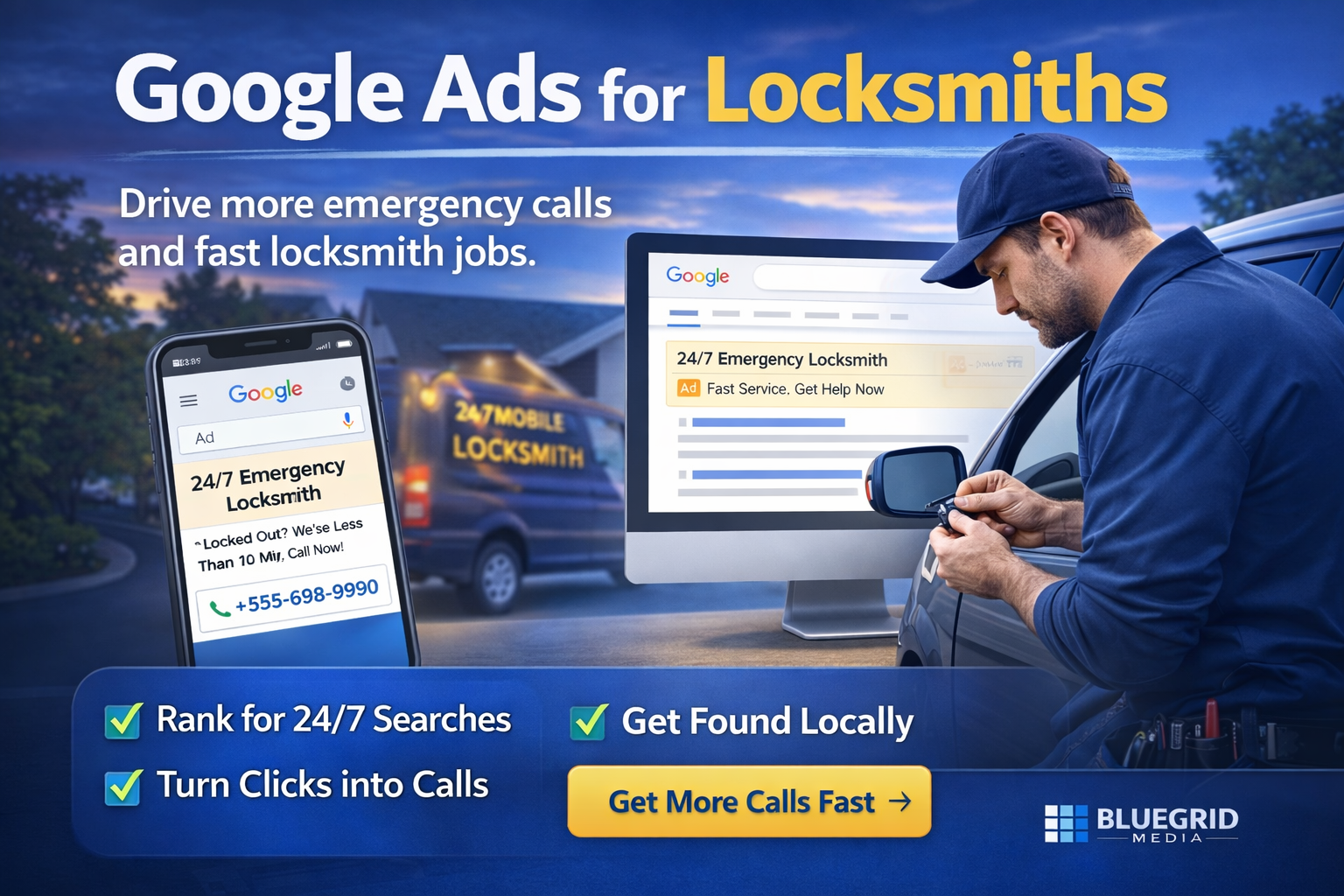
Direct answer: Locksmith Google Ads runs through a 4-campaign structure separated by intent: emergency lockout (CPC $25-$45, close rate 60-80 percent, avg ticket $75-$150), residential services (rekey, lock install, smart lock, CPC $12-$22), commercial (access control, master key systems, CPC $15-$28, ticket $300-$2,000+), and automotive (car key replacement, fob programming, CPC $15-$30, ticket $75-$250 standard or $400-$1,500 for coded keys). Locksmith services are one of only three business categories Google requires Advanced Verification to advertise (alongside garage door repair and Netherlands plumbers), so verification must complete before campaigns launch in the US, Canada, Spain, Netherlands, Germany, Sweden, or Belgium. Done correctly, CPL runs $40-$80 with cost per booked job under $130 on emergency lockout keywords. Done wrong (no verification, no negative keywords, generic landing pages), the same searches produce $90-$200 CPLs and frequent ad disapprovals on the most competitive emergency terms.
This guide covers the verification process Google reviewers actually evaluate, the campaign architecture that beats fake-locksmith bidders on Quality Score, brand-authorized bidding for Schlage, Yale, Medeco, ASSA, Mul-T-Lock, August, Kwikset, and Level dealers, seasonal patterns by service type, the trust-signal ad copy that converts the skeptical post-fake-locksmith homeowner, and the operational specifics we measure across the locksmith accounts we manage.
Why does Google require advanced verification for locksmith advertising?
Locksmith services are one of only three categories Google singles out for advertising restriction in its official Restricted Businesses: Local Services policy. The exact policy language: "Ads for locksmith services and garage door repair services are restricted. To advertise, you must apply for advanced verification." This applies to locksmith services in the United States, Canada, Spain, Netherlands, Germany, Sweden, and Belgium. In Spain, Netherlands, Germany, Sweden, and Belgium, locksmith advertising is prohibited entirely.
This is the critical context most Google Ads playbooks for locksmiths skip entirely. If you launch a Google Ads account targeting locksmith keywords without completing advanced verification, you will hit policy disapproval on your ads, your account can be suspended, and you will burn weeks of optimization momentum recovering. The verification step is not optional and it has to happen before campaign launch.
Why this policy exists (consumer protection history)
The locksmith restriction traces back to documented patterns of fraudulent and predatory locksmith operators going back to the early 2000s. Bait-and-switch pricing on emergency lockout calls, unlicensed operators using thin national directories to harvest leads, and aggressive upsells that turned $75 lockout calls into $400-$800 "emergency" tickets generated enough complaints that Google added locksmiths to the same restricted category as garage door services. The FTC's locksmith scam consumer guidance documents the predatory pricing scheme that prompted the policy. Major locksmith industry trade bodies including the Associated Locksmiths of America (ALOA) formally support the verification requirement because it raises the credibility floor for legitimate operators.
What advanced verification actually requires
Google's verification process for locksmith operators typically includes the following components. Specifics vary by jurisdiction and the documentation requirements have evolved over time.
- Business license verification: Active business license in the state and any locality where you operate. Some states (Illinois, North Carolina, Tennessee, Texas, Oklahoma, Louisiana, New Jersey, Virginia, Nevada, Alabama, Connecticut, California) require state-level locksmith licensure specifically; the state license must be current.
- General liability insurance: Certificate of insurance naming the business as insured, typically requiring $300,000-$1,000,000+ in general liability coverage depending on jurisdiction.
- Workers compensation insurance: Where required by state law for businesses with employees.
- Background check on business owner(s): Google partners with third-party background check providers (typically Pinkerton or Evident ID). The check covers criminal history, fraud history, and identity verification. Locksmith verification is particularly rigorous on this step given the trust-sensitive nature of the trade.
- Background checks on field technicians: Every technician who will run a Google-routed call must pass the same background check.
- Business documentation: Proof of business address (Google specifically flags PO box addresses as non-qualifying because of fake-locksmith association), vehicle registration for service vehicles, and EIN documentation.
The verification process takes 2 to 6 weeks from application submission to approval in most cases. Locksmith verification specifically tends to land on the slower end of that range because the fraud history in the trade prompts more careful review. Apply for verification at Google's Local Services Ads provider portal before you launch your Google Ads search campaigns so the timing aligns.
What we have seen across operator-run accounts
The advanced verification requirement is most visible in Local Services Ads (Google Verified, formerly Google Guaranteed), but Google's policy enforcement also affects Google Ads search campaigns targeting locksmith keywords. In our experience onboarding new locksmith clients, operators who skipped verification typically experienced one of three patterns within the first 30 days: ad disapprovals on locksmith-specific creative, limited ad serving on emergency lockout keywords, or full account suspension after a manual policy review. We have walked operators through resubmissions after rejection, and the most common rejection reason we encounter is incomplete background checks on field technicians rather than failed owner background checks. Operators who completed verification first launched cleanly and ran without policy friction.
The practical playbook: complete Google Ads advanced verification before launching search campaigns. Use the verification waiting period to build out negative keyword lists, landing pages, brand-authorized credentials, and your conversion tracking stack. When verification approves, you are ready to launch a clean account with full policy compliance.
Why are fake locksmiths driving up real locksmith Google Ads costs?
A homeowner locks herself out at 11pm. She Googles "locksmith near me." The first three paid results are fake national directories that resell the call to whoever pays the most that day. She picks one and calls. Someone shows up 90 minutes later and charges $300 for a job that should have cost $75. She leaves a one-star review. Not for the fake directory. For the locksmith who showed up.
This is the world you are advertising in. The fake locksmith problem is not a minor nuisance. It is an industry-wide issue that inflates your CPCs, damages the category's reputation, and has trained homeowners to be genuinely skeptical of Google Ads results for locksmiths specifically. According to the FTC, locksmith fraud is one of the most reported categories of local service scams in the country. Google has added verification steps and the Google Verified badge to help, but the fakes adapt fast. New campaigns launch constantly.
Here is what this means for your Google Ads account. Fake locksmith operations typically run national campaigns with thin local pages, no real address, and low Quality Scores. They bid aggressively to compensate for their poor QS, which inflates the auction for everyone. You end up paying $30-$45 per click on emergency lockout terms not because the market is worth that on its own, but because a fake in New Jersey is bidding against you in your city with a $50 max CPC and no Quality Score history behind it.
The free CPC calculator solves for spend, clicks or cost per click, whichever you are missing.
The good news is that Quality Score is your biggest advantage over fakes. A real local locksmith with a verified address, a conversion history, and relevant landing pages will consistently beat national fake operators on QS. That means lower CPCs for the same ad position. A local account with a QS of 7-8 on emergency lockout terms typically pays 25-35% less per click than a fake national campaign sitting at QS 4-5 on the same keywords. That gap grows over time as your account accumulates history and they keep launching fresh campaigns.
If you want the full foundation for contractor Google Ads first, start with the Google Ads for Contractors hub and come back here for the locksmith-specific detail.
What does the locksmith Google Ads keyword universe look like (4 categories with different CPCs)?
Locksmiths make a common mistake of throwing all their keywords into one campaign. Emergency lockouts, rekeying jobs, commercial installations, and car key replacements are four completely different buyers with different urgency levels, different average tickets, and very different conversion rates. Treating them identically wastes your emergency budget on low-urgency searches and starves emergency campaigns of the budget they need to win. The CPC ranges below come from the locksmith accounts we manage in 2026 cross-referenced with LocaliQ's home services PPC benchmarks.
An average ticket is revenue, not profit. The free contractor profit margin calculator shows what actually survives labor burden and overhead on a job that size.
| Category | Example Keywords | CPC Range | Conversion Rate | Avg Ticket |
|---|---|---|---|---|
| Emergency Lockouts | "locksmith near me," "locked out of house," "car lockout service," "24 hour locksmith" | $25-$45 | 60-80% | $75-$150 |
| Residential Services | "rekey locks," "lock installation," "deadbolt installation," "smart lock install" | $12-$22 | 15-25% | $100-$350 |
| Commercial | "commercial locksmith," "office rekeying," "access control installation," "master key system" | $15-$28 | 8-15% | $300-$2,000+ |
| Automotive | "car key replacement," "key fob programming," "auto locksmith," "lost car key" | $15-$30 | 40-65% | $75-$250 |
What is the actual CPL and cost per booked job by locksmith service type?
CPC by itself does not predict whether a category is profitable. The math that matters is CPL (CPC ÷ conversion rate) and cost per booked job (CPL ÷ close rate). The table below translates the CPC ranges above into CPL ranges and cost per booked job, with the brand-authorized row added at the bottom for operators who hold dealer credentials with Schlage, Yale, Medeco, ASSA, Mul-T-Lock, August, Kwikset, or Level.
| Service Type | CPC | Conv Rate | CPL | Close Rate | Cost per Booked Job | Avg Ticket |
|---|---|---|---|---|---|---|
| Emergency residential lockout | $25-$45 | 9-14% | $180-$500 | 75-88% | $205-$665 | $75-$150 |
| Emergency car lockout | $20-$38 | 9-13% | $155-$420 | 70-85% | $185-$600 | $75-$200 |
| Rekey / lock change residential | $12-$22 | 5-9% | $135-$440 | 40-60% | $225-$1,100 | $100-$300 |
| Smart lock install (August, Yale, Schlage Encode, Level) | $10-$20 | 6-10% | $100-$335 | 35-55% | $185-$955 | $200-$450 |
| Car key replacement / fob program | $15-$30 | 5-9% | $170-$600 | 40-60% | $285-$1,500 | $75-$250 standard, $400-$1,500 coded |
| Commercial rekey / master key system | $15-$28 | 4-7% | $215-$700 | 20-35% | $615-$3,500 | $300-$2,000+ |
| Access control install / commercial security | $18-$32 | 3-6% | $300-$1,065 | 20-30% | $1,000-$5,330 | $1,500-$15,000+ |
| Brand-authorized install (Schlage Pro, Yale Authorized, Medeco) | $12-$25 | 5-9% | $135-$500 | 35-55% | $245-$1,430 | $200-$1,200 |
Emergency lockout campaigns have one of the highest close rates of any home service keyword category in Google Ads (75-88 percent for residential, 70-85 percent for automotive) because the searcher physically cannot get into their property or vehicle. That close rate is your structural advantage and the largest reason we recommend allocating 35-45 percent of total budget to emergency campaigns in most locksmith accounts.
Why is brand-authorized status the highest-leverage move in locksmith Google Ads?
Brand-authorized programs in locksmith are an underexploited Google Ads lever. Schlage Authorized Service Provider, Yale Authorized Dealer, Medeco Authorized Dealer, ASSA ABLOY Authorized Service, Mul-T-Lock Authorized Service, August Authorized Installer, Kwikset Pro, and Level Bolt Authorized Installer programs all offer dedicated installer networks. In the brand-authorized locksmith accounts we manage, brand-specific keyword traffic ("Schlage smart lock install," "Medeco high-security rekey," "Yale Assure Lock authorized installer") consistently runs lower CPC because fewer authorized competitors can legitimately claim the credential, while close rate runs 25-40 percent higher than generic equivalents because the buyer is brand-loyal.
The three highest-leverage moves: (1) apply for at least one residential brand authorization program your service area supports. Schlage Authorized Service Provider and Medeco Authorized Dealer are the highest-volume residential programs and the easiest to start with. (2) Build a separate brand-specific campaign with brand-specific landing pages displaying your authorization credential, certifications, and brand-specific service capabilities. (3) For commercial work, pursue authorized status with ASSA ABLOY or Medeco commercial programs which produce $1,500-$15,000+ tickets at modest CPL.
What are the seasonal demand patterns for locksmith Google Ads?
Locksmith demand has four distinct seasonal patterns most operators leave unoptimized. In the accounts we manage where seasonal bid pacing is in place, we see a 12-22 percent margin lift over flat-budget accounts in the same metros.
- Winter peak (December through February): residential lockouts spike. Cold weather causes residents to break key rings and lock themselves out at higher rates. Visiting holiday relatives unfamiliar with the home account for a measurable share of December-January lockout calls. Push emergency residential lockout campaign budget up 25-40 percent December-February in cold-climate metros.
- Summer peak (May through August): car lockouts spike. Hot weather damages key fob battery life faster, beach and outdoor activity creates more lost-key opportunities, and rental car return lockouts hit a peak in vacation markets. Push emergency car lockout campaign budget up 30-50 percent in this window.
- Spring (March through May): residential install peak. Spring home improvement projects, post-winter security upgrades, and the smart lock install peak driven by new product release cycles concentrate in this window. Push smart lock and residential install campaign budget up 25-40 percent.
- Holiday season (November through December): residential install and smart lock spike. Smart locks (August, Yale Assure, Schlage Encode, Level Bolt) move as gift purchases. Holiday travel drives security upgrade demand. Push smart lock and security upgrade campaign budget up 30-50 percent.
Modifier keywords worth bidding on
Certain modifier keywords attract higher-intent searches across all categories. "24 hour locksmith" and "emergency locksmith" capture the urgency signal that often precedes an immediate call. "Cheap locksmith" is worth bidding on for budget-conscious searchers, but pair it with a landing page that shows upfront pricing. If you charge $89 for a standard lockout and your page says so clearly, you convert more of those visitors than a vague page that makes them call to find out. Price transparency reduces the "is this a scam?" hesitation that kills locksmith conversion rates.
Emergency lockout keywords have the highest CPC in the category but also the highest conversion rate by a wide margin. A 60-80% call-to-click rate for emergency searches versus 15-25% for residential rekeying means the math often favors putting more budget into emergency terms, even at a premium CPC, because the revenue per dollar of spend is stronger. Run the numbers for your own market using our locksmith Google Ads ROI calculator.
Negative keywords: add these before your first dollar of spend
Locksmith campaigns are consistently flooded with irrelevant traffic that looks like local service intent but is not. Add these as negatives before you launch:
- DIY and how-to terms: "how to pick a lock," "lockpick set," "bump key," "lockpicking kit," "how to unlock a door without a key"
- Training and education: "locksmith training," "locksmith school," "locksmith certification course," "how to become a locksmith," "locksmith apprenticeship"
- Jobs and employment: "locksmith jobs," "locksmith hiring," "locksmith careers," "locksmith salary"
- Supplies and equipment: "locksmith supplies," "locksmith tools," "lock pick tools," "locksmith equipment"
- Scam bait terms: "locksmith near me free," "free locksmith," "locksmith no charge" (these are commonly used in fake locksmith bait-and-switch searches, not legitimate service requests)
How should you structure Google Ads campaigns for a locksmith business?
The single biggest structural mistake in locksmith Google Ads is one campaign for everything. Your emergency lockout ads should run 24/7 with call-only format and a tight 5-10 mile radius. Your residential rekeying ads should run on a business hours schedule with landing pages. Your commercial campaigns should target business hours on weekdays only. None of that is possible if they share a budget, a schedule, and a bid strategy inside one campaign.
Campaign 1: Emergency Lockouts (Call-Only)
- Keywords: Exact and phrase match on lockout terms. "locked out of house," "car lockout service," "locksmith near me," "emergency locksmith [city]"
- Ad format: Call-only ads. No landing page needed. The CTA is the phone number. Emergency searchers on mobile do not want to visit a website first.
- Bidding: Manual CPC to start. Switch to Target CPA or Maximize Conversions once you have 30 or more conversions tracked.
- Budget: 50-60% of your total monthly spend
- Ad schedule: 24/7. Lockouts happen at midnight on a Tuesday as often as on a Saturday afternoon.
- Location: Tight radius, 5-10 miles from your dispatch point. Every call you cannot fulfill within 30 minutes is a bad customer experience and a wasted click.
- Key ad copy elements: "Local Locksmith," "Licensed and Insured," "30-Min Response," "No Hidden Fees," "Upfront Pricing"
Campaign 2: Residential Services (Search + Landing Page)
- Keywords: Phrase match or broad match with Smart Bidding (once conversion data exists). Rekeying, deadbolt installation, smart lock installation, residential locksmith.
- Ad format: Responsive search ads. 3 headline combinations rotating. Include a service-specific headline (e.g., "Rekey All Locks - $89 Per Door") to pre-qualify clicks.
- Bidding: Start with Maximize Clicks at a max CPC cap, move to Target CPA after 20-30 conversions.
- Budget: 25-30% of total spend
- Ad schedule: 7am-9pm daily. Most residential service searches happen evenings and weekends, not 3am.
- Landing page: Service-specific page for rekeying, not your homepage. Include pricing, a photo of your actual van or technician, and a click-to-call button above the fold.
Campaign 3: Commercial (Search + Landing Page)
- Keywords: Phrase and exact match. Commercial keywords attract more irrelevant queries from residential searchers adding "commercial" to sound authoritative. Tight match types reduce waste here.
- Budget: 15-20% of total spend
- Ad schedule: 8am-6pm Monday through Friday. Commercial decision-makers are not searching for access control installation at 10pm on Sunday.
- Landing page: Commercial-specific page with business language, not residential copy. Mention business types you serve (offices, retail, multifamily, property management). Include a quote request form, not just a call button, since commercial buyers often want email communication first.
- Conversion action: Track both calls AND form submissions as conversions so Smart Bidding sees the full commercial lead picture.
Automotive key services can be added as Campaign 4 if you offer car key replacement and programming. Many residential locksmiths skip this because automotive requires specialized equipment, and running automotive ads without the capability generates calls you cannot fulfill. Only add it if car key work is a real part of your service offering.
What should locksmiths spend on Google Ads by company size?
The most common question from locksmiths starting Google Ads is "how much should I spend?" The honest answer is: enough to generate enough conversion data for Smart Bidding to work, which means a minimum of 30 conversions per month across your campaigns. Below that threshold, you are essentially on manual control indefinitely.
Covers emergency lockouts in a single city. Expect 15-25 calls per month. Focus exclusively on Campaign 1 (call-only) until volume grows.
Covers emergency plus residential campaigns. 25-50 calls per month across both. Enough volume to start Smart Bidding on the emergency campaign by month 2-3.
Necessary to compete in Chicago, LA, Houston, NYC, and similar markets where fake locksmith operations inflate CPCs most aggressively. Under-spending in these markets generates inconsistent results.
When commercial accounts justify higher lead investment. Commercial CPLs run higher but ticket values ($300-$2,000+) and recurring contract revenue make the math work at this spend level.
Month 1 vs. Month 3 ROI Example: $2,000/mo Budget
Month 1 is intentionally below break-even in many locksmith accounts. The algorithm is learning which searches, times of day, and user signals produce callers who book. That learning phase costs real money, but skipping it by pausing campaigns early is the most common reason locksmiths write off Google Ads as "not working." The accounts that stick through months 1-2 and let Smart Bidding mature typically see CPL drop 30-45% from their initial rates by month 4-5.
What locksmith ad copy actually wins on trust (with fake locksmiths bidding next to you)?
Your ad needs to answer one unspoken question before anything else: "Is this a real local locksmith or another one of those fake services that will send someone who charges me $300?" That is what is running through the searcher's mind when they are locked out at night and scrolling through results. Your headline and description have about 3 seconds to answer it.
5 headline formulas that work for locksmiths
- "[City] Licensed Locksmith - Available Now" - Location plus license credential. The "licensed" signal is the most powerful trust marker for this category because fake locksmiths almost never include it. A customer who has been burned before notices it immediately.
- "Locked Out? 20-30 Min Response" - Urgency plus a specific ETA. Vague language like "fast response" or "quick service" is what fake locksmiths say. A specific number (20 minutes, not "fast") signals that a real dispatcher answered and gave you a real window.
- "$89 Flat Rate - No Hidden Fees" - Price transparency is the single biggest competitive advantage a real local locksmith has over fake operations. Fakes never publish prices because the bait-and-switch model depends on you not knowing until someone is at your door. Publishing a real rate upfront immediately differentiates you from every national fake in the auction.
- "[X] Years Serving [City] - [Star] Reviews" - Tenure and social proof together. "12 Years Serving Denver - 4.9 Stars" does more work in one headline than three paragraphs of marketing copy. Fake locksmith campaigns cannot compete on local history because they do not have any.
- "Licensed and Insured - Call [Phone]" - Put the phone number in the headline if character count allows. Call-only ads display the number automatically, but in responsive search ads, a headline with your number reinforces the call-focused CTA and bypasses website hesitation entirely.
What NOT to say in locksmith ads
- "Cheap Locksmith" - This attracts price shoppers who will argue about your bill, leave disputes, and generate bad reviews when the invoice does not match their mental expectation of "cheap." It also puts you in the same bucket as fake low-price bait operations in the searcher's mind.
- "24/7 Locksmith" without the actual capability - If you run 24/7 ads but let calls go to voicemail after 10pm, you are burning budget on calls you cannot fulfill. Set your ad schedule to match your actual availability. You will pay less per lead and generate better reviews.
- Generic phrases like "trusted," "reliable," or "professional" - Every locksmith ad says these things. They carry zero signal for a skeptical searcher. Specifics ("licensed by state of Colorado," "background checked technicians") do more in the same character count.
Callout extensions and location assets
Add these callout extensions to every ad group: "Licensed and Insured," "No Hidden Fees," "Upfront Pricing," "Local Dispatch." These appear below your ad and extend the trust signal beyond headline character limits.
Your location asset matters more in this category than almost any other trade. A real street address in the city beats a P.O. box or missing location information for both Quality Score and searcher trust. When a customer sees a local address next to your ad and a national fake has no address listed, the choice is obvious. Verify your business address in Google Ads location assets and keep it current.
Calculate Your Locksmith Google Ads ROI
Enter your budget, market, and funnel rates. See estimated calls, booked jobs, and ROAS before you spend a dollar.
- Emergency Lockout CPC: $25-$45
- Avg Job Value: $75-$350
- Call-to-Book Rate: 60-80%
How should locksmiths target locations for Google Ads (and why do tight circles beat broad city targeting)?
Most locksmiths who set up their own Google Ads target the entire city or metro area. It makes sense intuitively. You serve the whole city, so you should advertise to the whole city. But for emergency lockout campaigns, this logic breaks down fast.
A lockout job needs you on-site within 20-30 minutes to get a good review and a repeat customer. If your targeting radius is 40 miles, you are generating calls from the edge of your service area that you cannot fulfill in that window. The customer waits 55 minutes instead of 25, and you get a one-star review that damages your LSA ranking and your next three months of Google Ads Quality Score. The click cost the same $32 as a call from 3 miles away. The outcome was far worse.
Recommended radius setup by campaign type
- Emergency lockout campaigns: 5-10 mile radius around your primary dispatch point. If you have multiple vans and dispatch from different zones, use location bid modifiers to weight closer areas higher.
- Residential rekeying and installation: 15-20 miles. Response time is less critical for scheduled work, but you still want to avoid jobs that add 90 minutes of windshield time.
- Commercial campaigns: 20-25 miles. Commercial clients will wait for the right locksmith. Travel time is less of a conversion killer here.
Radius vs. city targeting
Radius targeting almost always outperforms city-level targeting for locksmiths. Cities have irregular shapes. A "Chicago" campaign could be sending you calls from neighborhoods that are 35 miles from your shop. Radius targeting from your dispatch address keeps every call geographically serviceable.
Use bid modifiers to fine-tune geography. Set a +20% bid modifier for your primary 3-5 mile service zone, and a -25% to -30% modifier for fringe areas you technically cover but with longer response times. You still appear in those areas. You just do not overpay for calls you are going to struggle to fulfill on time.
Exclude neighboring cities where you do not want to operate at all. Every "sorry, we don't service that area" call costs you a $25-$45 click and produces zero revenue.
How should locksmiths set up call tracking for Google Ads?
Google Ads reports clicks. Your business runs on calls. For most locksmith operations, 85-95% of conversions happen via phone. If you are not tracking calls as conversions, Smart Bidding is completely blind to the thing that actually produces revenue. It is optimizing for website clicks that may or may not have any correlation with the calls you actually want.
Set up Google Ads call tracking on every call surface
Enable Google forwarding numbers on every call extension and every call-only ad. This is free inside Google Ads and gives you call duration data, call time data, and the ability to mark calls as conversions. Without it, your campaign is flying blind.
Set the right call duration threshold
Not every call is a conversion. Calls under 45 seconds are almost never real inquiries. They are misdials, "what are your hours" questions from people who immediately found what they needed, or hang-ups. Set your conversion threshold to 60-90 seconds minimum. This filters out noise and tells Smart Bidding that a conversion means someone actually described their situation and got a quote, not someone who called the wrong number and hung up after 8 seconds.
Import booked jobs as offline conversions
If you use a CRM like ServiceTitan, Housecall Pro, or even a simple spreadsheet, import actual booked jobs back into Google Ads as offline conversions. This is the most impactful thing you can do for locksmith campaign performance beyond the basics. When Smart Bidding sees that calls of a certain type from certain search terms at certain times of day actually turn into paid jobs, it starts finding more of those. When it only sees raw call volume, it finds callers, some of whom book and many of whom do not.
What are the 8 biggest Google Ads mistakes locksmiths make?
-
1Targeting too wide a geographic area Critical Emergency lockout calls you cannot fulfill in 25-30 minutes produce bad reviews and zero repeat business. Every fringe-area click costs the same as a local click. Set radius targeting from your dispatch point, not city-level targeting. If your average response window is 20 minutes, your radius should be roughly 8-10 miles in a metro area. Adjust from there.
-
2Running one campaign for all job types Critical Emergency lockouts need call-only ads running 24/7 with a tight radius. Commercial installations need business-hours-only search ads with a form on the landing page. Rekeying jobs need residential landing pages with upfront pricing. One campaign cannot serve all three of these correctly. Separate campaigns let you set different bids, schedules, ad formats, and landing pages for each service type, which dramatically improves both CPL and lead quality.
-
3No call tracking or wrong duration threshold Critical Smart Bidding without call tracking is guessing. Without a minimum call duration set (60-90 seconds minimum), you are counting misdials and 10-second hang-ups as conversions. The algorithm then optimizes to find more of those. Set up Google forwarding numbers, set a duration threshold, and import booked job data from your CRM when possible. This single change typically reduces CPL by 20-35% in accounts that have been running without it.
-
4Skipping negative keywords before launch Moderate The first week of spend in a locksmith campaign without a negative keyword list consistently burns 20-30% of budget on "how to pick a lock," "locksmith jobs," "locksmith school," and "locksmith supplies." These are not edge cases. They are predictable. Build your negative keyword list from the list in Section 2 of this guide before you spend a dollar.
-
5Using standard search ads for emergency campaigns instead of call-only Moderate Someone who Googles "locksmith near me" at midnight on a mobile phone wants to call immediately. They do not want to click to your website, read your about page, and then find a phone number. Call-only ads display a phone number as the primary CTA and bypass the website entirely. For emergency lockout campaigns, standard responsive search ads can generate website visits with no calls. Call-only ads match the user behavior of emergency intent on mobile.
-
6Sending all traffic to the homepage Moderate Your homepage talks about everything you offer. A homeowner searching for rekeying services lands on your homepage and has to find the right section. A commercial property manager searching for access control lands on the same page and sees residential language. Service-specific landing pages match the intent of the search and convert at 2-3x the rate of homepages for the same keyword. Build separate landing pages for emergency lockout, residential services, and commercial.
-
7Bidding on broad match without conversion history Minor Broad match works extremely well for mature locksmith accounts with 50+ conversions per month. It finds searcher intent variations your phrase and exact lists miss. Without conversion data, broad match generates a high volume of irrelevant queries. Start with phrase and exact match, build conversion history for 60-90 days, then test broad match in controlled ad groups with a max CPC cap.
-
8Not running an ad schedule for commercial campaigns Minor Commercial locksmith searches peak 8am-5pm Monday through Friday. Running commercial campaigns 24/7 wastes budget on searches from homeowners who added "commercial" to their query, after-hours searches from residential customers who want a weekend locksmith, and Saturday morning DIY researchers. Setting commercial campaigns to business hours only typically reduces wasted spend by 20-30% with no meaningful reduction in actual commercial leads.
Should locksmiths start with Google Ads or LSA first?
This is a question every locksmith asks when they are starting with paid search. The answer depends almost entirely on budget.
Start with LSA if budget is under $1,500/month
Local Services Ads for locksmiths offer two things Google Ads cannot: a lower CPL on emergency calls (typically $35-$65 per booked lead vs. $90-$140 via Google Ads for the same market), and the Google Verified badge. In a category defined by a trust problem, that badge is not a minor marketing asset. It is the difference between a homeowner clicking your listing or the one next to it. Fake locksmith operations cannot get the Google Verified badge because verification requires a real background check and license confirmation. If you have under $1,500/month, put it all into LSA first.
Add Google Ads when budget exceeds $1,500/month
Google Ads adds significant value once you have enough budget to fund both channels properly. LSA does not give you keyword-level control, so you cannot specifically target commercial locksmith searches or automotive key replacement at a different bid than emergency lockouts. Google Ads fills that gap. It also performs better for residential service campaigns (rekeying, installation, smart lock setup) where searchers want to compare options before calling, and LSA's call-centric format is less suited to that buyer behavior.
Running both: the practical split
A 60% LSA / 40% Google Ads split works well for most residential locksmiths. LSA handles the high-urgency, high-volume emergency call flow where CPL is lowest. Google Ads handles the commercial, automotive, and planned residential work where keyword targeting adds real value.
During slow periods, shift more budget toward Google Ads. The keyword control lets you target specific services and create offers (e.g., "Rekey Special: $75/Lock All Month") that LSA cannot support. During busy periods when call volume is already strong, LSA usually outperforms on CPL and quality, so lean the split back toward 70/30 in LSA's favor.
For the complete LSA setup guide for locksmiths, see our Google LSA for Locksmiths: The Complete Guide.
Frequently Asked Questions
What does Google Ads cost for a locksmith per month?
$800-$2,500 per month for smaller operations targeting a single city. Competitive metro markets like Chicago, LA, Houston, and NYC typically require $2,500-$5,000 per month to maintain consistent lead volume. Emergency lockout keywords run $25-$45 per click. Base CPC for residential services like rekeying and lock installation is typically $18-$22. Your actual spend should be calibrated to generate at least 30 conversions per month for Smart Bidding to work effectively.
How do I stop bidding against fake locksmith services?
You cannot stop them from bidding, but Quality Score beats them consistently. Fake locksmith national campaigns run with low local Quality Scores because they have no real local history, generic landing pages, and no verified address. A real local locksmith with 6 months of conversion history, a locally-relevant landing page, and a real street address in their location assets will have a significantly higher Quality Score. That translates to lower CPCs for the same ad position. A real local account with QS 7-8 typically pays 25-35% less per click than a fake national campaign sitting at QS 4-5. The gap grows over time.
Should I use call-only ads or search ads for lockout calls?
Call-only ads for emergency and lockout campaigns, without question. Nearly all lockout searches happen on mobile, and the searcher wants to make a call immediately. They are not in the mindset to browse a website. Call-only ads put your phone number as the primary CTA and skip the website visit entirely. For residential and commercial service campaigns where searchers may research before calling, standard responsive search ads with a strong landing page perform better. Match ad format to buyer behavior, not just to convenience.
What negative keywords do locksmiths need?
Add these before you spend a dollar: "how to pick a lock," "lockpick set," "bump key," "locksmith training," "locksmith school," "locksmith certification course," "locksmith near me free," "locksmith jobs," "locksmith supplies," "lockpicking kit," "how to become a locksmith." The "free" modifier combination is particularly important because it frequently appears in fake locksmith bait-and-switch search patterns and will never produce a real paying customer for your business. Run a search terms report after the first 7 days and add any additional irrelevant queries you see to your negative list.
Google Ads vs. LSA for locksmiths: which is better?
Both serve different purposes. LSA is better for emergency lockout calls at lower CPL, and the Google Verified badge matters enormously in a category with a serious trust problem. Google Ads adds value for commercial, automotive, and residential rekeying campaigns where you want keyword-level targeting control and more detailed ad copy. Start with LSA if your budget is under $1,500 per month. Add Google Ads above that threshold. A 60% LSA / 40% Google Ads split works well for most residential locksmiths. Shift the split toward LSA during peak periods and toward Google Ads during slow months when you want to drive specific service types.
How long until locksmith Google Ads start working?
Emergency lockout campaigns typically generate calls in week 1. The intent is crystal clear and the conversion path is short. Residential and commercial campaigns take 4-6 weeks for Smart Bidding to optimize. Most locksmith accounts see their best cost per lead in months 3-5 once the algorithm has enough conversion data to find patterns in who actually books. Do not judge the channel based on month 1 CPLs. If you are seeing 2x your expected CPL in months 1-2, that is normal for a new account in a competitive market. By month 4-5, the CPL typically drops 30-45% from the opening rate.
More for locksmith operators
Pair this with the rest of the locksmith operator series: