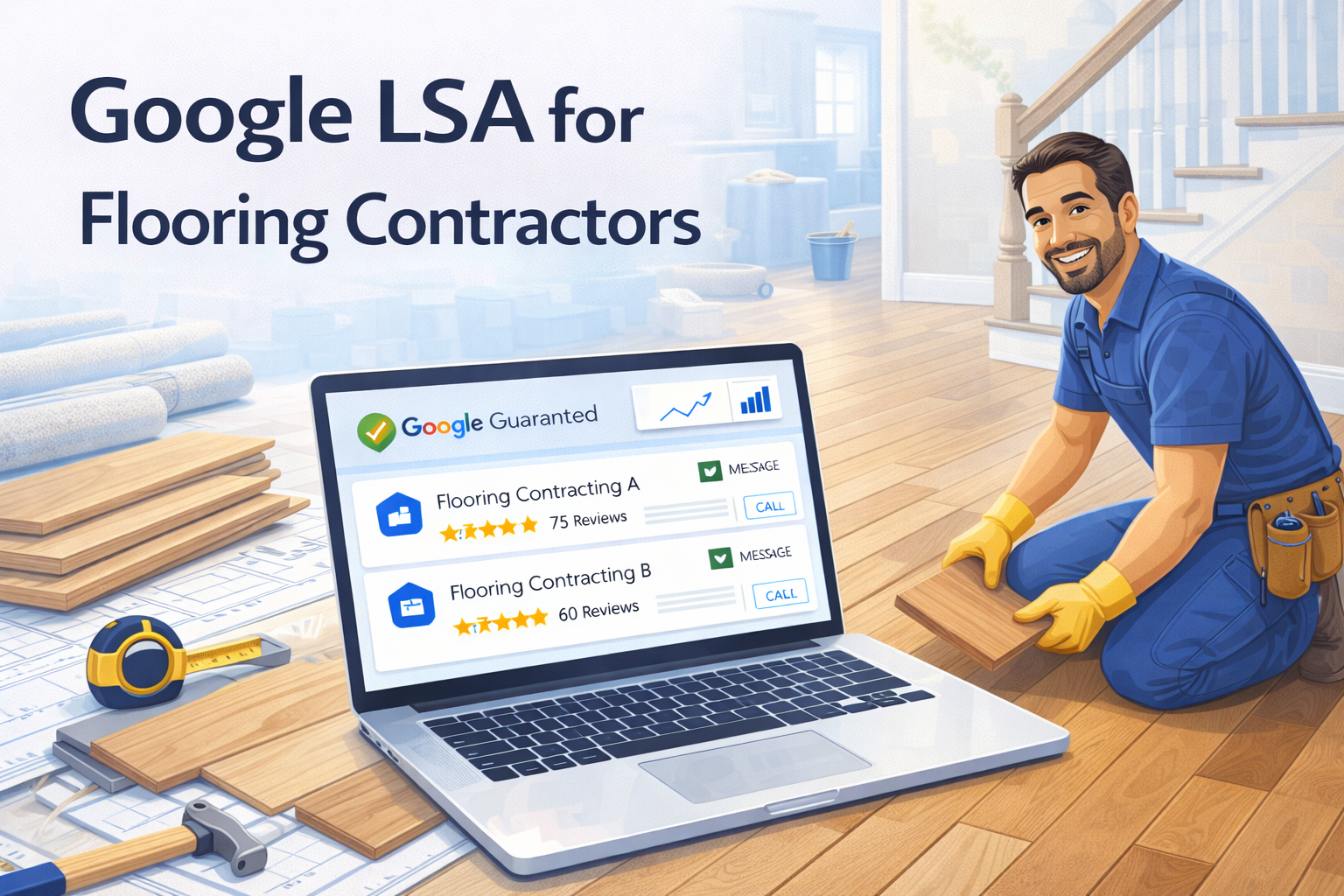
You install beautiful floors. The homeowner calls, you go measure, you leave a quote, and then... silence. They are comparison shopping three other flooring companies they found on the same lead platform that just sold your contact information to every contractor in a 20-mile radius.
That is the Angi and HomeAdvisor model. Google Local Services Ads work differently. When a homeowner searches "hardwood floor installation near me" and clicks your ad, they are calling you. Not you plus four other flooring companies. You.
This guide covers everything flooring contractors need to know: how to set up LSA, what job types to add, the material conversation strategy that separates good flooring companies from great ones, and how to time your budget around spring and fall peaks. We will cover the numbers, the setup, the ranking factors, and the mistakes to avoid.
Is Google LSA Worth It for Flooring Contractors?
Short answer: yes, especially for installation-focused companies. Flooring is one of the better LSA verticals because the average residential job value is high, lead quality is better than lead aggregators, and the Google Verified badge helps counteract the trust problem that plagues price-shopping homeowners.
A typical flooring LSA lead costs $20 to $70 depending on your market and the service type. Hardwood installation leads in competitive metro areas (Chicago, Dallas, Atlanta) tend to run $45 to $70. LVP and carpet in mid-tier markets often land $20 to $40. Compare that to the average residential job value of $3,500 to $7,000 and the math works in your favor, even at close rates as low as 25 percent.
Here is the practical math for a mid-size flooring company:
That said, flooring LSA only works when your review count is healthy, you answer the phone fast, and your profile is complete. We will cover all of that below.
What Google LSA Looks Like for Flooring Searches
When someone in your service area searches for flooring installation, Google shows Local Services Ads at the very top of the results, above traditional pay-per-click ads and above organic listings. These ads show your business name, star rating, review count, the Google Verified badge, and your general location.
You pay per lead, not per click. If someone calls your LSA number or sends you a message through the ad, you get charged. If they click but do not contact you, you pay nothing. This makes flooring LSA fundamentally different from Google Ads, where you pay every time someone clicks regardless of whether they buy.
On mobile, which is where 60 to 70 percent of local flooring searches happen, LSA takes up most of the visible screen before scrolling. The homeowner sees your badge, your rating, and your name before they see any other result. That placement advantage is hard to overstate for a high-consideration purchase like flooring.
How to Set Up Google LSA for Your Flooring Business
The setup process takes one to two weeks, most of which is waiting on Google verification. Here is the step-by-step breakdown:
Create or claim your Google Business Profile
Your LSA account connects directly to your GBP. If you do not have one, create it at business.google.com. Make sure your business name, address, phone number, and service categories are accurate. Use "Flooring Contractor" or "Flooring Store" as your primary category, not a generic "Home Improvement" label.
Go to ads.google.com/local-services-ads
Search for your business type. Select "Flooring" when prompted. Google will walk you through the initial profile creation. Have your business license, insurance certificate, and owner information ready. You will not need to submit everything upfront, but it helps to have it on hand.
Complete the verification process
Google will run a background check on the business owner and verify your license and insurance depending on state requirements. This takes 3 to 10 business days. Do not skip or rush this step. Your Google Verified badge comes from passing verification, and without it your ads will not show. See our full Google Verified guide for state-by-state requirements.
Add all your job types
This is where many flooring companies leave money on the table. We cover the full job type list in the next section. More job types mean more search queries trigger your ad. Do not just add "hardwood installation" if you also do LVP, carpet, tile, and removal. Add everything.
Set your service area
Add the ZIP codes or cities where you actually want to work. Flooring is a high-labor job with significant drive time per install. Be realistic about your radius. A 45-minute drive each way to an install site eats into your margin. If you cover multiple counties, add them all, but do not add markets you would not actually take a job in.
Set your budget and go live
Start with a budget that covers at least 20 leads per month. At $40 CPL that is $800. For most flooring companies, $1,000 to $1,500 per month is a reasonable starting point. Google will spend up to the monthly cap and stop. You can pause, adjust, or raise the budget any time through the LSA dashboard. Switch to Maximize Leads bidding once you have at least two weeks of data.
Flooring Job Types to Add to Your LSA Profile
Google uses your job type list to match your ad to search queries. If you only list "hardwood installation" but a homeowner searches "vinyl plank flooring installer," your ad may not show. Add every service you perform, including demolition, repair, and commercial work.
| Job Type | Search Demand | Avg Job Value | Notes |
|---|---|---|---|
| Hardwood floor installation | High | $5,500–$10,000 | Highest CPL but highest ticket; target spring peak |
| LVP / laminate installation | Very High | $2,800–$5,500 | Fastest-growing search term; pet-owner niche loves it |
| Tile installation | High | $3,000–$7,000 | Kitchens and bathrooms; good for year-round volume |
| Carpet installation | High | $1,500–$3,500 | Lower ticket but fast close; bedrooms and basements |
| Flooring removal | Medium | $400–$1,200 | Add as a standalone and as a bundled upsell |
| Subfloor repair | Low-Medium | $600–$2,000 | High-margin; homeowners do not know how to price it |
| Flooring repair | Medium | $200–$800 | Lower value but builds relationships and reviews |
| Stair nosing / stair installation | Low | $300–$900 | Common upsell during whole-floor installs |
| Commercial flooring | Medium | $8,000–$40,000+ | Slower sales cycle; high ROI when you land one |
| Hardwood refinishing | Medium | $1,200–$3,000 | Good winter filler when install volume dips |
Do not overthink this. If you have done it at least once in the past year, add it. Google rewards completeness in your profile, and every job type you add is another search query you can appear for.
How Much Does Google LSA Cost for Flooring Contractors?
Cost per lead for flooring runs $20 to $70, with the typical contractor landing in the $30 to $50 range. What drives the price up is competition density (more flooring companies bidding in your ZIP code) and service type (hardwood installation bids are pricier than carpet repair).
Cost per lead is just CPC divided by conversion rate, which the free CPA calculator will do for you.
Here is a practical way to size your budget before you even start:
10 ÷ 0.30 = 34 leads × $40 = $1,360/month
You can also use our LSA ROI calculator to model different scenarios before committing to a budget.
See the real numbers for your trade
Plug in your industry, budget, and close rate. Our calculator shows your projected leads, cost per booked job, and ROAS.
One important nuance for flooring: your cost per lead is only half the story. Your cost per booked job is what matters, and that is determined by your close rate and your follow-up speed. A flooring contractor who calls back within 10 minutes books 35 to 40 percent of LSA leads. One who calls back the next day books 10 to 15 percent. Same ad spend, wildly different results. See the full breakdown in our guide on LSA cost and CPL by industry.
The Material Conversation: Your Biggest LSA Advantage
Here is something the lead generation companies will never tell you: the homeowner who calls you through Google LSA is almost always still deciding what material they want. They searched "flooring contractor" or "floor installation near me," not "LVP vs hardwood." They want a floor. They are not sure what kind.
That is your opportunity. When you answer the phone fast (or call back within 10 minutes), you are the first voice in the conversation. You get to ask the questions. You get to understand their subfloor, their lifestyle, their pets, their kids, their budget. You get to steer them toward the material that is right for them and right for your margin.
Material Value by Job Size
Not all materials are created equal when it comes to your revenue per install and your repeat referral potential. Here is how the major flooring types stack up:
| Material | Avg Installed Cost (1,000 sq ft) | Your Margin | Repeat / Referral Value |
|---|---|---|---|
| Solid hardwood | $8,000–$14,000 | Medium-High | Very High (premium client) |
| Engineered hardwood | $5,500–$10,000 | Medium-High | High |
| LVP / luxury vinyl plank | $3,500–$6,000 | High | Medium (common market) |
| Laminate | $2,500–$4,500 | Medium | Medium |
| Porcelain / ceramic tile | $4,000–$8,000 | Medium-High | High (kitchen / bath) |
| Carpet | $1,500–$3,500 | Medium | Low-Medium |
The Pet-Owner Niche
Pet owners are one of the highest-value flooring customer segments and they are actively looking for flooring companies that understand their situation. Hardwood scratches. Carpet absorbs odors. What they need is waterproof LVP with an attached underlayment and a surface hardness rating above AC4.
If you add job-type language that signals waterproof flooring or pet-friendly flooring in your LSA profile and GBP description, you attract a buyer who is pre-qualified and motivated. These homeowners have usually already destroyed one floor and are shopping with urgency. They do not comparison shop as aggressively as a first-time floor buyer. They want a contractor who gets it.
Add to your GBP and LSA profile: "waterproof flooring installation," "pet-friendly LVP," "scratch-resistant hardwood alternatives." These are not just keywords. They are signals to the homeowner that you understand their specific problem.
Measure-and-Quote as Your Closing Move
Flooring is one of the few home service categories where the in-home measurement appointment is a built-in closing opportunity that most contractors underuse. When you come to measure, the homeowner has already invested time. They have moved their furniture mentally. They are picturing the new floor.
Contractors who come prepared with material samples, a printed quote range, and a clear process description close significantly more jobs than those who say "I will email you a quote in a few days." The homeowner who waits for a quote email is the homeowner who gets four more quotes in the meantime.
Consider offering a same-day preliminary quote at the measure appointment. It does not have to be final, but it gives the homeowner a reason to commit before the conversation cools. This is one of the highest-leverage habits in flooring sales and it costs nothing to implement.
Seasonal LSA Strategy for Flooring Contractors
Flooring has two distinct peaks and two slower valleys. Matching your budget to these seasons means you spend more when homeowners are actively shopping and less when they are not. This lowers your effective cost per booked job without changing anything about your ads.
Spring: March Through May (Peak Season)
Spring is the strongest flooring season of the year. Tax refunds drop in March and April. Home sales surge in April and May, and every home sale creates a flooring need. Homeowners who spent all winter saying "we really need to redo these floors" finally pull the trigger.
Raise your budget 30 to 50 percent above your baseline in March and hold that through Memorial Day. Competition increases too, so your CPL will be slightly higher, but lead volume more than compensates. A contractor running $1,500 per month in February should consider $2,000 to $2,200 in April and May.
Summer: June Through August (Moderate)
Summer volume stays solid, particularly for families who want installs done before the school year starts. The "back to school" flooring push is real. Parents want new bedroom carpet or living room hardwood installed while kids are at camp or before August moves back in. Hold budget steady or slightly elevated through August.
Fall: September Through November (Secondary Peak)
Fall is the second strongest flooring season, driven by homeowners wanting to finish remodel projects before the holidays. Nobody wants strangers in their house doing a full floor install in December when company is coming. September through early November is strong for both residential and commercial flooring.
Budget should match your spring levels during this window. One additional opportunity: commercial flooring clients often have Q4 budgets to spend. If you do commercial work at all, make sure your job types reflect it and consider a light increase in October when office managers are spending year-end budgets.
Winter: December Through February (Slow Season)
December is the slowest month in flooring. Homeowners are not scheduling large installs around the holidays. January and February pick up slightly as people make renovation resolutions, but volume stays well below spring peaks.
This is the time to drop your budget to a maintenance level ($600 to $800 per month), stay visible for in-market homeowners, and focus on hardwood refinishing jobs that fill crew days without requiring full installs. If your lead volume drops to the point where Google flags your responsiveness, see our guide on why LSA stops generating calls.
How to Rank Higher in Google LSA as a Flooring Contractor
Google uses several signals to decide which flooring contractors appear at the top of the LSA pack. These are listed on our full ranking factors guide, but here is how each one applies specifically to flooring:
1. Review Count and Rating
This is the single most important factor. Flooring contractors with 50 or more Google reviews consistently outrank competitors with stronger everything else. The sweet spot is 4.8 stars or higher with at least 50 reviews. Getting there should be your first priority when you launch LSA.
The best time to ask for a review in flooring is the day of installation, right after the final walkthrough when the floors look their absolute best. Send a text with a direct review link while you are still on-site or within two hours of leaving. That is when homeowner excitement peaks. Read more in our LSA review strategy guide.
2. Response Time
Google tracks how fast you respond to LSA leads, both calls and messages. Contractors who answer or call back within 5 minutes rank higher than those who take an hour or more. This is especially important for flooring because homeowners searching for installation services are often mid-project and comparing contractors. The first contractor who answers is usually the first one in the door for a measure.
If you cannot answer every call personally, set up a call forwarding system that routes LSA calls to a backup number. Even a voicemail with a callback commitment ("We will call you back within 10 minutes during business hours") beats a silent no-answer from Google"s ranking perspective.
3. Profile Completeness
A fully completed LSA profile, including all job types, business hours, service area, license information, and photos, ranks higher than a sparse profile. Upload at least 5 photos showing finished floor installations. Before-and-after photos perform especially well because they communicate transformation, which is what homeowners are actually buying.
4. Geographic Proximity
LSA factors in whether your business address is close to the searcher. This is partially outside your control, but setting your service area accurately helps. Do not add ZIP codes you would never actually drive to. Google"s algorithm penalizes broad service areas that appear unrealistic.
5. Dispute Behavior
Google tracks how often you dispute leads and whether those disputes are granted. Contractors who dispute leads too aggressively get penalized in ranking. Dispute genuinely bad leads (wrong service area, spam calls, completely wrong service type), but do not dispute leads because the customer went with a competitor. Read more about the LSA lead dispute process and what actually qualifies.
6 Common LSA Mistakes Flooring Contractors Make
1. Only Adding "Flooring Installation" as a Job Type
The broadest terms have the most competition. If your profile only says "flooring installation," you are competing for the same searches as every other flooring company. Add specific material and service types to capture lower-competition, higher-intent searches. "LVP flooring installer" or "hardwood floor removal and replacement" are much more targeted.
2. Slow Response to Leads
A flooring homeowner who has already made five calls in an hour will book the first contractor who sounds competent and available. If you return an LSA call 3 hours later, there is a high probability the job is already gone. Build a system: every LSA lead gets a call back within 10 minutes during business hours, and a text acknowledgment if outside business hours.
3. Waiting to Collect Reviews Until They Have a Problem
Most flooring companies only hear from customers again when something goes wrong (a plank buckled, a seam lifted). That means your only organic review flow is complaint-driven. Flip this by proactively asking for reviews at the moment of highest satisfaction: day of install, walkthrough complete, homeowner is thrilled. Most will not think to leave one unless you ask in that specific moment.
4. Running LSA at Flat Budget Year-Round
Flooring has real seasonal demand patterns. Spending the same in January as in April means you are underspending during your highest-ROI window and potentially over-spending during low-demand months. Match your budget to search volume. Your cost per booked job will drop significantly if you front-load spring and fall.
5. Disputing Too Many Leads
Flooring contractors sometimes dispute leads where the customer went silent after the initial call. That is not a disputable lead. The customer contacted you about your service. You cannot dispute a lead because they did not book. Only dispute leads that are clearly wrong: the call was for a service you do not offer, the location is outside your service area, or it was obviously spam. Over-disputing hurts your ranking more than the occasional unbooked lead costs you in CPL.
6. Not Connecting GBP to LSA
Your Google Business Profile and your LSA account need to be linked. If they are not, your reviews may not carry over to your ad, your hours may not display correctly, and your ranking suffers. This is a five-minute fix in the LSA dashboard. Check that the GBP listed on your LSA account is your primary verified profile. See the full GBP optimization guide for setup details.
Running LSA and Google Ads Together
LSA and Google Ads are not competitors. They appear in different positions on the search results page and they serve different intent levels. LSA captures high-intent, ready-to-book searchers at the very top. Google Ads catch people who are still researching or comparing, in a slightly lower position on the same page.
For flooring contractors with budgets over $2,500 per month, running both is a legitimate strategy. Set LSA as your primary lead source and Google Ads as a supplement targeting specific high-value queries like "hardwood floor installation [city]" or "commercial LVP installer [city]." See the full comparison in our Google Ads vs. LSA guide.
For contractors just starting out, focus entirely on LSA first. Get to 50 reviews, nail your response time, and optimize your job type list. Once your LSA is producing consistent results, layer in Google Ads for the high-ticket queries where you can afford the higher per-click cost because the job value justifies it.
How to Track LSA Results for Your Flooring Business
The LSA dashboard shows you lead volume, cost per lead, and total spend. That is the minimum you should check. Here is a more complete tracking approach:
Weekly Metrics
- Lead volume: Total calls and messages through LSA this week vs. last week and vs. same week last year
- Response rate: What percentage of leads did you respond to within 10 minutes? This is a ranking factor and a close rate driver.
- New reviews: How many reviews came in this week? Track your trajectory toward the 50-review and 100-review benchmarks.
Job-Level Tracking (Use Your CRM)
Tag each estimate and booked job with the lead source. If you do not have a CRM, even a simple spreadsheet works: date, lead source (LSA, referral, other), job type, quoted value, booked yes/no, revenue. This is the only way to calculate your actual close rate and cost per booked job, which are the numbers that determine whether your LSA investment is working.
Monthly Review
- Cost per booked job (total LSA spend / jobs booked from LSA)
- Revenue per LSA dollar (total revenue from LSA jobs / monthly LSA spend)
- Close rate trend: is it improving, flat, or declining? A declining close rate often means response time has slipped or you are getting lower-quality lead types.
If your LSA stops generating leads entirely, there is usually a specific reason. See our troubleshooting guide on why Google LSA stops working for a step-by-step diagnostic checklist.
Flooring LSA FAQs
Is Google LSA available for flooring contractors?
Yes. Flooring installation is an eligible category in Google Local Services Ads. You can get listed as a Google Verified or Google Guaranteed business depending on your state licensing requirements and background check status. Check the LSA eligibility page for your state, as license requirements vary significantly between states like California (CSLB required) and states with no formal flooring license requirement.
How much does Google LSA cost for flooring companies?
Cost per lead typically runs $20 to $70 for flooring contractors, depending on your market, service area size, and competition. Budget $800 to $2,500 per month to generate enough leads for consistent job flow. Your actual cost per booked job depends on your close rate, which averages 30 to 40 percent when following up within two hours. Use our LSA ROI calculator to model your specific numbers before committing to a budget.
What flooring job types should I add to my LSA profile?
Add every job type you perform: hardwood installation, LVP/laminate installation, tile installation, carpet installation, flooring removal, subfloor repair, stair nosing, commercial flooring, and flooring repair. More job types mean your ads appear for more searches and Google rewards profile completeness with higher rankings. If you also do hardwood refinishing, add that too. The more specific you are, the more precise search queries you match.
Why do flooring leads from Google LSA have better close rates than Angi or HomeAdvisor?
LSA leads are exclusive to you, not shared with 3 to 5 competing flooring companies at the same time. The homeowner called or messaged you directly after seeing your Google Verified badge, which means they already trust you before they pick up the phone. Shared lead platforms send the same contact to multiple contractors, which trains homeowners to shop on price and ignore whoever calls second. With LSA, you are the first and only call.
When is the best time of year to run flooring LSA ads?
Spring (March through May) is peak season for flooring, driven by home sales, renovations after tax refunds, and pre-summer remodel projects. Fall (September through November) is a strong secondary season as homeowners finish projects before the holidays. Increase your budget 30 to 50 percent during these windows and consider lowering bids slightly in January and February when volume drops. Match budget to demand to maximize your return on every dollar spent.
How do I get more flooring reviews on Google LSA?
The best time to ask is the day of installation, while the floors look brand new and the homeowner is most excited. Send a text with a direct link to your Google Business Profile review page. A message like: "The floors look great, thank you for choosing us, we would love a quick review here [link]" converts at 40 to 60 percent. Automate this with a CRM follow-up sequence if you are doing more than 5 jobs per week. Read the full system in our LSA review strategy guide.
The Bottom Line
Google Local Services Ads work well for flooring contractors because the math is favorable: $20 to $70 per lead against a $4,800 average job value means you only need a 1 to 2 percent close rate to break even. In practice, flooring contractors who answer fast, collect reviews systematically, and optimize their job type list close 30 to 40 percent of LSA leads.
The material conversation, the seasonal budget strategy, and the measure-and-quote closing approach are the three flooring-specific levers that separate contractors who get good results from LSA and those who get great results. None of them require more ad spend. They require better process.
If you want to see what LSA could produce for your flooring business specifically, our team runs free audits that cover your current lead generation setup, your LSA eligibility, and your market competition. No obligation, no sales pitch, just data.
Ready to Fill Your Install Calendar?
Get a free LSA audit for your flooring business. We will review your market, your current setup, and your ranking potential, then show you exactly what it would take to generate consistent install leads through Google.
Book Your Free ConsultationMore on Google Local Services Ads
Part of the BGM Local Services Ads library. Pair this with the master pillar and the deep-dive guides: