Before you price against these numbers
A break-even figure is only as good as the job cost behind it, and most are understated because labor burden and overhead never make it into the maths. The contractor profit margin calculator costs a job properly and returns the gross and net margin you actually keep. If you sell time rather than jobs, the hourly rate calculator sets the rate first, including the hours you pay for but cannot invoice.
Published by Blue Grid Media • March 2026 • Updated July 2026 • 14 min read
In This Guide
Here is the problem with most plumbing ROI conversations: everyone talks about it like it is one number. "What's a good ROAS for plumbing?" And the honest answer is that it depends on what kind of plumbing you do.
A $55 lead that books a $150 drain cleaning is a very different animal than a $55 lead that books a $5,500 tankless water heater install. Same CPL, wildly different ROI. If you are benchmarking your LSA performance against industry averages without separating your job types, you are almost certainly leaving money on the table or panicking over numbers that are actually fine.
This guide breaks down plumbing LSA ROI the right way, by company type, job category, and company size, so you can measure what actually matters. See the broader Plumbing LSA Playbook for setup and optimization fundamentals, and check out Plumbing LSA Cost Per Lead for CPL benchmarks by market.
Quick answer: Plumbing has one of the widest job-value spreads in the trades, from a roughly $150 drain clear to a $15,000 repipe or sewer line replacement, so a single blended ROI number is misleading. Against a plumbing LSA cost per lead of about $57 to $69 and a channel booking rate near 43.9 percent, even a low-ticket drain call clears break-even, while replacement and repipe work returns an order of magnitude more. Published data also puts LSA cost per lead 40 to 50 percent below standard search for home services, against a plumbing Google Ads non-branded CPL of $183. The models below separate ROI by company type and job type rather than averaging them.
How do you calculate plumbing LSA ROI?
Before benchmarks mean anything, you need a consistent way to calculate ROI. Here is the framework we use for plumbing companies:
- CPL (Cost Per Lead): What you paid for the lead in your LSA dashboard.
- Booking Rate: What percentage of those leads turn into booked jobs. (Emergency calls book at 70-80%; research-phase calls like water heater installs book at 55-70%.)
- Cost Per Booked Job: CPL divided by booking rate. A $55 CPL at 65% booking rate = $85 cost per booked job.
- Average Ticket: Your average revenue per completed job for that lead type.
- Gross Revenue ROAS: Average ticket divided by cost per booked job. A $650 average ticket at $85 cost per booked job = 7.6x gross ROAS.
- True ROAS (Margin-Adjusted): Gross ROAS multiplied by your gross margin percentage. At 50-60% gross margin, that 7.6x becomes roughly 4x true ROAS on actual profit dollars.
For a full breakdown of CPL by market and season, see Plumbing LSA Cost Per Lead. For budget sizing based on these numbers, check Plumbing LSA Budget Guide.
What is LSA ROI for each type of plumbing company?
Plumbing companies generally fall into three operating models. Your ROI benchmarks should match your model, not some blended industry average.
Scenario A: Emergency and Drain-Focused Company
High volume, lower average ticket. Lives on drain calls, toilet repairs, leak fixes, and urgent service calls. The bread-and-butter residential plumber.
Scenario B: Water Heater Specialist
Medium volume, high average ticket. Focuses on water heater repairs, tank replacements, and tankless installs. Often also handles expansion tanks and recirculating pump add-ons.
Scenario C: Full-Service Plumbing Company
Diversified service mix: drain calls, water heaters, repipes, sewer work, bathroom rough-ins. Blended average ticket reflects the full range.
What is a drain call actually worth over time?
Drain calls look like low-ROI leads on paper. A $55 CPL for a $150 drain cleaning produces gross revenue ROAS under 3x. That math alone might make you want to pause LSA for drain calls entirely. Do not do that.
A target ROAS only means something next to your margin, which the free ROAS calculator factors in.
The mistake is treating a drain call as a one-time transaction. Done right, a drain call is the front door to your most valuable jobs. Here is how the math actually plays out over 12-18 months:
At $1,400 blended LTV and a $55 CPL, your true lifetime ROAS on a drain call lead is over 25x, not 3x. The customers who start with a $150 drain cleaning are often the same homeowners who eventually call you for water heater replacements and repipes, because they already trust you and have your number saved.
What is the ROI on a water heater replacement lead?
Water heater replacement is the highest-ROI category in residential plumbing LSA, full stop. Here is a single-lead walkthrough:
Even at $90 CPL with a 55% booking rate (cost per booked job = $164), on a $4,500 water heater install at 50% margin, you are netting over $2,000 per job. There is almost no scenario where water heater LSA leads lose money.
Tankless installs push the math even further. A tankless water heater install averaging $6,500 at $85 cost per booked job produces 76x gross revenue ROAS. At 50% margin, that is $3,165 net profit per booked job after LSA cost.
What is the ROI on repipe and sewer line projects?
Repipe leads are the rarest and most valuable leads in residential plumbing. Most plumbing companies get only 3-8 repipe inquiries per month through LSA, even in large markets. But the ROI on those leads is extraordinary.
The CPL range for repipe-oriented leads runs $80-$120 in most markets. Average repipe projects run $8,000-$20,000 depending on home size and materials (copper vs. PEX vs. CPVC). Even at $120 CPL with only a 50% booking rate, the cost per booked repipe job is $240. On a $12,000 repipe at 45% margin, you net $5,160 after LSA costs. It is nearly impossible to lose money on repipe leads through LSA.
The bigger challenge with repipe leads is speed and qualification. Repipe inquiries often come from homeowners who got a different contractor's quote and want a second opinion, or from homeowners who just had a plumbing inspection flag old galvanized pipe. Whoever responds fastest, provides a clear estimate, and explains the process wins a disproportionate share of these jobs.
What is your break-even cost per lead by job type?
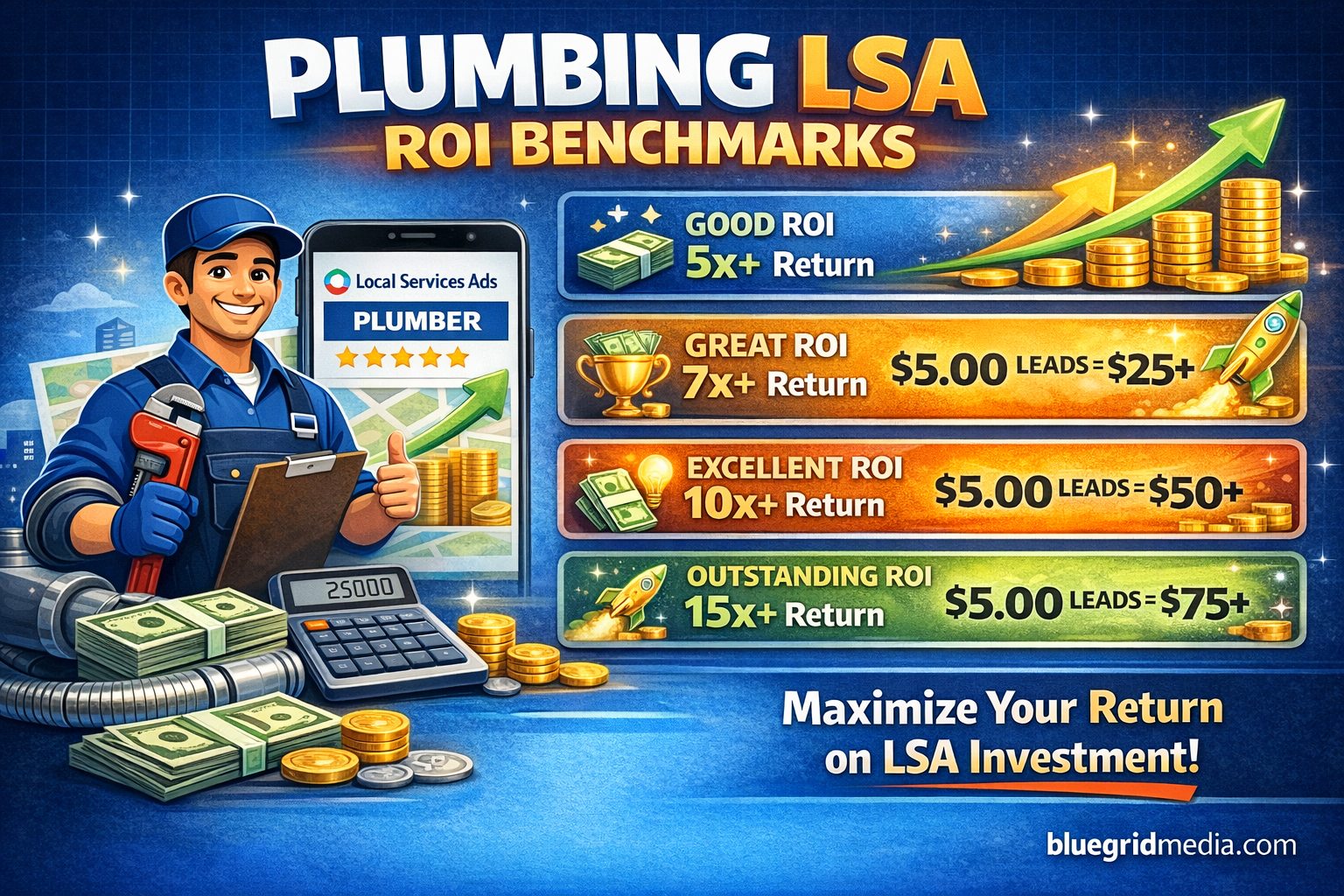
Break-even CPL is the maximum you can pay per lead before your LSA spend stops generating positive return at a 3x ROAS threshold (a healthy margin after overhead). The formula: break-even CPL = average ticket x gross margin x booking rate / 3.
| Job Type | Avg Ticket | Gross Margin | Booking Rate | Break-Even CPL (3x) | Typical Actual CPL |
|---|---|---|---|---|---|
| Drain cleaning | $175 | 55% | 75% | $24 | $40-$55 |
| Emergency leak / pipe | $400 | 55% | 78% | $57 | $40-$60 |
| Water heater repair | $650 | 50% | 65% | $70 | $55-$80 |
| Water heater install (tank) | $2,200 | 50% | 62% | $227 | $60-$90 |
| Tankless water heater install | $5,500 | 48% | 60% | $528 | $70-$100 |
| Repipe (whole home) | $12,000 | 45% | 50% | $900 | $80-$120 |
If your CPL for any job type is running above these break-even thresholds, that is a signal to audit your LSA profile before assuming the channel does not work. Common culprits: low review count, slow response time, service area that is too large (driving up cost with poor proximity scores), or job types that do not match your actual services. See Common Plumbing LSA Mistakes for a diagnostic checklist.
Want to calculate your own plumbing LSA break-even numbers? Run the numbers for your own market with our free plumbing LSA ROI calculator.
What ROAS should a plumbing company expect by size?
Company size affects ROI in two ways: overhead allocation per job, and ability to respond quickly to leads. Larger companies typically have lower per-job overhead (office, dispatch, insurance spread across more trucks), but they also face more internal competition for who answers the phone fastest.
| Company Size | Good ROAS | Great ROAS | Exceptional ROAS | Notes |
|---|---|---|---|---|
| 1-truck owner-operator | 4x | 8x | 15x+ | Low overhead, high booking rate (owner answers calls), limited job volume capacity |
| 2-3 truck company | 5x | 10x | 20x+ | Enough volume to see consistent ROI trends, review velocity matters most |
| 5+ truck company | 6x | 12x | 25x+ | Higher overhead per job but more capacity; LSA budget can scale aggressively with ROI |
Owner-operators often achieve the highest ROAS on a per-job basis because they answer calls immediately (cutting through the response-time ranking factor), they do not have dispatch overhead, and they can pick the most profitable jobs. The tradeoff is capacity: an owner-operator can only book so many jobs per week.
How does plumbing LSA ROI change by season?
Plumbing LSA performance is not flat across the year. Each season brings a different mix of job types, which means a different ROI profile even if CPL stays constant.
| Season | Dominant Job Types | Volume | Avg Ticket | Booking Rate | ROI Outlook |
|---|---|---|---|---|---|
| Winter (Dec-Feb) | Burst pipes, frozen lines, emergency drain | High | Lower ($200-$450) | Very high (80-90%) | High volume, modest ticket, excellent booking rate |
| Spring (Mar-May) | Repipes, bathroom rough-ins, water heater installs | Moderate-High | High ($1,500-$12,000) | 60-70% | Best overall ROI due to project work mix |
| Summer (Jun-Aug) | Water heater failures, slab leaks, outdoor plumbing | Moderate | High ($800-$5,500) | 65-78% | Water heater failures spike, strong ROAS on installs |
| Fall (Sep-Nov) | Pre-winter inspections, water heater replacements, drain maintenance | Moderate | Moderate ($400-$2,000) | 62-70% | Good mix, slightly softer volume than peak seasons |
Spring is the highest-ticket season for most full-service plumbing companies. Homeowners coming out of winter often have inspection reports flagging old galvanized pipe, outdated water heaters, or slow drains from root intrusion. They are ready to spend on projects, not just patches.
Winter generates the highest volume but the lowest average ticket. Burst pipe calls and emergency drain calls book fast and at strong margins, but they are not the $5,000 water heater installs that make ROI look elite. Budget accordingly: in most northern markets, LSA spend in January should be 20-30% higher than in September just to capture the emergency demand spike.
For a full month-by-month budget playbook, see Plumbing LSA Budget Guide.
How does plumbing LSA ROI compare to Google Ads and Angi?
Every plumbing company eventually gets pitched on Angi, HomeAdvisor, and Thumbtack alongside Google LSA. Here is how the ROI math compares across channels for residential plumbing.
| Channel | Typical CPL | Lead Type | Booking Rate | Cost Per Booked Job | ROI Outlook |
|---|---|---|---|---|---|
| Google LSA | $40-$90 | Exclusive phone call or message | 65-80% | $55-$130 | Best for emergency and project work |
| Google Ads (PPC) | $12-$30 CPC | Click to website (not a call) | 15-25% call rate | $120-$200 | Good for brand building, higher friction |
| Angi / HomeAdvisor | $20-$80 per lead | Shared with 2-4 contractors | 20-30% | $100-$400 | High cost per booked job, competitive friction |
The number that matters most in this table is cost per booked job, not CPL. Angi leads often look cheaper at $30 CPL versus $55 CPL for LSA. But because Angi leads are shared with two to four other contractors simultaneously, your booking rate drops from 70%+ to 20-30%. That $30 Angi lead that closes 25% of the time costs you $120 per booked job. The $55 LSA lead that closes 70% of the time costs you $79 per booked job.
For a full three-platform comparison including Thumbtack, see LSA vs. Thumbtack vs. Angi for Contractors. For the plumbing case study showing real-world LSA ROI results, see Plumbing LSA Case Study: Dallas, TX.
Plumbing LSA ROI FAQs
Want to Know How Your Plumbing LSA Actually Stacks Up?
We audit plumbing LSA accounts across dozens of markets. We can tell you within 15 minutes whether your CPL, booking rate, and ROAS are where they should be, and exactly what to fix if they are not.
Get a Free Plumbing LSA AuditSee the real numbers for your trade
Plug in your industry, budget, and close rate. Our calculator shows your projected leads, cost per booked job, and ROAS.
More for plumbing operators
Pair this with the rest of the plumbing operator series. Each guide covers a different angle on growing a plumbing company through paid search: