Migration note, updated August 2026
Google has started moving Local Services Ads into Google Ads as pay-per-lead Performance Max, and the standalone LSA dashboard is being retired in phases. If your account has not migrated yet, the steps below still apply exactly as written. If it has, here is where each control now lives.
| In the old LSA dashboard | In Google Ads after migration |
|---|---|
| The LSA dashboard itself | Redirects to your campaign overview in Google Ads |
| Weekly budget | Daily average budget, your weekly figure divided by 7 |
| A bid or max cost per lead per job type | One campaign-level Target CPA for the whole campaign |
| Lead inbox | Goals, then Conversions, then Leads |
Phase 1 began August 1, 2026. Service-area businesses without a storefront are in the late 2026 wave, and everyone else follows in 2027. Read the full migration breakdown.
Published by Blue Grid Media • March 2026 • 13 min read
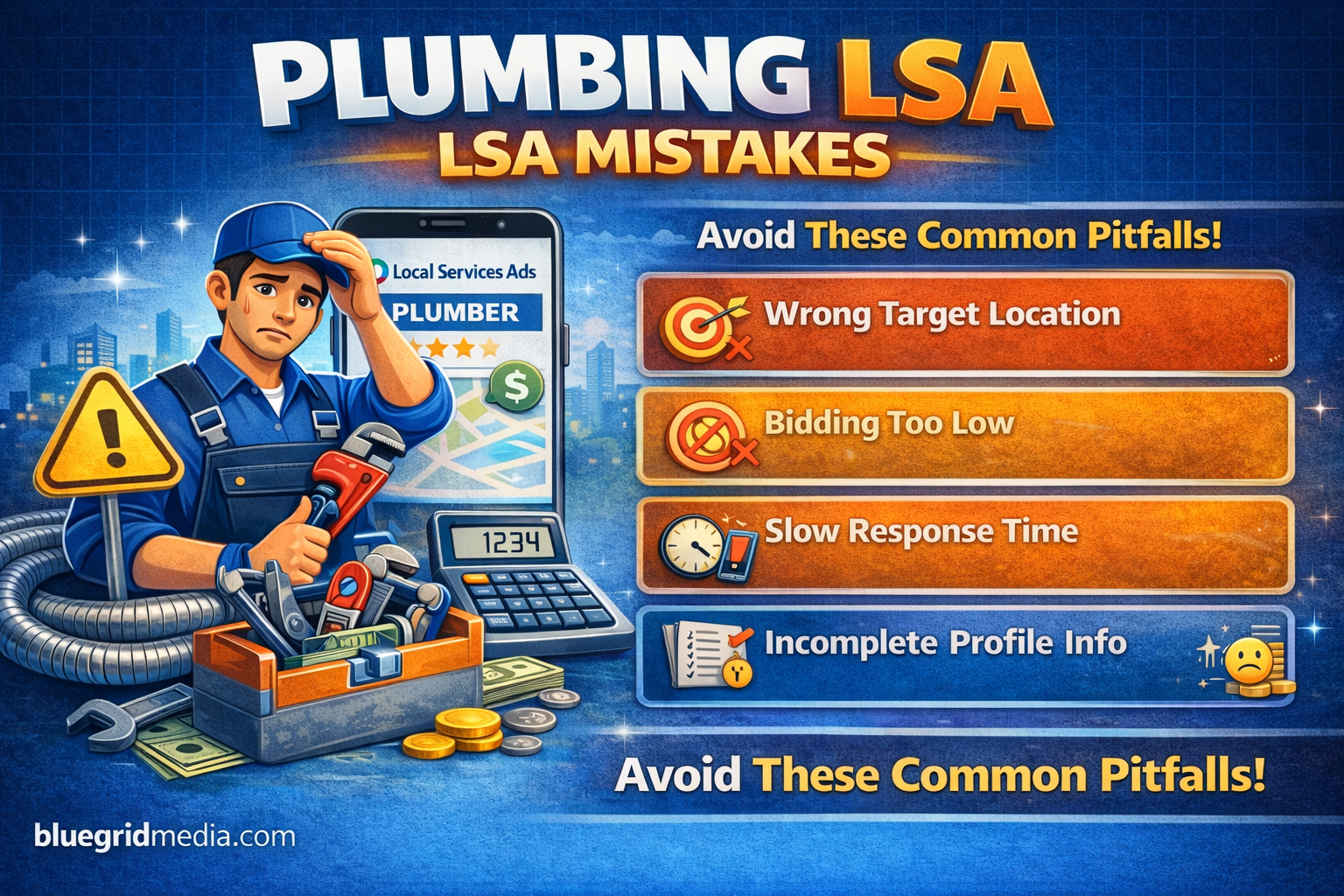
We review plumbing LSA accounts every week. And we see the same mistakes over and over, across markets, across company sizes, across regions. The frustrating part is that most of them are completely fixable. Some take 30 minutes. Some take a week of habit-building. But every single one is leaving real money on the table.
The average plumbing company running LSA is losing 30-50% of its potential lead volume to avoidable errors. That is not hyperbole. It is what the data shows when you audit a new account and compare it to what it could be doing.
This guide covers 12 plumbing-specific LSA mistakes with severity ratings, diagnosis signs, and step-by-step fixes. Work through this as an audit. Use the checklist at the top to track what you have fixed.
By the Numbers: Plumbing LSA Performance Data
Quick Reference: All 12 Mistakes
Use this table as your audit checklist. Check the "Fixed?" box once you have addressed each item. Your progress is saved automatically.
| # | Mistake | Severity | Time to Fix | Fixed? |
|---|---|---|---|---|
| 1 | Only enabling 2-3 job types | CRITICAL | 1 day | |
| 2 | No 24/7 answer coverage | CRITICAL | 1 day | |
| 3 | Not disputing wrong-service leads | MODERATE | Ongoing | |
| 4 | No water heater upsell protocol | MODERATE | 1 week | |
| 5 | Pausing budget in slow months | CRITICAL | Prevention only | |
| 6 | Missing tankless WH job type | MODERATE | 1 hour | |
| 7 | Runaway spend in max bid mode | MODERATE | Today | |
| 8 | Wrong service area | MODERATE | 2-4 weeks | |
| 9 | Disconnected Google Business Profile | CRITICAL | 30 min | |
| 10 | Under-collecting reviews | MODERATE | 1-2 months | |
| 11 | Residential-only profile | MINOR | 1 day | |
| 12 | Not auditing call recordings | MODERATE | 1-2 weeks |
Download This Checklist
Print it, share it with your dispatcher, or use it for quarterly plumbing LSA audits.
The 12 Mistakes in Detail
Mistake 1: Only Enabling Drain Cleaning and Emergency Plumbing
Diagnosis
Your profile shows 2-3 job types while competitors have 12-15. Log into your LSA settings and count how many job types are toggled on. If it is under 8, you are leaving ranking signals on the table.
Why It Happens
Plumbers check the basics during setup, drain cleaning and emergency plumbing, and stop there. It feels complete because those are the most common calls. But Google uses job type completeness as a profile quality signal, and a thin profile competes at a disadvantage even against identical companies with broader category coverage.
The Fix
Go through every job type in your LSA settings and enable everything you are licensed and equipped to do. The full list to check: drain cleaning, emergency plumbing, water heater repair, water heater installation, tankless water heater installation (this is a separate category, see Mistake 6), sewer line repair, sewer line replacement, pipe leak detection, garbage disposal repair and installation, toilet repair, backflow testing, repipe and repiping, gas line work. Turn on everything you can legally and practically deliver.
Time to See Improvement
Immediate once enabled. Ranking improvement typically visible in 2-4 weeks as Google re-indexes your profile completeness score.
Mistake 2: No 24/7 Answer Coverage for Emergency Plumbing Calls
Diagnosis
You are paying for leads you are not answering. Open your LSA dashboard and check your missed calls ratio. If more than 20% of incoming calls are going unanswered, you have a coverage problem. For emergency plumbing, a missed call at 11pm is likely a job that goes to whoever picks up the phone first.
Why It Happens
Most plumbing shops run on owner hours. After 7pm, calls forward to a cell phone that may or may not get answered. There is no answering service, no on-call rotation, and no backup plan. The result is paid leads converting into missed revenue at exactly the highest-value time of day.
The Fix
Set up call forwarding to an on-call tech for after-hours coverage. If you cannot do in-house coverage consistently, use a live answering service as a backstop. Options like Ruby Receptionists or PATLive run $300-$500 per month and can handle basic intake: address, problem type, dispatch or callback scheduling. Give them a script: "What is the plumbing issue? What is your address? Our tech will call you within 20 minutes." Emergency calls at 2am are routinely the highest-value jobs in your week. Treat them accordingly.
Time to See Improvement
Fix in one day. ROI is immediate on the first job that would otherwise have been missed.
Mistake 3: Accepting Every Lead Without Disputing Out-of-Service Calls
Diagnosis
You are getting calls from people asking about HVAC repairs, electrical work, or handyman jobs. Your effective cost per lead is higher than your LSA dashboard shows because you are paying for leads that were never going to convert. Check your recent lead list and count how many were genuinely wrong-service calls.
Why It Happens
Google's job categorization is good but not perfect. Plumbing LSA profiles sometimes attract calls from adjacent trades, particularly HVAC and electrical, because some customers search broadly. Most plumbers accept these leads by default because they do not know disputes are an option or assume it is not worth the time.
The Fix
Log every incoming lead by type. For any lead that should not have been charged, dispute it within the allowed window (typically 30 days from the lead date). In your LSA dashboard, go to Lead Management, find the lead, click Rate Lead, and select "Not a good lead" with the appropriate reason. Valid dispute reasons include wrong service requested, area outside your service territory, duplicate call, and spam or solicitation. For a detailed walk-through of the dispute process, see Why LSA Leads Get Disputed. Consistent disputing reduces effective CPL by 10-20% over 30 days for most plumbing accounts.
Time to See Improvement
Build the habit now. CPL improvement shows in your monthly reports after 30 days of consistent disputing.
Mistake 4: Not Training Techs on the Water Heater Upsell During Service Calls
Diagnosis
Your techs are closing drain calls, clearing backups, fixing leaks, and leaving without mentioning the water heater sitting 10 feet away. Roughly 15-20% of residential plumbing customers have a water heater that is 8 or more years old and is a near-term replacement candidate.
Why It Happens
Techs are focused on solving the problem they were called for, which is correct. But there is no protocol in place that makes a quick equipment check a normal part of every service visit. It gets skipped because nobody made it a standard step.
The Fix
Train every tech to check water heater age during any service call where they have access to the mechanical room. Give them a simple script they can use without it feeling like a sales pitch: "While I am here, I noticed your water heater is about X years old. Most standard units last 10-12 years. Want me to run a quick efficiency check while I am here?" Roughly 20-25% of customers say yes. Of those, a meaningful percentage book a replacement within 60 days. This is one of the highest-ROI operational changes available to a plumbing company running LSA, because you are monetizing leads you already paid for.
Time to See Improvement
Protocol takes about a week to implement and get consistent. Revenue impact is immediate once techs are running it on every call.
Mistake 5: Pausing LSA Budget During Slow Months
Diagnosis
You turned off or drastically cut your LSA budget during October or March thinking you were being financially disciplined. Now it is peak season, leads are down, and your ranking looks nothing like it did this time last year.
Why It Happens
Plumbers apply seasonal business logic to a platform that runs on ranking algorithms. When business is slow, cutting the ad budget feels obvious. But LSA is not a pure pay-per-click auction where you can turn it on and off without consequences. The algorithm uses your historical lead acceptance, response patterns, and continuity to determine where you rank. A full pause breaks that signal.
The Fix
Never fully pause. During slow months, reduce to a shoulder minimum rather than zero. For a one-truck operation, $200-$350 per week is enough to maintain ranking signal without bleeding cash. For a three-truck operation, $500-$700 per week. The goal during slow periods is not lead generation, it is rank preservation. Recovery from a full pause takes 4-8 weeks into your next busy season, which means you are paying a compound cost: the cost of the pause plus the cost of the slow recovery. See the Plumbing LSA Budget Guide for a month-by-month framework.
Time to See Improvement
This mistake cannot be undone quickly. Once ranking erodes, recovery takes time. The only fix is prevention going forward.
Mistake 6: Missing the Tankless Water Heater Job Type
Diagnosis
You install tankless systems but "tankless water heater installation" is not enabled as a separate job type in your LSA profile. Your profile shows water heater installation but not tankless specifically. Customers searching for tankless installers are not finding you.
Why It Happens
Plumbers assume "water heater installation" covers tankless. It does not. Google treats them as distinct search intents because the customer journey is different: tankless customers are doing more research, have often already decided to upgrade, and are typically further along in their buying process.
The Fix
Log into your LSA settings and locate "Tankless water heater installation" in the job type list. It is separate from standard water heater installation. Enable it. Tankless installations average $5,000-$8,000 per job depending on your market and the unit installed. If you are doing even two or three of these per month from LSA, that single category addition is worth thousands in monthly revenue. Takes less than an hour to fix.
Time to See Improvement
Fix is immediate. New lead type flow typically starts within 1-2 weeks as Google indexes the updated profile.
Mistake 7: Running Max Bid Mode Without a Ceiling During Peak Season
Diagnosis
Your weekly spend doubled or tripled unexpectedly during a freeze event, a heat wave, or a pipe-burst season. You set Maximize Leads mode and let it run, and Google spent aggressively without you realizing it until you checked the billing.
Why It Happens
Max bid mode, which Google calls Maximize Leads, has no automatic cap by default. During high-demand weather events, Google aggressively bids to fill your calendar. That sounds good until you realize you have $2,000 in lead charges for a week you were expecting $600.
The Fix
Set a manual weekly budget cap in your LSA dashboard. Check your spend daily during any weather event that affects plumbing demand: freeze events, major storms, extended cold snaps. The correct approach during a surge is proactive budget increase, not runaway spend. Decide in advance: during a freeze event, you want to increase budget intentionally by 50-100% to capture the volume. That is a strategic decision made by you, not an algorithm running unchecked. The difference between a good surge and a billing surprise is a 5-minute check of your dashboard every morning during peak weather.
Time to See Improvement
Fix your budget cap today. Cost control is immediate.
Mistake 8: Wrong Service Area (Too Large or Too Small)
Diagnosis
You are getting leads 45 minutes away that are not worth taking. Or: you are not showing up in key zip codes 15 minutes from your shop. Your service area settings were established at setup and have not been revisited since.
Why It Happens
Service area is treated as a one-time setting at onboarding. The natural tendency is to draw it large, thinking more area means more leads. But a large service area includes unprofitable zones with long drive times that drag down your average job margin. Meanwhile, the sweet spot near your base of operations sometimes gets diluted.
Drive time, quoting and callbacks are paid but never billed. The free contractor hourly rate calculator divides your costs across the hours you can actually invoice.
The Fix
Pull 60 days of lead location data from your LSA dashboard or CRM. Map where you are actually closing jobs at good margins and acceptable drive times. That is your profitable zone. Tighten your service area to a 10-20 mile radius from your shop or base address. Remove outer zones where jobs are marginal. For multi-truck operations, create overlapping zones centered on each truck's home base. Tighter service areas tend to improve ranking within that zone and improve lead quality simultaneously. See the Plumbing LSA Ranking Factors guide for how service area affects algorithm performance.
Time to See Improvement
Takes 1 hour to adjust settings. Lead quality changes are visible within 2-4 weeks as the new area definition takes effect.
Mistake 9: Disconnected Google Business Profile
Diagnosis
Your reviews are not showing up on your LSA listing. Your star rating looks lower than it should be. Or your LSA listing shows a different review count than your Google Business Profile. These are all symptoms of a broken GBP connection.
Why It Happens
The GBP link can break after profile edits, address changes, or category updates. It can also fail silently at initial setup if the accounts were not properly linked. Many plumbers do not notice because they are not checking their LSA listing from the customer-facing search results view.
The Fix
Log into your LSA dashboard and navigate to Profile Settings, then locate the Google Business Profile connection section. Verify that the correct GBP is linked. If it shows as disconnected, use the reconnect flow to reauthorize the connection through your Google account. This is the most common cause of ranking suppression that plumbing companies fail to diagnose, because the symptom (lower-than-expected ranking) looks like a bid or review problem rather than a connection issue. Fix takes 30 minutes or less. Ranking recovery typically follows within 1-2 weeks after reconnection.
Time to See Improvement
Fix in 30 minutes. Ranking recovery within 1-2 weeks.
Mistake 10: Under-Collecting Reviews Relative to Job Volume
Diagnosis
You are completing 5-8 jobs per day but collecting 2-3 reviews per week. The math does not work. At that ratio, you are converting roughly 1 in 15 customers into a review, when best-in-class operations collect 1 in 3. Check your current review count and your weekly job completions. The gap is what you are giving up in ranking advantage.
Why It Happens
There is no systematic process. Techs occasionally mention reviews when they remember. The business relies on a happy customer volunteering feedback without being prompted. That might capture the most enthusiastic 5-10%. It leaves the other 90% unasked.
The Fix
Automate review requests. Send an SMS (not email, SMS has a much higher open rate) within 30 minutes of job completion. A simple template: "Thanks for choosing [Company Name] today. A quick review would mean a lot to us: [direct link to GBP review form]." Target 1 review per 3 completed jobs. At 5 jobs per day, that is 30 or more reviews per month. Compounding monthly, that kind of velocity creates a dominant ranking advantage within 90 days. For a complete review system including templates, timing, and how review velocity affects ranking, see the LSA Review Strategy Guide.
Time to See Improvement
Takes about a week to set up. Ranking impact is visible in 60-90 days as review velocity compounds.
Mistake 11: Residential-Only Profile Angle
Diagnosis
Your LSA business description and profile language only mention residential work. Property managers, restaurant owners, and commercial building managers searching for plumbing contractors are seeing your listing and not connecting it with their needs.
Why It Happens
Most plumbing shops think of themselves as residential first. The profile is written to speak to homeowners because that is the mental model at setup time. Commercial work gets overlooked even when the company is capable of handling it.
The Fix
Update your LSA business description to include commercial references. Something like: "Serving residential and commercial properties including apartment buildings, restaurants, and office facilities." Enable commercial-relevant job types you have not already turned on: backflow testing, grease trap service, commercial water heater installation and repair. Commercial leads, particularly from property management companies, often have recurring service value that far exceeds individual residential calls. The profile update takes a day. Commercial lead flow may begin appearing within 2-4 weeks.
Time to See Improvement
Profile update takes 1 day. Commercial leads may start appearing within 2-4 weeks.
Mistake 12: Not Reviewing Call Recordings to Catch Booking Failures
Diagnosis
You are getting leads but your booking rate feels lower than expected. Leads are coming in, but the revenue is not matching the lead volume. The problem is not the leads. It is what happens on the phone after they arrive.
Why It Happens
Nobody is listening to the calls. The intake process was established once and never audited. CSRs or techs might be quoting prices too early, failing to ask discovery questions, or letting leads go cold by not booking on the first call.
The Fix
Enable call recording in your LSA settings. Listen to 10-15 calls per week, specifically looking for three patterns: Is pricing being quoted before the customer's problem is understood? Are intake reps asking discovery questions before suggesting solutions? Is the booking attempt happening on the first call or are leads being told "we'll call you back?" A strong intake script looks like this: "What is going on with your plumbing today? How long has this been happening? Is there any water damage or safety concern? Great, we have availability today and tomorrow. Does morning or afternoon work better for you?" Book on the call. Every unbooked lead you let go cold is a paid lead with a declining conversion probability by the hour.
Time to See Improvement
Takes about a week to audit calls and identify the specific failure points. Training improvements show in booking rate within 2-4 weeks.
How to Use This Audit
Work through these 12 items in severity order. The four critical mistakes (Mistakes 1, 2, 5, and 9) should be addressed first because they have the largest immediate impact and some of them, like Mistake 5, cannot be undone retroactively.
After you fix the critical items, move to the moderate mistakes in order of how quickly they can be resolved. Mistakes 6 (tankless job type) and 7 (bid mode ceiling) can both be done in under an hour today. Mistakes 3, 10, and 12 require ongoing habit development but have compounding returns over time.
For the full picture of how plumbing LSA performance is built and maintained, the Plumbing LSA Hub covers setup, ranking, budgeting, and ROI benchmarks in one place.
Plumbing LSA Mistakes FAQs
What is the most common plumbing LSA mistake?
The most common and damaging mistake is only enabling 2-3 job types. Plumbers who enable 12-15 job types consistently outrank those who only have the basics turned on. Google uses job type breadth as a profile completeness signal, and each additional category is another search query where your listing can appear.
How much does a disconnected Google Business Profile hurt plumbing LSA rankings?
A disconnected GBP is one of the top four critical mistakes and can cause severe ranking suppression. When your GBP is not connected, your reviews do not appear on your LSA listing, your star rating looks lower than it should, and Google treats your profile as incomplete. Reconnecting takes about 30 minutes and ranking recovery typically follows within 1-2 weeks.
Should I pause my plumbing LSA budget during slow months?
No. Pausing is a critical mistake with lasting consequences. The LSA algorithm uses your historical lead acceptance and response patterns to determine ranking position. A full pause breaks that continuity and recovery can take 4-8 weeks into your next busy season. Instead, reduce to a shoulder minimum of $200-$350 per week for a one-truck operation, or $500-$700 per week for a three-truck shop. Never go to zero.
How do I dispute plumbing LSA leads that are not relevant?
In your LSA dashboard, go to Lead Management, find the lead, and click Rate Lead. Select "Not a good lead" and choose a reason: wrong service, outside service area, duplicate, or spam. File disputes within the allowed window, typically 30 days from the lead date. Consistent disputing reduces effective CPL by 10-20% over 30 days for most plumbing accounts. For a complete walk-through, see the lead dispute guide.
See the real numbers for your trade
Plug in your industry, budget, and close rate. Our calculator shows your projected leads, cost per booked job, and ROAS.
More for plumbing operators
Pair this with the rest of the plumbing operator series. Each guide covers a different angle on growing a plumbing company through paid search: