Published by Blue Grid Media • March 2026 • Updated July 2026 • 14 min read
(Dec-Jan)
(Mar-May, Sep-Oct)
(highest ticket jobs)
positive ROAS
In This Guide
Plumbing CPL is one of the most misunderstood numbers in the LSA world. You might be paying $38 per lead in October and $82 per lead in December, and both can be completely normal for your market. Or you might be paying $70 in a suburban market where $45 should be the ceiling. The difference between those two scenarios is whether you understand what is actually driving your number.
This guide breaks down plumbing LSA cost per lead by month, market size, and job type so you can benchmark your performance against realistic ranges. It also covers how to audit a CPL that looks wrong, when to dispute leads, and how to calculate the CPL your business can actually afford. For the full plumbing LSA strategy overview, see our plumbing LSA hub. For cross-industry CPL context, How Much Does Google LSA Cost has the comparison.
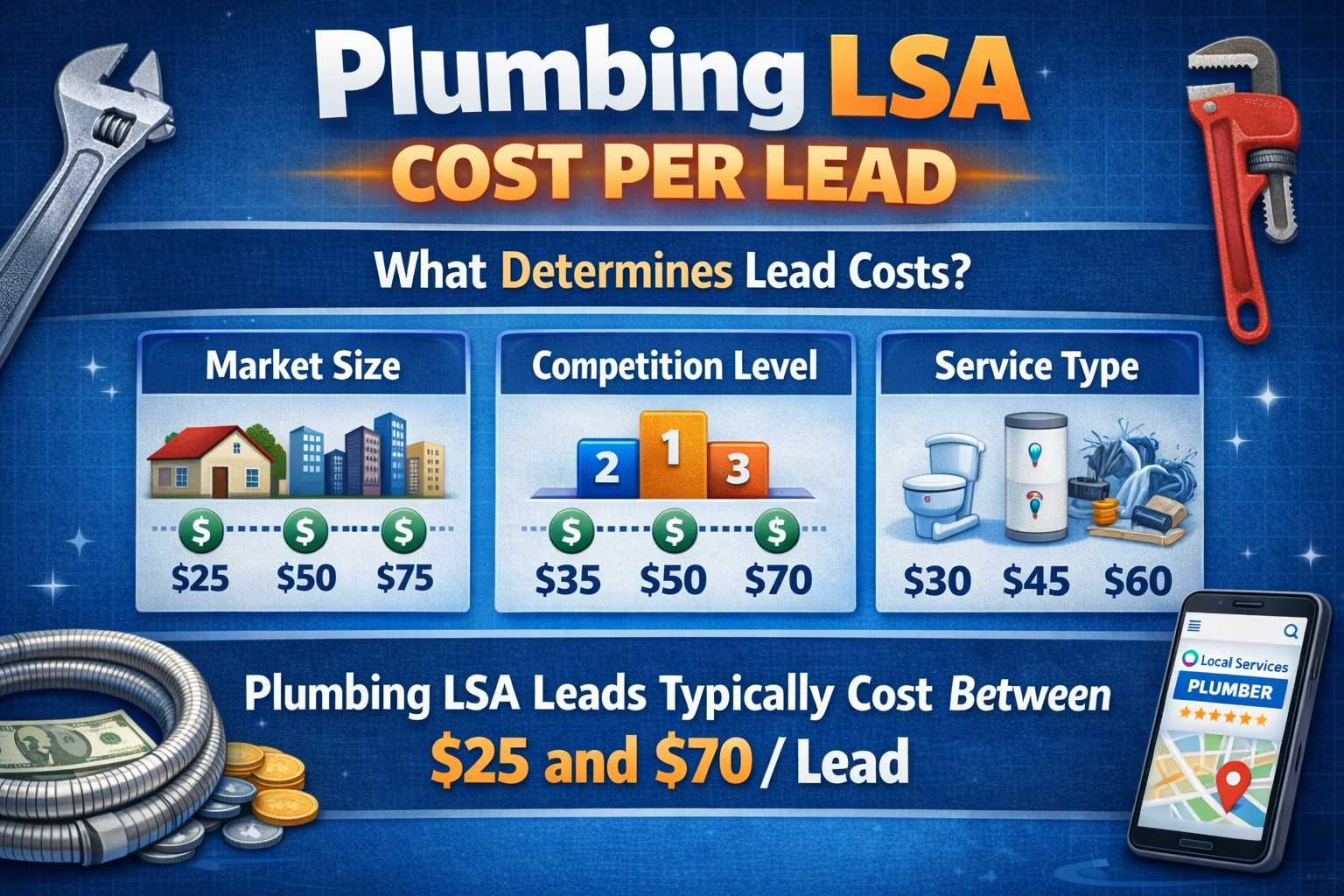
Quick answer: Published 2026 benchmarks put plumbing Local Services Ads cost per lead at roughly $57 to $69, against an all-trade LSA average near $53. Traditional Google Search Ads run far higher for plumbing: SearchLight’s benchmark set, built on $14.6 million in tracked spend across 524 plumbing contractors from January to March 2026, reports a non-branded cost per lead of $183, with average cost per click around $8.45 and individual keywords ranging $6 to $35 depending on market and emergency intent. Your own number moves with season, market size, and job type, and the sections below break down each one.
Why does plumbing LSA cost per lead vary so much by market and season?
Three forces pull plumbing CPL in different directions at the same time, and they rarely line up neatly.
Emergency urgency vs. planned work. A homeowner with a burst pipe at 6am is not shopping around. They are calling the first company that picks up, and Google knows it. Emergency searches command higher CPLs because the intent signal is stronger and the booking rate is predictably high. Planned jobs, like a water heater replacement the homeowner has been thinking about for three months, carry lower CPLs but more competition at the booking stage. Your job type mix determines how much emergency premium you are paying on average.
The job value range is enormous. A drain clearing job might be $150. A whole-house repipe might be $12,000 or more. Google's auction does not know your ticket size. It sets price based on advertiser competition and search intent signals. That means a $35 lead for a drain call and an $85 lead for a sewer line replacement might both be completely reasonable ROI, or both be terrible, depending on your booking rate and close rate for each job type.
Competition density by market. A market with 4 active plumbing LSA advertisers will have CPLs 30 to 50 percent lower than a market with 14 active advertisers chasing the same searches. Urban markets, especially in fast-growing metros, have added a lot of new plumbing advertisers in the past two years. If your CPL has drifted up without any change in your own settings, competition entering your market is likely the culprit.
What does the month-by-month plumbing LSA CPL calendar look like?
These ranges reflect typical suburban and mid-market performance, similar to markets like Charlotte, Indianapolis, Sacramento, or the Dallas suburbs. Adjust up for major metros and down for rural markets using the section below. Freeze event spikes can push CPL 30 to 60 percent above these ranges temporarily, regardless of the month.
| Month | CPL Range | Lead Volume | What's Driving It |
|---|---|---|---|
| January | $45-$75 | High | Freeze season emergency demand, burst pipes, high intent, fewer budget cuts |
| February | $40-$70 | Medium-High | Tail end of freeze season, cold snaps still driving burst pipe calls |
| March | $35-$60 | Medium | Shoulder month, outdoor plumbing projects begin, planned work picks up |
| April | $35-$60 | Medium | Spring plumbing projects, irrigation, lower emergency mix drives CPL down |
| May | $40-$65 | Medium-High | Demand builds, water heater season ramps, advertiser budgets increase |
| June | $45-$70 | High | Peak summer demand, irrigation/outdoor, water heater and sewer season |
| July | $45-$75 | High | Full summer demand, competition at peak, emergency volume remains elevated |
| August | $45-$75 | High | Sustained peak demand, similar to July in most markets |
| September | $40-$65 | Medium-High | Back-to-school burst, demand moderates, shoulder begins in northern markets |
| October | $35-$60 | Medium | Pre-winter prep, water heater replacements before cold weather, low competition |
| November | $40-$70 | Medium-High | Freeze season begins in cold climates, CPL starts climbing, emergency mix rises |
| December | $50-$85 | High | Peak freeze/emergency demand, highest CPL month for most plumbing companies |
How does plumbing LSA cost per lead change by market size (rural / suburban / metro)?
Your market's population and advertiser density set the baseline CPL floor, regardless of season. Here is how geography typically adjusts your number.
These ranges represent annual averages. During peak months, add $15 to $30 to the upper end for suburban and metro markets. During shoulder months, expect to land near the lower end of each range.
How Competition Density Changes Your Number
Population is a rough proxy, but the actual number of LSA advertisers in your service area matters more. Search "plumber near me" from a location in your service area and count the LSA listings. Three to five advertisers and you are in a relatively low-competition market. Eight to twelve and you are mid-density. Fifteen or more and you are in a heavy-competition market where CPL will track closer to the major metro ranges regardless of city size.
Want to see what plumbing LSA leads cost in your specific city? Run the numbers for your own market with our free plumbing LSA ROI calculator.
What does plumbing LSA cost per lead run by job type?
Here is something most plumbing contractors do not realize: the job types you enable in LSA directly affect your CPL. High-ticket job categories attract more advertiser competition, which raises prices. But they also deliver much higher ROI when you book them. The table below shows what you should expect to pay per lead for each major job type.
| Job Type | CPL Range | Avg Ticket | Notes |
|---|---|---|---|
| Drain clearing | $30-$50 | $125-$300 | High volume, fast close, but lower ticket limits break-even room |
| Toilet / fixture repair | $30-$50 | $100-$250 | Low-ticket, high-frequency; booking rate matters a lot here |
| Backflow testing | $35-$55 | $100-$300 | Often commercial; low ticket but predictable volume |
| Pipe leak repair | $40-$70 | $250-$800 | Mid-ticket emergency; solid ROI at market-rate CPL |
| Water heater repair | $45-$75 | $200-$500 | Strong emergency intent; repair often converts to install upsell |
| Water heater install | $55-$90 | $900-$2,500 | Higher CPL, massive ROI; see the water heater paradox section |
| Gas line work | $55-$95 | $300-$1,500 | Specialty work, lower volume, higher intent leads |
| Sewer line repair | $60-$100 | $2,000-$8,000 | Highest CPL bracket, but ticket size makes ROI exceptional |
| Repipe | $65-$110 | $4,000-$18,000 | Project leads; highest CPL, highest ticket, best ROAS for large companies |
Your blended CPL is a weighted average of all the job types you have enabled. If you run mostly drain clearing, your CPL will look low but your ROI per lead is tighter. If you enable repipe and sewer replacement, your average CPL rises, but a single booked job can pay for 30 to 60 leads.
How much more do emergency plumbing leads cost than planned jobs?
Not all plumbing leads are created equal, and the type of intent behind a lead affects what you pay for it.
Emergency leads (burst pipe, sewage backup, no hot water, active leak) come with higher CPLs because the search signals are urgent. Google's auction charges more when a search query is highly intent-driven and the caller is unlikely to shop around. You pay a premium, but your booking rate on emergency leads should be 50 to 70 percent or higher. If someone calls with a burst pipe and you pick up in 30 seconds, they are booking. The ROI math on emergency leads is almost always strong even at $75 to $90 CPL.
Planned leads (water heater planning, bathroom renovation plumbing, soft repipe inquiry) carry lower CPLs because the caller has time to compare. Your CPL drops, but so does your booking rate if your follow-up process is slow. Planned leads often take two to five contacts before they convert. They are not worse leads, they just require more from your sales process.
The practical takeaway: if your booking rate on emergency leads is below 40 percent, you have a response time or phone coverage problem, not a CPL problem. Get that fixed first before worrying about your CPL number. See our plumbing LSA playbook for the full response time and lead management system.
Why do water heater leads cost more but pay better?
Here is a comparison that surprises most plumbing contractors when they see it laid out.
The water heater install lead costs twice as much per lead and delivers 9 times the gross profit per booked job. The "expensive" lead is not expensive at all when you run the full math. This is why enabling high-ticket job types, even at higher CPLs, almost always improves your overall ROAS.
The same logic applies to repipe and sewer replacement leads. A $100 CPL for a sewer line replacement that books at $5,000 to $8,000 is one of the best marketing investments a plumbing company can make. The mistake is looking at CPL in isolation without accounting for the job value on the other side.
How do you audit whether your plumbing LSA CPL is too high?
Before you conclude your CPL is a problem, run through this four-step audit. Most plumbing companies that think they are overpaying are actually in range for their market, or the issue is booking rate rather than lead cost.
-
1Benchmark your market
Compare your CPL against the seasonal and market size ranges in this guide. Are you in a major metro during December? A $75 CPL is normal. Are you in a suburban market in April and paying $75? That is worth investigating. Start with an honest market comparison before drawing any conclusions.
-
2Check your job type mix
If you recently enabled repipe, sewer line, or water heater installation job types, your blended CPL should have risen. That is expected and usually good for ROAS. Pull your leads from the last 60 days and sort by job type. If high-ticket types are driving the CPL up, the ROI is almost certainly positive.
-
3Count active advertisers in your service area
Search "plumber near me" from your target zip code. Count the LSA listings. If the count has grown compared to six months ago, competition entering your market is likely pulling your CPL up. This is not a setting you can fix, but it tells you whether the cause is external or internal.
-
4Calculate your effective CPL by job type
Take the total amount spent on LSA in a given period and divide it by the number of leads in each job category. This is more work but gives you a real picture. You may find that your drain leads are $35 and your water heater leads are $90, and that the blend creates a misleading average that hides great ROI on your best categories.
If you work through this audit and conclude your CPL is genuinely above market rate, the next step is reviewing your LSA bid strategy and profile completeness score. The detailed tactics are in our guide on how to lower your Google LSA cost per lead.
A click cost and a conversion rate give you the lead cost. The free CPA calculator does that step.
When should you rate a plumbing lead as invalid?
Disputing leads is one of the most misunderstood tools in LSA. Used correctly, it recovers budget from genuinely invalid leads. Used incorrectly, it signals to Google that you have a bad booking rate and can actually hurt your ranking.
Valid dispute reasons for plumbing LSA leads:
- The caller needed a service you do not offer: HVAC, electrical, general handyman, roofing, or similar non-plumbing work
- The call was a duplicate from the same phone number within 72 hours
- The caller never left a voicemail and did not answer your callback attempts within 24 hours
- The job location is clearly outside your listed service area
- The call was solicitation, telemarketing, or a robocall
- The call was from another contractor or vendor, not a homeowner
Do not dispute these:
- A caller who got a cheaper quote from someone else and did not book with you
- A lead who decided not to move forward with the project
- A lead who called about a service you offer but went with a competitor
- Leads with a ticket size you did not expect
What is your break-even cost per lead by company type?
Your maximum tolerable CPL is not the same as the market average. It depends on your average job ticket, gross margin, and booking rate. Here is how it breaks down for three common plumbing company structures.
These ranges assume you are booking plumbing calls at a 35 to 50 percent rate. If your booking rate is lower, your break-even CPL drops significantly. The fastest path to tolerating higher CPLs is improving your first-call conversion rate, not reducing what you spend on leads.
Break-even depends on the margin behind the ticket, which is the number most contractors estimate. Pin yours down in the free profit margin calculator.
For a deeper look at ROAS targets and ROI modeling by company type, the plumbing LSA ROI benchmarks guide runs the full numbers including how budget level affects return. If you are trying to figure out how much to spend in total, the plumbing LSA budget guide covers monthly budget sizing by company size and market.
What are the full plumbing LSA CPL benchmarks for 2026?
Use this table as a quick reference when evaluating your plumbing LSA performance. Find the row that best matches your situation and compare your current CPL against the range.
| Category | Low CPL | Mid CPL | High CPL |
|---|---|---|---|
| By Season | |||
| Jan-Feb (freeze season) | $45 | $58 | $75 |
| Mar-May (spring shoulder) | $35 | $48 | $65 |
| Jun-Aug (summer peak) | $45 | $58 | $75 |
| Sep-Oct (fall shoulder) | $35 | $48 | $65 |
| Nov-Dec (pre/early freeze) | $40 | $63 | $85 |
| By Market Size | |||
| Rural (under 100K) | $25 | $35 | $45 |
| Suburban (100K-500K) | $40 | $55 | $70 |
| Major Metro (500K+) | $65 | $88 | $110 |
| Competitive Metro (LA, NYC, etc.) | $80 | $100 | $120 |
| By Job Type | |||
| Drain clearing / toilet repair | $30 | $40 | $50 |
| Backflow testing | $35 | $45 | $55 |
| Pipe leak repair | $40 | $55 | $70 |
| Water heater repair | $45 | $60 | $75 |
| Water heater installation | $55 | $73 | $90 |
| Gas line work | $55 | $75 | $95 |
| Sewer line repair/replacement | $60 | $80 | $100 |
| Repipe (whole house) | $65 | $88 | $110 |
Plumbing LSA Cost Per Lead FAQs
What is the average cost per lead for plumbing LSA?
Most plumbing companies pay between $35 and $75 per lead on Google LSA, with the exact number depending on market size, season, and job type mix. Suburban markets in shoulder months land closer to $35 to $55. Major metros in December or during freeze events can push $80 to $100 per lead. The number that matters more than raw CPL is your cost per booked job. If you are booking 40 percent of leads at a $65 CPL, your cost per booked job is $162, which is highly profitable even on a basic service call.
Why is my plumbing LSA CPL so high?
High plumbing CPL usually comes from one of four sources: you are in a dense metro with many active advertisers, it is freeze season or a spike event driving emergency demand, your job type mix skews toward high-ticket categories like repipes and sewer replacement, or your booking rate is low which raises your effective cost per booked job even if the raw CPL looks normal. Start by checking how many LSA advertisers are showing in your area, then look at your job type distribution and booking rate before assuming the CPL itself is the problem.
Does job type affect plumbing LSA CPL?
Yes, significantly. Drain clearing leads typically run $30 to $50 because volume is high and job values are lower. Water heater installation leads run $55 to $90 because the ticket is much higher and competition is stronger for that job type. Sewer line and repipe leads can reach $65 to $110, which sounds expensive until you realize the average job ticket is $4,000 to $18,000. Your blended CPL depends heavily on which job types you have enabled. Enabling more high-ticket categories raises your average CPL but almost always improves your overall ROAS.
When should I dispute a plumbing LSA lead?
Dispute a plumbing LSA lead when it clearly falls outside the service you advertise. Valid dispute reasons include: the caller needed a service you do not offer (HVAC, electrical, general handyman work), the call was a duplicate from the same number within 72 hours, the caller never left a voicemail and did not answer your callback attempts within 24 hours, the job location is outside your listed service area, or the call was solicitation or a robocall. Do not dispute leads just because the caller got a cheaper price elsewhere or decided not to book. Disputing valid leads aggressively hurts your LSA ranking. Only dispute what genuinely does not qualify.
Not Sure If Your Plumbing CPL Is Too High?
We audit plumbing LSA accounts for free. We'll tell you exactly what you should be paying in your market and what's driving your current number.
Get My Free Plumbing LSA AuditSee the real numbers for your trade
Plug in your industry, budget, and close rate. Our calculator shows your projected leads, cost per booked job, and ROAS.
More for plumbing operators
Pair this with the rest of the plumbing operator series. Each guide covers a different angle on growing a plumbing company through paid search: