Published by Blue Grid Media • Updated for 2026 • 14 min read
Why Junk Removal Is One of the Best LSA Categories (and Most Haulers Don't Know It)
Junk removal has something most home service categories don't: instant bookability. A homeowner calls, describes what needs to go, you quote a price over the phone, and you're on your way. No estimate appointment. No follow-up email. No two-week decision cycle.
That speed advantage makes LSA ridiculously effective for haulers. When someone searches "junk removal near me," they're not researching options for next month. They're staring at a pile of old furniture or a garage full of stuff and they want it gone today. Maybe they're prepping for a move, dealing with an eviction cleanout, or finally tackling the basement they've been avoiding for three years.
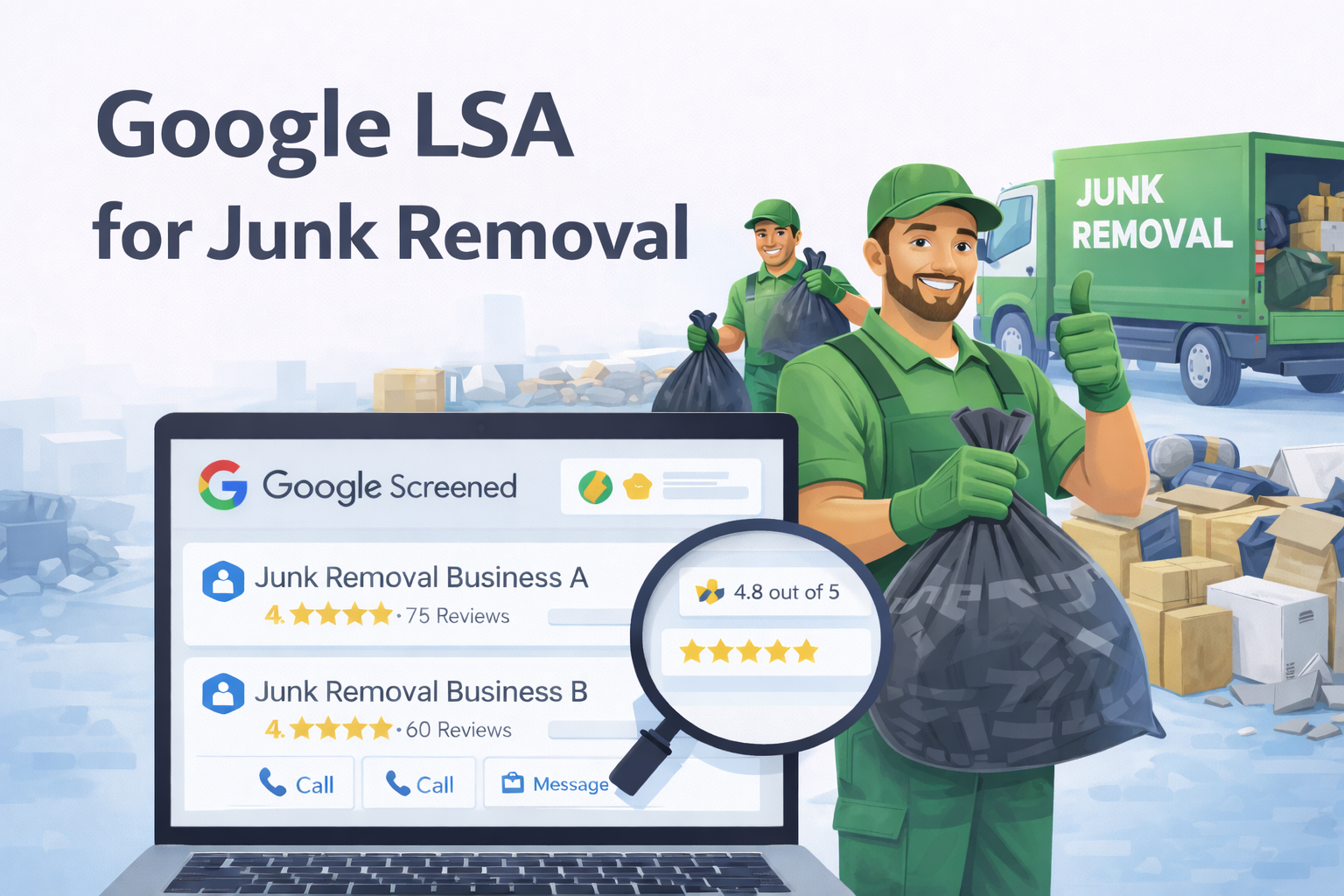
LSA puts your business right at the top of that search, with your Google Guaranteed badge, star rating, and a big green "Call" button. No website visit. No form submission. No waiting for callbacks from five different companies. The customer taps, calls, and you answer.
Compare that to the lead aggregator model where you're buying a lead that's been sold to three other haulers. By the time you call back, someone else already booked it. LSA leads are exclusive. The person called you. That's a completely different conversation than "Hi, I got your number from [aggregator]. What's your availability?"
What Junk Removal LSA Leads Actually Cost (And Why Aggregators Can't Compete)
Here's the math that makes hauling company owners switch to LSA the moment they see it.
Average cost per LSA lead: $30
Close rate (same-day service): 55%
// Cost per booked load
$30 ÷ 0.55 = $54.55 per booked job
// Average revenue per full truck load
Full load revenue: $450
ROAS = $450 ÷ $54.55 = 8.2x return
// Add disposal cost back
Dump fee: ~$60 per load
Labor + fuel: ~$85 per load
Net profit per load: $450 - $60 - $85 - $54.55 = $250.45 net profit
Now compare that to the aggregator model. You pay $45-$120 per lead, that lead was also sent to 2-4 other haulers, and your close rate drops to 15-25% because whoever calls back first wins. The cost per booked job on those platforms runs $180-$480.
| Metric | Google LSA | Lead Aggregators | Google Search Ads |
|---|---|---|---|
| Cost per lead | $15-$50 | $45-$120 | $25-$75 |
| Exclusive lead? | Yes | No (shared 2-4x) | Yes |
| Close rate | 50-65% | 15-25% | 30-40% |
| Cost per booked job | $30-$85 | $180-$480 | $65-$190 |
| Lead intent | Same-day urgent | Browsing/comparing | Active search |
| Dispute option | Yes (invalid calls) | Limited/none | No |
The numbers aren't close. LSA is the best lead source available for junk removal companies right now, and it's not particularly debatable. The only question is whether you're set up correctly to capture your share.
See the real numbers for your trade
Plug in your industry, budget, and close rate. Our calculator shows your projected leads, cost per booked job, and ROAS.
Setting Up Your Junk Removal LSA Profile (The Right Way)
Most haulers rush through the setup, toggle on "junk removal" as a job type, and wonder why they're getting 2 calls a week when the company down the street is getting 15. The profile is your storefront. Here's how to build it so Google actually ranks you.
10 Job Types You Should Enable (Most Haulers Only Pick 3)
Every job type you enable is a separate set of searches where your listing can appear. The hauler who enables 3 categories is invisible for 70% of the searches happening in their market. Here are the 10 categories that drive real volume.
| Job Type | Avg. Revenue | Why It Matters |
|---|---|---|
| General junk removal | $250-$600 | Your bread and butter. Highest search volume by far. |
| Furniture removal | $150-$400 | Huge search volume from people replacing couches, mattresses, bedroom sets. |
| Appliance removal | $75-$200 | Quick jobs. Stack 3-4 per day between larger loads for bonus revenue. |
| Construction debris removal | $400-$1,200 | Higher ticket. Contractors and flippers search for this separately from residential junk. |
| Yard waste removal | $150-$350 | Seasonal peaks in spring and fall. Different customer than general junk removal. |
| Estate cleanout | $800-$3,000+ | Highest per-job revenue. Families dealing with a deceased relative need full-house clearing. |
| Garage / attic cleanout | $300-$700 | Specific search intent. These callers know exactly what they need and book fast. |
| Hoarding cleanup | $1,500-$5,000+ | Sensitive, high-value work. Far less competition because most haulers don't enable this category. |
| Hot tub / shed removal | $300-$800 | Niche but steady. Homeowners searching "hot tub removal near me" are extremely ready to book. |
| Foreclosure / eviction cleanout | $500-$2,000 | Commercial volume from property management companies. One relationship = recurring jobs. |
Notice the range. A company that only enables "general junk removal" is missing estate cleanouts ($800-$3,000+), hoarding cleanup ($1,500-$5,000+), and construction debris ($400-$1,200). These are completely separate search queries with completely separate callers. If you don't have the category enabled, you're invisible for those searches.
The Phone Quoting Advantage: Why Junk Removal Closes Faster Than Any Other LSA Category
Roofers need to climb on a roof. Painters need to walk through the house. Plumbers need to open a wall. All of those trades require an in-person estimate before they can price a job. Junk removal doesn't.
When someone calls from your LSA listing, the conversation goes like this: "What do you need removed?" They tell you. "Can you send a few photos?" They text pictures. You look at the photos, estimate the truck-load fraction, and quote a price. The whole thing takes 3-5 minutes. If the price works, you can be at their door within a few hours.
This phone-to-booked pipeline is why junk removal close rates on LSA hit 50-65%. There's no estimate lag. No proposal to email. No two-week decision period where the customer gets three more quotes and picks the cheapest. You're quoting and booking in the same phone call.
How to Quote Over the Phone Without Underbidding
The risk with phone quoting is leaving money on the table. Here's how experienced haulers handle it:
- Always ask for photos first. "Can you text me a few pictures of what needs to go? That way I can give you the most accurate price." This takes 30 seconds and prevents you from showing up to a "small pile" that's actually two truck loads.
- Quote in truck-load fractions. "Based on those photos, that looks like about a half-truck load, which runs $275." Truck fractions are intuitive for customers and standardize your pricing across your crew.
- Build in a buffer for on-site surprises. "If it ends up being a bit more than the photos show, we'll talk about it before we start. But most of the time, the photo estimate is right on."
- Offer same-day service as the default. "We can actually get to you this afternoon between 2 and 4. Does that work?" Don't ask "when would you like us to come?" Default to today and let them push back if needed.
Truck Routing and Daily Capacity: How to Book 3-5 Loads Per Day From LSA
Volume is great, but only if your trucks can handle it. The difference between a hauler making $1,500/day and one making $600/day from the same number of LSA leads comes down to routing and load stacking.
Zone-Based Scheduling
Divide your service area into zones. Schedule morning pickups in one zone, afternoon pickups in another. This eliminates the 45-minute drives between jobs that eat your margin. When an LSA call comes in, check the address against today's route. If it fits a zone you're already working, offer a tighter time window. If it's across town, schedule it for tomorrow when you'll be in that area.
Stacking Small Jobs Around Anchor Jobs
An estate cleanout or hoarding cleanup is a full-day anchor job. But a single appliance removal or a few pieces of furniture? Those are 20-30 minute stops. Stack 2-3 small pickups around a larger job to maximize revenue per truck per day.
Another truck spreads the same overhead across more billable hours. The free contractor hourly rate calculator shows what that does to the rate you need.
Example daily route:
- 8:00 AM - Appliance pickup (washer/dryer), $150, 20 minutes on-site
- 9:00 AM - Garage cleanout, $450, 90 minutes on-site
- 11:30 AM - Dump run #1
- 1:00 PM - Furniture removal (couch + mattress), $200, 30 minutes
- 2:00 PM - Construction debris from bathroom remodel, $500, 60 minutes
- 3:30 PM - Dump run #2
Total revenue: $1,300 from a single truck with two crew members. After dump fees ($120), fuel ($45), and labor, you're netting $800+ per truck per day. Scale to two trucks and you're clearing $6,000-$8,000/week before overhead.
How to Rank Higher Than Competing Haulers in Your Market
Google ranks LSA listings based on a handful of signals, and the weight of each one is different for junk removal than for other categories. Here's what actually moves the needle.
For a deeper look at the ranking algorithm across all industries, read our complete LSA ranking factors guide.
1. Responsiveness (Biggest Factor for Haulers)
Google tracks how quickly you answer calls and whether you miss them. For junk removal specifically, responsiveness matters more than almost any other category because the search intent is so immediate. If you're answering 95% of calls within 15 seconds, you'll outrank a competitor with more reviews but a 60% answer rate.
Set up call forwarding to your cell when you're on the road. Use a virtual receptionist service for after-hours calls. Never let an LSA call go to voicemail.
2. Reviews (Volume and Velocity)
Junk removal has a built-in review advantage: high job volume. If you're doing 3-5 pickups per day, that's 15-25 potential reviews per week. Ask every single customer for a review right after the job, when they're standing in their newly empty garage feeling relieved. Our LSA review strategy guide breaks down the exact timing and templates.
Aim for 50+ reviews within your first 3 months on LSA. Companies with 100+ reviews dominate the top positions in most markets.
3. Proximity to the Searcher
Google favors businesses closer to the person searching. If you only have one location, you'll naturally rank better in nearby zip codes. If you serve a wide metro area, consider whether a second location or mailing address in a different part of town could improve coverage for underserved areas.
4. Business Hours and Availability
Extended hours help. If your competitors close at 5 PM and you accept calls until 7 PM, you capture all the after-work searches. Weekend availability is even more valuable since most residential junk removal searches happen Saturday mornings when homeowners are tackling projects.
If you're struggling to rank despite doing everything right, read our troubleshooting guide: LSA not working? 12 reasons and fixes.
Seasonal Demand Patterns and Budget Strategy for Haulers
Junk removal has distinct seasonal peaks that smart haulers exploit with their LSA budget.
Spring Cleaning (March-May): The Big Surge
This is your highest-volume season. Homeowners cleaning out garages, sheds, basements, and yards. Budget should be 30-40% above your baseline during these months. Search volume for "junk removal near me" doubles compared to winter in most markets.
Moving Season (May-September): Sustained Volume
People moving in or out of homes generate massive junk removal demand. They're clearing out stuff they don't want to pack and move. This overlaps with spring cleaning for a sustained peak from March through September. Moving companies often refer their customers to junk haulers for pre-move cleanouts, creating a partnership opportunity.
Post-Holiday (January-February): The Purge
After the holidays, people are getting rid of old furniture and appliances that were replaced by gifts, clearing out to start the new year fresh. It's not as strong as spring, but it's a reliable bump that catches many haulers off guard.
Winter Dip (November-December): Maintenance Mode
Lowest volume. Lower your budget by 20-30% but don't pause. The haulers who stay active through winter build review momentum and maintain their ranking position for when spring hits.
Targeting High-Value Jobs: Estate Cleanouts, Hoarding, and Commercial Work
The average residential junk removal job pays $250-$600. That's solid. But the same LSA listing can generate calls for estate cleanouts ($800-$3,000+), hoarding cleanup ($1,500-$5,000+), and commercial recurring contracts. Here's how to position for those higher-ticket opportunities.
Estate Cleanouts: The Empathy Job
When a family calls about clearing a deceased relative's home, they're dealing with grief on top of logistics. The hauler who handles this with patience and compassion wins not just the job, but referrals from estate attorneys, realtors, and other family members for years afterward.
Price estate cleanouts by the room, not the truck load. A 3-bedroom home typically runs $1,200-$2,500 depending on how full it is. Offer to separate donations from trash since families appreciate knowing that usable items went to charity rather than a landfill.
Hoarding Cleanup: Low Competition, High Revenue
Most haulers avoid hoarding jobs because they're messy, time-intensive, and emotionally complex. That's exactly why they pay $1,500-$5,000+. The competition on LSA for hoarding cleanup is 80% lower than for general junk removal in most markets.
If you're willing to take these jobs, make sure your LSA profile has "hoarding cleanup" enabled. Mention it in your business description. When the call comes, approach it with sensitivity. These callers are often embarrassed and have put off the call for months. A calm, non-judgmental response on the phone is what seals the deal.
Construction Debris: The Contractor Pipeline
General contractors, flippers, and remodelers generate construction debris on every project. One relationship with a busy GC can mean 2-4 debris hauls per month at $400-$1,200 each. LSA is often how they find you the first time.
After the first job, follow up with a simple offer: "We can set up a standing schedule if you've got more projects coming up. We'll give you priority scheduling and consistent pricing." This converts a one-time LSA lead into recurring commercial revenue.
The Eco-Friendly Angle: Donation and Diversion as a Selling Point
Homeowners increasingly care about where their junk ends up. A company that says "we haul it to the dump" and a company that says "we donate usable items, recycle what we can, and only landfill what's truly trash" are competing for the same leads, but the second company closes more of them at higher prices.
Build this into your LSA profile and phone pitch:
- Track your diversion rate. "We diverted 62% of items from landfills last year through donations and recycling." Put this number in your business description.
- Partner with local charities. Goodwill, Habitat for Humanity ReStore, and local shelters will accept furniture, working appliances, and household goods. Some will even pick up from your warehouse if you batch donations.
- Offer donation receipts. Customers can write off the value of donated items on their taxes. Mention this during the phone call. It makes the price feel lower because they're getting a deduction.
- Photograph the donation process. Post photos of your crew unloading donations at local charities. These make great review reply content and GBP posts that boost your local presence.
The eco-friendly positioning also helps with review strategy. Customers who feel good about where their stuff went are significantly more likely to leave a positive review without being asked.
Disputing Invalid Junk Removal Leads
Not every LSA call is a real lead. Google lets you dispute charges for calls that don't meet quality standards. For junk removal, the most common disputes are:
- Wrong service requests: "Can you move my furniture to my new apartment?" (That's a moving job, not junk removal.)
- Outside your service area: Calls from zip codes you don't cover, often caused by the caller using a VPN or incorrect location.
- Spam or robocalls: Automated calls, solicitors, or wrong numbers.
- Duplicate calls: The same customer calling twice about the same job within a short window.
- Pricing shoppers who hang up in under 30 seconds: If the caller says "how much?" and hangs up before you can have a real conversation, dispute it.
For a complete breakdown of the dispute process and which disputes Google approves, see our guide to LSA lead disputes.
Pricing Strategy: Truck-Load Fractions vs. Item-Based Quoting
How you price over the phone directly impacts your close rate and profitability. There are two main approaches.
Truck-Load Fraction Pricing
This is the industry standard and what works best for most residential jobs. You quote based on how much of your truck the items will fill: 1/8 load ($99-$150), 1/4 load ($175-$250), 1/2 load ($275-$350), 3/4 load ($375-$475), full load ($450-$600).
Advantages: simple for customers to understand, predictable for your crew, easy to quote from photos.
Item-Based Pricing
Better for small, defined jobs. "Couch removal: $125. Mattress: $75. Refrigerator: $150." This works well for appliance pickups and single-item removals where truck fractions feel overpriced to the customer.
Many haulers use a hybrid approach: item-based pricing for 1-3 items, truck-load fractions for larger jobs. The switch point is usually around $200 in item-based pricing. At that point, a 1/4 or 1/2 truck quote is both more accurate and more profitable.
Building Review Momentum When You're Doing 15+ Jobs Per Week
Junk removal companies have a massive advantage in the LSA review game: job volume. If you're doing 3-5 pickups per day, that's 15-25 review opportunities per week. Even a 20% review request conversion rate gives you 3-5 new reviews per week, or 12-20 per month.
That kind of velocity puts you at 100+ reviews within 6 months, which is the point where your ranking becomes very difficult for competitors to overtake.
When to Ask (Timing Matters)
The best moment to ask is right after the crew finishes and the customer sees their clean space. They're experiencing maximum satisfaction. Your crew lead should say something like: "If you're happy with the job, a quick Google review would really help us out. I can text you the link right now." Then text the direct review link before leaving the property.
Don't wait until later to send a follow-up email. Junk removal has a short emotional window. By tomorrow, the customer has moved on to other things and the motivation to leave a review drops by 70%.
For full review strategy details including templates and scripts, see our LSA review strategy guide.
LSA vs. Other Lead Sources for Junk Removal
Junk removal companies typically use 2-3 lead sources. Here's how LSA stacks up against the most common alternatives.
| Lead Source | Avg CPL | Close Rate | Cost per Booked Job | Lead Type |
|---|---|---|---|---|
| Google LSA | $15-$50 | 50-65% | $30-$85 | Exclusive, urgent |
| Google Search Ads | $25-$75 | 30-40% | $65-$190 | Exclusive, intent-based |
| Lead aggregators | $45-$120 | 15-25% | $180-$480 | Shared 2-4x |
| Thumbtack | $20-$80 | 15-20% | $100-$400 | Shared 3-5x |
| Nextdoor / Facebook | $10-$30 | 10-20% | $50-$300 | Low intent, browsing |
LSA should be your primary paid lead source. Google Search Ads can supplement LSA for high-value keywords (like "estate cleanout" or "construction debris removal") where you want additional coverage beyond the LSA pack. Organic social channels like Nextdoor are great for brand awareness but shouldn't be relied on for consistent booking volume.
For a complete comparison of LSA vs. marketplace platforms, see our LSA vs. Thumbtack vs. Angi breakdown.
Junk Removal LSA FAQs
How much do junk removal leads cost on Google LSA?
Junk removal LSA leads typically cost $15-$50 per call depending on your market. Metro areas like Houston or Chicago run $35-$50, while smaller markets see $15-$25 leads. The real metric is cost per booked load. If you're closing 50-60% of LSA calls, your cost per booked truck load runs $30-$85.
Do I need a special license to run LSA for junk removal?
Most areas don't require a contractor license for junk removal, but you will need a business license, general liability insurance ($500K+ minimum), and to pass background checks. Some cities require a separate waste hauling permit. Google will verify whatever your jurisdiction requires.
What job types should I enable for junk removal LSA?
Enable every category you service: junk removal, furniture removal, appliance removal, yard waste, construction debris, estate cleanout, hoarding cleanup, garage cleanout, hot tub removal, and foreclosure cleanout. Each enabled category unlocks separate searches where your listing can appear.
How do junk removal LSA leads compare to aggregator leads?
LSA leads are exclusive (the customer called you directly) while aggregator leads are shared with 2-4 other companies. LSA close rates run 50-65% for junk removal versus 15-25% on shared leads. Cost per booked job is typically 60-70% lower through LSA.
How fast should I answer LSA calls for junk removal?
Immediately. Junk removal is one of the most urgency-driven LSA categories. Most callers want same-day pickup. If you don't answer within 30 seconds, they'll call the next listing. Companies that answer 90%+ of calls within 15 seconds consistently outrank slower competitors.
Should I offer phone quotes or on-site estimates?
Phone quotes are the standard for junk removal. Ask the caller to describe or photograph what needs to go, then quote based on truck-load fractions. You can go from LSA call to booked job in under 5 minutes. This speed is one of the biggest advantages junk removal has over other LSA categories.
Ready to Fill More Trucks Per Day?
We help junk removal companies set up, optimize, and scale Local Services Ads. Get a free audit of your current LSA performance or set up from scratch.
Get My Free Junk Removal LSA AuditMore on Google Local Services Ads
Part of the BGM Local Services Ads library. Pair this with the master pillar and the deep-dive guides: