Published by Blue Grid Media • Updated for 2026 • 12 min read
The moving industry has a lead problem. You sign up for a quote aggregator, pay $15 to $30 per lead, and that lead goes to four or five other moving companies at the same time. Before you've even opened the email, two competitors have already called, texted, and sent a quote. You respond an hour later and the customer has already booked. You paid for a lead you never had a real chance at closing.
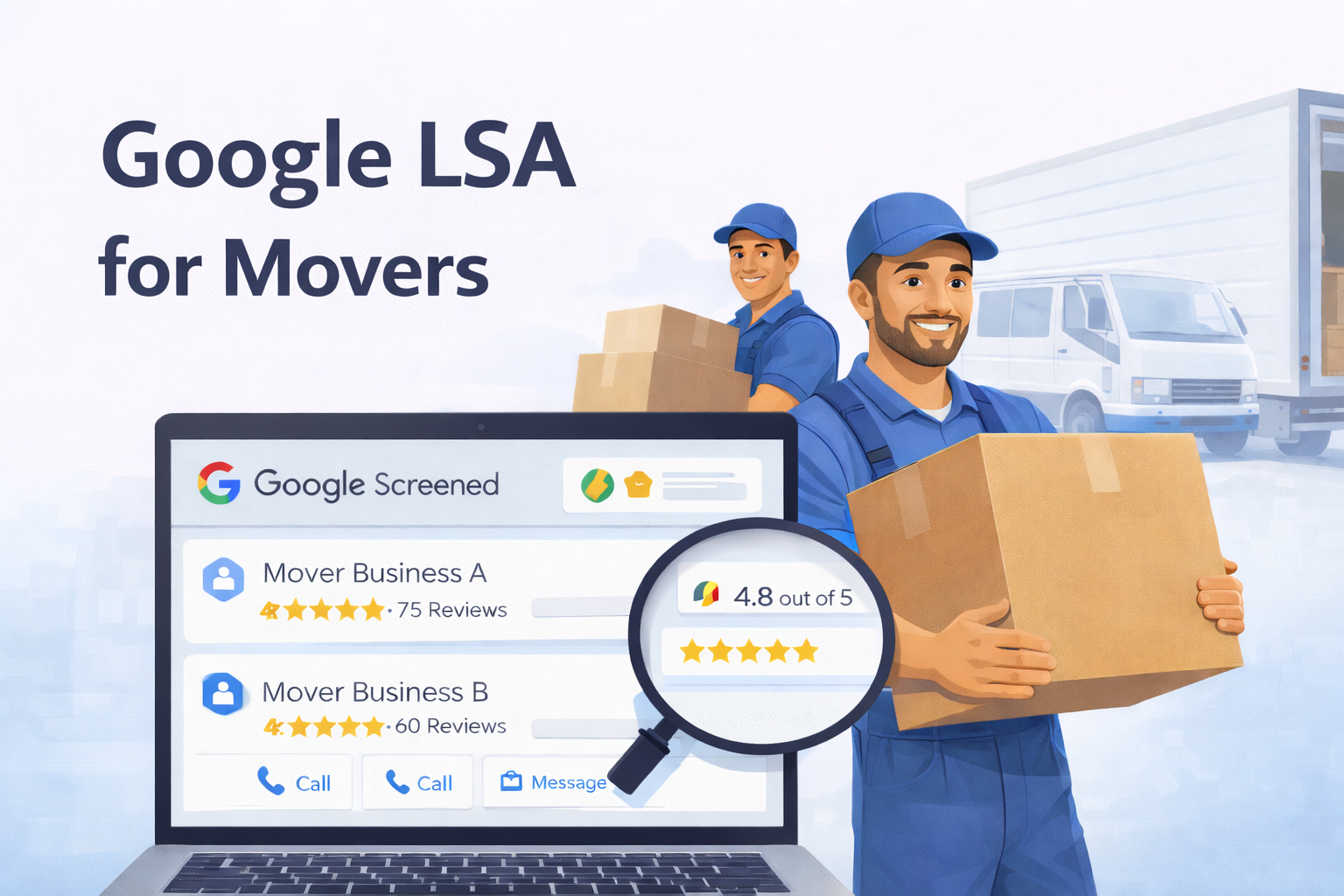
Google Local Services Ads work differently. When a homeowner searches "movers near me" or "moving company in Dallas," your listing shows at the top of the page with a Google Verified badge, your star rating, and a direct call button. They call you. Not you and five competitors. Just you. That single change in lead structure transforms the economics of customer acquisition for moving companies.
This guide covers how to set up LSA for a moving business, what it costs, how to convert quote requests into booked moves faster than your competition, and how to manage your budget around the extreme seasonality that defines the moving industry.
Is Google LSA Worth It for Moving Companies?
Yes, and the math is straightforward once you look at the job values involved.
Moving has some of the highest per-job revenue of any service trade on LSA. A local residential move averages $800 to $2,500. A long-distance move runs $2,500 to $8,000+. Commercial office relocations can top $10,000 to $50,000 depending on scope. Even at the higher end of LSA lead costs ($50 to $80 per lead), the revenue-to-cost ratio is exceptional because a single booked move can represent thousands of dollars in revenue.
The real advantage over moving-specific lead platforms is exclusivity. On a lead aggregator, you're one of five companies quoting the same move. On LSA, the customer called you directly. They saw your badge, your reviews, your years in business, and they chose to call your number. That changes everything about the closing dynamic. You're not competing on price against four instant quotes. You're having a conversation with a homeowner who already trusts you enough to call.
Close rates on LSA leads for movers run 30-40% for local moves when you provide a quote within 24 hours. Compare that to 10-15% on shared leads from aggregator platforms. At those rates, LSA delivers a lower cost per booked move even at a higher per-lead price.
What Google LSA Looks Like for Movers
When someone in your service area searches "movers near me," "moving company," "local movers," "long distance moving company," or related terms, Google shows Local Services Ads at the very top of the page. Above Google Ads. Above the map pack. Above organic results.
Your listing displays your business name, star rating, review count, years in business, and a call button. On mobile, it's the first thing the customer sees. For someone who just signed a lease and needs to be out in three weeks, the decision often comes down to who looks most established and trustworthy at the top of that list.
The Google Verified badge is particularly powerful for movers because the industry has a well-known fraud problem. Rogue movers who hold furniture hostage for inflated prices, unlicensed operators who damage belongings and disappear, companies that quote low and inflate on moving day. The Verified badge signals that Google has checked your DOT registration, insurance, and run background checks on your team. For a customer entrusting you with every possession they own, that signal carries real weight.
Setting Up Google LSA for Your Moving Company
Moving company verification is more involved than most trades because Google requires DOT and state-level registration documentation. Budget 2 to 4 weeks for the full process. Here's how to do it right.
| Available Job Type | Why It Matters |
|---|---|
| Local residential moving | Highest volume category; bread and butter of most moving companies |
| Long-distance moving | Higher revenue per job ($2,500-$8,000+); requires USDOT authority |
| Apartment moving | Captures renters specifically; often shorter moves with lower ticket but high volume |
| Office / commercial moving | Premium pricing; property managers and businesses search Google for these |
| Packing & unpacking services | High-margin add-on; $500-$1,500 revenue boost per move |
| Loading & unloading only | Budget-conscious customers who rented their own truck; growing demand |
| Storage services | Revenue beyond the move day; monthly recurring for customers between homes |
| Specialty / heavy item moving | Pianos, safes, hot tubs, pool tables; premium pricing for niche expertise |
| Senior / assisted moving | Niche but growing; high-service, high-touch moves with emotional component |
| Junk removal / disposal | Common add-on during moves; captures separate searches too |
See the real numbers for your trade
Plug in your industry, budget, and close rate. Our calculator shows your projected leads, cost per booked job, and ROAS.
What Does LSA Cost for Movers?
Moving company LSA runs $30 to $80 per lead in most markets. This is higher than trades like house cleaning or locksmithing because the average job value is significantly larger. Google's pricing algorithm accounts for job revenue, so higher-ticket trades pay more per lead. For a complete breakdown, see our LSA pricing guide.
What you keep from that ticket matters more than the ticket. Run one through the free contractor profit margin calculator.
Despite the higher per-lead cost, the unit economics are strong because moving job tickets are large and close rates on exclusive LSA leads are significantly better than on shared leads from aggregators.
Cost per booked move
Lead cost: $55.00
× Call answer rate: × 85%
× Quote provided: × 75%
× Close rate: × 35%
──────────────────────────────────
= Cost per booked move: ~$247
# At $1,800 avg local move + $800 packing add-on:
= $2,600 revenue per booked move
= 10.5:1 return on ad spend
And that's for local residential moves. Long-distance moves at $4,000 to $8,000 produce a 15 to 30:1 return on the same lead cost. Commercial moves can exceed 50:1. The point is that even at $55 to $80 per lead, the revenue generated per booked job makes LSA one of the most efficient acquisition channels available to moving companies.
Speed-to-Quote: The Variable That Decides Everything
Moving is a quote-driven business. Almost nobody books a move on the first phone call without knowing the price. The customer calls, describes their move, and wants a number. How fast you provide that number determines whether you book the job or lose it to a competitor who quoted faster.
Offer virtual estimates for smaller moves
For local moves involving apartments and homes under 3 bedrooms, offer a video call estimate. The customer walks their phone through the home, you inventory the major items, and you provide a quote within 15 to 20 minutes. This eliminates the scheduling delay of an in-home estimate and gives you a massive speed advantage over competitors who require an in-person walkthrough before quoting.
Schedule in-home estimates within 48 hours
For larger moves (4+ bedrooms, homes with specialty items, long-distance), an in-home estimate is usually necessary for accuracy. Schedule it within 48 hours of the initial call. Movers who get an estimator to the house within two days close at nearly double the rate of those who schedule estimates a week out. The customer is actively planning their move. Delay costs you the job.
Send the written quote the same day
After the estimate (virtual or in-person), send a detailed written quote the same day. Include your company name, DOT number, the itemized quote, liability coverage options, and a clear booking process. Professional presentation matters. A clean, detailed quote builds confidence. A text message with a number on it does not.
Follow up at 24 and 72 hours
If the customer doesn't book immediately, follow up once at 24 hours and once at 72 hours. "Hey [name], just checking if you had any questions about the estimate. Happy to walk through anything or adjust the scope if needed." Movers who follow this timeline close 35-40% of their quotes. Those who send the quote and wait close under 15%.
Peak Season LSA Strategy (May Through September)
Moving is the most seasonal trade on LSA. Roughly 70% of all residential moves happen between May and September. Lease turnovers, school-year timing, and weather all drive this concentration. Your LSA strategy needs to account for this extreme seasonality or you'll overspend in winter and underspend when demand peaks.
Scale budget aggressively in peak season
Increase your weekly LSA budget 40-60% starting in late April. By June and July, you should be running your maximum budget. Search volume for "movers near me" can be 3 to 5 times higher in July than in January. This is when your crews should be fully booked 2 to 3 weeks in advance. If they're not, your budget isn't high enough.
Book further in advance during peak
In the off-season, customers often call and want to move within a week. During peak season, the planning window extends to 2 to 6 weeks. Your quoting process should reflect this: "Our next available Saturday is July 19th. If you'd like to book, a deposit secures the date and crew." Scarcity of availability actually helps close rates during peak because customers understand they need to act fast.
End-of-month and first-of-month surges
Within each peak month, the last three days and first three days see the highest demand because that's when leases turn over. Expect your LSA call volume to spike dramatically around the 28th through the 3rd. Make sure your phone coverage is airtight during these windows. Every missed call during month-end is likely a lost move worth $1,000+.
Off-season doesn't mean off
Reduce your budget 30-40% from October through April, but don't pause. Corporate relocations, military PCS moves, and apartment-to-apartment moves happen year-round. Leads are cheaper in winter because fewer movers are actively spending. The customers who search during off-season are often more motivated (they have a hard deadline) and less price-sensitive.
How to Rank Higher in Moving Company LSA
Google's ranking algorithm for movers follows the same principles as other trades, with a few variables that carry extra weight in the moving vertical. For the complete breakdown, see our LSA ranking factors guide.
Reviews mentioning careful handling and on-time arrival
Moving customers care about two things above all else: "Did they show up on time?" and "Did they break anything?" Reviews that specifically mention punctuality, careful handling, and damage-free delivery carry enormous weight. When you ask for reviews, prompt customers: "If you wouldn't mind mentioning the crew and how everything arrived, that really helps other families feel confident about choosing us." For a full review collection system, see our LSA review strategy guide.
Responsiveness during peak season
Google tracks your call answer rate and response time. During peak season when call volume surges, your answer rate can drop if you're not prepared. Dedicate someone to answering LSA calls during the May-September rush. Even a 10% drop in answer rate during your highest-volume months can significantly impact your ranking for the rest of the year.
Broad service type coverage
Enable local moves, long-distance, commercial, packing, loading/unloading, storage, and specialty items. Each service type is a separate search category. Movers who only enable "local moving" miss searches for "packing service near me," "piano movers," "office relocation," and "storage companies near me." These are separate customers with separate needs, and they're searching right now.
Common LSA Mistakes Movers Make
Slow quoting process
This is the biggest revenue leak in the moving industry. A customer who calls on Monday and doesn't get a quote until Thursday has already booked with someone else. Offer virtual estimates for standard moves and provide written quotes the same day as any walkthrough. Speed-to-quote is the single most controllable variable in your close rate.
Flat budget all year
Spending the same amount in January as in July means you're wasting money in winter and leaving money on the table in summer. Moving demand is 3 to 5 times higher during peak season. Your budget should reflect that. Scale up aggressively May through September and pull back October through April.
Not enabling packing and specialty services
Packing services alone can add $500 to $1,500 per move in revenue. If you don't enable packing, unpacking, specialty item moving, and loading/unloading as separate job types, you're invisible for all of those searches. That's lost revenue from services you already offer.
No photos of trucks and crew
Customers are deciding whether to trust you with everything they own. A profile with no photos or stock images doesn't build that trust. Upload photos of your branded trucks, your crew wrapping furniture, your loading process, your storage facility. Show that you're a real, professional operation.
Ignoring off-season opportunities
Pausing LSA in winter kills your ranking history and forces you to rebuild visibility from scratch when peak season returns. Corporate relocations, military moves, and lease turnovers happen year-round. Off-season leads are cheaper and the customers are often less price-sensitive because they have hard deadlines.
If your LSA is live but calls aren't coming in, our LSA no-calls troubleshooting guide covers the most common causes.
Should Movers Run LSA and Google Ads Together?
Yes, and the split is cleaner for movers than most trades because the customer journey divides naturally between urgent and planning-phase searches.
LSA captures the ready-to-book searcher. "Movers near me," "moving company in [city]," "local movers." These people have a move date, they need a mover, and they're calling today. LSA owns this moment with the Verified badge and direct-call format.
Google Search Ads capture the research and comparison phase. "How much does it cost to move a 3-bedroom house," "best moving companies in [city]," "moving checklist 2026," "long distance movers reviews." These homeowners are planning a move that's 2 to 8 weeks away. They're not ready to call yet, but they will be. Google Ads with landing pages that provide cost estimates, checklists, and comparison content convert this audience into leads that LSA can't reach. For a deeper comparison, see our Google Ads vs. LSA guide.
The same LSA model works across other service trades. If you serve multiple verticals, we cover HVAC, electrical, roofing, house cleaning, and painting in separate guides.
Moving Company LSA FAQs
What's the average job value for movers from LSA leads?
Local residential moves average $800 to $2,500 depending on home size and distance. Long-distance moves range from $2,500 to $8,000+. Commercial relocations can exceed $10,000. Even at the lower end, moving has some of the highest per-job values of any LSA trade. For lead volume expectations, see our LSA lead volume benchmarks.
How do moving company LSA leads compare to leads from moving.com or HireAHelper?
LSA leads are exclusive. The customer called your company directly. Marketplace platforms share your quote request with 3-6 other movers simultaneously, creating a price war. LSA leads close at 30-40% for local moves because the customer chose you specifically. Marketplace leads close at 10-15% because you're competing against multiple instant quotes.
What license does Google require for moving companies to run LSA?
Most states require movers to register with the state's public utilities commission or department of transportation. Interstate movers need a USDOT number and FMCSA operating authority. Google verifies these credentials during the LSA application. You'll also need general liability insurance, cargo insurance, and background checks for all crew. For the full verification walkthrough, see our step-by-step guide.
Should moving companies adjust their LSA budget seasonally?
Yes. May through September accounts for roughly 70% of annual moving volume. Increase your budget 40-60% during peak summer. Reduce 30-40% in winter but don't pause. Corporate relocations, apartment turnovers, and military PCS moves happen year-round. See our LSA pricing guide for benchmarks.
How should movers handle the quote-to-booking process with LSA leads?
Offer virtual walkthrough estimates via video call for local moves under 3 bedrooms. Provide an accurate quote within 15 minutes instead of scheduling an in-home estimate days later. For larger moves, schedule the in-home estimate within 48 hours. Send the written quote the same day. Follow up at 24 and 72 hours. Movers who quote within 24 hours close at 35-40%. Those who take 3+ days close under 15%.
Can moving companies use LSA for packing and storage services?
Yes. Enable packing, unpacking, storage, and specialty item moving as separate job types. Many homeowners search specifically for "packing service near me" or "storage near me" without associating those with a mover. Each enabled job type expands your search visibility. Packing services alone can increase average job value by $500-$1,500. If you receive low-quality leads, see our guide to LSA lead disputes.
Bottom Line
Moving has some of the highest per-job revenue of any trade on LSA, and the exclusive lead format solves the industry's biggest problem: competing against five other movers for the same customer. At $30 to $80 per lead with close rates of 30-40% on local moves, the cost to acquire a $1,800+ job is well under $250. When you add packing services, long-distance moves, and commercial contracts into the mix, the return on ad spend becomes exceptional.
The movers who dominate LSA do three things: they quote fast, using virtual estimates for standard moves and same-day written quotes after every walkthrough. They scale their budget with the season, spending aggressively May through September and maintaining minimum visibility the rest of the year. And they enable every service type they offer, so they capture searches for packing, storage, specialty items, and loading-only that their competitors miss. The ad gets the phone to ring. Your quoting speed turns that call into a booked move.
Start with LSA to capture the homeowners searching for movers in your market right now. Build your review base by asking every happy customer to mention your crew's professionalism and care. And if you want someone to look at your current setup and show you where you're leaving moves on the table, that's what we do at Blue Grid Media.
Get a Free Moving Company LSA Audit
We'll analyze your market, competition, and current lead sources. No pitch, no pressure.
Book Your Free ConsultationResults vary by market, competition, and how consistently you follow up on quotes and manage seasonal budget scaling. Blue Grid Media specializes in LSA and Google Ads for local service businesses.
More on Google Local Services Ads
Part of the BGM Local Services Ads library. Pair this with the master pillar and the deep-dive guides: