Published by Blue Grid Media • Updated for 2026 • 13 min read
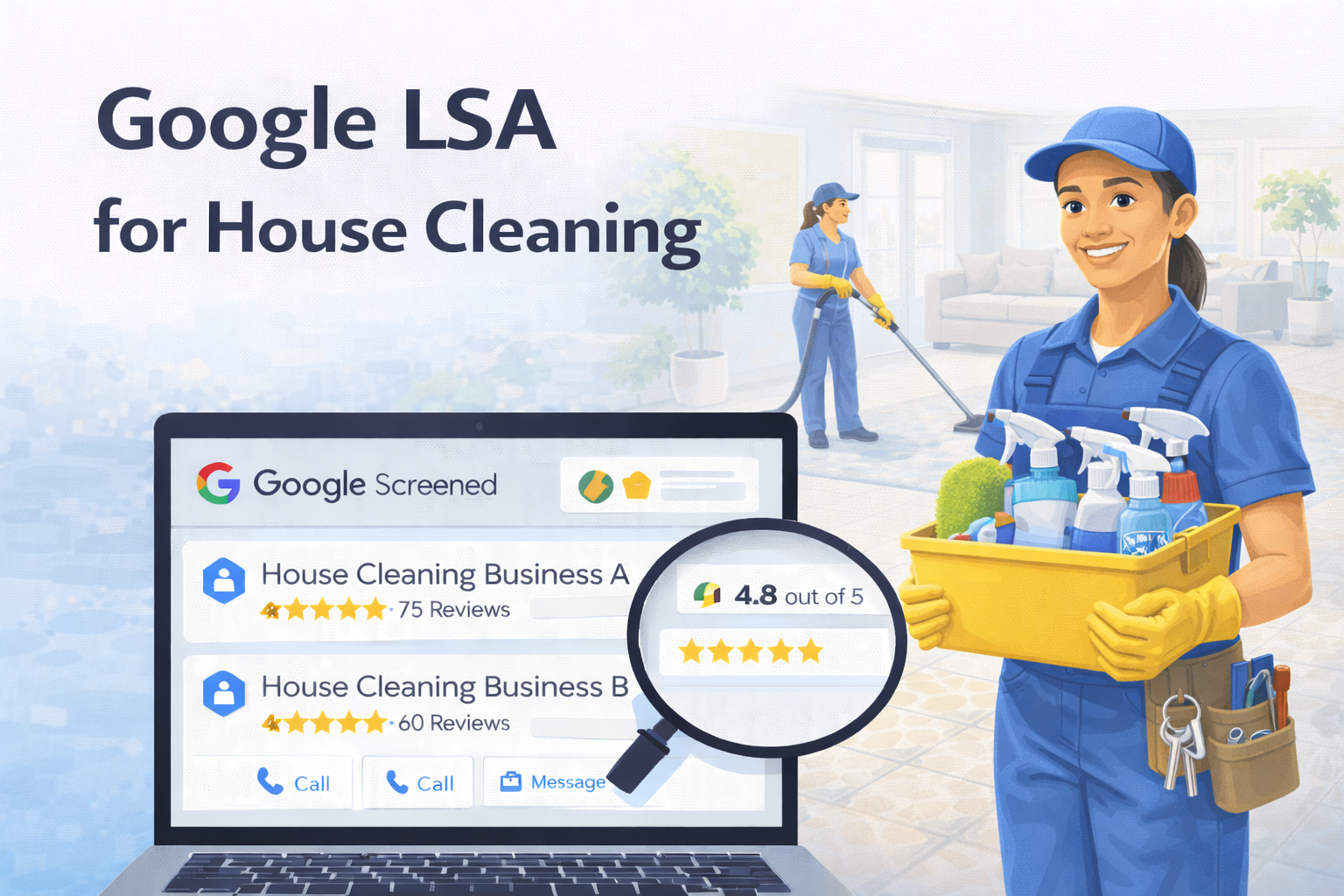
Most house cleaning companies grow the hard way: Thumbtack leads that get shared with four other cleaners, Handy taking a 20%+ cut of every job, Nextdoor posts that generate one call a week, and referrals that come in slowly when your schedule already has gaps. You spend money to fill next Tuesday's openings and then start over the following week with the same empty slots.
Google Local Services Ads work differently for cleaning companies because they solve the real problem: customer acquisition for recurring service. When a homeowner searches "house cleaning near me" and calls your verified listing, that's not just a one-time deep clean. That's a potential weekly or biweekly client worth $3,000 to $6,000 in annual revenue. The lead might cost you $20 to $35. The lifetime value of converting that lead to a recurring plan is where the math gets very good, very fast.
This guide covers how to set up LSA for a cleaning business, what it costs per lead, how to convert first-time cleanings into recurring clients, and how to manage your lead flow so LSA fills your schedule without creating chaos in your booking calendar.
Is Google LSA Worth It for House Cleaning Companies?
Yes, and cleaning is one of the few LSA verticals where the true value of a lead is 10 to 50 times higher than the sticker price, because of how naturally cleaning leads convert to recurring service.
Here's the comparison that matters. On Thumbtack, you pay $15 to $30 for a lead that goes to four other cleaners simultaneously. Your close rate on those shared leads is typically 10-20%. If you win the job, it's usually a one-time deep clean at $150 to $300. That's the end of the transaction. You got a single cleaning job from a lead you had a one-in-five chance of closing.
On LSA, you pay $20 to $35 for an exclusive lead. The homeowner called you specifically because they saw your Verified badge, your reviews, and your rating. Your close rate on these direct calls is 45-60% for the initial cleaning. And here's where it changes: 30-40% of those first-time customers convert to a weekly or biweekly recurring plan when you present the offer during the first visit. A biweekly client paying $150 per visit generates $3,900 in year one. A weekly client generates $7,800.
At a $25 CPL and a 50% booking rate, you're paying $50 to acquire a new customer. If 35% of those new customers sign up for biweekly service, your cost to acquire a $3,900/year recurring client is roughly $143. That's a 27:1 return on the initial ad spend. No cleaning marketplace platform comes close to that math.
The Recurring Revenue Model That Makes Cleaning LSA Exceptional
House cleaning is one of a handful of LSA trades (alongside pest control and pool service) where the business model is fundamentally recurring. Most homeowners who hire a cleaning company don't want to search for a new one every time their kitchen needs attention. They want to hire once and have someone show up reliably every week or every two weeks.
This means every LSA lead isn't just a $150 deep clean. It's a potential subscription customer. And the retention rates in residential cleaning are remarkably high: customers who stay past the third visit typically retain for 18 to 24 months on average. A biweekly client who stays for two years is worth $7,800 in total revenue from a single $25 lead.
Why LSA leads convert to recurring at higher rates
LSA leads convert to recurring plans at higher rates than leads from any other channel because of the trust signals built into the listing. The homeowner saw your Google Verified badge, read your reviews, noticed you've been in business for years, and chose to call you. That's a different starting point than someone responding to a Craigslist ad or clicking the cheapest option on a marketplace app. They already trust you before you walk in the door, which makes the "would you like to set up a recurring schedule?" conversation significantly easier.
Setting Up Google LSA for Your Cleaning Business
House cleaning verification is among the simplest on LSA because most states don't require a specific cleaning license. The process focuses primarily on insurance and background checks, which makes sense given that your team enters customer homes regularly.
| Available Job Type | Why It Matters |
|---|---|
| Standard house cleaning | Highest volume; the gateway to recurring plan conversion |
| Deep cleaning | Higher ticket ($250-$500); often the first booking before recurring |
| Move-in / move-out cleaning | High urgency, time-sensitive; $300-$600 per job. Often booked alongside moving services and junk removal |
| Recurring / maid service | Directly targets homeowners searching for ongoing service |
| Post-construction cleaning | Specialty service; $500-$2,000+ depending on scope |
| Office / commercial cleaning | Recurring contracts; property managers search Google |
| Carpet cleaning | Add-on service; some cleaning companies offer this |
| Window cleaning (interior) | Common add-on to deep cleans; increases average job value |
| Vacation rental / Airbnb turnover | Growing niche; frequent, time-sensitive cleanings |
| Green / eco-friendly cleaning | Niche but growing; captures health-conscious homeowners |
See the real numbers for your trade
Plug in your industry, budget, and close rate. Our calculator shows your projected leads, cost per booked job, and ROAS.
What Does LSA Cost for House Cleaning?
House cleaning is one of the most affordable LSA categories. Most markets run $15 to $40 per lead. Suburban markets with moderate competition sit at $15 to $25. Dense metro areas with multiple established cleaning companies push toward $30 to $40. For a complete pricing breakdown across all trades, see our LSA cost guide.
The reason cleaning CPLs are low is that Google factors average job value into pricing, and a standard cleaning is a $100 to $200 job. But that sticker price is misleading for cleaning companies because it only reflects the first visit. The real value is in the recurring plan that follows.
Cost per acquired recurring client
Lead cost: $25.00
× Call answer rate: × 90%
× First-clean booking: × 55%
──────────────────────────────────
= Cost per first cleaning: ~$51
# Recurring plan conversion (35% of first cleans):
$51 ÷ 35% conversion
= Cost per recurring client: ~$145
# Biweekly client at $150/visit (26 visits/year):
= Year-one value: $3,900
= Year-one ROAS: 27:1
Even if you only look at the one-time cleaning math and ignore recurring revenue entirely, the economics still work. At $51 per acquired first-time customer and a $200 deep clean, you're looking at a 4:1 return. But the cleaning companies that treat every LSA lead as a potential recurring client, and build their phone and follow-up process around conversion, are the ones generating $200,000+ in recurring annual revenue from a $1,000/month ad spend.
Converting the First Cleaning Into a Recurring Client
This is the section that determines whether LSA is "pretty good" or "business-changing" for your cleaning company. The lead quality from LSA is excellent. The real leverage is in what happens during and after the first cleaning visit.
Set expectations on the phone
When the homeowner calls from LSA, mention your recurring plans during the booking call: "We can absolutely schedule a deep clean for this Saturday. Most of our clients start with a deep clean and then move to a biweekly or weekly plan to keep everything maintained. I'll have the team mention the options when they're wrapping up." This plants the seed before they've even met your team. It frames the first cleaning as the beginning of a relationship, not a one-time transaction.
Deliver an exceptional first clean
Your first cleaning is your audition. Go above and beyond what the customer expects. Leave a small touch that surprises them: a handwritten thank-you note on the counter, a fresh scent they didn't ask for, towels folded instead of just hung. These small details create the "wow" moment that makes the recurring conversation feel natural instead of salesy.
Make the offer at the right moment
The best time to present the recurring plan is at the end of the first cleaning when the customer walks through their spotless home. They're feeling the value right now. Have your team lead say something like: "Everything's done. I hope you love it. If you'd like to keep it this way, we have a biweekly plan at $150 per visit. I can set it up right now if you want, and your next cleaning would be in two weeks." That's it. No hard sell. Just a clear offer at the moment of highest satisfaction.
Follow up if they don't commit on the spot
If the customer says "let me think about it," follow up with a text 24 hours later: "Hey [name], hope you're enjoying the clean house! Just wanted to let you know that recurring biweekly plan spot is still available if you'd like to lock in a regular day/time. Just let me know." One more follow-up at 72 hours. That's all you need. The customers who convert from follow-up almost always do so within the first 48 hours.
How to Rank Higher in House Cleaning LSA
Google's LSA ranking factors for cleaning companies follow the same core algorithm as other trades, but certain variables carry outsized weight for this vertical. For the complete breakdown of all ranking signals, see our LSA ranking factors guide.
Check your current position before you change anything with the free LSA Visibility Scanner.
Review volume and recency
Cleaning companies with 50+ reviews and a 4.8+ rating dominate most local markets. The advantage for cleaning businesses: you serve the same customers repeatedly, which means you can ask for a review after the third or fourth visit when the relationship is established and the customer is consistently satisfied. Recurring customers leave the most detailed, positive reviews because they have genuine experience with your reliability and quality. For a step-by-step review collection process, see our LSA review strategy guide.
Responsiveness
Answer every call within 30 seconds or have it forwarded to someone who will. Cleaning customers calling from LSA are typically booking within the next few days. They'll call two or three companies and book with whoever answers and sounds professional. A missed call or a voicemail means they've already moved on.
Photos that show real results
Cleaning is a visual-results trade. Before-and-after photos of kitchens, bathrooms, and messy-to-organized spaces show customers what they're paying for. Your team in branded shirts matters too. It signals that you're a professional operation, not a solo cleaner with a bucket. Google favors profiles with more photos, and customers make calling decisions based heavily on the images they see.
Complete job type coverage
Enable every cleaning service you offer. Standard cleaning, deep cleaning, move-in/move-out, recurring service, post-construction, commercial, vacation rental. Each is a separate search category that you're invisible for if it's not turned on. Competitors with all categories enabled will capture every search you're missing.
Managing LSA Lead Flow With Your Cleaning Schedule
This is a challenge unique to cleaning companies on LSA. Unlike an HVAC company that can stack service calls throughout the day, cleaning teams work in multi-hour blocks. You can't squeeze in an extra cleaning between two existing jobs. Lead flow needs to align with your actual scheduling capacity.
Use your LSA budget as a scheduling lever
If your teams are fully booked this week, reduce your weekly budget temporarily to slow lead flow. If you have open slots on Tuesday and Thursday, increase the budget to fill them. This isn't possible on marketplace platforms where leads come whether you have capacity or not. On LSA, you control the spend dial.
Prioritize recurring slots over one-time bookings
When a new lead calls and wants a one-time deep clean, book them on a day where you'd ideally like to place a recurring client. If they convert to biweekly after the first clean, that slot is now permanently filled. If they don't convert, you still got paid for the one-time job and can fill the slot with the next lead. Over time, your schedule fills with recurring clients and LSA becomes less about generating new leads and more about replacing natural churn.
Build a waitlist when you're full
When your schedule is fully booked with recurring clients, don't turn off LSA entirely. Reduce the budget to a minimum and use incoming leads to build a waitlist. Cleaning client churn is natural (people move, change budgets, etc.). A waitlist ensures you can fill every lost slot within days instead of weeks.
Common LSA Mistakes Cleaning Companies Make
Treating every lead as a one-time cleaning
If you book the deep clean, do the job, and never mention a recurring plan, you're leaving 90% of the lead's value on the table. Every LSA lead is a potential $3,900+/year recurring client. Your phone script, your first-visit process, and your follow-up should all be built around converting one-time customers to recurring plans.
Only enabling "house cleaning" as a job type
Deep cleaning, move-in/move-out, commercial, vacation rental turnover, and recurring service are all separate search categories. If you only have "house cleaning" turned on, you're invisible for "deep clean near me," "move out cleaning," "Airbnb cleaner near me," and dozens of other high-intent searches. Check every box you can deliver on.
No branded photos
Homeowners are letting you into their home unsupervised. A profile with no photos or stock images does nothing to build that trust. Upload before-and-after shots of your work, your team in uniform, your branded vehicle. Show that you're a real, professional operation. This matters more in cleaning than almost any other trade because of the in-home access factor.
Not adjusting budget around holidays
The weeks before Thanksgiving, Christmas, Hanukkah, Easter, and Fourth of July are peak cleaning demand. Homeowners hosting guests want their home spotless. Increase your LSA budget 30-50% during these windows. The leads are higher-intent, close faster, and many of them convert to recurring clients because they just experienced the value of a professionally cleaned home.
Slow response times
A homeowner searching "house cleaning near me" is going to call two or three companies and book with whoever answers first and sounds organized. If your first call-back takes two hours, you've already lost to the company that picked up in 15 seconds. Speed to answer is the single most controllable variable in your conversion rate.
If your LSA profile is live but calls aren't coming in, our LSA no-calls troubleshooting guide walks through the most common causes.
Should Cleaning Companies Run LSA and Google Ads Together?
Start with LSA. It's the highest-ROI lead source for cleaning companies because of the direct-call format and the recurring conversion opportunity. Once your schedule is consistently full and you want to accelerate growth (adding teams, expanding service area), Google Ads makes sense as a complement.
LSA captures the ready-to-book homeowner. "House cleaning near me," "maid service near me," "deep clean my house." These searches represent someone who wants to hire a cleaner this week. LSA puts you first with a verified badge and a call button. That's the moment your business is built for.
Google Search Ads capture research-phase and specialty traffic. "How much does house cleaning cost," "best cleaning service in [city]," "Airbnb cleaning service rates," "commercial office cleaning." These searches don't convert on an LSA listing because the customer isn't ready to call yet. They're comparing options. Google Ads with a well-built landing page converts this audience. For a deeper comparison, see our Google Ads vs. LSA guide.
The same LSA model works across other home service trades. If you serve multiple verticals, we cover HVAC, electrical, pest control, painting, and locksmith in separate guides.
House Cleaning LSA FAQs
What percentage of house cleaning LSA leads convert to recurring plans?
Cleaning companies that pitch a recurring plan on every first cleaning typically convert 30-40% of LSA leads to weekly or biweekly service. The key is making the offer during the first visit when the customer sees your work firsthand. Companies that wait and email a plan offer later convert under 10%. For lead volume benchmarks, see our LSA lead volume guide.
How do house cleaning LSA leads compare to leads from care.com or Handy?
LSA leads are exclusive. The customer called your business directly. Marketplace platforms share leads across multiple cleaners and take a revenue cut. LSA leads also carry higher intent because the customer searched Google with an active need. The cost per acquired recurring client is typically 50-70% lower through LSA.
Does Google require a license for house cleaning companies to run LSA?
Most states don't require a specific license for residential cleaning. Google still requires general liability insurance and background checks for all employees who enter customer homes. Some cities require a business license or registration. The background check is especially important because customers give you unsupervised access to their home. For the full verification walkthrough, see our step-by-step guide.
What's the best LSA budget for a house cleaning startup?
Start with $150 to $300 per week on Maximize Leads. At $20-$40 CPL, that generates roughly 5-15 leads per week. Focus on converting every lead to a recurring plan rather than maximizing volume. A company with 20 recurring biweekly clients generates $6,000+ per month in predictable revenue. Most companies build that base in 2-3 months of consistent LSA spending. See our LSA pricing guide for detailed benchmarks.
Should house cleaning companies run LSA during holidays?
Absolutely. Weeks before Thanksgiving, Christmas, and New Year's are peak demand. Homeowners hosting guests want a spotless home and will pay premium rates for short-notice cleanings. Increase your budget 30-50% during November and December. These holiday one-time cleanings are also your best chance to convert customers to recurring plans. They just experienced the value of a professionally cleaned home.
How important are photos for house cleaning LSA profiles?
Extremely important. Cleaning is a visual-results trade. Before-and-after photos of kitchens, bathrooms, and living spaces show customers what they're paying for. Your team in branded shirts signals professionalism and reduces anxiety about strangers entering the home. Profiles with 15+ real photos generate significantly more calls. If you want to dispute low-quality leads, see our guide on LSA lead disputes.
Bottom Line
House cleaning has the best compounding economics of any LSA vertical. A $25 lead that becomes a biweekly recurring client generates $3,900 in year one and nearly $8,000 over a typical two-year customer lifetime. No other advertising channel, not even Facebook Ads or HomeAdvisor, delivers that kind of customer acquisition cost relative to lifetime value for cleaning companies.
The cleaning companies that dominate LSA in their markets do three things: they answer every call fast and book the first cleaning within a few days of the inquiry. They deliver an exceptional first clean that makes the recurring conversation feel like a natural next step. And they present the recurring plan at the end of every first visit when the customer is standing in their spotless home feeling great about the result. The advertising gets the phone to ring. Your first-visit experience turns that call into years of recurring revenue.
Start with LSA to fill your schedule with first-time customers and convert them to recurring clients. Build your review base by asking your happiest recurring customers to leave detailed reviews. Use your budget as a scheduling lever: increase it when you have open slots, reduce it when you're full. And if you want someone to look at your current setup and tell you where you're leaving cleaning revenue on the table, that's what we do at Blue Grid Media.
Get a Free House Cleaning LSA Audit
We'll analyze your market, your competition, and your current lead sources. No pitch, no pressure.
Book Your Free ConsultationResults vary by market, competition, and how consistently you convert first-time cleanings into recurring clients. Blue Grid Media specializes in LSA and Google Ads for local service businesses.
More on Google Local Services Ads
Part of the BGM Local Services Ads library. Pair this with the master pillar and the deep-dive guides: