Published by Blue Grid Media • Updated for 2026 • 10 min read
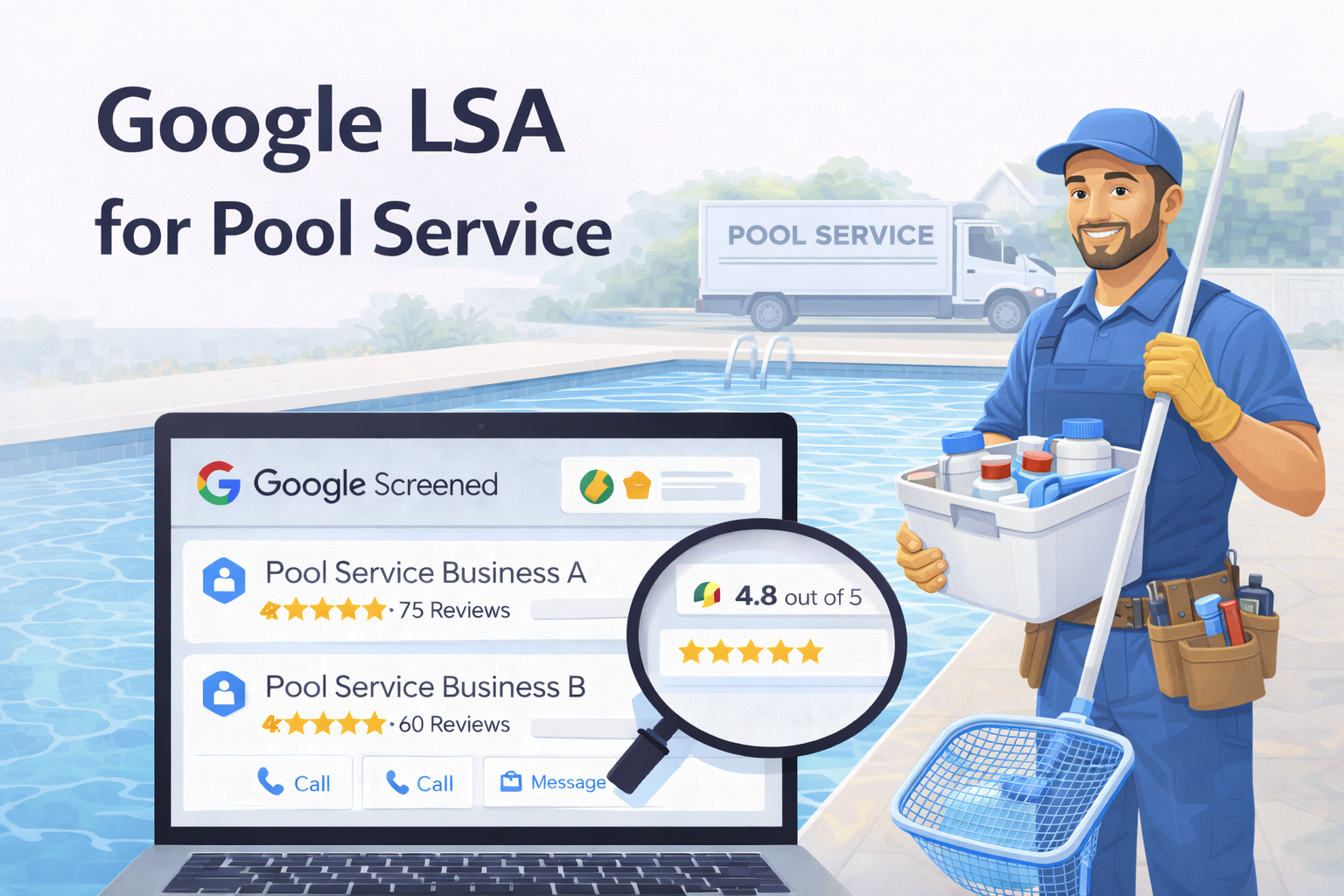
Why Pool Service Owners Should Think About LSA Differently Than Every Other Trade
Most trades measure LSA success by cost per job. Plumber gets a lead, fixes a pipe, invoices $300, done. Pool service is different because the real money isn't in one-time jobs. It's in the weekly maintenance route.
Want this run for you? Our pool service marketing page covers how we target by route density rather than a radius, and what it costs.
A homeowner calls from your LSA listing because their pool pump stopped working. You drive out, diagnose the issue, replace the capacitor for $175. Job complete. But here's the opportunity most pool companies miss: that homeowner now trusts you. They saw your Google Guaranteed badge, read your reviews, watched you fix their pump in 30 minutes, and they're standing next to a pool that clearly hasn't been maintained properly. This is the conversion point.
"By the way, if you want to avoid issues like this in the future, we offer weekly maintenance for $175/month. We handle the chemicals, skimming, filter cleaning, equipment checks, everything. Most of our repair customers switch to maintenance once they see how much easier it is." About 30-40% say yes on the spot.
That $35 LSA lead just became a client worth $2,100 per year. If they stay 3 years (average retention for good pool service companies), that's $6,300 in lifetime revenue from a single ad click.
Pool Service LSA Economics: One-Time Jobs vs. Recurring Revenue
The math changes dramatically depending on whether you're thinking about LSA as a one-time job machine or a recurring client acquisition channel.
Average LSA lead cost: $35
Close rate (repair/cleanup): 55%
Cost per booked job: $35 ÷ 0.55 = $63.64
Average repair revenue: $250
ROAS: 3.9x (decent, not amazing)
// Recurring conversion math
LSA leads per month: 30
One-time jobs booked: 30 × 0.55 = 16.5 jobs
Converted to weekly maintenance: 16.5 × 0.35 = 5.8 new clients
Monthly recurring revenue added: 5.8 × $175 = $1,015/mo
Annual value of new recurring clients: $1,015 × 12 = $12,180/year
Monthly LSA spend: 30 × $35 = $1,050
Annual LSA spend: $12,600
First-year ROAS on recurring alone: 0.97x (break-even)
Year 2+ ROAS: pure profit (clients stay, no re-acquisition cost)
That's the insight most pool service owners miss. The first year of LSA spend roughly pays for itself through one-time job revenue. The recurring clients you acquire during that year generate revenue for the next 2-3 years with zero additional ad spend. By month 12, you've added 60-70 recurring maintenance clients, generating $10,500-$12,250 per month in recurring revenue.
See the real numbers for your trade
Plug in your industry, budget, and close rate. Our calculator shows your projected leads, cost per booked job, and ROAS.
Check any of these against your own break-even in the free ROAS calculator.
Setting Up Your Pool Service LSA Profile
Pool service has more job type categories than most trades on LSA. Getting the setup right means more search visibility and more types of calls.
10 Job Types Pool Service Companies Should Enable
| Job Type | Avg. Revenue | Why It Matters |
|---|---|---|
| Weekly pool maintenance | $150-$250/mo | Your core revenue stream. Every search for "pool cleaning service" and "pool maintenance near me." |
| Green pool cleanup | $300-$800 | Urgent, high-margin. Homeowner's pool turned green. They want it fixed today, not next week. |
| Pool equipment repair | $150-$500 | Pumps, filters, heaters, chlorinators. Repair calls convert to maintenance clients at 35-40%. |
| Pool pump replacement | $400-$1,200 | Variable speed pump upgrades are high-ticket. Energy savings pitch makes this an easy upsell. |
| Pool heater repair / install | $300-$3,500 | Seasonal demand. Homeowners want the heater working before pool party season starts. |
| Salt system installation | $1,500-$3,000 | Trending upgrade. Homeowners are converting from chlorine to salt. High ticket, low competition. |
| Pool opening / closing (seasonal) | $200-$400 | Predictable seasonal surge. Every pool in cold-weather markets needs opening in spring. |
| Leak detection | $200-$500 | Specialty service. Homeowners searching "pool leak" are panicking about water bills. High urgency. |
| Pool tile cleaning / calcium removal | $250-$600 | Cosmetic service that signals a homeowner who cares about appearance. Good maintenance conversion target. |
| Pool resurfacing | $5,000-$15,000 | Highest per-job revenue. Not every pool company does resurfacing, but if you do, enable it. |
Green pool cleanup deserves special attention. It's the single highest-urgency call type in the pool service category. When someone's pool turns green, they're not researching options for next month. They're calling the first Google Guaranteed company they see. Close rates on green pool calls exceed 70% for companies that can offer same-day or next-day service.
Route Density: The Hidden Metric That Determines Your Profitability
Pool service profitability isn't about how many clients you have. It's about how close together they are. A 40-pool route where every stop is within a 2-mile radius generates significantly more profit than 40 pools spread across a 30-mile area, even if the monthly rates are identical.
The Drive-Time Tax
Every minute spent driving between pools is a minute not spent servicing pools. If your average drive time between stops is 5 minutes, your tech can hit 12-15 pools per day. If average drive time is 15 minutes, that drops to 7-9 pools. Same labor cost, 40-50% less revenue.
The free contractor hourly rate calculator works out how many hours you can genuinely sell in a year, and what each one has to earn.
How to Use LSA for Route Building
When an LSA call comes from a zip code where you already have 8+ weekly clients, prioritize that lead. You're adding density to an existing route. When a call comes from an area where you have zero clients, it's still worth taking, but understand that isolated clients are less profitable until you build density around them.
Some pool companies adjust their LSA service area quarterly. Start with a tight radius around your existing routes. As those routes fill up, expand to adjacent zip codes where you want to build the next route. This prevents you from acquiring scattered clients across a wide area before you've filled your core zones.
The 20-Pool Route Threshold
A route becomes consistently profitable at around 20 weekly clients in a tight geographic area. Below that, the drive time between stops eats too much of the tech's day. Above 20, each additional client on the same route is almost pure margin because the tech is already in the neighborhood.
LSA is the fastest way to hit that 20-pool threshold in a new zone. Run targeted LSA with your service area set to just those zip codes, combine with door-hanger marketing in the same area, and you can build a profitable route in 3-4 months.
How to Rank Above Competing Pool Companies on LSA
Pool service LSA competition varies wildly by market. In Phoenix and South Florida, you'll face 8-12 competing pool companies. In Midwest seasonal markets, you might see only 2-3. Regardless of competition level, the ranking factors are the same.
For the full algorithm breakdown, read our LSA ranking factors guide, and for a step-by-step playbook, see our guide on how to rank #1 in Google LSA.
1. Reviews (Volume + Recency)
Pool service companies that do 15+ jobs per week should be generating 3-5 new reviews per week. The trick is asking at the right time. For maintenance clients, ask after you've been servicing their pool for 2-3 months and they're happy with the results. For one-time repairs, ask immediately after the fix when they can see the pool working again.
For the full review playbook, see our LSA review strategy guide.
2. Responsiveness
Pool service calls come in during business hours when you're likely out on a route. Set up call forwarding or hire a virtual receptionist to ensure every LSA call is answered live. Techs who are waist-deep in a pool pump replacement can't answer the phone, and letting calls go to voicemail drops your ranking.
3. Job Types and Profile Completeness
The more job categories you've enabled, the more search queries match your listing. A pool company with 3 job types enabled gets a fraction of the impressions that one with 10 categories receives. Upload 15+ photos showing different services (before/after green pool cleanups are especially effective).
4. Business Hours and Availability
Saturday availability is valuable in pool service. Many homeowners want to discuss their pool when they're home on the weekend, not when they're at work Monday through Friday. Companies that list Saturday hours capture weekend search traffic that competitors miss.
Seasonal Strategy: Year-Round Markets vs. Seasonal Markets
Pool service has the most dramatic seasonal split of any LSA category. A pool company in Phoenix has completely different budget strategy than one in Columbus, Ohio.
Year-Round Markets (FL, AZ, Southern CA, TX Gulf Coast)
Pools are used 10-12 months per year. Maintenance demand is steady. Repair demand spikes after summer storms and during the first cold snap when heaters get turned on. Run a consistent LSA budget year-round with 15-20% increases during March-May (new homeowner acquisition season) and September-October (post-summer equipment failures).
Seasonal Markets (Midwest, Northeast, Mid-Atlantic)
Pool season runs May through September. Here's the budget calendar:
- March-April: Ramp up budget 40-50%. Pool opening searches spike. This is your #1 new client acquisition window.
- May-August: Maintain strong budget. Repair calls peak in June-July when pools are in heavy use. Green pool calls spike after extended heat waves.
- September-October: Pool closing season. Moderate budget for closing service leads. This is also when maintenance clients decide whether to re-sign for next year.
- November-February: Drop budget 60-70% but don't pause. Collect reviews from satisfied summer clients. Respond to any off-season leads (indoor pool owners, hot tub customers). Maintain your ranking for the spring ramp.
The biggest mistake seasonal pool companies make is pausing LSA in October and re-starting in April. You lose 6 months of ranking momentum and spend the first 3-4 weeks of spring rebuilding your position while competitors who stayed active are already capturing leads.
Equipment Upsells: Turning Maintenance Visits Into Additional Revenue
Your weekly maintenance tech visits 12-15 pools per day. Each visit is a chance to identify equipment that needs repair, replacement, or upgrading. This isn't about being pushy. It's about being observant and proactive.
Common Upsell Opportunities From Maintenance Visits
- Variable speed pump upgrade ($800-$1,500): "Your single-speed pump is costing you $80-$120/month in electricity. A variable speed pump pays for itself in 12-18 months through energy savings." This is an easy yes because you're saving them money.
- Salt chlorine generator ($1,500-$2,500): "Tired of the chlorine smell? A salt system produces chlorine naturally and feels much softer on skin. Most of our customers who switch say they'll never go back."
- Pool heater installation ($2,000-$4,500): Spot this opportunity when the homeowner mentions they wish they could use their pool earlier in spring or later in fall.
- LED pool light replacement ($300-$700): Notice burned-out or dim pool lights during evening maintenance stops. "We can swap those lights to color-changing LEDs for about $X. Night swimming looks amazing with them."
- Automation system ($1,500-$3,500): "You can control your pump, heater, lights, and cleaning from your phone. Most homeowners love the convenience."
Pool companies that train their techs to identify and mention one upsell opportunity per week (not per visit, per week) add an average of $2,000-$4,000 per tech per month in additional equipment revenue. This is revenue that requires zero additional advertising spend.
Disputing Invalid Pool Service LSA Leads
Review your LSA calls weekly and dispute any that don't qualify. Common pool service disputes:
- Pool construction inquiries: "I want to build a pool." (That's a pool builder, not a service company, unless you also do construction.)
- Hot tub / spa inquiries if you don't service them.
- Commercial/municipal pool calls beyond your scope.
- Calls from outside your service area.
- Spam, wrong numbers, and calls under 30 seconds where no real conversation occurred.
Most pool service companies recover 8-15% of their monthly LSA spend through legitimate disputes. See our LSA lead dispute guide for the full process.
LSA vs. Other Lead Sources for Pool Service
| Lead Source | Avg CPL | Close Rate | Cost per Client | Lead Type |
|---|---|---|---|---|
| Google LSA | $20-$55 | 45-60% | $35-$120 | Exclusive, high intent |
| Google Search Ads | $25-$70 | 25-35% | $70-$200 | Exclusive, keyword targeted |
| Thumbtack | $15-$60 | 12-20% | $75-$300 | Shared 3-5x |
| Nextdoor | $5-$20 | 30-50% | $10-$65 | Neighborhood trust |
| Door hangers / yard signs | $2-$8 | 1-3% | $65-$400 | Cold outreach |
LSA should be your primary paid lead source. Nextdoor is an excellent free supplement for neighborhood trust. Door hangers work best for route densification in specific neighborhoods where you want more clients. Google Search Ads can target high-value keywords like "pool resurfacing" or "salt system installation" where LSA coverage alone may not capture all demand.
For the complete platform comparison, read our LSA vs. Thumbtack vs. Angi breakdown.
Pool Service LSA FAQs
How much do pool service leads cost on Google LSA?
Pool service LSA leads typically cost $20-$55 per call. Maintenance leads tend to be cheaper ($20-$35), while repair and equipment leads run $35-$55. The real value metric is cost per acquired recurring client, which runs $65-$185 for companies converting 30% of callers to weekly maintenance.
Do pool service companies need a license for LSA?
Licensing varies by state. Florida requires a CPC license for structural work. California requires a D-35 or C-53 license. Arizona requires licensing for repairs but not basic maintenance. Google verifies whatever your state mandates, plus general liability insurance and background checks.
What job types should pool service companies enable?
Enable everything you service: pool cleaning, weekly maintenance, green pool cleanup, equipment repair, pump replacement, heater repair, salt system installation, pool opening/closing, leak detection, tile cleaning, and resurfacing. Each category unlocks different search queries.
How can I convert LSA leads into recurring maintenance clients?
The best conversion point is right after completing a one-time repair or cleanup. Offer weekly maintenance while the customer is satisfied with your work: "$175/month covers chemicals, skimming, filter cleaning, and equipment checks." About 30-40% convert on the spot. Green pool cleanups convert at 40-50%.
What's the best LSA strategy for seasonal pool markets?
Ramp up 40-50% during spring opening season (March-May). Maintain strong spend through summer. Moderate budget for closing season (September-October). Drop 60-70% in winter but don't pause. Staying active preserves your ranking position for the spring ramp.
How do green pool cleanup calls work with LSA?
Green pool cleanup is one of the highest-value LSA services for pool companies. These are urgent calls averaging $300-$800 per cleanup. Close rates exceed 70% for same-day service. Green pool customers convert to weekly maintenance at 40-50% because they don't want it happening again.
Ready to Build a More Profitable Pool Route?
We help pool service companies set up, optimize, and scale Local Services Ads. Get a free audit of your current LSA performance or start fresh.
Get My Free Pool Service LSA AuditMore on Google Local Services Ads
Part of the BGM Local Services Ads library. Pair this with the master pillar and the deep-dive guides: