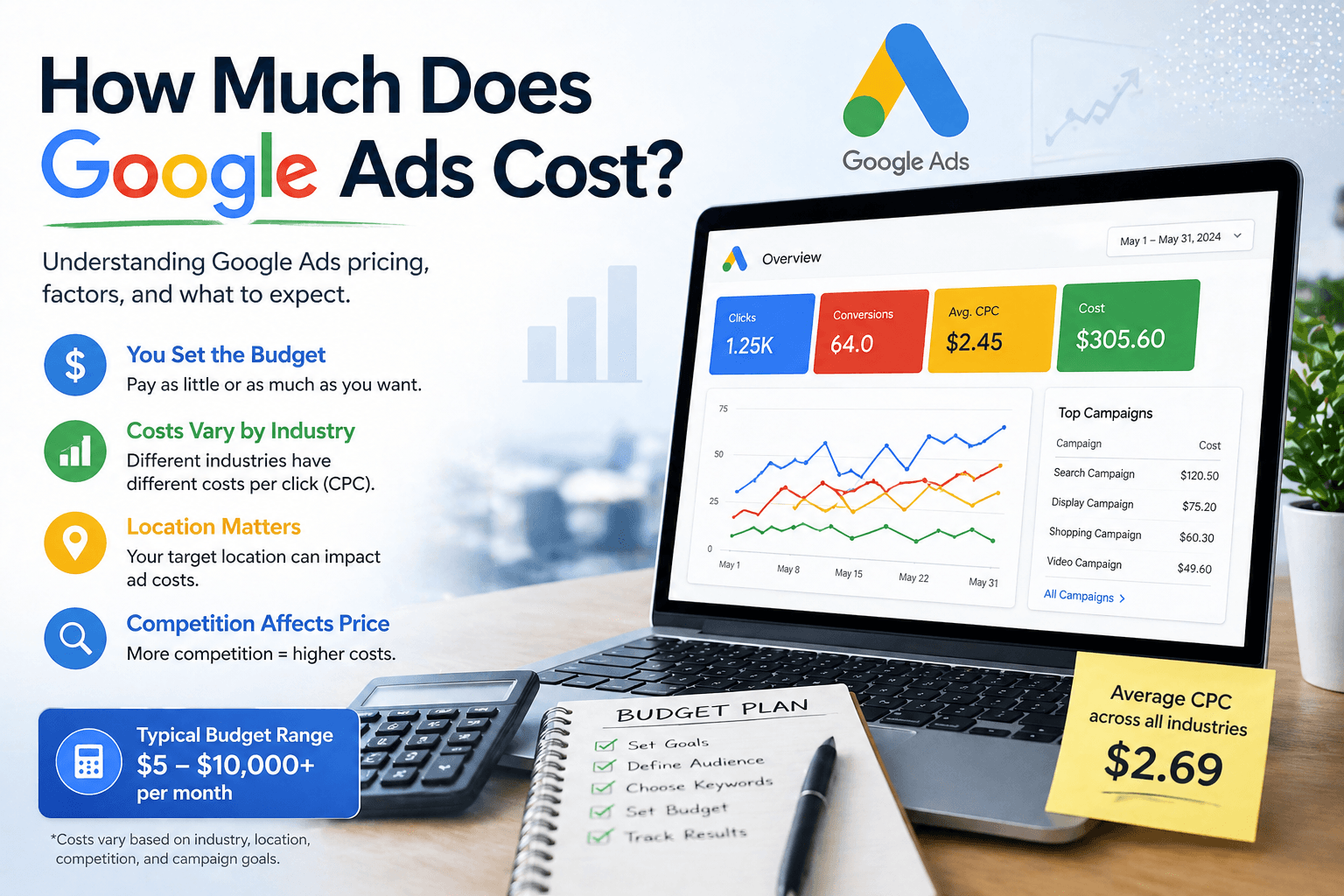
What does Google Ads actually cost for contractors in 2026?
Most articles about Google Ads cost are useless to a contractor. They quote a "$2 to $4 average CPC" pulled from cross-industry data that mixes B2B SaaS, ecommerce, and dental together, then tell you to "estimate your own cost." That is not an answer. It is a shrug.
You can back into the clicks a budget buys with the free CPC calculator.
Here is a real one: in 2026, contractor Google Ads costs run from about $1.50 to $45+ per click and $30 to $300+ per lead, with most trades landing between $5 and $14 per click and $45 and $230 per lead. Total monthly spend for a serious contractor account ranges from $1,000 (single-truck operator) to $15,000+ (multi-location regional player). The exact number for your business depends on your trade, your market, your Quality Score, and how aggressively your competitors are bidding.
If you only read one paragraph, read this one: the cheapest click is not the cheapest customer. Painting has the highest contractor CPC at $13.74 but converts at 10.80 percent, producing a $138 lead. Construction has the lowest CPC at $5.31 but converts at only 2.61 percent, producing a $166 lead. Higher CPCs are not "expensive ads," they are usually a signal of higher-intent searches.
What is the Google Ads cost per click (CPC) by contractor trade in 2026?
This is the data that exists nowhere else in one place. The numbers below come from LocaliQ's 2025 Home Services Search Advertising Benchmarks[1] (the gold standard for contractor PPC data, drawing on 3,200+ campaigns from April 2024 through March 2025), with cross-checks against WordStream's 2025 Google Ads Benchmarks[2]. Where there is variance between sources, we report the LocaliQ figure because their dataset is the most contractor-specific.
One thing to remember as you read these: averages hide regional variance. Plumbing in Denver averages $59.81 per click[1], versus $15.53 in Birmingham. Same trade, same ads, 4x cost. We get into the regional multipliers later.
| Trade | Avg CPC | Typical Range | vs Home Services Avg | Competition |
|---|---|---|---|---|
| Painting | $13.74 | $8–$22 | +75% | Very High |
| Electrical | $12.18 | $7–$25 | +55% | Very High |
| Roofing & Gutters | $10.70 | $6–$30+ | +36% | High |
| Plumbing | $10.49 | $5–$45+ | +34% | High |
| Air Conditioning (HVAC) | $9.68 | $5–$40+ | +23% | High |
| Heating & Furnaces | $9.30 | $4–$28 | +18% | High |
| Window Cleaning | $9.12 | $5–$15 | +16% | Medium |
| Landscaping | $8.76 | $3–$14 | +12% | Medium |
| Doors & Windows | $8.76 | $4–$15 | +12% | Medium |
| House Cleaning | $8.50 | $4–$13 | +8% | Medium |
| Home Services Average | $7.85 | — | — | — |
| Blinds / Window Treatments | $7.69 | $4–$12 | -2% | Medium |
| Storage | $7.46 | $3–$11 | -5% | Medium |
| Handyman | $7.10 | $3–$12 | -10% | Lower |
| Pest Control | $6.50 | $3–$15 | -17% | Medium |
| Locksmith | $6.20 | $3–$18 | -21% | Medium |
| Tree Service | $6.00 | $3–$11 | -24% | Lower |
| Carpet Cleaning | $5.95 | $2–$10 | -24% | Lower |
| Pools & Spas | $5.81 | $2–$10 | -26% | Lower |
| Garage Door | $5.75 | $2–$11 | -27% | Lower |
| Movers | $5.60 | $2–$13 | -29% | Medium |
| Restoration / Water Damage | $5.50 | $3–$25+ | -30% | High |
| General Contractors | $5.31 | $2–$10 | -32% | Lower |
Data: LocaliQ Search Advertising Benchmarks[1], with WordStream cross-checks[2]. Pest control, locksmith, tree service, carpet cleaning, movers, restoration, garage door averages estimated from active managed accounts where LocaliQ does not publish a dedicated category. Ranges reflect typical metro-to-rural variance.
For a deeper breakdown of the dataset behind these figures (CTR, CVR, ROAS, mobile-vs-desktop splits, year-over-year trends), see our Google Ads Statistics for Contractors guide.
What is the Google Ads cost per lead (CPL) by contractor trade?
CPL is what you actually care about. Clicks do not pay your bills. Leads do, eventually. CPL is calculated as your CPC divided by your conversion rate, where a "conversion" is a phone call, form fill, or chat that you can attribute back to the ad.
The wide spread between CPC ranking and CPL ranking is the most interesting thing in this dataset. General contractors have the lowest CPC ($5.31) but a $166 CPL because they convert at only 2.61 percent. Cleaning services have a relatively low CPC ($8.50) but the lowest CPL of any trade ($46.99) because they convert at a stunning 17.65 percent.
| Trade | Avg CPC | Avg CVR | Avg CPL | CPL Range |
|---|---|---|---|---|
| House Cleaning | $8.50 | 17.65% | $47 | $30–$80 |
| Pools & Spas | $5.81 | 10.89% | $45 | $30–$75 |
| Handyman | $7.10 | 13.45% | $54 | $35–$95 |
| Window Cleaning | $9.12 | 13.58% | $67 | $45–$110 |
| Garage Door | $5.75 | 5.66% | $81 | $50–$130 |
| Home Services Average | $7.85 | 7.33% | $91 | — |
| Electrical | $12.18 | 9.08% | $94 | $60–$160 |
| Pest Control | $6.50 | 5.50% | $118 | $70–$180 |
| Landscaping | $8.76 | 6.42% | $118 | $70–$180 |
| Air Conditioning (HVAC) | $9.68 | 6.56% | $128 | $80–$220 |
| Plumbing | $10.49 | 7.63% | $129 | $75–$240 |
| Heating & Furnaces | $9.30 | 7.48% | $129 | $80–$220 |
| Painting | $13.74 | 10.80% | $138 | $90–$240 |
| General Contractors | $5.31 | 2.61% | $166 | $100–$300+ |
| Doors & Windows | $8.76 | 4.41% | $200 | $140–$300+ |
| Roofing & Gutters | $10.70 | 3.70% | $228 | $140–$400+ |
Data: LocaliQ Search Advertising Benchmarks[1]. CPL Range columns reflect aggregated managed-account data and typical metro-to-rural variance.
Google Ads Budget Guide for Contractors →
Minimum budgets by trade, monthly calendar, signs you are underspending, and the full budget formula by company size.
The 4 Things That Determine YOUR Cost
The averages above tell you what most contractors pay. They do not tell you what you will pay. Your cost is determined by four levers, three of which you partially control and one of which you do not. Here they are in order of impact.
1. Quality Score
Quality Score[3] is Google's diagnostic measure of how relevant your ads, keywords, and landing pages are to a given user's search. It runs 1 to 10 and gets calculated for every keyword in your account. The components are expected click-through rate, ad relevance, and landing page experience.
Quality Score directly affects your CPC. A keyword with a Quality Score of 10 can cost half what a keyword with a Quality Score of 5 costs in the same auction, against the same competitors. This is the single largest cost lever you control. We have seen accounts cut their effective CPC by 30 to 50 percent just by fixing landing page experience (page speed, mobile usability, content matching the ad copy). It is the most underrated optimization in Google Ads.
2. Your max CPC bid
Your bid is the maximum you are willing to pay per click. In a manual bidding setup, this is your direct control. In Smart Bidding (Maximize Conversions, Target CPA, Target ROAS), Google sets your bids automatically using your conversion data and a target you give it. Smart Bidding documentation[4] is worth reading if you want the algorithmic detail.
Two things contractors get wrong here: setting bids too low (your ads never show), and assuming a higher bid always wins (Quality Score can override a higher bid in the auction). The correct approach is to bid what a click is worth to you (job value times conversion rate times close rate) and let Quality Score do the heavy lifting on actual cost.
3. Your competition (market)
If three franchise plumbers move into your market and start bidding hard on "emergency plumber near me," your CPC goes up whether you change anything or not. This is the lever you do not control. What you can do is target less-competed long-tail terms ("burst pipe repair Tuesday morning Naperville" instead of "plumber"), which often have lower CPC and higher conversion rates than the obvious head terms.
4. Your conversion rate
Technically, this does not change your CPC. But it changes your CPL, which is what you actually pay attention to. If your landing page converts at 3 percent and you fix it to 8 percent, your effective CPL drops 60 percent at the same CPC. Most contractors leave this lever completely untouched and complain about CPC instead.
Practical fixGoogle Ads Landing Pages for Contractors →
The landing page elements that drive contractor conversion rates from 3% to 8%+: phone above the fold, trust signals, mobile speed, form simplicity.
How does Google Ads actually charge you (the auction in plain English)?
Google Ads runs a second-price auction every time someone searches a keyword you are bidding on. Most contractors think they pay their max CPC bid every click. They do not. They pay just enough to beat the next-highest competitor.
Here is the actual mechanic, simplified. Google's official auction documentation[5] covers it in more detail.
- A user searches. Google identifies all eligible advertisers (you set keywords, geographic targeting, and audience filters that determine eligibility).
- Google calculates each advertiser's Ad Rank. The simplified formula is
Ad Rank = Max CPC Bid × Quality Score, with adjustments for ad extensions and search context. Ad Rank docs[6] have the full mechanics. - The highest Ad Rank wins position 1. Second-highest takes position 2, and so on.
- You pay just enough to beat the next position. Your actual cost is
(Next-highest Ad Rank ÷ Your Quality Score) + $0.01, not your max bid.
# Contractor A
Max CPC: $15.00
Quality Score: 5
Ad Rank = 15 × 5 = 75
# Contractor B
Max CPC: $10.00
Quality Score: 9
Ad Rank = 10 × 9 = 90
# Contractor B wins position 1 with a LOWER bid.
# Contractor B's actual cost = (75 / 9) + $0.01 = $8.34
# Contractor A pays full bid of $15 and ranks below.
This is the most important paragraph in this entire article: if your Quality Score is high, you can outrank competitors who bid more than you while paying less per click. This is not theoretical. We see it happen every week in client accounts.
How costs are calculated and billed
Google's billing documentation[7] explains the basics: you set a daily budget, Google can spend up to 2x that daily budget on individual high-traffic days but caps your monthly spend at 30.4 times your daily budget, and you are billed when you hit a threshold or at the end of each month, whichever comes first.
Budget Tier Breakdown: $500 to $15,000 Per Month
The most useful question is not "what does Google Ads cost," it is "what does each budget tier actually unlock?" Here is what each spend level realistically buys for a typical home services contractor at the home services average $90 CPL.
| Monthly Budget | Approx Leads/Mo | Approx Booked Jobs | What this unlocks |
|---|---|---|---|
| $500 | ~5 | ~2 | One zip code, one keyword theme, exact match only. Smart Bidding will struggle for lack of data. Below this tier, LSA is usually a better fit. Best for solo handyman testing waters. |
| $1,500 | ~16 | ~6–8 | One geographic zone, 2–3 service categories, basic conversion tracking. Smart Bidding starts to work after 30 days. Realistic floor for a small contractor with good close rates. |
| $3,000 | ~33 | ~13–15 | Full metro coverage, 4–6 service categories, dayparting + audience layers. Smart Bidding has enough data to optimize properly. The most common starting point for a 2–3 truck operation. |
| $7,500 | ~83 | ~33–38 | Multi-city coverage, 6–10 service categories, separate emergency vs planned campaigns. Performance Max layered alongside Search. The sweet spot for a 5–8 truck operation with proper sales process. |
| $15,000+ | ~165+ | ~70+ | Regional coverage, all service categories, custom landing pages per service. Aggressive remarketing, brand defense, video. Multi-location or franchise scale. |
Booked jobs assume a 40 to 45 percent lead-to-job close rate for home services. Actual rates vary 25 to 60 percent depending on operations.
The "data tax": why $500 budgets fail
Google Ads needs roughly 30 conversions per month for Smart Bidding (Maximize Conversions, Target CPA, Target ROAS) to optimize properly. Below that threshold, the algorithm cannot detect patterns, your bids drift, and your costs spike. At a $90 CPL, 30 conversions costs $2,700, which is why $1,500 to $3,000 is the realistic floor for a serious account. Below that, Smart Bidding behaves erratically and you essentially pay a "learning tax" without getting useful data back.
Full breakdownMinimum Budgets by Trade and Company Size →
Trade-specific budget minimums, weekly cadence, the data tax explained, and the 5 signs you are underspending vs overspending.
Book a free 30-minute call. We will look at your trade, your market, and your current numbers and tell you what you should actually be spending, no obligation.
The Hidden Costs Nobody Tells You About
Every article online quotes "average CPC" and stops. Here are the real costs that show up on your books that no one warns you about. Every contractor we have onboarded was surprised by at least three of these. Most by all six.
| Cost | Range | What it covers |
|---|---|---|
| Agency management fee | $300–$2,000+/mo | Ongoing management of campaigns, bids, keywords, negatives, ad copy testing. Some agencies charge a percentage of spend (typically 10–20%); some charge flat. Below $1,500 in spend, an agency rarely pays for itself. |
| Call tracking | $30–$300/mo | CallRail, WhatConverts, or similar. Required for properly attributing phone calls back to ad clicks. Without it you have no idea which keywords drive booked jobs. Invoca research[8] shows that 60%+ of contractor leads come by phone, so this is non-negotiable. |
| Landing page builder | $30–$300/mo | Unbounce, Instapage, Leadpages, or similar. You can use your existing website pages, but conversion rates typically run 30–60% lower than dedicated landing pages built for ad traffic. |
| Conversion tracking setup | $0–$2,000 one-time | Adding GA4 + Google Ads conversion tags + GTM events. If you are technical, free. If you hire a developer, $500–$2,000 depending on complexity. Without this, you cannot tell which campaigns work. |
| CRM & offline conversion import | $50–$500/mo | Servicetitan, Housecall Pro, Jobber, or HubSpot integration. Imports closed-job revenue back into Google Ads so Smart Bidding optimizes for revenue, not just leads. The single biggest unlock for ROAS at scale. |
| Creative production | $0–$1,500 one-time | Photography, video for YouTube ads, copy writing, graphic design. Basic search-only campaigns need almost none. Performance Max needs assets and benefits from professional production. |
Add it up. A real-world fully-loaded "Google Ads cost" for a contractor running a $3,000/mo media spend looks more like:
Media spend (paid to Google): $3,000
Agency management: $600
Call tracking (CallRail): $75
Landing page tool (Unbounce): $99
CRM integration: $50
# True monthly cost
$3,824/mo (28% above the "media" number)
Anyone who quotes you a Google Ads budget without including these line items is selling you a partial picture. Build them in from the start so you know your true cost-per-booked-job.
Cost Per Booked Job: The Only Number That Matters
If you take one thing from this article, take this. CPC and CPL are vanity metrics for contractors. Cost per booked job (CPBJ) is the only number that determines whether your account is profitable. Here is the formula:
CPBJ = Total monthly spend ÷ Total booked jobs
# Or, expanded:
CPBJ = (Spend ÷ Leads) ÷ (Leads-to-jobs close rate)
CPBJ = CPL ÷ Close rate
# Example: HVAC company
CPL: $128 ÷ Close rate: 42% = $305 per booked job
# Average HVAC ticket: $1,800
ROAS: 1,800 ÷ 305 = 5.9x
Three real examples by trade
| Trade | Avg CPL | Close Rate | Cost / Booked Job | Avg Ticket | Approx ROAS |
|---|---|---|---|---|---|
| HVAC | $128 | 42% | $305 | $1,800 | 5.9x |
| Roofing | $228 | 22% | $1,036 | $12,000 | 11.6x |
| House cleaning | $47 | 55% | $85 | $220 (per visit, recurring) | 2.6x first job, 30x+ LTV |
Notice: roofing has the most "expensive" CPL on the entire list at $228 but the second-highest ROAS because tickets are huge. House cleaning has the cheapest CPL at $47 and the lowest first-job ROAS, but its lifetime value (recurring weekly or biweekly cleans) makes it the highest LTV-adjusted ROAS in the dataset. Always look at CPBJ alongside ticket and LTV. CPL alone tells you nothing.
Cost by Market Size and Region
National averages hide enormous regional variation. According to LocaliQ's geographic data[1], plumbers in Denver pay an average $59.81 per click versus $15.53 in Birmingham, a 3.85x difference for the exact same trade. Here is how to size your expectations by market.
| Market Type | Examples | CPC vs National | Why |
|---|---|---|---|
| Tier 1 metro | NYC, LA, Chicago, San Francisco, Boston, Miami | +80% to +150% | Maximum competition. National franchises bid aggressively. High CPM display markets push up search CPC indirectly. |
| Tier 2 metro | Denver, Seattle, Atlanta, Dallas, Phoenix, Minneapolis | +30% to +80% | High population density + multiple regional players. Often higher CPC than Tier 1 in specific verticals (Denver plumbing being the canonical example). |
| Tier 3 mid-size | Indianapolis, Kansas City, Nashville, Columbus, Charlotte | +0% to +30% | Roughly at national average. Steady regional competition, less aggressive franchise activity. |
| Tier 4 small metro | Birmingham, Toledo, Spokane, Buffalo, Lubbock | -10% to -30% | Lower competition floor. Fewer full-service ad agencies driving up bids. Easier to win Quality Score battles. |
| Rural / micropolitan | Towns under 50K population, small county seats | -30% to -50% | Light auction depth. Often only 2–3 competing advertisers. Volume is the constraint, not cost. |
If you operate across multiple market types (a regional HVAC chain hitting Denver and three Tier 4 cities, for example), do not use a single average CPC for budget planning. Build separate campaigns per market and adjust budgets to match the local cost reality. Lumping them together averages your math wrong in both directions.
Google Ads vs LSA, Meta Ads, and SEO: Cost Per Booked Job Comparison
Contractors do not buy "Google Ads," they buy customer acquisition. Here is how Google Ads stacks up against the other three real options on cost per booked job, using an HVAC company example with $1,800 average ticket and a 42% close rate.
What you keep from that ticket matters more than the ticket. Run one through the free contractor profit margin calculator.
| Channel | Typical CPL | Close Rate | Cost / Booked Job | Speed to leads | Notes |
|---|---|---|---|---|---|
| Google LSA | $60–$120 | 50–65% | $120–$220 | Days | Highest intent. Caps at one slot. Limited targeting control. |
| Google Ads (Search) | $80–$220 | 35–45% | $220–$580 | Days | Unlimited reach. Full keyword and audience control. Higher learning cost. |
| Meta Ads (Facebook/Instagram) | $25–$70 | 15–25% | $120–$370 | Days | Cheaper leads, lower intent. Best for maintenance plans, install upgrades, recurring services. |
| Local SEO | $0 marginal | 40–55% | ~$30–$80 (allocated) | 3–9 months | Cheapest at scale. Highest upfront. Compounds. Cannot turn on overnight. |
Each channel has a job. The contractors with the best unit economics run two or three of these in parallel. LSA captures emergency intent for the cheapest cost-per-booked-job. Google Ads captures planned and research-stage intent (which LSA cannot target). Meta builds awareness and recurring program signups. SEO compounds over time as your foundation. None of them is "best." They serve different parts of the funnel.
Head-to-headGoogle Ads vs LSA: Full Cost & Quality Comparison →
Lead quality, management effort, recommended budget split, and which one to start with by trade.
Stats referenceMeta Ads Cost Per Lead for Contractors →
Facebook and Instagram CPL by trade, lead quality benchmarks, and how Meta compares to Google Ads on cost-per-booked-job.
How to Lower Your Google Ads Cost
The same account can pay 30 to 60 percent less for the same volume of leads with proper optimization. Here are the seven highest-impact levers, ranked by what we see actually move the needle in client accounts.
1. Improve your Quality Score
This is the highest-ROI lever, period. Quality Score is composed of expected CTR, ad relevance, and landing page experience[3]. Fix mobile page speed (under 2.5 seconds Largest Contentful Paint), match landing page H1 to your top keyword, simplify form fields, and your QS will rise within 2 to 3 weeks. We have seen clients drop CPC from $14 to $9 on the same keyword in 6 weeks just from Quality Score work.
2. Tighten your match types
Broad match keywords waste budget by matching tangentially related searches. Move from broad to phrase match, or phrase to exact match, on your top spenders. Yes, volume drops. Cost drops more, and conversion rate usually rises because your ads only show on relevant queries.
3. Add negative keywords every week
Pull your search terms report, find queries that converted at 0% or are obviously irrelevant ("free," "cheap," "DIY," competitor brand names), and add them as negatives. Most contractor accounts have 50+ negatives waiting to be added on day one of a real audit. This single habit can cut wasted spend by 15 to 30 percent on neglected accounts.
4. Fix your landing page conversion rate
Your landing page is half of your CPL. Doubling CVR halves CPL at the same CPC. The contractor wins are usually: phone number above the fold, sticky tap-to-call button on mobile, a short form with 3 to 4 fields max, real photos of your team and trucks, and trust signals (BBB rating, license number, real review screenshots). See our contractor landing page guide for the full template.
5. Use dayparting (ad scheduling)
If 80 percent of your booked jobs come from calls between 7am and 7pm Monday through Saturday, do not run ads at 2am Sunday. Add an ad schedule. Pause off-hours unless you have 24/7 coverage and are intentionally targeting after-hours emergency calls. This alone often cuts spend 10 to 20 percent with no lead loss.
6. Apply geo-exclusions
Google's default location targeting is "presence or interest." That includes people researching your service area from outside it. For contractors, this is wasted spend. Switch to "presence" only, exclude zip codes you do not service, and exclude any zip codes that historically convert poorly. Geo-exclusions are the second-most underused lever after negative keywords.
7. Layer in audience signals
Even on Search, you can apply audience adjustments (in-market for "home services," remarketing audiences, customer match lists). Bid up on remarketing audiences and customers who have engaged before. Bid down on audiences you can identify as low-converting (renters, for many contractor categories). Google's Smart Bidding documentation[4] covers how the algorithm uses these signals.
RelatedHow to Lower Your Cost Per Lead (LSA Specific) →
The LSA-specific levers for cutting CPL: review velocity, dispute cadence, profile optimization, response time targets.
Frequently Asked Questions
What is the average Google Ads cost per click for contractors in 2026?
The home services average CPC is around $7.85 according to LocaliQ's 2025 Search Advertising Benchmarks[1]. The range across contractor trades runs from about $5.31 (general construction) to $13.74 (painting), with emergency-intent keywords in plumbing and HVAC routinely clearing $40 per click in mid-size markets and exceeding $80 in highly competitive metros.
How much should a contractor budget per month for Google Ads?
Most contractors should budget between $1,500 and $7,500 per month to generate consistent lead flow. The math is leads needed per month multiplied by your trade CPL, plus a 20 percent variance buffer. For example, an HVAC company wanting 30 leads per month at a $130 CPL would budget around $4,700. Single-truck operators can start at $1,000 to $1,500 per month, while multi-location businesses typically run $7,500 to $15,000 or more. See our full budget guide for the complete breakdown.
Is Google Ads cheaper than Local Services Ads (LSA)?
It depends on what you measure. Average LSA CPL is around $60 versus a home services Google Ads CPL of around $90. But LSA caps at one ad slot and has limited control. Google Ads has unlimited keyword targeting and broader reach. Most contractors get the lowest cost per booked job by running both, with LSA capturing emergency intent and Google Ads capturing planning and research intent. See our full Google Ads vs LSA comparison.
Why did my Google Ads CPC suddenly go up?
The four most common causes are a Quality Score drop from a low landing page experience, increased competition from a new advertiser entering the auction, seasonality (HVAC summer, roofing storm season), and Google's automated bidding raising bids to chase a conversion goal. Industry-wide CPC rose for 75 percent of home services businesses in 2025, with an average increase of 12.88 percent year-over-year[1].
Do I need a Google Ads agency or can I run it myself?
Below $1,500 per month, the agency fee usually outweighs the optimization gain, so DIY or a lightweight setup makes sense. Above $3,000 per month, a competent manager typically saves more than they cost by improving Quality Score, killing wasted spend on broad-match queries, and tightening conversion tracking. Agency fees range from $300 per month for basic management to $2,000+ per month for full-service campaigns with landing page work.
What is a good ROAS for contractors on Google Ads?
A healthy benchmark for contractor Google Ads is 4x to 10x revenue ROAS, depending on trade. High-ticket trades like roofing and remodeling can hit 15x to 30x because a single $12,000 job easily covers months of ad spend. Service trades like plumbing and electrical typically run 3x to 8x because tickets are lower. The number that actually matters is gross profit ROAS (revenue minus job cost, divided by ad spend), which for most contractors should clear 2x to maintain a profitable account.
How long until Google Ads becomes profitable?
Most accounts hit a profitable state between 60 and 90 days. The first 30 days are largely a data tax, paying Google to learn what converts. Months two and three are where you tighten match types, kill wasted spend, layer in negatives, and let Smart Bidding stabilize. Accounts with proper conversion tracking from day one get profitable faster than accounts that bolt tracking on later.
Can I run Google Ads on $500 per month?
Technically yes, practically no for most contractor trades. With a $90 CPL, $500 buys you about 5 leads per month, far below the 30+ leads per month that Smart Bidding needs to optimize properly. At that budget, target one geographic zone, one job type, exact match keywords only, and expect the first month to be a learning period. Below $1,000 per month, LSA usually makes more sense than Google Ads.
How does Google Ads pricing work?
Google Ads runs a second-price auction. Every search triggers an auction between eligible advertisers. Your Ad Rank is calculated as your max CPC bid multiplied by your Quality Score (with adjustments for ad extensions and context)[6]. The highest Ad Rank wins the top slot, but you pay just enough to beat the next-highest Ad Rank, plus one cent. That is why a competitor with a lower bid but higher Quality Score can outrank you, and why you rarely pay your full max CPC.
What is the cheapest contractor trade for Google Ads?
General construction has the lowest average CPC at $5.31, followed by garages ($5.75) and pools and spas ($5.81)[1]. Cleaning services have the lowest cost per lead at around $47 because their conversion rate (17.65 percent) is the highest of any home services trade. The most expensive are painting ($13.74 CPC) and electricians ($12.18 CPC), driven by emergency intent keywords and high job values.
Sources and Methodology
Every benchmark in this article is sourced. Cost per click and cost per lead figures are pulled from LocaliQ's 2025 Home Services Search Advertising Benchmarks dataset (3,200+ contractor campaigns from April 2024 through March 2025). Cross-checks come from WordStream's 2025 Google Ads Benchmarks. Auction mechanics, Quality Score, Ad Rank, and billing details come from Google's official advertising support documentation. Where we cite a figure for a trade not in LocaliQ's published table (pest control, locksmith, tree service, carpet cleaning, movers, restoration, garage door), the number reflects our aggregated managed-account data and we have flagged it in the table notes. Regional multipliers come from LocaliQ's geographic data plus our own client account observations. We do not invent figures.
If you find a number in this article that contradicts a source we link, the source wins. Email us and we will correct it.
- LocaliQ. 2025 Home Services Search Advertising Benchmarks. https://localiq.com/blog/search-advertising-benchmarks/
- WordStream. Google Ads Benchmarks for Your Industry. https://www.wordstream.com/blog/google-ads-benchmarks
- Google Ads Help. Quality Score: Definition. https://support.google.com/google-ads/answer/2375419
- Google Ads Help. About Smart Bidding. https://support.google.com/google-ads/answer/6167123
- Google Ads Help. How the Google Ads auction works. https://support.google.com/google-ads/answer/2375454
- Google Ads Help. Ad Rank: Definition. https://support.google.com/google-ads/answer/142918
- Google Ads Help. How Google Ads costs are calculated. https://support.google.com/google-ads/answer/1704424
- Invoca. Call Tracking Statistics. https://www.invoca.com/blog/call-tracking-statistics
- Think with Google. Insights and research for marketers. https://www.thinkwithgoogle.com/
- Google. Ads Transparency Center. https://adstransparency.google.com/
- IAB. Internet Advertising Revenue Report 2024. https://www.iab.com/insights/internet-advertising-revenue-report-2024/
- Statista. Google: company statistics & facts. https://www.statista.com/topics/2891/google/
- U.S. Bureau of Labor Statistics. Industries at a Glance. https://www.bls.gov/iag/
Bottom Line
Google Ads cost is not a single number. It is a function of your trade, your market, your Quality Score, and your operations. Home services contractors pay an average $7.85 per click and $90.92 per lead, with monthly budgets typically running $1,500 to $7,500 for serious accounts. The cheapest trade is general construction at $5.31 CPC, the most expensive is painting at $13.74. Cleaning services have the lowest CPL at $47, roofing has the highest at $228 (offset by ticket size).
Stop optimizing for CPC and CPL. Start optimizing for cost per booked job, including the hidden costs (call tracking, landing pages, agency fees, conversion tracking) that the surface-level "$2 to $4 average CPC" articles never mention. Build your Quality Score. Tighten your match types. Add negative keywords every week. Fix your landing page conversion rate. Run LSA alongside Google Ads to capture emergency intent at a lower cost per booked job. Layer Meta and SEO over time as the account stabilizes.
That is the whole playbook. The contractors winning at Google Ads in 2026 are not the ones with the biggest budgets. They are the ones who understand which lever to pull and when, and who know what their cost-per-booked-job actually is.
Want a Real Cost Estimate for Your Business?
We will look at your trade, your market, your current account (if you have one), and tell you exactly what you should expect to pay and what you should be spending. No charge, no obligation, no upsell deck.
Book Your Free 30-Minute AuditCPC and CPL ranges reflect aggregated data from LocaliQ's 2025 Search Advertising Benchmarks (3,211 home services campaigns), WordStream's 2025 Google Ads Benchmarks, and Blue Grid Media-managed contractor accounts. Actual costs vary by market, competition level, account quality, and seasonality. Blue Grid Media specializes in Google Ads management and LSA management for local service businesses.
More on contractor lead costs
Part of the BGM contractor lead cost library. Pair this with the cost references and CPL trackers: