By Blue Grid Media • Published April 24, 2026 • 22 min read
Most contractor SEO guides were written for a search landscape that no longer exists. They tell you to stuff keywords into title tags, buy citations from Fiverr, and spin up 500 city pages with a Python script. All three will actively hurt you in 2026. Google removed 292 million fake reviews in 2025, banned review gating in April 2026, and rolled out AI Overviews that knocked Position 1 click-through rate from 28 percent down to roughly 19 percent. The playbook shifted. Most websites did not.
This guide is not another recycled "optimize your GBP and get backlinks" checklist. It is the specific architecture, schema, and execution plan that works for contractors right now. What to build first. How to structure service-area pages without triggering a doorway penalty. Which schema types move the map pack. Where to get real backlinks that a contractor can actually earn (and a few you would not expect). How to set up call tracking so you can prove SEO is working instead of guessing. And how to structure content so AI Overviews and Perplexity cite you instead of a competitor.
If you already run LSA or Google Ads, SEO is the channel that quietly drives your cost per lead down over 12 to 24 months. If you are starting from zero, this is the 8-to-12 month roadmap to a lead channel that keeps producing when you stop paying.
The Real Contractor Search Funnel (Stop Thinking Like a B2B Blogger)
Most SEO advice for contractors was copy-pasted from B2B SaaS playbooks. The model those playbooks assume is: blog post ranks, user reads, user opts into an email list, user gets nurtured, user converts 90 days later. That is not how a homeowner with a broken furnace behaves. She is in her kitchen at 9 PM, it is 12 degrees outside, and she has three tabs open. The contractor who answers the phone in 30 seconds wins.
The real contractor search funnel has three distinct tiers, and each one needs a different kind of page to convert. Building a site without understanding the tiers is how contractors end up with 40 blog posts, two service pages, and no leads.
Tier 1: Problem-Aware Search (Top of Funnel)
These are symptom searches. The homeowner is trying to diagnose before deciding whether to call. Examples: "why is my furnace making a banging sound", "water heater making popping noise", "AC blowing warm air", "shingles curling on roof". Intent is 40 percent informational, 60 percent commercial. These searches feed AI Overviews heavily, which means the page that wins is the one that answers the question directly in the first paragraph and shows up as the citation. Not sure whether ChatGPT, Perplexity, or Google AI Overviews can find and recommend your business yet? Run our free AI Visibility Checker for contractors.
Page type: blog posts, diagnostic guides, symptom-to-solution walkthroughs. Conversion rate from these pages is 0.5 to 2 percent, but they feed retargeting and brand recall.
Tier 2: Brand and Geo Search (Middle of Funnel)
The homeowner has decided to hire someone and is now comparing. Examples: "best HVAC companies near me", "top rated plumber Chicago", "roofer with good reviews in Denver". Intent is heavily commercial. Google responds with the local map pack (3 GBP listings) plus organic results dominated by directory aggregators (Yelp, Thumbtack, BBB) and local contractors with strong GBP profiles.
Page type: Google Business Profile, homepage, and location-specific service-area pages. This is where 60 to 75 percent of contractor leads originate. Conversion rate from these pages is 8 to 15 percent because intent is high.
Tier 3: Action Search (Bottom of Funnel)
The homeowner is ready to book. Examples: "emergency HVAC Chicago", "24 hour plumber near me", "roof leak repair today". Intent is 95 percent commercial. This is where LSA and Google Ads dominate, but organic still captures 25 to 40 percent of clicks depending on the query.
Page type: service landing pages with phone number prominent, service-area pages with emergency coverage sections, and dedicated emergency service pages. Conversion rate: 15 to 30 percent. If your current site is not built this way, a purpose-built contractor website is usually the fastest fix.
Service-Area Page Architecture (The 3-Tier Model)
Service-area pages are the highest-leverage SEO asset a contractor owns. Done right, they can 3x your local organic traffic in a year. Done wrong, they can trigger a manual action under Google's doorway page guidelines. The line between the two is specific and well-documented.
Google's Doorway Page Problem
In multiple Search Engine Roundtable interviews between 2019 and 2024, John Mueller explicitly warned against "scaled city pages" where a contractor creates hundreds of near-identical pages (Chicago HVAC, Evanston HVAC, Naperville HVAC, etc.) with only the city name swapped. Mueller's line: "if these pages are only serving to catch search traffic and they do not provide unique value to the user in each location, we would treat them as doorway pages."
Generating 500 city pages with ChatGPT is the single fastest way to kill an otherwise healthy site in 2026. The penalty does not always fire immediately, but over 6 to 18 months the site quietly loses rankings across all pages, not just the city pages.
The Tier Model That Works
Instead of 200 copy-paste pages, build three tiers of service-area coverage that reflect the reality of your business:
| Tier | What It Is | What Each Page Must Contain |
|---|---|---|
| Core City (HQ) | The city where your physical address is located. Usually 1 page. | Long-form content (1,500 to 2,500 words), full service list, local team bios, hero projects, pricing examples, NAP, embedded Google Map, 10+ reviews, local FAQs, embedded YouTube job walkthroughs. |
| Satellite Cities | Cities you actively serve with trucks and completed jobs. 5 to 15 pages. | 800 to 1,200 words of genuinely unique content: photos of trucks in that city, completed job addresses (blurred street numbers), 3 to 5 customer reviews from that city, pricing examples from that market, 2 to 4 local landmarks or neighborhoods referenced naturally, embedded Google Map pinned to that city. |
| Nearby / Coverage | Cities within your service radius where you will travel but rarely go. 1 parent page listing all of them. | One page titled "Areas We Serve" with all city names as clickable anchors, brief service description, phone number, and map. Do not build individual pages for these. |
The test for whether a city deserves its own page is simple: can you genuinely prove you serve it? Do you have trucks there? Completed jobs? Customer reviews from that zip code? If yes, build the page with real proof. If no, include it on the coverage page instead.
URL Structure: Service-First vs. City-First
Two common URL patterns:
/services/hvac-repair/chicago/(service-first)/chicago/hvac-repair/(city-first)
For most contractors, service-first wins. Reasons: your service hub (/services/hvac-repair/) aggregates link equity from all city variants and ranks for high-value generic commercial queries. The city pages are children that inherit topical authority from the parent. It also gives you a cleaner internal linking structure and prevents accidental URL collisions as you add services.
City-first makes sense only if your brand positions around geography (multi-location franchise with strong city-level identity). For single-location contractors and 2-to-5 location regional businesses, service-first is the correct choice.
What Must Be Genuinely Unique on a Satellite City Page
The test for "is this a doorway page or a real page" is whether a human reader would find information on the page that does not appear on any other page. Specifically:
- Photos from that city. Job site photos, truck photos in front of recognizable local buildings, before-and-after shots from that market. Stock photos do not count.
- Customer reviews from that city. Pull 3 to 5 reviews where the reviewer mentions the city or a neighborhood by name. Embed them with schema.
- Completed job addresses. List 5 to 10 completed jobs by neighborhood or street (blur house numbers for privacy). Example: "Recent installs on N. Halsted Ave, W. Diversey Pkwy, and Logan Blvd."
- Pricing examples from that market. Markets have local pricing patterns. A furnace install in Chicago costs differently than one in Evanston. Reference that if you legitimately know it.
- Local landmarks or neighborhoods referenced naturally. Not a forced keyword drop. Example: "We serve Wicker Park, Bucktown, Lincoln Park, and the Loop. Our technicians know the old boilers in pre-war brownstones and the challenges with condo mechanical rooms."
- Embedded Google Map pinned to that city. Use a real pin at a specific address (your truck staging location or a partner supply house), not a wide radius.
Schema Stacking (With Real Code You Can Copy)
Schema markup is the single most under-used SEO lever for contractors. Most contractor sites have either zero schema or a generic LocalBusiness block. The winners stack 4 to 6 schema types per page and use industry-specific subtypes that Google's Knowledge Graph understands at a deeper level.
Use Industry-Specific LocalBusiness Subtypes
Google supports specific LocalBusiness subtypes that signal trade clearly. Using the correct subtype helps Google classify your business for relevant queries. The subtypes that matter for contractors:
HVACBusiness(for HVAC contractors)Plumber(for plumbing contractors)Electrician(for electrical contractors)RoofingContractor(for roofers)HomeAndConstructionBusiness(for general contractors, remodelers, handymen)HousePainter(for painters)MovingCompany(for movers)LocalBusinesswithadditionalTypepointing to a Wikipedia URL for trades without a direct schema subtype (pest control, landscaping, junk removal)
The 4-Layer Schema Stack
On every service-area page, stack these four schema types:
- Industry-specific LocalBusiness (with
areaServedas aGeoCircle, latitude, longitude, and radius in miles) - Service (describing the specific service offered, linked to the LocalBusiness via
provider) - AggregateRating (pulled dynamically from your review count and average star rating)
- FAQPage (4 to 6 local FAQs answering real queries users type for that city)
Here is a real, copy-paste-ready example for an HVAC contractor's satellite city page. Replace the placeholders with your own data:
<script type="application/ld+json">
{
  "@context": "https://schema.org",
  "@graph": [
    {
      "@type": "HVACBusiness",
      "@id": "https://example.com/services/hvac-repair/evanston/#business",
      "name": "Example HVAC, Evanston",
      "image": "https://example.com/assets/truck-evanston.jpg",
      "url": "https://example.com/services/hvac-repair/evanston/",
      "telephone": "+1-847-555-0199",
      "priceRange": "$$",
      "address": {
        "@type": "PostalAddress",
        "streetAddress": "1234 N. Main St",
        "addressLocality": "Chicago",
        "addressRegion": "IL",
        "postalCode": "60614",
        "addressCountry": "US"
      },
      "areaServed": {
        "@type": "GeoCircle",
        "geoMidpoint": {
          "@type": "GeoCoordinates",
          "latitude": 42.0451,
          "longitude": -87.6877
        },
        "geoRadius": "25 mi"
      },
      "aggregateRating": {
        "@type": "AggregateRating",
        "ratingValue": "4.9",
        "reviewCount": "248"
      },
      "openingHoursSpecification": [
        {
          "@type": "OpeningHoursSpecification",
          "dayOfWeek": ["Monday","Tuesday","Wednesday","Thursday","Friday"],
          "opens": "07:00",
          "closes": "19:00"
        }
      ]
    },
    {
      "@type": "Service",
      "@id": "https://example.com/services/hvac-repair/evanston/#service",
      "serviceType": "HVAC Repair",
      "provider": { "@id": "https://example.com/services/hvac-repair/evanston/#business" },
      "areaServed": "Evanston, IL",
      "hasOfferCatalog": {
        "@type": "OfferCatalog",
        "name": "HVAC Repair Services",
        "itemListElement": [
          { "@type": "Offer", "itemOffered": { "@type": "Service", "name": "Furnace Repair" } },
          { "@type": "Offer", "itemOffered": { "@type": "Service", "name": "AC Repair" } },
          { "@type": "Offer", "itemOffered": { "@type": "Service", "name": "Heat Pump Repair" } }
        ]
      }
    },
    {
      "@type": "FAQPage",
      "mainEntity": [
        {
          "@type": "Question",
          "name": "How fast can you get to Evanston for emergency HVAC repair?",
          "acceptedAnswer": {
            "@type": "Answer",
            "text": "Our Evanston response time is 45 to 90 minutes for emergency calls within city limits."
          }
        }
      ]
    }
  ]
}
</script>Where to Put Each Schema Type
- Homepage: Organization + LocalBusiness (industry subtype) + WebSite + BreadcrumbList
- Service hub page: LocalBusiness + Service + BreadcrumbList
- Service + City pages: LocalBusiness (industry subtype with GeoCircle) + Service + AggregateRating + FAQPage
- Project case study pages: Article + ImageObject + LocalBusiness + Review (if customer-submitted)
- Blog posts: BlogPosting + BreadcrumbList + Person (author with credentials) + FAQPage if applicable
Backlink Sources That Actually Work for Contractors
Generic SEO guides tell contractors to "build high-quality backlinks" without naming a single source. That is why most contractors end up buying garbage from Fiverr. The real sources are specific, repeatable, and sit in front of you if you know where to look.
The categories below are ranked by difficulty-to-ROI ratio. Start with the easiest wins and work down.
Tier 1: The Easy, High-Value Wins
- BBB accreditation. Domain Authority 91 per Moz. Membership runs $500 to $700 per year depending on business size. You get a dofollow link from your BBB profile, a trust badge for your site, and a dispute resolution framework that resolves complaints before they become Yelp reviews. Every legitimate contractor should have BBB.
- Local Chamber of Commerce. Membership $300 to $600 per year. DA ranges 30 to 70 depending on metro size. You get a member directory link (usually dofollow), networking access, and name recognition. Large-metro chambers are the strongest local links available to contractors.
- Google Business Profile. The single most important "link" is the website field on GBP. Make sure it points to your main homepage with UTM tracking.
- Expertise.com and Three Best Rated. Niche directories that curate local service businesses. Submission is free but selective. If you get in, you get a moderately strong link and referral traffic from homeowners who actively use these sites.
Tier 2: Trade Associations (Industry-Specific)
Trade association membership is often overlooked but produces some of the strongest topical backlinks available to contractors.
- ACCA (Air Conditioning Contractors of America) for HVAC, DA 72
- PHCC (Plumbing-Heating-Cooling Contractors Association) for plumbers, DA 65
- NECA (National Electrical Contractors Association) for electricians, DA 70
- NRCA (National Roofing Contractors Association) for roofers, DA 68
- NALP (National Association of Landscape Professionals) for landscapers, DA 58
- NPMA (National Pest Management Association) for pest control, DA 62
- NAHB (National Association of Home Builders) for general contractors and remodelers, DA 78
Membership fees range $400 to $1,200 per year. The associations also have state-level and local chapters which often add a second backlink from a separate domain. ACCA-affiliated state chapters like Illinois ACCA and Massachusetts ACCA each provide member listings.
Tier 3: Manufacturer Dealer Locators
This is the single most under-used link source for contractors. Almost every major manufacturer maintains a dealer locator tool that lists authorized installers. Getting listed requires being a dealer (training, minimum purchase volume, or signed dealer agreement). The links are dofollow and usually come from high-DA root domains.
- HVAC: Trane (trane.com, DA 75), Lennox (lennox.com, DA 72), Carrier (carrier.com, DA 84), Goodman (goodmanmfg.com, DA 64), Mitsubishi Electric (mitsubishielectric-comfort.com, DA 68), Rheem (rheem.com, DA 68)
- Plumbing: Kohler (kohler.com, DA 84), Moen (moen.com, DA 73), Delta (deltafaucet.com, DA 71), Rinnai (rinnai.us, DA 62), Navien (navieninc.com, DA 58)
- Roofing: GAF Master Elite (gaf.com, DA 79), Owens Corning Platinum Preferred (owenscorning.com, DA 82), CertainTeed ShingleMaster (certainteed.com, DA 75), Malarkey Emerald Pro (malarkeyroofing.com, DA 58)
- Windows/Siding: Pella certified (pella.com, DA 71), Marvin (marvin.com, DA 65), James Hardie Elite Preferred (jameshardie.com, DA 72)
Tier 4: Supplier and Pro Pages
- Ferguson Pro, Home Depot Pro, and Lowe's Pro all maintain "find a contractor" pages. Enrollment through their pro accounts is free.
- Local independent supply houses often maintain partner contractor pages. Ask your account rep.
- Equipment rental companies (Sunbelt Rentals, United Rentals) sometimes feature contractor partners.
Tier 5: Community and Local Sponsorship
These links require real-world action but produce some of the most defensible local SEO signals because they demonstrate actual community presence.
- HOA newsletter sponsorships. $200 to $500 per HOA per year, often with a link from the HOA community site and an ad in the quarterly newsletter. Target 5 to 15 HOAs within your service radius.
- Little League, youth sports team sponsorships. $300 to $1,500 per season. The sponsor page on the league website is a local dofollow link.
- Salvation Army, Habitat for Humanity local chapters. Donating labor or materials for a build day often results in a sponsor recognition page with a link.
- Local charity 5K sponsorships and walks. These events build sponsor recognition pages that stay up for years.
- Community event sponsorships. Farmers markets, chili cookoffs, fireworks displays. The event website usually has a sponsor section.
Tier 6: Local News and PR
- HARO (now Qwoted and Connectively). Respond to reporter queries in your trade. A link from the Chicago Tribune, Patch, or a local TV station is worth more than 50 directory links.
- Local business journals. Most metros have a business journal (bizjournals.com network). Pitch a story angle: a milestone anniversary, an unusual job, a charitable initiative.
- Podcast interviews on local business shows. Chamber-affiliated podcasts and trade-show podcasts (Contractor Evolution, ToolBoxBuzz) often include a link in show notes.
Tier 7: Content-Driven Links
- Guest posts on local real estate agent blogs. Home tips that an agent can share with buyers. Easy to pitch, high-quality local link. Example topic: "5 Things to Check Before Buying a Home With an Older Furnace."
- Link-bait data pieces. Publish one serious data study per year. Example: analyze your own install data and publish "The 10 Most Common Furnace Failures in Chicago by Neighborhood." Local news outlets and trade publications will link to it.
- Reddit subreddit participation. Active, non-spammy answering on r/HVAC, r/Plumbing, r/Construction, r/homeowners. Over time these accounts build authority and moderators tolerate occasional links when they are genuinely useful. Perplexity and ChatGPT pull from Reddit threads heavily, so this also feeds AI citations.
Call Tracking and Attribution Setup
Most contractors have no idea which marketing channel is actually producing leads. They see calls come in, they close some percentage, and they hope. Without call tracking and multi-touch attribution, you cannot tell if your 2,500 dollar SEO retainer is paying for itself or if your Google Ads are stealing organic credit.
Why Server-Side Tracking Beats Page-View Tracking
A page view is not a lead. A call, a form submission, or a booked appointment is a lead. Contractors who measure SEO by traffic are measuring the wrong metric. Server-side tracking (call recording platforms, CRM offline conversion import, webhook-based form tracking) gives you the actual conversion event tied back to the source.
Dynamic Number Insertion (DNI)
CallRail and CallTrackingMetrics both offer DNI, which swaps the phone number on your website based on the visitor's traffic source. An organic visitor sees one phone number. A Google Ads visitor sees a different phone number. A direct visitor sees a third. Every call is then attributed to the exact source and keyword that produced it.
Pool size formula: Daily unique visitors multiplied by 1.5 equals the phone number pool size you need. A site with 200 daily uniques needs 300 numbers. CallRail pricing starts around $45 per month for 10 numbers and scales up. For most single-location contractors, 15 to 30 numbers is sufficient.
UTM Convention for GBP Website Button
The Google Business Profile "Website" button is the single most-clicked element on your GBP listing. If you do not tag it, every click shows up as "direct" traffic and you lose the attribution. Use this UTM pattern:
?utm_source=gbp&utm_medium=organic&utm_campaign=[city]-[service]
For a Chicago HVAC contractor, the GBP website URL should be:
https://example.com/?utm_source=gbp&utm_medium=organic&utm_campaign=chicago-hvac
Now every GBP click appears in GA4 under "Traffic acquisition" with source gbp and campaign chicago-hvac. If you have multiple GBP locations, use a different campaign per location.
CRM Integration and Offline Conversion Import
Leads do not convert at the call. They convert when they book a job. The missing link in most contractor analytics is pushing closed-won data back into GA4 and Google Ads so the platforms know which leads actually became revenue.
Connect ServiceTitan, Housecall Pro, Jobber, or FieldEdge to GA4 through Zapier or a native integration. On job won, fire an offline conversion event with the gclid or source attribution captured at lead creation.
The Channel-to-Tracking Matrix
| Channel | How to Track | What to Import to GA4 |
|---|---|---|
| Organic search (SEO) | CallRail DNI pool, GBP UTM, form webhook | Call events, form submissions, booked jobs (offline conversion) |
| Google Ads (PPC) | Dedicated CallRail number, gclid capture, ad-specific landing pages | Auto-imported via Google Ads conversion import + offline conversion for closed-won |
| Local Services Ads (LSA) | Native LSA reporting + lead dispute data | Export weekly to GA4 as offline conversion, tag source as lsa |
| Google Business Profile (organic) | GBP Insights + UTM-tagged website button | Direction requests, website clicks, profile calls (manual monthly pull) |
| Referral and direct | Separate CallRail pool, distinct phone number | Tag lead source at intake, import as offline conversion with source label |
Site Architecture and Internal Linking
Site architecture is the skeleton that decides how link equity and topical authority flow through your site. Most contractor sites have broken or shallow architectures, which is why a site with a great domain can still lose to a competitor with half the authority but a cleaner structure.
The Correct Hierarchy (Visualized)
Build the site in 4 clean layers:
Home
 |
 +-- /services/                          (service hub)
 |    |
 |    +-- /services/hvac-repair/         (service page)
 |    |    |
 |    |    +-- /services/hvac-repair/chicago/     (service + city)
 |    |    +-- /services/hvac-repair/evanston/    (service + city)
 |    |    +-- /services/hvac-repair/naperville/  (service + city)
 |    |
 |    +-- /services/hvac-installation/
 |    +-- /services/furnace-repair/
 |    +-- /services/ac-repair/
 |
 +-- /projects/                          (project case studies)
 |    +-- /projects/lincoln-park-furnace-install/
 |    +-- /projects/bucktown-ac-replacement/
 |
 +-- /blog/                              (content hub)
 |    +-- /blog/why-is-my-furnace-making-a-banging-sound/
 |    +-- /blog/signs-your-ac-needs-repair/
 |
 +-- /areas-we-serve/                    (coverage page)
 +-- /about/
 +-- /contact/
Internal Linking Rules
- Service hub links to every service page. Include the full service list in the hub with brief descriptions and "Learn more" links.
- Each service page links to all its city variants. Use a "Cities We Serve for This Service" section at the bottom.
- Each service-area page links back to: the service hub, the core homepage, and 3 related project case studies. This is the critical loop most contractors miss.
- Blog posts link into relevant service pages. A post titled "Why is my furnace making a banging sound" should link to /services/furnace-repair/ naturally in the resolution section.
- Project case studies link to the service page and the city service-area page. A Lincoln Park furnace install case study links to /services/furnace-repair/ and /services/furnace-repair/chicago/.
- Footer links should include the service hub, main service pages, and top 5 service cities. Do not dump 50 links in the footer.
This architecture produces a dense, bidirectional internal link graph. Link equity from your strongest page (usually the homepage or service hub) flows down to city pages and project pages. Topical authority accumulates naturally because every service-city page is connected to the relevant service hub and to project proof.
Content Calendar by Search Intent
Most contractor blogs fail because they are filled with generic thought leadership that nobody searches for. The content that works is tightly mapped to the three search funnel tiers, weighted toward commercial intent, and anchored in the trades you actually serve.
The 20/40/30/10 Mix
- 20% Emergency-intent content. Rapid, diagnostic, highly specific. Examples: "Furnace not turning on: 6 things to check before calling", "Hot water heater leaking: is it safe to keep using."
- 40% Service-intent content. Cost, process, comparison, decision guides. This is your bread and butter. Examples: "HVAC repair cost Chicago 2026", "Tankless water heater installation: what to expect", "Is a 20-year-old furnace worth repairing."
- 30% Informational content. How-to, maintenance, seasonal prep. Long-tail SEO and AI Overviews bait. Examples: "How often should I replace my HVAC filter", "Signs of roof damage after a storm."
- 10% Project and case study content. Photo-rich, specific project walkthroughs with before/after. These also serve as service-area page proof and feed internal linking.
Sample Topics by Trade
| Tier | HVAC | Plumbing | Roofing |
|---|---|---|---|
| Emergency (20%) | "Furnace making banging noise", "AC frozen over in summer" | "Water heater leaking from bottom", "Kitchen sink won't drain" | "Shingles blew off in storm", "Ceiling stain after heavy rain" |
| Service (40%) | "Furnace repair vs replace", "Heat pump installation cost 2026" | "Tankless vs tank water heater cost", "Sewer line replacement cost" | "Asphalt vs metal roof cost", "Roof replacement insurance claim process" |
| Informational (30%) | "When to replace HVAC filter", "How long does a furnace last" | "How to find a water leak", "Signs your water heater is failing" | "How often should I inspect my roof", "What damages a roof fastest" |
| Project (10%) | "Lincoln Park 1920s boiler conversion to forced air", "Evanston ductless mini-split install" | "Bucktown cast iron to PEX repipe", "Lakeview tankless water heater upgrade" | "Hyde Park storm damage full replacement", "Wicker Park GAF Timberline HDZ install" |
Publishing Cadence
Quality over frequency. A strong contractor content program is 2 to 4 pieces per month, not daily output. Focus the first 90 days on 8 to 10 cornerstone pieces that cover the highest-volume keywords in your trade and market. Then shift to 2 pieces per month with ongoing refreshes of your top performers.
The On-Page Conversion Stack
Rankings without conversions are a vanity project. The page elements below are what separate a site that ranks and bleeds traffic from a site that ranks and books jobs.
Sticky Phone Bar on Mobile
Over 70 percent of contractor traffic is mobile. A tap-to-call button pinned to the bottom of the screen (56 pixels tall, contrasting color, with phone icon) increases call rate 40 to 80 percent versus a page where the phone number is only in the header. Use a single sticky bar, not a floating widget, because widgets trigger mobile UX issues.
Service-Area Map Embed
Embed a Google My Maps view showing your core city (dark pin), satellite cities (medium pin), and coverage area (shaded polygon). This does three things: confirms you serve the visitor's area, provides genuine unique content for service-area pages, and embeds a link back to Google Maps which subtly reinforces your GBP signals.
Short Form vs. Long Form
Short forms convert about 2x better than long forms but collect less information upfront. The optimal pattern for contractors: a 3-field initial form (name, phone, service needed) that converts hard, then enrichment happens on the phone call when the prospect is already committed. Do not ask for address, budget, timeline, and details on the first form. You will lose 60 percent of prospects to form abandonment.
Trust Signal Stack (in priority order)
- License number in footer. State contractor license or trade board number. Signals legitimacy to Google and to homeowners.
- Insurance certificate badge. "Licensed and Insured" badge linking to a PDF of your certificate (blur policy numbers).
- Google Verified badge. Post-October-2025 rebrand from Google Guaranteed. Full guide to getting the badge.
- Review snippet. Star rating plus review count plus a single rotating quote. Schema-marked as AggregateRating.
- Years in business. "Serving Chicago since 2004" is worth more than a generic tagline.
- BBB A+ badge. Links to your BBB profile.
- Trade certification badges. NATE (HVAC), EPA 608 (HVAC refrigerant), Master Plumber license, OSHA 10 or 30, GAF Master Elite (roofing), IICRC certifications (water damage).
Live Chat and SMS Widget
A simple SMS widget ("Text us: 312-555-0199") often outperforms chat bots for contractor lead capture. Homeowners who do not want to call but do not want to fill a form will text. Use Podium or a native SMS integration in your CRM.
AI Overviews and SGE Optimization
Google's AI Overviews rolled out fully in 2024 and now appears on an estimated 13 to 18 percent of contractor-related queries, heavily weighted toward informational searches. First Page Sage's 2024 CTR study showed Position 1 CTR dropped from about 28 percent to 19 percent in queries where AI Overviews appeared. Perplexity and ChatGPT also eat search traffic from the top of the funnel.
The contractors who lose ground are the ones who ignored AI Overviews and kept writing narrative blog posts. The contractors who gain ground are writing pages structured for AI citation.
Answer-First Writing
Put the direct answer to the page's query in the first 40 to 60 words. Before any preamble. Before the "before we dive in, let me explain why." The answer goes first, then the depth.
Bad: "Many homeowners experience issues with their furnace over the years. One of the most common is a banging or popping sound. In this article we'll explore why this happens and what to do about it..."
Good: "A banging sound from your furnace is usually caused by delayed ignition, where gas builds up in the combustion chamber before igniting in a small explosion. It can also come from expanding ductwork or a loose blower wheel. Delayed ignition is the most serious cause and should be inspected within 24 hours."
Definition Blocks
Within the article, place 40-to-60-word definition blocks under h2 or h3 headings that directly answer a specific query. Use the heading as the question ("What causes delayed ignition in a furnace?") and answer in a single short paragraph. These blocks get picked up as AI Overviews citations.
Citation-Magnet Content
AI models cite content that is easy to quote. Tables, numbered lists, and data-driven paragraphs get cited 4 to 6 times more often than narrative prose. Build:
- Comparison tables (e.g. "Furnace types and lifespans")
- Numbered cost breakdowns ("Average HVAC repair costs by service type")
- Step-by-step troubleshooting lists (numbered, short sentences)
- Original data or survey results unique to your brand
Reddit, Forums, and Community Platforms
Perplexity and ChatGPT pull heavily from Wikipedia, Reddit, and trade forums when ranking sources. For contractors, the implication is specific: participate genuinely in r/HVAC, r/Plumbing, r/Construction, r/HomeImprovement, r/RealEstate, and trade-specific forums like HVAC-Talk or Plbg.com. Answer questions thoroughly, demonstrate expertise, and occasionally (sparingly) link to relevant pages on your site. Over time, these threads become AI citation sources.
E-E-A-T for Contractors (Experience, Expertise, Authoritativeness, Trust)
E-E-A-T is Google's framework for evaluating content quality, especially in YMYL (Your Money or Your Life) categories. Home services touch YMYL because bad work can cause physical harm or financial loss. Google's rater guidelines explicitly include home service categories. The bar is higher than for casual blogs.
The Contractor E-E-A-T Stack
- License number in footer. State contractor license or trade board number with a link to the state's license lookup.
- Insurance certificate image. Scanned and published in your "About" or "Credentials" page. Blur the policy number but keep the issuer visible.
- Trade certification badges. NATE certified technician badge, EPA 608 certification, Master Plumber credential, OSHA 10 or 30 cert, IICRC (for water damage), GAF Master Elite or Owens Corning Platinum (for roofers).
- Team bio page with real technician headshots and credentials. Not stock photos. Real people with real certifications listed.
- Video walkthroughs of actual jobs. YouTube-embedded videos of your team doing real work. This is the single most powerful E-E-A-T signal available to contractors and 90 percent of contractors skip it.
- Author schema on blog posts. Each blog post should have a named author (owner, lead tech, or senior estimator) with real credentials, years of experience, and a LinkedIn link.
- Physical address with street view. Real shop or office (not a UPS box) with Google Street View matching what the site claims.
Sample "About the Author" Pattern
Every blog post about a technical topic should end with an author bio. A strong pattern:
About the Author: Mike Thompson is a NATE-certified HVAC technician with 18 years of residential and light commercial experience. He holds EPA 608 Universal certification and is a Trane Comfort Specialist. Mike leads the repair team at Example HVAC in Chicago and specializes in retrofit installs in pre-war buildings. Connect with Mike on LinkedIn.
Timeline and Budget Reality
Contractors come to SEO either wildly optimistic ("I'll be number 1 in three months") or wildly pessimistic ("SEO takes two years"). The truth is in the middle and it is predictable if you know what to expect month by month.
Month-by-Month Expectations
| Phase | Months | Focus | Expected Outcome |
|---|---|---|---|
| Foundation | 0 to 2 | GBP audit + optimization, NAP cleanup, schema deployment, technical SEO (Core Web Vitals, crawl issues, sitemap), 3 base service pages, homepage rewrite | GBP insights start moving, technical errors resolved, foundation ready to rank |
| Content Build | 2 to 4 | 6 to 8 cornerstone blog pieces, 3 to 5 satellite city pages, review velocity program launch (target 10 new reviews per month) | First organic rankings appear, map pack visibility expands, first attributable organic leads |
| Authority | 4 to 8 | Link building (BBB, chamber, trade associations, manufacturer dealer locators, 1 to 2 local news features), social proof expansion, content refreshes | Rankings climb to top 10 for primary terms, map pack top 3 in core city, organic leads become consistent |
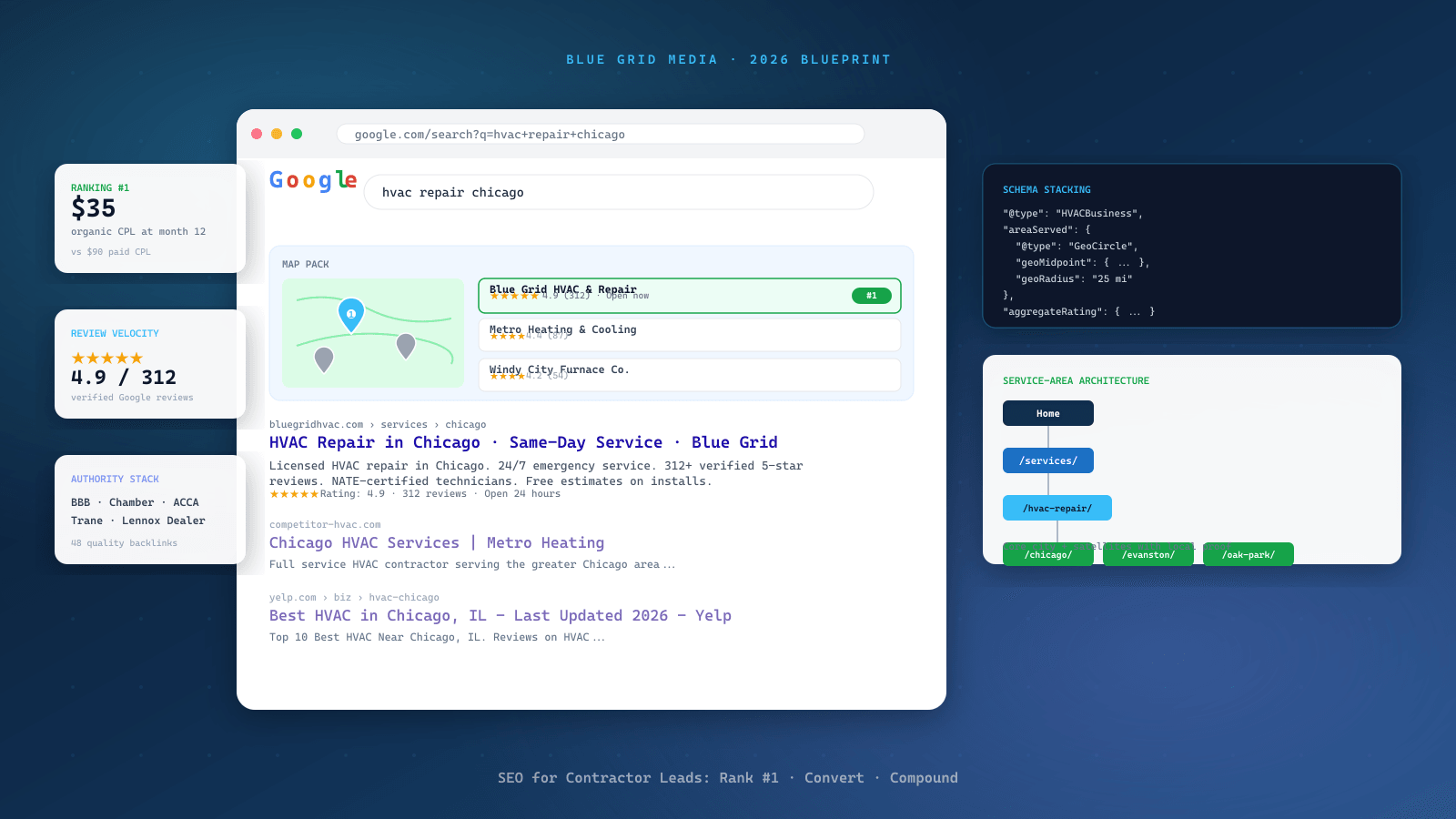
| Compounding | 8 to 12 | Scale content output, expand to additional satellite cities, deepen project case studies, refine by GSC data | Predictable 20 to 40 organic leads per month for single-location contractors, cost per lead settles around $35 |
| Market Domination | 12 to 24 | Multi-city expansion, advanced link building, original data studies, video content scaling | Top 3 organic in core market, 50 to 150 organic leads per month, ROI compounds as paid spend holds flat |
Budget Reality
| Investment Level | Monthly Cost | What You Get | Expected Result |
|---|---|---|---|
| DIY | $0 to $200 (tools) | Your own time, 10 to 15 hours per week minimum. SEMrush or Ahrefs, CallRail, a basic CMS. | Slow, inconsistent. Most DIY contractors quit at month 4 when results have not materialized yet. |
| Freelancer | $800 to $1,500 | GBP management, 2 blog posts per month, basic link building, monthly report. | Content-light. Good for rural or low-competition markets. Underpowered for metros. |
| Specialist agency | $2,000 to $4,000 | Full GBP program, 4 to 6 content pieces, technical SEO, aggressive link building, call tracking setup, quarterly strategy reviews. | Competitive in most markets. Predictable lead flow by month 6 to 8. |
| Enterprise / aggressive | $5,000 to $10,000 | Multi-city SEO, PR outreach, original data, video SEO, dedicated account team, weekly calls. | Category dominance in major metros. Top 3 organic in 8 to 12 months, 100+ leads per month. |
Per First Page Sage's 2024 home services benchmark, the average SEO cost per lead for home service businesses settles around $35 by month 12. Compare that to LocaliQ's 2024 cost-per-lead data which puts home services paid CPL at $90.92 on average. The gap compounds. SEO lead costs keep dropping as organic traffic grows. Paid lead costs stay flat or rise with competition. By year two, most SEO programs deliver 2 to 3 times the lead volume at half the cost per lead versus pure paid. Our local SEO statistics page has the full benchmark data.
Work out what a lead should cost you in the free CPA calculator before judging the number you are getting.
10 SEO Myths That Will Kill Your Contractor Site
- "Post a blog daily or Google will penalize you." False. Google rewards quality over frequency. Two deep posts per month beat 30 thin ones. Helpful Content System updates (2022 to 2024) specifically targeted volume-over-quality sites.
- "Buy citations from Fiverr." Destroys NAP consistency when cheap directories get taken down. The 500-citation "package" becomes 80 citations within 18 months, and your local ranking takes a hit from the sudden inconsistency. Only use real directories (BBB, Chamber, trade associations, GBP, Bing, Apple).
- "Review gating is fine if you're polite." Google explicitly banned review gating in April 2026 after removing 292 million fake reviews in 2025. Filtering out likely negative reviewers before asking is a policy violation. Ask every customer or ask none.
- "Use AI to write 500 city pages." Doorway page territory. John Mueller has publicly flagged this pattern multiple times. Scaled city pages without genuine local content are one of the fastest ways to trigger algorithmic damping in 2026.
- "Keyword stuffing still works." Google's Helpful Content system penalizes unnatural keyword density. Write for humans, let the keywords appear organically, and build topical depth instead of keyword repetition.
- "More backlinks is always better." One link from BBB, ACCA, or a local .gov domain beats 50 Fiverr links. Relevance and authority trump volume. A contractor with 40 high-quality links will out-rank one with 400 low-quality links.
- "SEO is free." Your time is not free. A DIY contractor spending 12 hours per week on SEO is investing roughly $2,400 per month at a modest $50/hr opportunity cost. Paid SEO is often cheaper on a true cost basis.
- "GMB and GBP are different." Google My Business was renamed Google Business Profile in 2021. Same product, same ranking signals. Older SEO guides still use GMB and it confuses contractors reading both.
- "Exact-match domains dominate." Google's Exact Match Domain update in 2012 neutralized the ranking boost for EMDs. A domain like chicagohvacrepair.com does not outrank examplehvac.com on domain alone. Branding beats EMD.
- "Hire any SEO, they all do the same thing." Generalist SEO agencies rarely understand contractor-specific architecture (service-area pages, doorway page risks, manufacturer dealer programs, trade seasonality). A contractor-specialized agency compresses your timeline to results by 3 to 6 months.
2026-Specific Shifts You Cannot Ignore
1. The Google Verified Rebrand (Oct 2025)
Google Guaranteed became Google Verified in October 2025. The badge is the same in function but the branding is different across the Google properties. If your site still references "Google Guaranteed" in text or images, update to "Google Verified." Our guide to the badge covers the new verification flow.
2. Review Crackdown and Gating Ban
Google removed 292 million fake or policy-violating reviews in 2025, a 45 percent year-over-year increase. In April 2026, Google formally banned review gating (the practice of filtering out likely-negative reviewers before asking for a review). Platforms that automate gating were forced to remove the feature. Contractors running review-gating SMS or email sequences should disable them immediately. Review flow moving forward: every customer gets the same ask, no filtering.
3. AI Overviews at Scale
AI Overviews now appear on an estimated 13 to 18 percent of contractor-relevant queries, heavily weighted to informational top-of-funnel. Position 1 CTR dropped from 28 percent to 19 percent in queries where AIO appears. The fix is content restructuring (answer-first writing, definition blocks, citation-magnet tables) not abandoning SEO.
4. Google Maps Dominance
Google Maps takes over 60 percent of discovery for local service queries. The map pack (3 featured GBP listings above organic results) captures a disproportionate share of clicks. GBP optimization is no longer "the first step in SEO." It is the primary SEO lever. Our GBP optimization guide for contractors covers the full framework.
5. Perplexity and ChatGPT Referral Traffic
AI chatbot referral traffic is small but growing fast (roughly 0.3 to 1.5 percent of total site traffic for contractors actively cited by AI tools, up from essentially zero in 2023). The lift comes from content structured for AI citation and from genuine participation in Reddit, forums, and Wikipedia adjacent sources that AI models trust.
Frequently Asked Questions
How long does SEO take to generate leads for a contractor?
Expect 3 to 4 months before you see meaningful Google Business Profile movement and 6 to 12 months before organic traffic becomes a consistent lead channel. Newer websites in competitive metros lean closer to 12 months. The first 90 days are foundation work (technical fixes, schema, base service pages). Months 3 to 6 add content and local citations. Months 6 to 12 are when rankings compound and the lead flow becomes predictable.
What's the difference between local SEO and regular SEO for contractors?
Regular SEO optimizes for generic keyword rankings without geographic intent. Local SEO optimizes for searches with local intent ("HVAC repair near me", "plumber Chicago") and the local map pack. For contractors, 95 percent of leads come from local searches, so local SEO is the entire game. That means Google Business Profile optimization, service-area pages, local citations, NAP consistency, and geo-tagged schema.
Is SEO worth it if I'm already running Google Ads or LSA?
Yes, and they reinforce each other. LSA and Google Ads give you paid visibility now. SEO builds a compounding asset that drives cost-per-lead down over 12 to 24 months. Home services SEO settles around a $35 cost per lead by month 12 per First Page Sage, versus roughly $90 cost per lead on paid channels per LocaliQ's 2024 data. Most contractors cap paid spend because ROAS flatlines. SEO is how you add incremental leads without adding paid spend. See our LSA lead volume breakdown for comparison.
How much should a contractor budget for SEO per month?
A freelance retainer runs $800 to $1,500 per month. A specialist agency runs $2,000 to $4,000 per month. Enterprise budgets of $5,000 to $10,000 per month target category dominance in major metros. Below $1,000 per month, most contractors spin wheels. The DIY path is 10 to 15 hours per week of your time plus about $200 in tools.
Can I rank in multiple cities without opening physical locations there?
Yes, but the rules are strict. You can rank organically in any city you legitimately serve by building a service-area page with genuinely unique content: local photos from completed jobs in that city, reviews from customers in that city, pricing examples from that market, and landmarks or neighborhoods referenced naturally. You cannot rank in the local map pack of a city where you do not have a physical address. Copy-paste city pages are treated as doorway pages and can trigger manual actions under John Mueller's guidance.
Do I need a blog if I'm a contractor?
Yes, but not the kind of blog most agencies push. You do not need 500 thin articles. You need 15 to 30 strong pieces that answer the specific questions your customers search before, during, and after a job. A mix of 20 percent emergency-intent, 40 percent service-intent, 30 percent informational, and 10 percent project case studies. Blogs also feed AI Overviews and Perplexity citations, which now take a growing share of search traffic.
What's the single most important SEO factor for contractors in 2026?
Google Business Profile proximity plus review velocity. Proximity is the strongest local ranking factor, which is why your service-area strategy has to be built around legitimate locations and satellite city pages. Review velocity (new reviews per month) is a close second because Google weights recency. A contractor earning 10 new reviews per month will out-rank a competitor with twice the review count but a stale stream.
How do I measure if my SEO is actually working?
Stop watching traffic. Watch leads. Set up call tracking (CallRail or CallTrackingMetrics), tag your Google Business Profile website button with a unique UTM, and pipe every form submission and phone call into your CRM with source attribution. Measure booked jobs per month from organic and local sources, not just sessions. Traffic without booked jobs is noise.
Does AI Overviews kill SEO for contractors?
No, but it reshuffles who wins. Position 1 CTR dropped from 28 percent to 19 percent after AI Overviews rolled out fully. That hits informational queries hardest. For local contractor searches with commercial intent ("HVAC repair near me", "emergency plumber Chicago"), Google still surfaces the map pack above AI Overviews. Build AI-Overviews-optimized content (direct 40-60 word answers, tables, citation-friendly data) and keep your local pages strong.
Should I hire a general SEO agency or a contractor-specialized one?
A contractor-specialized agency almost always wins. General agencies know keywords, backlinks, and technical SEO but rarely understand service-area page architecture, manufacturer dealer link programs, HVAC seasonality, emergency call query intent, or how to structure a 15-city service-area strategy without triggering doorway penalties. The depth of trade-specific knowledge compresses your timeline to results by 3 to 6 months.
Bottom Line
Contractor SEO in 2026 is not the same game it was in 2018. The fundamentals (technical SEO, content, links, GBP) still apply but the execution looks different. Service-area architecture has to reflect real business operations or Google treats it as a doorway. Schema stacking with industry-specific subtypes now matters more than generic LocalBusiness. Backlinks come from trade associations, manufacturer dealer programs, and local sponsorships, not Fiverr. Call tracking separates winners from guessers. AI Overviews changed the top of the funnel permanently.
What has not changed: contractors who commit to 12 to 18 months of focused work end up with a lead channel that keeps producing when paid spend pauses. The contractors who quit at month 4 because "SEO does not work" did not build the foundation. The ones who stay the course build an asset that compounds for years.
If you want a second set of eyes on your current setup, we offer a free 30-minute audit that covers GBP, service-area pages, schema, backlink profile, and call tracking. No pitch, no pressure. Worst case you leave with a prioritized fix list you can hand to your current agency or freelancer.
Want a Second Set of Eyes on Your SEO and LSA Setup?
Free 30-minute audit. We review your GBP, service-area pages, schema, and attribution setup, then send a prioritized fix list. No sales pitch.
Get My Free AuditData points in this article reflect benchmarks from First Page Sage (2024 home services SEO study), LocaliQ (2024 CPL benchmark report), BrightLocal (2024 local search data), Moz (domain authority figures), and Search Engine Roundtable (John Mueller doorway page guidance, 2019-2024). Contractor-specific numbers reflect aggregated managed account data from Blue Grid Media client engagements. Actual results vary by market, competition, trade, and execution quality.
More on contractor SEO
Part of the BGM contractor SEO library: