By Blue Grid Media • Published March 10, 2026 • 16 min read
You have $3,000 a month for marketing. Maybe a little more, maybe a little less. And everyone is telling you something different. Your web guy says you need SEO. Your buddy who runs an HVAC company says Local Services Ads changed his life. Some agency on Instagram swears you need both, plus TikTok, plus a podcast. You are just trying to book more jobs.
We get it. The honest answer is that both SEO and LSA work, but they work in very different ways, on very different timelines, for very different reasons. One is like buying a house. The other is like renting one. Neither is wrong. But putting your budget in the wrong place at the wrong time can cost you months of growth you will not get back.
This article breaks down the real numbers behind each channel: what they cost, how fast they work, what kind of leads they generate, and how the ROI compares over 6, 12, and 24 months. No theory. No fluff. Just the data you need to make a decision that actually fits your business right now.
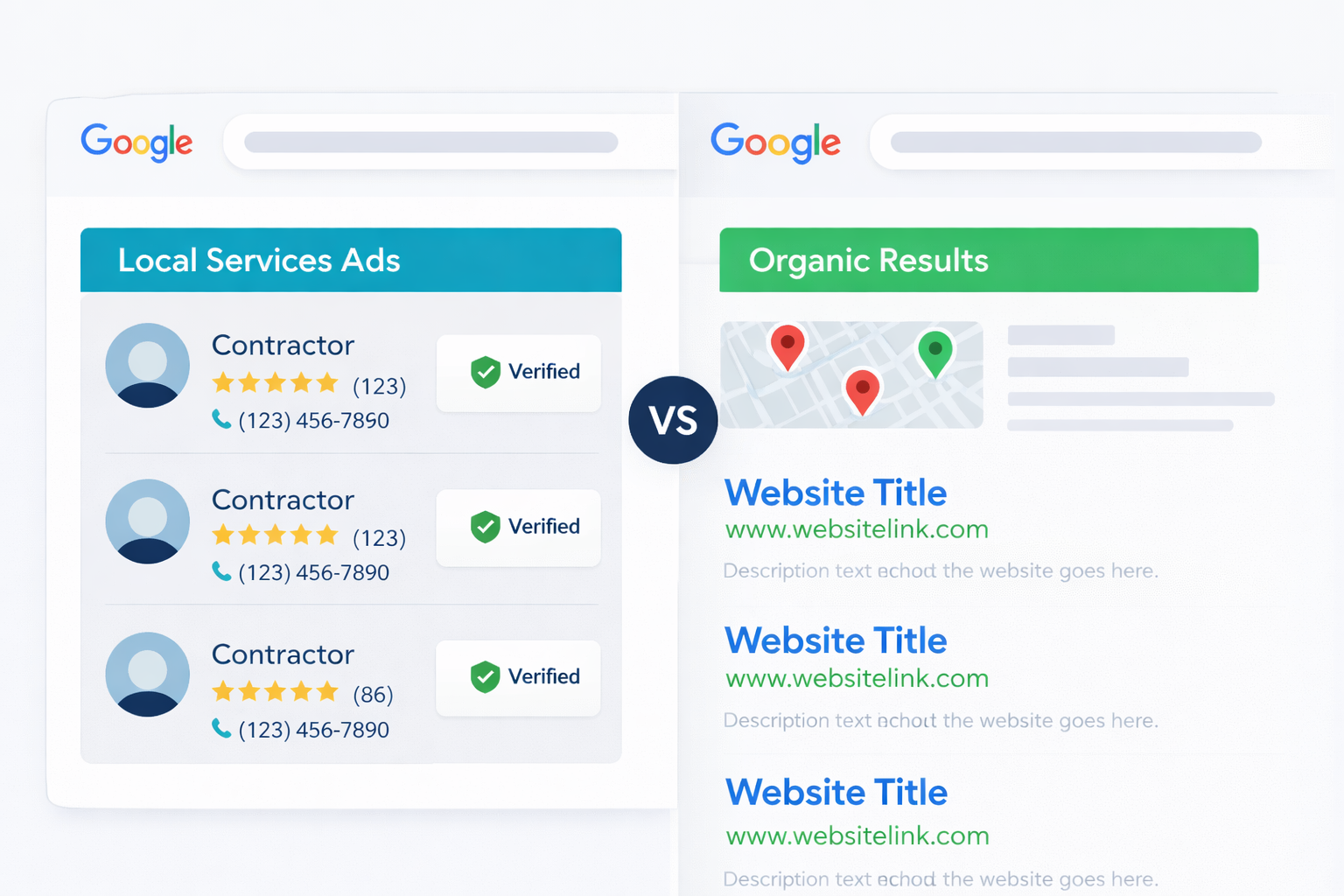
The Difference in 60 Seconds
SEO (Search Engine Optimization) is the process of building your website and online presence so that Google shows your business in the organic (unpaid) search results. This includes your website content, service area pages, blog posts, backlinks from other sites, technical website health, and your Google Business Profile. You do not pay per click or per lead. The traffic is "free" once you rank, but earning those rankings takes consistent investment over months.
LSA (Local Services Ads) are paid ads that appear at the very top of Google search results, above everything else. You pay a flat fee every time a customer contacts you through the ad. Google handles the targeting based on your service categories and zip codes. You can be live and receiving calls within days of passing Google's verification. But the moment you stop paying, the leads stop.
That is the fundamental trade-off. SEO is slow money that compounds over time. LSA is fast money that stops when the budget runs out. Understanding that distinction is the foundation of every decision in this article.
The Real Cost of Each Channel
Contractors love comparing sticker prices. "SEO costs $2,500 a month." "LSA costs $75 a lead." But sticker price does not tell the full story. Here is what you are actually paying for with each channel and what you get in return.
What You Actually Pay
📈 SEO Investment
- Monthly retainer
- $1,500 – $3,000
- Content creation
- Included or $300+/post
- Backlink building
- $200 – $600/link
- Technical audits
- Included or $2K one-time
- Per-lead cost
- $0 (organic traffic)
📞 LSA Investment
- Monthly ad spend
- $1,500 – $5,000
- Setup fee (agency)
- $500 – $1,500 one-time
- Management fee
- $300 – $800/month
- Content/backlinks
- Not required
- Per-lead cost
- $25 – $150/lead
The math is straightforward. SEO costs roughly $2,000 to $4,000 per month when you factor in the agency retainer, content, and link building. LSA costs roughly $2,000 to $6,000 per month in ad spend plus management. The difference is what happens to that money. Every dollar you put into SEO builds an asset. Better website, stronger domain authority, higher rankings that persist even if you pause spending for a month. Every dollar you put into LSA buys a lead. Valuable, yes. But temporary.
For a deeper look at exactly what LSA costs by trade, we broke the numbers down in a separate guide.
The Timeline: When Results Actually Show Up
This is where most contractors make their decision, and honestly, it is fair. If your phone is not ringing, you need leads now. Not in six months. Not after your website ranks. Now.
LSA delivers. You submit your paperwork, pass the background check, set your budget, and you are live in 7 to 14 days. Leads start coming in during week one or two. It is the fastest path from "I need more work" to "my phone is ringing."
SEO is a slower burn. Optimizing your Google Business Profile can show small improvements within weeks, but meaningful organic website traffic, the kind that consistently generates 10, 20, 30 leads a month, takes 6 to 12 months of consistent work. For brand new websites in competitive markets, 12 months is realistic.
Lead Generation Timeline: SEO vs. LSA
Here is what the SEO timeline actually looks like for a typical contractor:
- Months 1 to 3: Technical fixes, website content, GBP optimization, citation building. You probably will not see a noticeable change in leads yet. This is the foundation phase, and it is where most contractors lose patience.
- Months 3 to 6: Rankings start moving. You might show up on page 2 or the bottom of page 1 for your main keywords. A trickle of organic leads starts coming in. Not life-changing, but proof that the investment is working.
- Months 6 to 12: This is where SEO starts paying for itself. Rankings stabilize in the top 5 for your target keywords. Organic lead flow becomes consistent and predictable. Your cost per lead drops significantly because you are not paying per click.
- Months 12 to 24: The compounding kicks in. Content you published six months ago keeps generating traffic. Backlinks keep building authority. Your organic cost per lead can drop below $20 while your competitors are still paying $75 per LSA lead.
Where Each One Appears on Google
When a homeowner searches "plumber near me" or "HVAC repair," Google shows results in a specific order. Understanding this layout helps explain why both channels matter.
Google Search Results: Who Gets Seen First
Click share data from BrightLocal local search studies, 2025.
Look at those numbers. The Map Pack captures more clicks than any other zone, roughly 42% of all clicks on local searches. Organic results grab another 29%. Together, that is over 70% of all clicks going to unpaid results. LSA captures about 14%, which is valuable because those are the highest-intent callers, but it is a smaller slice of the total pie.
Here is the takeaway: if you only run LSA, you are competing for 14% of the clicks. If you also invest in SEO, you can capture the Map Pack and organic positions too, giving you visibility across 85% of the results page. That is why the contractors who dominate their local markets show up in all three zones.
For a deep dive into how to climb the Map Pack through GBP optimization, check out our Google Business Profile guide for contractors.
Cost Per Lead: The Numbers That Matter
Here is where the long-term math gets interesting. LSA gives you a clear, predictable cost per lead from day one. SEO gives you a terrible cost per lead in month one and an incredible cost per lead by month 12.
Cost per lead is just CPC divided by conversion rate, which the free CPA calculator will do for you.
Head-to-Head: SEO vs. LSA
| Metric | SEO | LSA |
|---|---|---|
| Cost per lead (month 1) | $500+ (minimal leads) | $25 – $150 |
| Cost per lead (month 12) | $10 – $50 | $25 – $150 |
| Time to first lead | 2 – 6 months | 1 – 2 weeks |
| Lead exclusivity | 100% exclusive | 100% exclusive |
| Lead quality | ★★★★★ | ★★★★★ |
| Close rate | ~14% | ~25 – 31% |
| Management effort | High (ongoing) | Low to medium |
| Leads after you stop paying | ★★★★★ | ★★★★★ |
| 24-month ROI | 500 – 1,000%+ | 200 – 400% |
Notice the crossover. In the first three months, LSA destroys SEO on every metric that matters for cash flow. By month 12, the tables start turning. By month 24, SEO is generating leads at a fraction of the cost and continues to do so whether you are actively spending or not.
A quick example. Say you spend $3,000 per month on LSA and generate 40 leads per month at $75 each. After 12 months, you have spent $36,000 and generated 480 leads. Solid.
Now say you spent that same $3,000 per month on SEO instead. Months 1 through 4, you get maybe 10 total leads. Painful. But by month 12, you are generating 30 to 50 organic leads per month, and your effective cost per lead is under $30. By month 24, your site is generating 50 to 80 leads per month at under $15 per lead, and the traffic keeps coming even if you reduce your SEO budget.
The Compound Effect: Why SEO Builds Equity
Think of LSA like renting an apartment. It is comfortable, it works right now, and you can move in tomorrow. But the moment you stop paying rent, you are out. You do not build equity. You do not own anything.
SEO is like buying a house. The upfront cost is higher. The first year feels like you are just writing checks. But every month, you own a little more. The content you create, the backlinks you earn, the domain authority you build, it all compounds. After two years, you have an asset that generates leads 24/7 without a per-lead fee.
Cumulative ROI: $3,000/Month Investment Over 24 Months
The chart above assumes a $3,000 monthly investment in each channel and average job values of $1,500 to $3,500 (typical for HVAC, plumbing, electrical). The exact numbers shift by trade and market, but the shape of the curve stays the same. LSA is a straight line. SEO is a hockey stick.
The construction industry sees an average SEO ROI of 681% and breaks even at around month 5. HVAC comes in at 678% ROI with a 6-month break-even (First Page Sage, 2026). Those are not hypothetical projections. They are industry averages across real campaigns.
See the real numbers for your trade
Plug in your industry, budget, and close rate. Our calculator shows your projected leads, cost per booked job, and ROAS.
When LSA Wins
LSA is the clear choice in these situations:
- You are a new business and need leads this week. You do not have 6 to 12 months to wait for SEO to compound. LSA gets your phone ringing in days. Revenue first, strategy second.
- You are in a seasonal crunch. Summer is here and you are an HVAC contractor, or storm season just hit and you do roofing. LSA lets you scale your budget up instantly to capture demand when it spikes.
- You want the highest-intent leads available. LSA leads are homeowners who searched for your service, saw your profile with the Google Verified badge, and clicked to call you directly. The close rate of 25 to 31% reflects that intent.
- You do not have a strong website yet. LSA does not depend on your website. It runs on your Google profile, reviews, and responsiveness. If your website is outdated or thin, LSA still works while you build out the site for SEO.
- You want predictable, controllable spend. Set your weekly budget, get a predictable number of leads. If leads slow down, increase budget. If cash is tight, dial it back. LSA gives you a lever you can pull in real time. See our troubleshooting guide if leads dry up.
When SEO Wins
SEO is the better long-term investment in these situations:
- You have been in business 2+ years and have stable revenue. You can afford to invest in something that takes 6 months to mature because your LSA (or referrals) keep the lights on in the meantime.
- You want to reduce your dependence on paid ads. Every organic lead is a lead you did not have to pay for. Contractors who build strong organic traffic eventually reduce their LSA budget by 30 to 50% while maintaining the same overall lead volume.
- You serve multiple cities or zip codes. SEO lets you build service area pages that rank in dozens of markets simultaneously. One well-optimized page can generate leads from a city you never ran an ad in.
- You want to build brand authority. When a homeowner searches your company name and finds a professional website with helpful content, 50+ reviews, and strong Map Pack visibility, they trust you before they ever call. That trust compounds over time in ways that paid ads simply cannot replicate.
- Your competitors are not investing in SEO. In many local markets, the SEO bar is shockingly low. A contractor with a clean website, 10 solid service pages, and consistent GBP activity can leapfrog competitors who have been in business for 20 years but never touched their online presence.
The Best Strategy: Use Both
The contractors who grow the fastest and build the most resilient businesses do not pick one or the other. They use LSA for immediate lead flow and SEO for long-term equity, and the two channels actually make each other stronger.
How SEO strengthens your LSA performance
Your Google Business Profile is the engine behind both your Map Pack ranking and your LSA ranking. When you invest in SEO, you are optimizing that profile, building review volume, improving your website authority, and strengthening NAP consistency across the web. All of those signals feed directly into how Google ranks your LSA profile. Contractors who invest in both channels consistently report lower LSA cost per lead than competitors who run LSA alone.
Check your current position before you change anything with the free LSA Visibility Scanner.
How LSA data improves your SEO strategy
LSA gives you immediate data on which services get the most calls, which zip codes produce the best leads, and what times of day customers are searching. That data is gold for SEO. Use it to decide which service area pages to build, which blog topics to write about, and which cities to target first. LSA is essentially a paid research lab for your organic strategy.
The phased budget approach
If you have a limited budget, here is a practical framework:
- Phase 1 (Months 1 to 6): 80% LSA, 20% SEO. Put most of your budget into LSA to generate immediate revenue. Use the remaining 20% to optimize your GBP, fix technical website issues, and start building foundational content.
- Phase 2 (Months 6 to 12): 60% LSA, 40% SEO. Organic traffic starts building. Reinvest a larger share into content, service area pages, and backlinks. LSA keeps the pipeline full while SEO gains traction.
- Phase 3 (Months 12+): 40% LSA, 60% SEO. Organic leads now represent a meaningful share of your total volume. Maintain LSA at a level that keeps your ad position competitive, but let SEO carry more of the weight.
This is not a rigid formula. If you are in a market where LSA competition is fierce and cost per lead is climbing, accelerating SEO investment makes even more sense. If you just expanded to a new city and need leads immediately, temporarily shift more budget to LSA for that market.
Which Strategy Fits You?
LSA First
Best when:- ✓ New business, need leads now
- ✓ No website or weak website
- ✓ Seasonal demand spike
- ✓ Budget under $2K/month
- ✓ Want predictable lead cost
SEO First
Best when:- ✓ Established business, stable revenue
- ✓ Referrals cover short-term pipeline
- ✓ Want to reduce ad dependency
- ✓ Serve multiple cities/markets
- ✓ Competitors have weak SEO
Both Together
Best when:- ✓ Budget of $3K+/month total
- ✓ Want maximum local visibility
- ✓ Building a long-term growth engine
- ✓ Ready to dominate your market
- ✓ Want data-driven SEO strategy
SEO vs LSA FAQs
Is SEO or LSA better for a brand new contracting business?
LSA. You can be live and receiving calls within 7 to 14 days after passing Google's verification. SEO takes 6 to 12 months to build meaningful organic traffic. Start with LSA to generate revenue, then invest a portion into SEO so you are building long-term lead flow while the short-term pipeline stays full.
Can I do contractor SEO myself or do I need to hire an agency?
You can handle the basics: optimize your Google Business Profile, collect reviews consistently, and make sure your name, address, and phone number are correct across the web. Where most contractors hit a wall is technical SEO, backlink building, and service area page strategy. If you have 5 to 10 hours per week, DIY is possible. Otherwise, a contractor-focused SEO agency will get results faster.
Will Local Services Ads replace the need for SEO?
No. LSA gives you paid visibility at the top of search results, but only while you are paying. SEO builds organic visibility that generates leads without a per-lead cost. They serve different roles. The contractors who dominate their markets invest in both. SEO also strengthens LSA performance because GBP optimization, review volume, and website authority all feed into how Google ranks your LSA profile.
How much should a contractor budget for SEO per month?
Most single-location contractors should budget $1,500 to $3,000 per month for a quality SEO program. In competitive markets (HVAC, roofing in major metros), $3,000 to $5,000 is common. Below $1,000 per month, you are unlikely to outpace competitors who are investing more. For LSA budgeting, we cover the numbers in detail separately.
Do I need a website to run Local Services Ads?
Technically, no. LSA runs on your Google profile, reviews, and responsiveness. But having a solid website strengthens your Google Business Profile ranking, gives customers a place to research your business, and captures organic traffic that LSA cannot reach. A website is not required for LSA, but it is required for a complete marketing strategy.
How do SEO and LSA rankings affect each other?
They share a common foundation. Your Google Business Profile feeds both your Map Pack ranking and your LSA ranking. Reviews count toward both. NAP consistency strengthens both. A strong website boosts your GBP authority, which can improve LSA visibility. The two channels reinforce each other. Contractors who invest in both typically see their LSA lead volume increase and cost per lead decrease as their organic presence grows.
Bottom Line
If your phone is quiet and you need work booked this month, start with LSA. It is the fastest, most reliable way to get qualified leads calling your business. Get verified, set your budget, and your phone starts ringing.
If you are already booking consistently and want to build something that compounds over time, invest in SEO. It is slower, it tests your patience, and the first few months feel like you are spending money for nothing. But by month 12, you will have an asset generating leads at a fraction of what your competitors pay per lead.
If you can swing both, do both. Use LSA as the revenue engine that keeps the lights on today. Use SEO as the investment that makes tomorrow cheaper. The data is clear: contractors who combine both channels generate more leads, pay less per booked job, and build businesses that are not dependent on any single platform. Wondering how LSA stacks up against Facebook Ads or Yelp Ads? We have detailed breakdowns of those matchups too.
Not sure where to start? We manage LSA campaigns for contractors across the country and can tell you exactly where your next dollar will have the biggest impact. The audit is free, the advice is specific, and there is zero pressure.
Get Your Free LSA & Marketing Strategy Review
We will analyze your market, your competitors, and tell you exactly where to invest your marketing budget for maximum booked jobs.
Request Your Free ReviewData points in this article reflect aggregated industry benchmarks from First Page Sage, BrightLocal, Backlinko, and managed account data as of 2025-2026. Actual results vary by market, competition level, trade, and execution quality. Blue Grid Media specializes in LSA management for local service businesses.
More on contractor SEO
Part of the BGM contractor SEO library: