Published by Blue Grid Media • Updated for 2026 • 13 min read
Garage door is one of the most urgency-driven calls in the home service trades. A broken spring at 6am isn't a "get to it next week" problem. The car is trapped, the house isn't secure, the homeowner is standing in the garage stressed out before work. They are not comparison shopping. They are not reading blog posts. They are grabbing their phone and calling whoever comes up first on Google that looks legitimate.
That's the environment Google Local Services Ads was built for. LSA puts your business at the very top of search results, above every Google Ad and every organic listing, exactly when someone in your area has an urgent problem and real money to spend. You pay only when a customer contacts you directly. And that last part matters more in garage door than almost any other trade: this industry has a documented spam problem. Fake companies, bait-and-switch operators, out-of-state call centers posing as local businesses. Homeowners know it's a problem and they are actively looking for trust signals before they call. The Google Verified badge on your listing is that signal. It tells the homeowner Google has already vetted your license, insurance, and background, before they even dial.
Most garage door companies either aren't running LSA at all or have a profile that's missing half the job types they actually offer. That leaves a real gap. This guide covers how LSA works specifically for garage door businesses, what it costs, how to rank above your local competition, and how to build a setup that turns emergency searches and installation requests into booked jobs consistently.
Is Google LSA Worth It for Garage Door Companies?
Yes, especially for residential service and repair work.
Garage door emergencies don't get comparison shopped. When someone's door is stuck open in the middle of winter or a spring breaks and their car is blocked in, they need someone today. They're going to call whoever Google puts in front of them first with a verified badge and solid reviews. That's exactly what LSA is designed to capture.
The numbers work in your favor too. Garage door companies typically see cost per lead anywhere from $20 to $75 depending on market and job type. A single new door installation averaging $1,200 to $2,500 covers a significant number of leads. Even a spring replacement at $200 to $350 returns three to five times your lead cost if you answer the phone and show up on time.
LSA is also one of the few advertising channels where you only pay when a real customer actually contacts you. Not for clicks. Not for impressions. For contact. That's a fundamentally better risk model than traditional Google Ads for most garage door contractors, and when homeowners in your area search for urgent help, the person who wins that call is whoever is at the top of their screen.
A practical example: if your LSA leads cost $40 each in your market and you're booking 6 out of every 10 conversations, your cost per booked job is about $67. On a $300 spring repair that's a solid margin. On a $1,800 door installation it's exceptional. Most garage door companies running LSA consistently see their cost per booked job drop over the first 60 days as their profile builds review history and Google learns which leads convert best for them.
| Feature | Local Services Ads (LSA) | Google Search Ads |
|---|---|---|
| How you pay | Pay per lead (calls/messages) | Pay per click |
| Lead intent | Very high (ready to hire now) | Varies (research to urgent) |
| Typical CPL (garage door) | $20–$75 per lead | $8–$35 per click (varies) |
| Best for | Emergency repairs, spring replacement, opener installs | New door installs, commercial, scale |
| Setup difficulty | Moderate (verification required) | Higher (ongoing campaign management) |
See the real numbers for your trade
Plug in your industry, budget, and close rate. Our calculator shows your projected leads, cost per booked job, and ROAS.
What Google LSA Looks Like for Garage Door Businesses
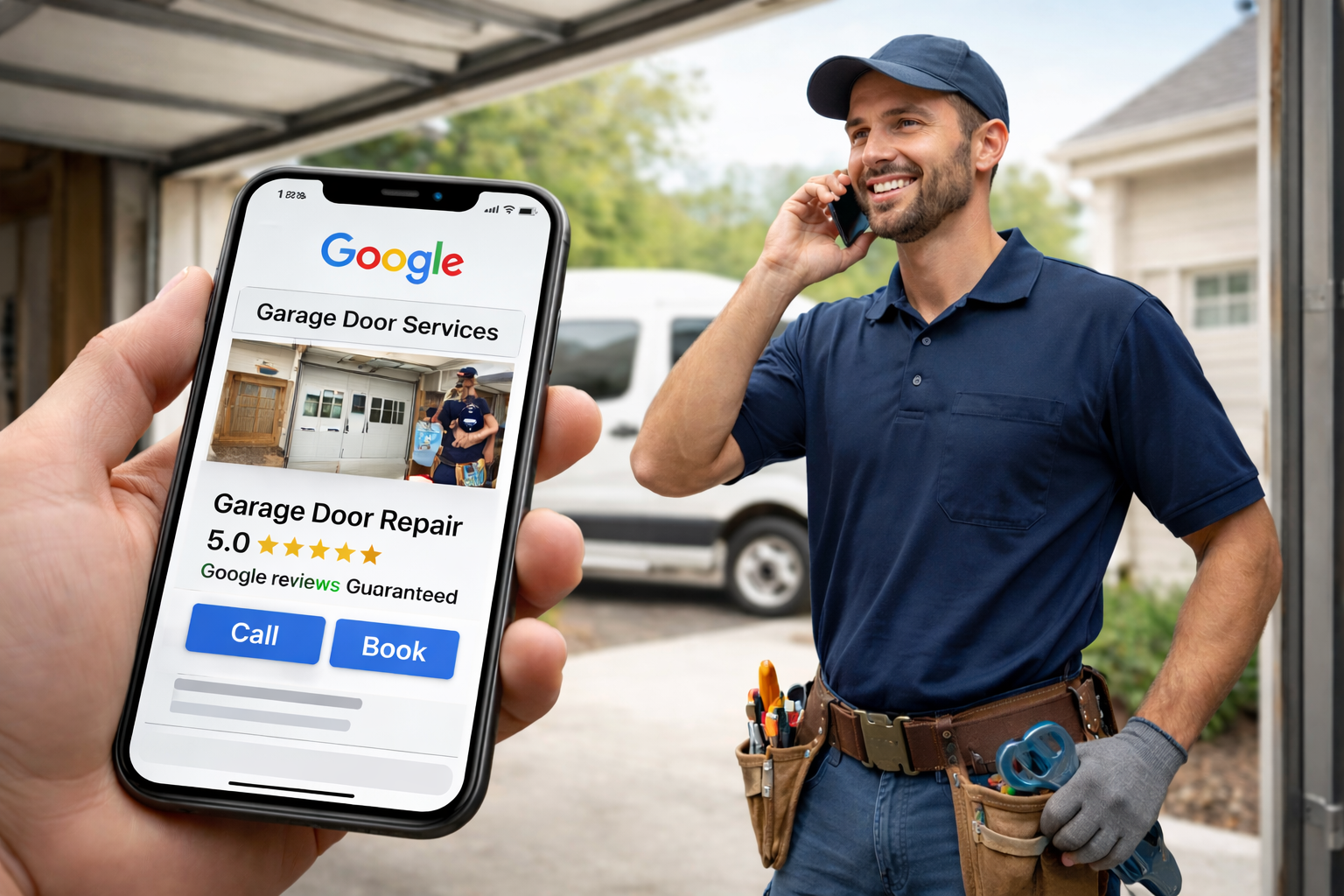
When someone searches "garage door repair near me," "broken garage door spring," "garage door opener installation," or any similar query, Google serves a row of Local Services Ads at the absolute top of the page. Above regular Google Ads. Above the map pack. Above every organic result.
Your listing shows your business name, star rating, review count, years in business, and a direct click-to-call button. On mobile, it takes up most of the visible screen before the user scrolls. That's prime real estate at the exact moment someone in your area is ready to spend money.
The Google Verified badge on your listing tells the homeowner that Google has checked your licenses, insurance, and background. It's a powerful trust signal that removes the friction of wondering whether you're legitimate. Customers who see it don't need to dig around for your credentials because Google has already vouched for you. That's why LSA listings convert at a much higher rate than standard pay-per-click ads.
The Google Verified badge carries particular weight in the garage door industry because the industry has a well-documented spam problem. Search for "garage door repair" in any major market and you will find a mix of legitimate local companies and out-of-state lead farms with fake local numbers, low advertised prices, and a habit of tripling the quote once they're on-site. Homeowners have been burned by this enough times that they've started actively looking for verification before calling. The Verified badge is what separates real local businesses from the bait-and-switch operators. It's not just a nice aesthetic touch on your listing, it's a competitive advantage specific to this trade. Quick note on terminology: Google retired the old "Google Guaranteed" badge in October 2025 and replaced it with the unified Google Verified badge. The screening process is the same, but the money-back guarantee attached to the old badge is gone. Any older content you see still referencing "Google Guaranteed" for garage door is out of date.
Setting Up Google LSA for Your Garage Door Business
Getting verified takes work upfront but once you're live it runs with minimal ongoing management compared to traditional Google Ads. Here's how to do it right.
- Create your LSA profile. Go to ads.google.com and navigate to the Local Services Ads section. Select "Garage Door" under the home services category. Add your business name, service areas, hours, and a description. Write your description like a human, "Family-owned garage door company serving the greater Phoenix area, spring repair, opener installation, new doors, cables, and 24/7 emergency service" beats a generic paragraph every time.
- Enable every job type you actually offer. This is the single most common setup mistake we see in garage door LSA profiles. Google only shows your ad for job types you have explicitly turned on, and Google's job type list for garage door is more granular than most contractors expect. The categories to enable include: garage door repair, garage door installation, garage door opener repair, garage door opener installation, garage door spring repair, garage door cable repair, and garage door panel replacement. Most companies only check "garage door repair" and maybe "garage door installation," then wonder why call volume is thin. "Garage door opener installation" is a separate high-volume category that captures a completely different set of searches. "Garage door spring repair" is one of the highest-converting job types in the trade because the search intent is extremely specific, the problem is urgent, and the customer has already diagnosed the issue before they call. If it is not enabled separately in your profile, you are invisible for it. Go through every available job type and turn on everything you can actually deliver. This step alone can increase your lead volume by 30 to 50%.
- Upload your license and insurance. Google requires proof of general liability insurance and your business license where applicable. Have digital copies ready before you start. Uploading everything upfront avoids verification delays that can add weeks to your launch timeline.
- Complete background checks. Garage door contractors enter customer homes, so Google requires background checks for business owners and any technicians who go on site. This is the slowest part of the whole process. Start it first.
- Connect your Google Business Profile. Your GBP feeds directly into your LSA listing. The reviews on your GBP show up on your LSA ad. If your GBP is incomplete, has wrong hours, or is missing photos, it hurts your LSA performance from day one. Clean it up before you go live.
- Set your budget and bid mode. Start with Maximize Leads and set a weekly budget that targets roughly 10 to 15 leads per week based on your expected cost per lead in your local market. Don't cap yourself with a low Max Per Lead bid, in competitive markets it'll throttle your visibility before you even see what LSA can do.
- Add real photos. Branded trucks, completed installations, before-and-after door replacements, your team on the job. Real images from your actual business. Google rewards complete profiles and customers click on photos before calling. Skip the stock photos.
Get a Free Garage Door LSA Audit
What Does LSA Cost for Garage Door Companies?
Most US markets see garage door LSA leads ranging from $20 to $75 per lead. Bigger metros and emergency searches push toward the higher end. Smaller markets and less competitive areas come in lower.
The number that actually matters is cost per booked job, not cost per lead. If you're paying $40 per lead, answering 80% of calls, and booking 65% of those conversations, you're paying roughly $77 per booked job. For a new door installation that's an easy return. For a $250 cable repair it's tighter but still workable if your volume is right.
| Market Size | Typical CPL Range | Example Cities |
|---|---|---|
| Small Market | $18 – $35 | Boise, Spokane, Chattanooga |
| Mid-Size Market | $30 – $55 | Denver, Nashville, Indianapolis |
| Large Market | $45 – $75 | Los Angeles, Chicago, Houston |
Garage door has a wide job range, from a $150 tune-up to a $1,800 full door replacement, and the companies losing money on LSA are almost always struggling on one specific side of the economics: spring repair calls. Spring repair is one of the highest-intent, highest-converting job types in the trade. Customers are calling with a specific, urgent problem, often willing to pay $250 to $450 to get it fixed today. But if your truck isn't stocked with the right torsion spring sizes when you show up, you lose the close. You either have to come back tomorrow or the customer calls someone else. That's a paid lead that turned into zero revenue. The other common culprit is phone time. Answering "how much does it cost" questions in detail for 15 to 20 minutes on every call sounds helpful but it tanks your booking rate. The goal of the first call is to get the appointment, not to give a free education. Get on site, assess the job in person, and close there. Same-day close rate is the number to watch in garage door, not just booking rate.
Want to see what garage door LSA leads cost in your market? Try our free calculators for Houston, Denver, and Columbus.
How to Rank Higher in Garage Door LSA Results
Garage door service has a ranking advantage that most other trades do not: the combination of high emergency intent and relatively fast job completion means you can collect reviews at a pace that builds profile strength quickly. A busy garage door technician completing 4 to 6 jobs per day has 4 to 6 review opportunities, every single day. Here is how to turn that into ranking dominance.
- Enable every garage door service type. Spring replacement, opener repair, opener installation, new door installation, panel replacement, cable repair, off-track repair, and weatherstripping are all separate job types in LSA. Many garage door companies only check 3 or 4 and wonder why they are not getting more calls. Every unchecked service type is an entire category of searches where you are invisible. Log into your LSA dashboard and enable everything you can actually deliver. This alone can increase your lead volume by 30 to 50%.
- Stock common parts for same-day completion. Completing a spring replacement or opener repair on the first visit is the fastest path to a 5-star review. Customers whose car was trapped in the garage this morning and whose door is working again by lunch are happy customers. Stock torsion springs in the most common sizes, extension springs, common opener motors, remotes, wall buttons, and safety sensors on your truck. A same-day, same-visit fix generates the kind of gratitude that turns into a review without you having to ask twice.
- Transparent pricing in your profile reduces price-shopping calls. Garage door service has a reputation problem, homeowners worry about being overcharged, especially on emergency spring replacement calls. Mention diagnostic fees, common repair price ranges, and your approach to pricing in your LSA description. "Free on-site estimates for all repairs, no service call fee" or "$89 service call applied to repair" sets expectations before the customer even dials. This reduces tire-kicker calls and increases the percentage of leads that actually convert to booked jobs. For more on what drives your ranking position, see our guide to LSA ranking factors.
- Split your focus between repair calls and installation leads. Repair calls ($200 to $500 for springs, cables, openers) are urgent, high-conversion, same-day jobs that build your review count fast. New door installation leads ($1,000 to $5,000) are lower volume but much higher revenue per job. Your LSA profile needs to serve both audiences. Mention both emergency repair and new door installation prominently in your description so customers searching for either type see themselves in your listing.
- Use Maximize Leads bid mode. Setting a manual Max Per Lead cap limits your delivery before your profile builds enough history to compete on quality. Maximize Leads lets Google's algorithm find you the most leads within your budget. For garage door companies just starting LSA, this mode consistently outperforms manual bidding during the first 90 days. For context on how ranking factors interact across all industries, see our guide on ranking #1 in LSA.
Common LSA Mistakes Garage Door Companies Make
- Not auditing job types. If you do opener installations but "garage door opener installation" isn't checked in your LSA backend, you don't appear for it. Go through your full job type list today. Most garage door companies are missing at least two or three categories they could be appearing for.
- Ignoring bad leads. You'll get wrong numbers, out-of-area calls, and calls for services you don't offer. Dispute every single one in your LSA dashboard. Google issues credits for valid disputes but only within a specific time window. Set a weekly reminder to log in and clear them out.
- Letting reviews flatline. Getting 30 reviews in your first month and then stopping is worse than you think. Google's algorithm reads a flatline in review activity as a sign your business may be inactive. Reviews need to come in consistently month after month, year-round.
- Turning off LSA during slow periods. Slow periods are exactly when your competitors are pulling back. A lower budget running consistently during off-peak months keeps your profile active, builds ranking history, and captures the work that is out there even when demand is lower.
- Setting overly restrictive hours. Garage door emergencies happen evenings and weekends. If your hours are set to 9am–5pm Monday–Friday, you're missing the majority of urgent calls. If you offer emergency service, set your hours to reflect that.
- Not tracking outcomes. Mark every lead in your dashboard, booked job, no answer, wrong number, out of service area. This data directly influences how Google scores your profile going forward. Businesses that track outcomes consistently see better lead quality over time.
Garage door companies running LSA with slow call volume almost always have one of three problems: service area misconfigured too broadly or too narrowly, the wrong job types enabled (or key ones missing entirely), or reviews sitting below the threshold their top competitors have already crossed. Our LSA troubleshooting guide covers those three and nine other common causes, with specific fixes for each one.
Should Garage Door Companies Run LSA and Google Ads Together?
Yes, and here's the practical reason why. LSA captures people who have already decided they need a garage door company right now. They're not researching. They want someone to show up today. That's LSA's sweet spot.
Google Search Ads capture everyone earlier in the process, homeowners comparing quotes for a new door, someone wondering about the cost of a belt-drive opener upgrade, a property manager looking for a commercial garage door contractor for an ongoing account. That's traffic LSA doesn't reach on its own.
The combination is particularly powerful for garage door companies that offer both emergency service and larger planned projects. LSA dominates local search results for urgent calls and fills your schedule with same-week work. Google Ads handles the prospecting side, getting your name in front of homeowners in your service area who are weeks or months away from pulling the trigger on a new door or full replacement. Together, they cover the full customer journey and your blended cost per booked job is typically lower than running either channel alone at the same total spend.
Start with LSA if you're new to paid advertising. Lower cost to enter, simpler to manage, and the lead quality is excellent. Once you have consistent LSA volume and your team can handle more work, layer in Google Ads to capture the broader market.
For a deeper look at how the two platforms compare, see our guide on Google Ads vs. Local Services Ads.
How to Track Your Garage Door LSA Results
Skip the vanity metrics. Here's what to actually track.
- Cost per booked job. Take your total LSA spend for the month and divide by the number of jobs you actually booked from LSA leads. That's your real cost per acquisition. If it's profitable, scale the budget. If not, find the leak, it's usually missed calls or a low booking conversion rate on the phone.
- Call answer rate. Check this in your LSA dashboard weekly. If it drops below 80% you have a problem that will hurt your ranking before it shows up in your lead count.
- Lead outcome breakdown. What percentage of your leads are becoming booked jobs vs. no answers vs. bad leads? If your bad lead rate is high, make sure you're disputing them. If your booking rate is low, the issue is probably call handling, not LSA.
- Review velocity. How many new reviews did you get this month? If the answer is zero your ranking will start to slip. Build the review request into your job close workflow so it's automatic.
Garage Door LSA FAQs
How much do Google LSA leads cost for garage door companies?
Most markets run $20 to $75 per lead for garage door companies. Emergency calls like broken springs or doors off track tend to cost more. Smaller markets and less competitive areas usually come in on the lower end. The number that matters more than cost per lead is cost per booked job, that's the one to optimize around.
Do garage door companies need background checks for Google LSA?
Yes. Garage door contractors enter customer homes, so Google requires background checks for business owners and any technicians who go on site. You'll also need proof of general liability insurance and your business license where applicable. Start the verification process first, it's the slowest part of getting live.
How long does it take to get approved for garage door LSAs?
The approval process typically takes 2 to 6 weeks. It includes a background check, license verification, and insurance verification. Having your documents ready before you start speeds up the process significantly.
How many leads can a garage door company expect from LSAs?
Volume depends on your market size and weekly budget. A garage door company in a mid-size market spending $500 to $1,000 per month can typically expect 15 to 40 leads per month. Larger budgets in bigger markets can generate 60 or more leads per month.
Can I dispute bad leads from Google LSA?
Yes. Google allows you to dispute leads that are spam, wrong number, or outside your service area. Approved disputes result in a credit back to your account. Log into your LSA dashboard, find the lead, and submit a dispute with a reason. Set a weekly reminder to review and dispute invalid leads before the window closes.
Are LSAs better than Google Ads for garage door companies?
For most garage door companies, LSAs deliver a lower cost per lead and higher intent traffic than traditional Google Ads. LSAs are best for capturing emergency calls and urgent service requests. Google Ads offer more control over targeting and messaging and work well for reaching homeowners earlier in their decision process. Many companies run both simultaneously for maximum coverage.
Conclusion & Next Steps
Garage door companies that win with LSA aren't necessarily the ones with the biggest budgets. They're the ones who answer their phones, collect reviews consistently, keep their profiles complete, and enable every service they can actually deliver. The setup work is front-loaded, once you're verified and optimized, LSA becomes one of the most reliable and low-maintenance lead channels you'll run in your local market.
Start with LSA to capture customers who are ready to hire right now. Add Google Search Ads when you're ready to scale and reach homeowners earlier in their decision process. And if you want someone to walk through your current setup and tell you exactly what's working and what isn't, that's what we do at Blue Grid Media.
No obligation. We'll look at your setup and tell you what's working and what isn't.
Results vary by market, competition, and how consistently you follow up on leads. Blue Grid Media specializes in LSA and Google Ads for local service businesses, book a free review and let's look at your numbers together.