Here is a scenario every general contractor knows. The phone rings, it is a homeowner who “just wants a rough number” on a kitchen remodel. You drive out on a Tuesday afternoon, spend an hour measuring and asking questions, and discover they have no real budget, no timeline, and their spouse has not agreed to the project yet. You send a quote. They ghost you. Three weeks later you see they hired someone cheaper to do half the job, and it shows.
The tire-kicker problem is more acute for general contractors than for almost any other trade. Kitchen remodels, room additions, and whole-home renovations involve big money, long timelines, and a lot of decision-makers. Every hour you spend on a dead-end estimate is an hour you are not managing jobs that are actually running. And if your lead source is Thumbtack, Angi, or a lead broker, you are getting shared leads where four other GCs are calling the same homeowner the same day.
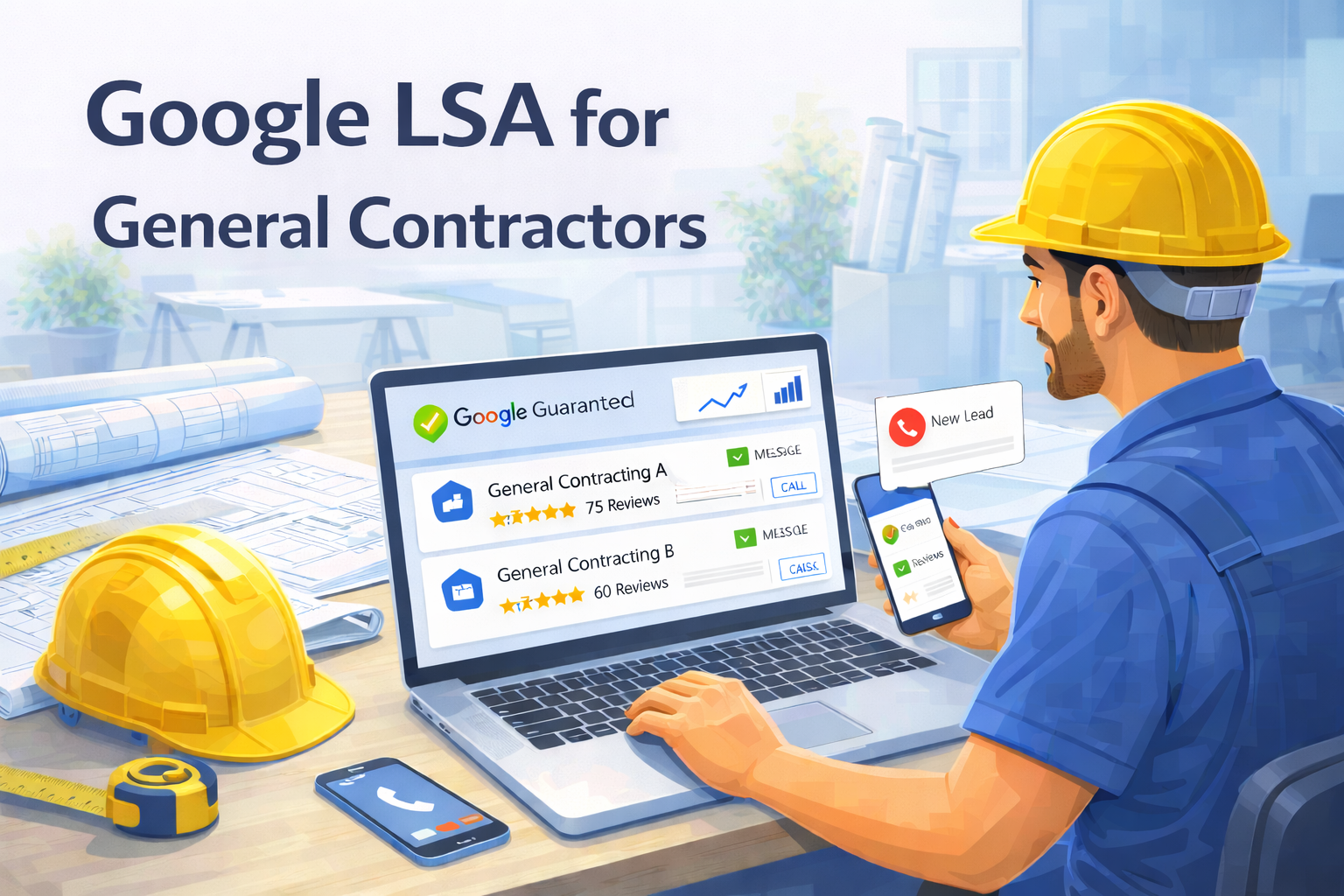
Google Local Services Ads change the lead quality equation. When a homeowner searches “general contractor near me” or “home remodeling contractor,” your listing appears at the top of Google with a verified badge, your star rating, and a direct call button. The homeowner searched with intent, saw your credentials, and picked up the phone. That is a different call than a lead you bought from a directory. This guide covers the full setup, what it costs, how to qualify the calls you get, and how to rank above your local competitors.
Is Google LSA actually worth it for general contractors?
Yes, and the numbers are almost absurdly in your favor when you look at the unit economics. General contracting is one of the highest-ticket categories on the entire LSA platform. Kitchen remodels run $15,000 to $60,000. Room additions go $40,000 to $100,000. Basement finishing, whole-home renovations, deck builds, ADU conversions. Even a straightforward bathroom remodel averages $8,000 to $25,000. When your average project is $18,000 to $45,000, paying $40 to $100 per lead is not a meaningful expense. It is a rounding error on the job margin.
Think about the cost per booked job math. If you pay $75 per lead, generate 20 leads a month, and close 30% of them after walkthroughs, you booked 6 jobs at a cost of $417 each. At a $25,000 average project value, that is a 107:1 return on ad spend. Even if your close rate is lower and your CPL is higher, the margin between what you spend and what you earn is enormous. Run the exact math for your market with the free LSA ROI Calculator.
The other factor working in your favor: general contractor is a relatively undercrowded LSA category in many markets. HVAC and plumbing companies have been running LSA for years. But many GCs still rely on referrals, yard signs, and word of mouth. The contractors who show up first on Google with a verified badge and 60+ reviews are capturing a disproportionate share of the highest-intent residential remodeling searches, often without serious competition.
The challenge unique to general contracting: more of your leads will require qualification work before you know if they are worth a walkthrough. That is not a flaw in the platform, it is the nature of the trade. LSA leads still qualify significantly better than lead broker leads, and with a simple first-call script you can identify real buyers from tire-kickers before you ever leave the shop.
What LSA Looks Like for General Contractor Searches
When a homeowner in your service area types “general contractor near me,” “home remodeling contractor,” “kitchen remodel contractor,” “room addition contractor,” or “home renovation near me” into Google, Local Services Ads appear at the very top of the results page. Above Google Ads. Above the local map pack. Above every organic result. On a mobile screen, the LSA block dominates the visible area without any scrolling required.
Your listing shows your business name, Google Verified badge, star rating with review count, years in business, and a click-to-call button. The homeowner can see your credibility signals immediately, before they ever visit your website or know anything else about you. For high-ticket decisions like a kitchen remodel, that verification matters. They are inviting a contractor into their home for weeks or months. The Google Verified badge communicates that you have been screened.
The search terms that trigger GC ads cover a wider range than most trades because “general contractor” as a category is broad. You can show up for kitchen remodels, bathroom remodels, room additions, deck builds, basement finishing, home renovations, and more, all under a single LSA profile. One profile, one budget, one place to manage, but visibility across an entire category of home improvement searches.
Setting Up Google LSA for Your General Contracting Business
GC verification involves more documentation than most other trades because licensing requirements are more complex. Every state has a different system for contractor licensing. California’s B-license (General Building Contractor) is the most well-known, but Texas, Florida, Arizona, and other large states each have their own framework. Know what your state requires before you start.
Job Types That Drive the Best GC Leads on LSA
General contractors have one of the widest job type menus on LSA. Every job type you enable is a search category you are eligible to appear for. Enable them all. A GC who enables 15 categories gets far more impressions than a GC who only enables “home renovation.” The homeowner searching “deck contractor near me” and the homeowner searching “kitchen remodel contractor” are both in your target market. Show up for both.
| Job Type | Typical Project Value | Why It Matters for GCs |
|---|---|---|
| Kitchen remodel | $15,000–$60,000 | Highest-demand remodeling category; strong buyer intent when searched |
| Bathroom remodel | $8,000–$25,000 | High volume, faster sales cycle than large projects, solid margin |
| Room addition | $40,000–$100,000 | Largest project type on LSA; longer sales cycle but exceptional ticket value |
| Whole-home renovation | $75,000–$200,000+ | Full remodeling pipeline; best clients for long-term relationships |
| Deck and patio construction | $8,000–$35,000 | Spring/summer spike; faster project cycle, easier to close |
| Basement finishing | $15,000–$50,000 | Growing demand in cold-weather markets; dedicated search category |
| Window and door replacement | $5,000–$20,000 | Faster cycle than full remodels; good entry point for larger future work |
| Roof replacement | $8,000–$18,000 | High search volume; GCs who self-perform roofing capture this directly |
| Siding replacement | $8,000–$20,000 | Often paired with window replacement; exterior curb appeal projects |
| Flooring installation | $3,000–$8,000 | Common add-on to remodels; also a standalone search category |
| Garage conversion / ADU | $25,000–$80,000 | High demand in urban and suburban markets; strong ROI motivation |
| In-law suite / accessory dwelling | $40,000–$100,000 | Growing category driven by multigenerational living trends |
| Drywall installation and repair | $2,000–$8,000 | Lower ticket but high volume; often a door-opener to larger project conversations |
The general rule: if your crew can do it and deliver quality results, enable it. You can always dispute leads for categories that are not a fit in specific cases. But you cannot get a lead for a category you never enabled. Disputed leads are refundable. Invisible profiles cost you every lead that went to your competitor instead.
What does Google LSA cost for general contractors per lead?
General contractor LSA leads typically run $40 to $100 per lead depending on your market, the search categories driving your impressions, and local competition. Metro markets with established GC competition push toward $65 to $100. Mid-size suburban markets often sit at $45 to $75. Rural markets can run $30 to $55. For a complete breakdown of LSA pricing across trades, see our Google LSA cost by industry guide.
Here is why paying $75 per lead as a GC is still one of the best advertising decisions you can make. No other home service trade has the combination of CPL range and average job value that general contracting offers. A plumber might pay $50 per lead on a $300 average job. An electrician pays $55 on a $400 average job. A GC pays $75 on an $18,500 average remodeling job. The ratio is completely different, and even after accounting for a longer sales cycle and a moderate close rate, the economics are compelling.
The math that makes GC LSA almost unfair
Lead cost: $75.00
× Call answer rate: × 85%
× Walkthrough set rate: × 65%
× Close rate: × 30%
───────────────────────
= Cost per booked job: ~$466
# At $18,500 average remodel value:
= 47:1 return on ad spend
# At $53,000 for a room addition:
= 114:1 return on ad spend
See the real numbers for your trade
Plug in your industry, budget, and close rate. Our calculator shows your projected leads, cost per booked job, and ROAS.
Budget sizing for general contractors
Most GCs should start with a monthly LSA budget of $1,500 to $3,000 to generate enough leads for meaningful data. At $75 CPL and a $2,250 monthly budget, you are looking at roughly 30 leads per month. At a 65% walkthrough rate and 30% close rate, that is about 6 booked projects. Six projects at even a conservative $15,000 each is $90,000 in new revenue from a $2,250 investment. After 60 days, adjust your budget based on your actual CPL and close rate.
The Lead Qualification Problem (and How to Solve It)
Let us address this directly, because every GC who has used any lead platform has dealt with it. Not every LSA call is a ready-to-hire homeowner with a clear scope and a realistic budget. Some calls are exploratory. Some homeowners have not yet told their spouse. Some have Pinterest boards full of $60,000 kitchens and a $15,000 budget. General contractors get more tire-kicker leads than nearly any other trade because the projects are complex, expensive, and require a lot of homeowner research before they are ready to commit.
The good news: LSA leads are still substantially better than Thumbtack or Angi leads for GC qualification, because the search intent is higher. A homeowner who Googled “general contractor near me” and called your verified listing is further along in the decision process than a homeowner who posted “I want to remodel my kitchen, give me quotes” on Angi. That additional intent does not guarantee they are ready to buy, but it means the conversation starts at a better baseline.
The first-call qualification script
Every GC who runs LSA should have a brief first-call qualification process before scheduling a walkthrough. This is not about being rude or dismissive. It is about using your time intelligently. Ask these four questions during every first call:
- What is the project? Get a clear description of scope. “We want to remodel our kitchen” is different from “We need a full gut renovation including moving walls and adding an island.” The scope tells you how serious the conversation is.
- What is your timeline? “Hoping to start in the next 60 days” is a buyer. “Maybe next year sometime” is a future lead to nurture, not a walkthrough to schedule this week.
- Have you talked to a designer or architect? For larger projects, a homeowner who has plans or has been to a design center is much further along than one who is still in the inspiration phase.
- Have you given thought to budget? You do not need an exact number. But a homeowner who responds “we are thinking around $20,000 to $40,000” is ready for a real conversation. A homeowner who says “I do not know, whatever it costs” or “I was hoping it would be around $5,000” needs education or a polite redirect before a walkthrough makes sense.
This four-question process takes about three minutes on the phone and separates motivated buyers from exploratory callers. For motivated buyers, schedule the walkthrough immediately. For exploratory callers, get their contact information, send them a brief overview of your process and typical project ranges, and follow up in 30 to 60 days.
Give budget ranges up front to filter mismatches early
Many GCs are reluctant to mention price during the first call because they do not want to lose the lead before seeing the project. This instinct is understandable, but it costs you more in wasted walkthroughs than it saves. Mentioning typical ranges filters mismatches before you drive anywhere: “Our kitchen remodels typically run between $15,000 and $60,000 depending on scope, materials, and layout changes. Does that range work for your project?” A homeowner who wanted to spend $8,000 will tell you now rather than at the estimate appointment. That is a good outcome. You saved three hours.
Compare this to how LSA leads outperform Thumbtack and Angi for GC qualification: on aggregator platforms, your lead was shared simultaneously with three to five other contractors. The homeowner was in “get me multiple quotes” mode from the start. On LSA, they called you specifically from a verified listing. The conversion gap is real, even accounting for GC-specific qualification challenges.
Commercial vs. Residential on LSA
LSA is built for residential leads. The platform’s search query volume, the homeowner intent behind those searches, and the verification process all point toward residential remodeling and home improvement as the primary use case. If your GC business is primarily commercial, tenant improvements, ground-up construction, or government contracts, LSA is probably not your highest-leverage marketing channel.
That said, if you do residential work alongside commercial work, LSA is worth running exclusively for the residential side of your pipeline. The residential remodeling market is enormous, the leads are high quality relative to other residential channels, and the ROI math makes a strong case for residential GC LSA even if commercial is where your biggest projects live.
What happens when a commercial call comes through LSA
Occasionally a small business owner, property manager, or building owner will find your LSA listing and call about a commercial project. Maybe a small office renovation, a retail space buildout, or a property manager who needs unit rehabs done. Do not dismiss these automatically. Evaluate the project on its merits. A $30,000 office renovation is a $30,000 project regardless of which channel it came from.
If the commercial project is too large, too specialized, or outside your normal scope, decline it gracefully. But if it fits your capabilities, the fact that it came through LSA rather than a commercial procurement process does not make it less valuable. Some GC businesses build meaningful commercial relationships from LSA calls that started as one-off small projects.
For commercial-focused GCs looking to fill their pipeline: Google Ads with specific targeting and landing pages for commercial renovation searches is a better fit than LSA. Our Google Ads vs. LSA comparison covers when each channel makes more sense.
How do general contractors rank higher in Google LSA?
The same ranking factors that govern every LSA category apply to general contractors, but certain variables carry extra weight for high-ticket trades where the homeowner’s due diligence process is longer. For the full deep-dive on all ranking signals, see our Google LSA ranking factors guide.
To see where you actually sit in the LSA pack right now, run the free LSA Visibility Scanner.
Reviews with project photos
Reviews are the single largest ranking factor in LSA, and for GCs, the content and visual proof in those reviews matters more than in any other trade. A 5-star review that says “They remodeled our entire kitchen and it looks incredible. Before photos looked like a 1980s time capsule, after photos look like a magazine shoot” is worth ten times as much as “Good job, would hire again.” Ask for a detailed review from every completed client and request permission to share before-and-after photos on your GBP. Aim for 40+ reviews with a 4.7+ average. For a complete review collection system, see our LSA review strategy guide.
Response speed
Google tracks how quickly and consistently you answer LSA calls. A GC who answers 90%+ of calls within 30 seconds ranks above a GC with twice as many reviews who lets calls go to voicemail. The solution is operational: set up call forwarding to an office manager, use a virtual receptionist service during job hours, or designate a dedicated first-call person. Missing LSA calls does not just lose that lead. It degrades your ranking for future calls too.
Service categories enabled
Every enabled category expands your impression footprint. A GC with 14 categories enabled will appear for 14 different types of remodeling searches. A GC with 4 categories enabled will be invisible for the other 10. Review your category list quarterly and enable any new services your crew has added.
Bid strategy and budget consistency
Google rewards consistent budget allocation. GCs who pause their LSA during slower months or cut budgets aggressively lose ranking history and take weeks to rebuild momentum when they turn it back on. Run your LSA consistently year-round, adjusting budget seasonally rather than stopping and starting. Maximize Leads is the right bid mode for most GCs in the first six months.
Project photos in your GBP as social proof for large jobs
For large-ticket remodeling projects, the photos in your Google Business Profile do real pre-selling work before the homeowner calls. A kitchen that looked like 1983 and now looks like a design magazine, a backyard that gained 800 square feet of finished space, a basement that became a functional family room. These photos communicate scale, quality, and capability in ways that no review or badge can. Upload before-and-after sets for every completed project type you want to attract more of. Homeowners making $25,000 decisions look at photos carefully.
Common LSA Mistakes GCs Make
Not enabling all job type categories
This is the most common and most costly mistake. A GC who only enables “home renovation” and “kitchen remodel” is invisible for bathroom remodels, room additions, deck builds, basement finishing, window replacement, siding, flooring, and ADU conversions. Each unchecked box is a homeowner searching for exactly what you do who will find your competitor instead. This takes five minutes to fix and immediately expands your impression share across every relevant remodeling search category.
Driving to walkthroughs without qualifying the call first
Hours are the most valuable resource a GC has. Spending two hours driving to and from a free estimate for a homeowner who was never going to hire you is the most expensive mistake in this trade. Use the four-question script from the qualification section on every first call. Most GCs who implement a basic first-call qualification process save 6 to 10 hours per month immediately.
No follow-up system after the first call or estimate
GC projects have long buying cycles. A homeowner who calls in March might not be ready to start until June. If you do not have a system for following up with unconverted calls and unsold estimates at 30, 60, and 90 days, you are leaving a significant portion of your LSA investment on the table. Many GCs close 15 to 20% of their eventual projects from leads they followed up with more than once. Build a simple tracking list and set calendar reminders.
Writing a vague profile description
A profile that says “We are a quality home improvement company serving the area. Licensed and insured. Call us for your next project” tells the homeowner nothing and builds no trust. Be specific: which project types you handle, what your crew size is, how long you have been in business, and what makes you different from the GC down the road. Specificity signals competence. Vagueness signals that you could not be bothered.
Setting your service area too large
More geographic coverage sounds better but actually dilutes your performance. LSA ranking considers proximity, and a GC with a tight service area in a high-demand residential zone will rank above a GC with a massive service area spanning three counties. More importantly, leads from 60 miles away that require a two-hour round trip for a walkthrough drain profitability. Focus your service area on the zip codes and cities where you genuinely want to work and where your reputation is strongest.
Ignoring or under-responding to negative reviews
Every GC gets a difficult client eventually. How you respond publicly matters more than the review itself. A measured, professional response that acknowledges the concern and offers to resolve it shows every future customer how you handle problems. Ignoring negative reviews or responding defensively tells potential clients you will be the same way when their project hits a snag. Respond to every negative review within 48 hours.
If your LSA profile is live but the calls are not coming, see our LSA no-calls troubleshooting guide for a step-by-step diagnostic process.
Should GCs Run LSA and Google Ads Together?
Yes, and the combination works particularly well for general contractors because the two platforms capture different stages of the homeowner’s decision process, and GC projects have longer research cycles than most other trades.
LSA captures the ready-to-hire homeowner who has decided to remodel, is searching for a contractor right now, and wants to call someone verified today. “General contractor near me,” “kitchen remodel contractor,” “home addition contractor.” These are people who know what they want and are ready to have the conversation. LSA owns this moment completely and produces the highest-intent calls you will get from any advertising channel.
Google Ads captures the research-phase homeowner who is still figuring out scope, timeline, and budget. Searches like “how much does a kitchen remodel cost,” “what does a room addition cost per square foot,” and “should I remodel or move” represent a massive volume of homeowners in the early stages of a remodeling project. A GC with a Google Ads campaign and helpful landing pages targeting these queries can capture email addresses and phone numbers from homeowners who are 2 to 6 months away from being ready to hire. Our Google Ads vs. LSA comparison has the full breakdown.
The practical recommendation: start with LSA only. It is the simpler platform, the leads are the highest-intent you will get, and the ROI is immediately measurable. Once your LSA is running consistently and your follow-up process is built, add Google Ads targeting research-phase searches to build a broader pipeline. At a combined monthly budget of $3,000 or more, most GC markets can support both channels running effectively at the same time.
How to Track Your GC LSA Results
LSA provides basic analytics inside the dashboard, but GCs need to supplement that with a few additional tracking metrics to understand whether the platform is actually driving profitable growth. The six KPIs below give you a complete picture of your LSA performance.
The 6 KPIs every GC should track monthly
| KPI | What It Tells You | Target Benchmark |
|---|---|---|
| Cost per lead (CPL) | What you are paying Google per call. Higher CPL can still be excellent ROI if your job values are large. | $40–$100 for most GC markets |
| Cost per estimate given | What it costs to drive a walkthrough and quote. Divide total LSA spend by number of walkthroughs completed. | $100–$350 depending on market |
| Estimate-to-close rate | Percentage of walkthroughs that become signed contracts. This is your most controllable variable. | 25–40% for GCs with solid follow-up |
| Revenue per booked job | Average contract value of projects sourced from LSA. Track separately from referral or repeat business. | Establish your own baseline; aim higher over time |
| Return on ad spend (ROAS) | Total revenue from LSA-sourced projects divided by total LSA spend. | 40:1 or better is achievable for GCs |
| Monthly lead volume trend | Are you getting more or fewer leads each month? Volume growth indicates healthy ranking momentum. | Stable or growing month-over-month |
Track these numbers in a simple spreadsheet if you do not have a CRM. At minimum, log every LSA call: date, project type, walkthrough scheduled, quote sent, contract signed, and contract value. That data set tells you everything you need to know about whether your LSA investment is working and where the pipeline is leaking.
The most important ratio for GCs is cost per estimate given versus your estimate-to-close rate. If you are spending $75 per walkthrough and closing 35% of walkthroughs, your cost per booked job is $214. At a $18,000 average project, that is a 84:1 return. If your close rate drops to 15%, your cost per booked job jumps to $500. The qualification script and follow-up cadence covered earlier are what keep your close rate in the productive range.
General Contractor LSA FAQs
Can general contractors actually get quality leads from LSA, or is it all tire-kickers?
Yes, LSA delivers higher-intent leads than aggregators because the homeowner searched with intent and chose to call your verified listing specifically. Qualification still matters and you should have a script ready for the first call, but the call quality is noticeably better than Thumbtack or Angi. Homeowners who call from LSA have already seen your Google Verified badge, your review count, and your years in business. Expect a meaningful percentage of exploratory callers regardless, because GC projects are complex and have long buying cycles. The key is qualifying them quickly rather than driving to free estimates that have no chance of converting this month.
What’s a realistic budget for a GC starting with LSA?
$1,500 to $3,000 per month is a reasonable starting range to generate 15 to 30 leads. Adjust after 60 days based on your actual CPL and close rate. GCs should budget slightly higher than other trades because CPL runs $40 to $100 versus $20 to $50 for simpler service trades. The higher CPL is offset by much larger job values, so the ROI math still works strongly in your favor. Run the numbers for your specific market with the LSA ROI Calculator before setting your starting budget.
Does LSA work for large projects like additions or whole-home renovations?
Yes, but expect a longer sales cycle. Most LSA leads for GCs are for projects in the $15,000 to $75,000 range. The lead quality tends to be better for mid-range remodels than for new-construction bids. Homeowners searching for general contractors on Google are typically planning a specific project, not just browsing. Kitchen remodels and bathroom remodels close fastest. Room additions and whole-home renovations take longer but are worth the pursuit given the project values involved.
Do I need a contractor’s license to run LSA as a general contractor?
Yes. Google requires license verification for GCs in most states. Requirements vary by state: California requires a B-license (General Building Contractor). Texas requires a registration for projects over certain dollar thresholds. Florida requires a Certified General Contractor license (CGC). Other states have their own licensing systems. Have your license number ready when applying. If your state has no GC-specific license requirement, you will still need general liability insurance and background checks to get verified. For the complete verification walkthrough, see our Google Verified step-by-step guide.
Should I run LSA for commercial work or just residential?
LSA is primarily a residential channel. For commercial projects, your time is better spent on relationship-based prospecting and targeted Google Ads campaigns. Use LSA to fill your residential remodeling pipeline and pursue commercial work through other channels. That said, do not automatically dismiss a commercial call that comes through LSA. Occasionally a small office renovation or retail buildout comes through and fits your capabilities. Evaluate each on its merits rather than turning it away automatically.
How do I stand out against other GCs in my market on LSA?
Reviews with project photos, a strong GBP profile with before-and-after images, fast response time under 5 minutes, and a clear service list. Most GCs in any given market have not optimized any of these things seriously. A GC with 40+ reviews, real project photos, a response time under 5 minutes, and all relevant job categories enabled will rank above competitors with bigger crews and longer track records who never asked for a review or thought about their GBP. The bar is surprisingly low. For more on what drives ranking, see our guide to ranking #1 in LSA.
Bottom Line
General contracting has some of the most compelling LSA economics of any trade on the platform. Large project values, relatively low competition in many markets, and homeowners who are actively searching because they have already decided to remodel. The main challenge unique to GCs is the lead qualification layer, and that is a solvable process problem, not a platform flaw. A four-question first-call script, a policy of giving budget ranges upfront, and a consistent follow-up cadence after estimates dramatically improve your conversion rate from every lead the platform delivers.
The GCs who dominate LSA in their markets do a few things consistently: they enable every job type they are equipped to handle so they show up across all remodeling search categories. They have a first-call qualification process so they stop spending afternoons on free estimates that were never going to convert. They ask for detailed reviews with project photos from every completed client. And they follow up on unsold estimates at 30, 60, and 90 days, because GC buying cycles are long and the homeowner who was not ready in March is often ready in June.
Start with LSA to capture the homeowners searching for a general contractor in your market right now. Build your review base with every completed project. Layer in Google Ads when you are ready to capture the research-phase traffic. And if you want someone to look at your current setup and tell you where you are leaving remodeling jobs on the table, that is exactly what we do at Blue Grid Media.
Ready to Fill Your Remodeling Pipeline?
No pitch, no pressure. A real look at your market, your CPL benchmarks, and what LSA should cost for your general contracting business.
Book Your Free ConsultationResults vary by market, competition, and how consistently you qualify leads and follow up on estimates. Blue Grid Media specializes in LSA and Google Ads for local service businesses.
More on Google Local Services Ads
Part of the BGM Local Services Ads library. Pair this with the master pillar and the deep-dive guides: