Published by Blue Grid Media • Updated for 2026 • 14 min read
HVAC has the most violent seasonality of any major trade. Emergency AC repair searches in July can run 3 to 5 times the volume of the same searches in April. Furnace failure calls in January look the same in northern markets but with a different season swap. The contractor who allocates ad spend like every month produces the same demand ends up paying premium CPL during peak season when they should be spending more, and burning budget on dead shoulder-season months when they should be redirecting toward maintenance plan acquisition. Channel selection for HVAC is not just a question of which channels work, it is a question of which channels work in which season.
This guide compares every channel that produces HVAC leads in 2026 with real cost-per-lead numbers from our own data, the major published industry studies, and the published programs of every factory-authorized dealer network worth joining. Google Local Services Ads. Google Ads. Google Business Profile and local SEO. Pay-per-call services like ResultCalls and Service Direct. Shared lead aggregators like Angi, HomeAdvisor, and Thumbtack. Factory-authorized dealer programs from Carrier, Trane, Lennox, Bryant, Rheem, and American Standard. Maintenance plan acquisition as the LTV multiplier that changes every other channel's math. The full picture with seasonality woven through every section, no marketing copy, no upsell pressure.
If you are weighing pay-per-call against building your own LSA account, or wondering whether the Carrier Factory Authorized Dealer commitment is worth the co-op marketing requirement, or trying to figure out why your CPL doubled in July when last year it stayed flat, this is the document that will give you the math to decide. We will also walk through where factory-authorized dealer work fits into a serious HVAC lead mix, because it is the channel almost every comparison guide skips and the one that materially changes the economics if you can qualify.
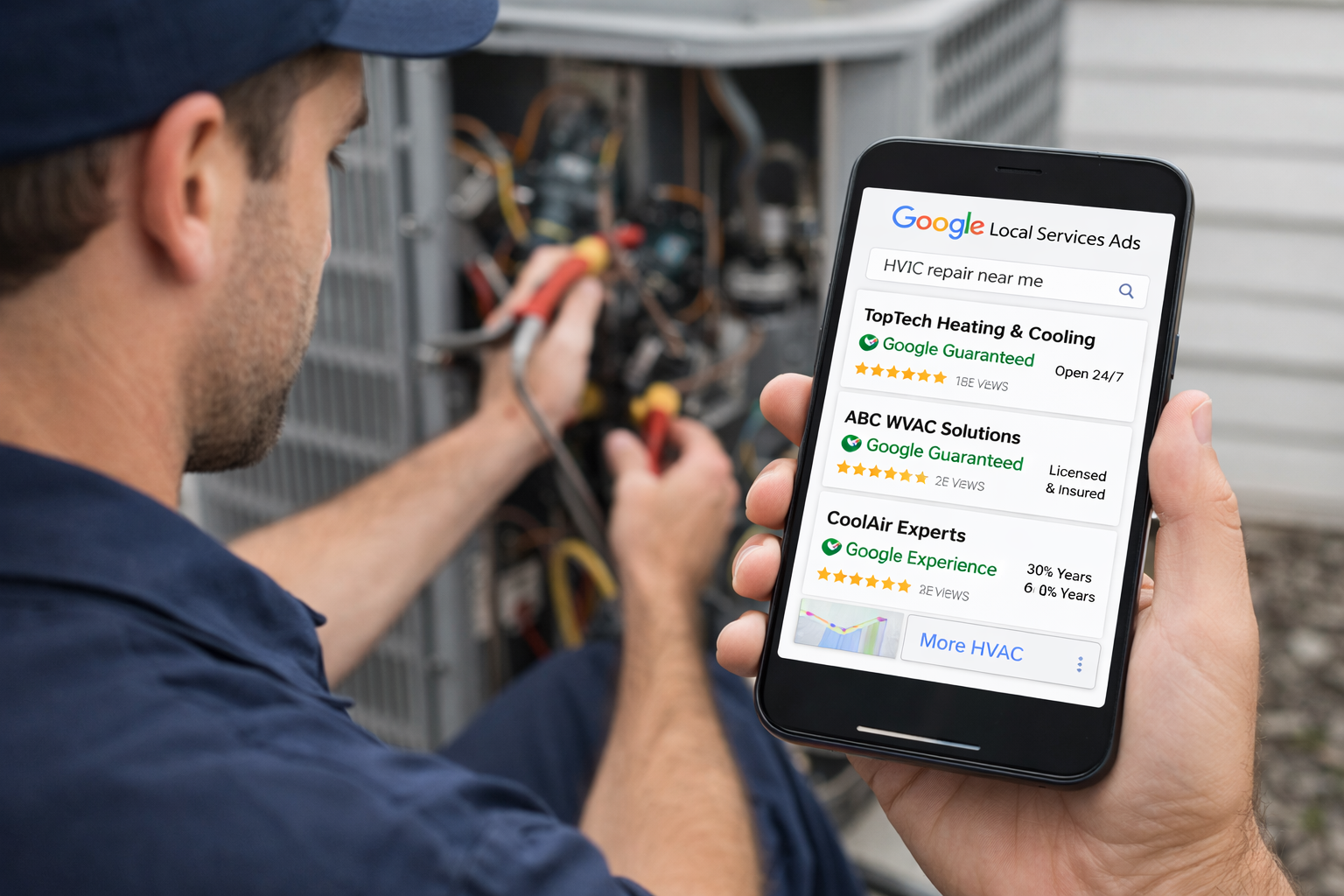
The 7 ways HVAC companies get leads in 2026
Almost every HVAC company we talk to uses some combination of these seven channels. The ratio between them, and how the ratio shifts month to month with the season, is what determines whether you have a cost-controlled scalable lead system or a CPL treadmill that bleeds margin every July.
- Google Local Services Ads (LSA). Pay-per-lead at the top of Google search, Google Verified badge. The highest-intent channel for same-day "AC not cooling," "furnace not heating," and emergency HVAC calls.
- Google Ads (PPC). Pay-per-click for search and Performance Max. Best for brand-specific install searches (Carrier dealer near me, Trane installation, Lennox Premier Dealer) and broader keyword coverage.
- Google Business Profile and local SEO. The cheapest lead source long-term, effectively free per lead, and the channel where maintenance plan customers find you for the next breakdown.
- Factory-authorized dealer programs. Factory leads from Carrier, Trane, Lennox, Bryant, Rheem, American Standard. Zero per-lead cost with co-op marketing commitments, the channel almost every comparison guide ignores.
- Pay-per-call lead services. ResultCalls, Service Direct, Networx, others. Rent leads at $30 to $80 per call, no setup required, useful during peak-season capacity ramps.
- Shared lead aggregators. Angi, HomeAdvisor, Thumbtack. Leads sold to multiple companies simultaneously.
- Direct mail, Nextdoor, Facebook. Lower volume, niche channels. Direct mail with seasonal tune-up offers actually punches above its weight in HVAC.
The first four are channels you own or have a contracted relationship with. The next two are channels you rent. The seventh is mixed. The framing throughout this guide is built around that distinction, plus the seasonality overlay that determines which channels deserve which share of budget month to month.
Channel 1: Google Local Services Ads
Cost per lead: $50 to $110 in most US markets, with peak-season CPL in major metros spiking to $130-$180 during July-August AC emergency demand or January-February heating emergency demand. Shoulder-season CPL drops 30-40 percent below the annual average.
Work out what a lead should cost you in the free CPA calculator before judging the number you are getting.
LSA puts your business at the very top of Google search results, above every Google Ad, above the map pack, above every organic listing. You pay only when a homeowner contacts you directly through the listing, never per click or per impression. The Google Verified badge on your listing tells the homeowner that Google has already vetted your license, insurance, and background, which converts harder when an emergency caller is already stressed about their broken AC at 2pm on a 100-degree day.
Why it wins for HVAC specifically: direct-dial emergency intent at scale. When the homeowner's AC dies at 2pm in a 95-degree Phoenix summer, every second of friction between them and a human technician matters. Pay-per-call vendors route through IVR. Aggregators route through quote forms. LSA dials directly. Combined with the Google Verified badge, LSA is the single highest-converting paid channel in HVAC emergency repair. The complication: peak-season CPL spikes that catch operators by surprise if they have not pre-budgeted for them.
Pros: pay-per-lead model, direct-dial without IVR friction, top-of-SERP placement during the moments emergency intent is highest, Google Verified trust signal, lead dispute system that recovers 10-15 percent of spend on bad leads at scale.
Cons: 2-6 week verification timeline, peak-season CPL spikes can be brutal in Sun Belt metros, the 12+ HVAC job types take careful setup (most operators miss heat pump installation, ductwork, and indoor air quality as separate job types and lose 20-30 percent of potential volume to invisible profiles).
For the full setup walkthrough including job-type strategy and dispute workflow, see our Google LSA for HVAC Companies guide.
Channel 2: Google Ads
Cost per lead: $50 to $150 in most markets at a 12 to 18 percent conversion rate. Peak-season emergency keyword CPC sometimes doubles in Sun Belt metros (Phoenix, Houston, Dallas, Atlanta, Tampa) where a single click on "AC repair emergency" can hit $45-$70. Bad accounts run $180-$330 per lead. Well-run accounts can hit $40-$65 in shoulder seasons.
Google Ads gives you control LSA cannot: brand-specific install landing pages, dedicated maintenance plan acquisition campaigns, ad copy that speaks to specific seasonal pain (broken AC in heat wave, no heat in cold snap), branded campaigns that defend your name from franchise competitors. The HVAC keyword universe is also unusually deep on the install/replacement side, where queries like "Carrier infinity system install" or "Lennox heat pump dealer" produce $7,000-$15,000 install tickets.
Why it wins for install searches and brand-specific work: homeowners researching new system installs or shopping a specific manufacturer (Carrier, Trane, Lennox, Goodman, Bryant) are deeper in the buying journey than emergency callers and convert at higher ticket value. LSA cannot target brand-specific install queries. Google Ads can run dedicated landing pages per brand with manufacturer-specific financing offers, warranty extensions, and dealer credentials. Install tickets average $7,000-$15,000 (AC), $5,000-$12,000 (furnace), and $12,000-$25,000 (full system replacement), which makes the higher Google Ads CPL economically defensible.
Pros: full keyword and audience control, brand-specific landing pages for Carrier/Trane/Lennox, branded defense, broader geo coverage, scales with budget, captures install demand LSA misses.
Cons: higher CPL than LSA, peak-season CPC spikes can be brutal, the wide HVAC keyword universe means a poorly structured account leaks budget on DIY queries ("how to recharge AC", "furnace filter sizes", "DIY thermostat install").
For the full Google Ads campaign structure see our Google Ads for HVAC Companies playbook.
Channel 3: Google Business Profile + Local SEO
Cost per lead: $15 to $45 at maturity. Cheapest sustained lead source and the channel where maintenance plan customers re-contact you for the next breakdown. The HVAC complication: GBP demand still tracks seasonality, just at a much lower CPL than paid channels.
Google Business Profile drives the map pack, the local 3-pack at the top of search results for "HVAC repair near me," "AC installation near me," and similar queries. A well-optimized GBP with current photos, regular posts, verified services, and 150+ reviews can produce 40-100 inbound calls per month at essentially zero per-lead cost. The investment is in profile management, review collection, and seasonal post strategy.
Why this channel matters disproportionately in HVAC: maintenance plan customers and referrals. The customer whose AC you fixed in July and enrolled in your maintenance plan will Google your business name directly when their furnace fails in January. That customer also tells neighbors. The 5-year compounding effect of GBP-acquired customers with maintenance plan attachment is the highest LTV multiplier in HVAC unit economics. Direct-search traffic to a mature HVAC GBP often runs 30-45 percent of total GBP-attributed calls, which is a higher ratio than most trades.
Pros: lowest CPL at maturity, compounding asset value, direct-search leads from past customers, organic trust from review count, beats franchise generic GBPs on local proximity.
Cons: 3-6 month ramp before first meaningful leads, ongoing review collection investment, hyper-competitive in large Sun Belt metros, demand still drops in shoulder seasons.
See our GBP optimization playbook for contractors for the full setup checklist.
Channel 4: Factory-authorized dealer programs
Cost per lead: $0 acquisition (manufacturer-routed leads), with co-op marketing commitments of 1-3 percent of sales reinvested into approved marketing. Most HVAC lead-gen comparison guides skip this channel entirely. They should not. For most established HVAC operators, factory-authorized work produces 20-35 percent of total lead volume at zero per-lead cost.
Major HVAC manufacturers route consumer leads from their corporate websites and dealer locator tools to authorized service providers in each territory. The biggest programs are:
- Carrier Factory Authorized Dealer (FAD). Highest-volume program. Requires NATE-certified technicians, sales volume minimums, and Customer Satisfaction Index threshold maintenance. The Carrier dealer locator drives meaningful Google traffic.
- Trane Comfort Specialist (TCS). Trane's premier dealer program with similar volume to Carrier FAD in their dealer footprint. Strong consumer brand recognition that lifts cash-pay conversion when displayed on your GBP.
- Lennox Premier Dealer. Tiered program (Premier Dealer and Dave Lennox Award levels). Comes with dealer-only financing through Synchrony that customers cannot get elsewhere.
- Bryant Factory Authorized Dealer. Sister brand to Carrier with similar program structure. Often run by Carrier FAD dealers as a dual-line dealership.
- Rheem Pro Partner. Lower volume than the premium brands but lower commitment thresholds, making it accessible to smaller operators.
- American Standard Customer Care Dealer. Sister brand to Trane, similar economics to Bryant/Carrier pairing.
What you get: dealer locator placement on the manufacturer's site, consumer-facing financing offers customers cannot get elsewhere, manufacturer warranty extensions, co-op marketing fund matching (often 50-100 percent match on approved local advertising), and a visible badge on your website and GBP that lifts cash-pay conversion rate 15-30 percent. The badge alone is worth meaningful CPL improvement on every other channel you run.
What it actually costs you: sales volume minimums (typically $250K-$500K+ in annual brand sales), technician NATE certification, Customer Satisfaction Index threshold maintenance (usually 90+ percent), exclusivity restrictions (most programs limit how aggressively you can sell competing brands), and 1-3 percent of brand sales committed to approved co-op marketing. The exclusivity restriction is the variable most operators underestimate. If you join Trane Comfort Specialist, your ability to recommend Goodman as a budget alternative for value-conscious customers gets constrained.
How to think about it strategically: factory-authorized work is not a replacement for cash-pay channels, it is a baseline that produces predictable revenue and lifts conversion on everything else through badge effects. The right ratio for most full-time HVAC operators is 25-40 percent factory-authorized, 60-75 percent cash-pay from owned channels. Operators who go 100 percent on one brand often see margin compression during manufacturer rebate season cycles and lose flexibility when customer budget tier varies.
How to apply: contact each manufacturer's regional dealer development manager directly through your local distributor. Carrier dealer development runs through your local Carrier Enterprise distributor. Trane Comfort Specialist applications go through Trane Supply. Lennox applications go through Lennox Plus dealer portal. Each application requires sales history, technician certification verification, financial review, and a territory analysis showing you are not over-saturated with existing FAD dealers. Approval timelines run 90-180 days. Start with the brand most prevalent in your existing service calls, which you can identify by reviewing the brands installed in homes you currently service.
Channel 5: Pay-per-call lead services
Cost per call: $30 to $80 per call. Vendors include ResultCalls, Service Direct, Networx, HomeAdvisor's pay-per-call program, and smaller regional operators. HVAC pay-per-call rates run higher than most trades because the per-job revenue is higher.
Pay-per-call services run their own paid ad campaigns and route inbound calls to contractors who have signed up for that geo. You pay per call, the vendor handles ad spend, targeting, and campaign management. From your side, the only thing you do is answer the phone.
What that actually looks like in practice: the vendor runs Google Ads targeting your zip code, the homeowner clicks an ad, calls a tracked phone number, the vendor's IVR briefly qualifies the call (asks about service type and urgency), and the call routes to your line. You pay per call regardless of whether you book the job. Peak-season pricing typically rises 30-50 percent on top of base per-call rates.
Pros: zero setup, leads start within 24 to 72 hours, no campaign management, no Google Verified background check required, useful for peak-season capacity ramps when in-house ad accounts cannot scale fast enough.
Cons: permanent rental cost, no asset ownership, lead disputes harder to win than LSA disputes, "exclusive" usually means one company per call but the same geo is sold to multiple companies, IVR pre-qualification adds 30-90 second friction that hurts hangup rates on emergency calls, per-call cost stays flat over time.
The "exclusive" definition is worth pausing on. Most pay-per-call vendors define exclusivity as one company per call, not one company per geographic territory. A homeowner three doors down from your last customer might get routed to a competitor using the same vendor. True geographic exclusivity in residential HVAC is rare and significantly more expensive than the headline rates suggest.
Channel 6: Shared lead aggregators
Cost per lead: $20 to $60 per shared lead, $50 to $130 per exclusive lead. The largest aggregators in residential home services are Angi (formerly Angi's List), HomeAdvisor, Thumbtack, and Networx.
Aggregators collect lead intake forms through their own marketing, then sell each lead to multiple contractors simultaneously, typically 3 to 4 per shared lead. The contractor who responds fastest usually wins the job, which creates a race-to-the-phone dynamic that benefits whoever is sitting at their desk that minute.
The economics math nobody runs: a $40 shared lead sold to 4 contractors only converts for one of them. The other three paid $40 each for nothing. Aggregators usually do not offer credits for those losses. So the real CPL for a contractor running on aggregator leads is closer to $120-$160 when you account for the leads you paid for and lost, not just the ones you booked.
Pros: instant volume, no setup, works as a shoulder-season capacity filler when paid channels go quiet.
Cons: shared with 3-4 competitors per lead by default, dispute friction is high, brand dilution because you appear on their platform and not your own, no asset ownership, race-to-the-phone dynamics, lead quality declines over time as the aggregator scales.
Aggregators are a defensible choice as a shoulder-season gap filler. They are a money loser as a primary lead channel.
Channel 7: Direct mail, Nextdoor, Facebook
Cost per lead: highly variable, $25 to $90+ depending on channel and execution.
Direct mail (the underrated channel in HVAC). Postcards with seasonal offers (pre-summer AC tune-up special, fall furnace check, maintenance plan enrollment) actually punch above their weight in HVAC. The mailer that sits on the homeowner's fridge for two weeks in May is the company they call when their AC fails in July. Maintenance plan enrollment from direct mail responses runs 15-25 percent attachment rate when the offer is structured correctly, which makes the math work even at $75 per lead because plan customers carry 5-7x higher LTV.
Nextdoor. Sponsored posts and neighborhood-targeted ads. A single endorsement post from a satisfied maintenance plan customer can produce 10-25 calls over the following 60 days. Particularly effective for "trusted local technician" positioning in family-heavy suburbs where homeowners rely on neighbor recommendations. See our Nextdoor ads for contractors guide for the targeting playbook.
Facebook and Instagram. Effective for maintenance plan acquisition through retargeting customer email lists, brand awareness in shoulder seasons, and seasonal urgency campaigns. Less effective for emergency repair because intent on social platforms is low. Best used as a top-of-funnel channel that builds remembered-name recognition before the next system failure.
The seasonality framework: month-by-month channel allocation
The single biggest mistake HVAC operators make on lead generation budget is treating July like April. Peak season and shoulder season require completely different channel ratios. Here is the framework we apply on managed HVAC accounts.
Peak summer (June-August in cooling markets): emergency AC repair demand spikes 3-5x. Concentrate spend on LSA and Google Ads emergency campaigns. Push LSA budget caps to maximum. Activate Google Ads daypart bid adjustments for the 12pm-7pm window when most AC failures occur. Pause maintenance plan acquisition campaigns. Pay-per-call services become viable as overflow capacity at $50-$80 per call because peak-season per-call rates still net out at acceptable cost per booked job. Goal: capture every emergency call you can fulfill.
Peak winter (December-February in heating markets): mirror of peak summer but for heating emergencies. Activate furnace-specific landing pages and ad copy. Add gas line and heat pump job types if not always-on. Increase GBP post cadence with cold snap urgency messaging. Same overflow capacity strategy with pay-per-call.
Shoulder seasons (April-May, September-October): emergency demand collapses 60-80 percent. This is when most operators waste budget. The correct play is to reallocate 40-60 percent of peak-season ad spend toward: maintenance plan acquisition campaigns on Facebook and direct mail, install/replacement campaigns on Google Ads targeting end-of-season equipment buyers, GBP review collection from your peak-season customer base, and factory-authorized dealer program development. Pause pay-per-call entirely.
Year-round baseline (always-on): GBP optimization, LSA at moderate budget (peak-season increases happen on top of this), factory-authorized dealer relationships, maintenance plan service and renewal calls. These do not stop. The peak-season ramp is on top of, not instead of, the year-round baseline.
The 7-channel cost comparison table
All seven channels side by side. CPL ranges show shoulder-season floor to peak-season ceiling, since HVAC demand swings are too large to use single-number averages.
| Channel | CPL range | Time to first lead | Asset ownership | Best for |
|---|---|---|---|---|
| Google LSA | $50-$110 ($130-$180 peak) | 14 to 42 days (after verification) | Yours | Emergency calls, direct-dial intent, peak season priority |
| Google Ads | $50-$150 (peak season $120-$220) | 3 to 14 days | Yours | Install searches, brand-specific (Carrier, Trane, Lennox), branded defense |
| GBP + Local SEO | $15-$45 (at maturity) | 3 to 6 months | Yours (compounding) | Maintenance plan customers, referrals, year-round baseline |
| Factory-authorized dealer | $0/lead (co-op marketing 1-3% sales) | 90 to 180 days (application) | Relationship-owned | Baseline volume, badge effects on other channels, financing offers |
| Pay-per-call services | $30-$80 per call (peak +30-50%) | 1 to 3 days | Rented (zero) | Peak-season overflow capacity only |
| Lead aggregators | $20-$60 shared, $50-$130 exclusive | 1 to 3 days | Rented (zero) | Shoulder-season capacity filler only |
| Direct mail / Nextdoor / Facebook | $25-$90+ (varies) | 2 to 6 weeks | Mixed | Maintenance plan acquisition (especially direct mail in shoulder season) |
The columns that matter most are asset ownership and time to first lead. Owned channels (LSA, Google Ads, GBP) have higher upfront friction but accumulate value over time. Brand-authorized warranty is its own category, a contracted relationship that produces steady work without per-lead spend but at compressed labor rates. Rented channels (pay-per-call, aggregators) produce instant flow but stop the day you stop paying.
The maintenance plan multiplier: how plan attachment changes every CPL calculation
Every HVAC channel comparison that stops at "cost per lead" is leaving the most important number on the table. The metric that decides whether HVAC unit economics work long-term is not CPL, it is customer LTV after maintenance plan attachment. And the spread between plan customers and non-plan customers is enormous.
Single-call thinking: a $75 LSA lead converts to a $450 AC repair. Cost per booked job is $144 assuming 80 percent answer rate and 65 percent booking rate. Gross margin is roughly 35 to 45 percent on the repair itself. Reasonable economics for a single transaction. Most channel comparison guides stop here. This is what makes most HVAC operations look stuck on the CPL treadmill.
Maintenance plan thinking: the same $75 LSA lead converts to a $450 repair plus a $349/year maintenance plan enrollment. Year-one revenue from the customer is $799. Year 2 brings $349 in plan revenue plus 1.3x the industry-average repair attachment rate ($580 expected). Year 3 to 5 brings continued plan revenue plus high-probability repair calls. Year 5 brings system replacement consideration where the established trust relationship converts at 60-75 percent vs the 12-20 percent rate of cold install bids. Total typical 5-year LTV of a maintenance plan customer in HVAC: $4,000 to $9,000.
Non-plan thinking: the same $75 LSA lead converts to the $450 repair but the customer does not enroll. They forget your name within 18 months. Their next emergency calls some other LSA result. Total typical 5-year LTV: $400 to $1,200.
The 5-7x LTV difference between plan and non-plan customers is the single biggest unit economics lever in HVAC. The implication for channel selection: the cost of acquiring a lead matters less than the operational discipline to attach a maintenance plan on every first-touch repair call. A $150 LSA lead in peak season that becomes a maintenance plan customer is dramatically better economics than a $50 lead from any channel that does not.
Why this matters for channel weighting: the channels that produce customers most likely to attach a plan (in order: LSA, GBP-direct, Google Ads with maintenance plan landing pages, factory-authorized dealer leads) deserve disproportionate budget allocation. The channels that produce price-shopping leads less likely to attach a plan (aggregators, certain pay-per-call vendors with aggressive cost-conscious targeting) deserve less even when their headline CPL looks competitive.
A useful rule of thumb: when comparing channels in HVAC, weight by expected plan attachment rate. LSA emergency calls attach plans at 25-35 percent. GBP-direct calls attach at 30-45 percent. Aggregator-sourced calls attach at 8-15 percent. Multiply CPL by the inverse of expected attachment rate to get a more honest channel comparison.
The own-the-channel playbook for HVAC
If you decide to build instead of rent, here is the order of operations for the first 120 days.
- Set up and verify Google LSA. Start the background check and license verification first, it is the slowest step. While verification processes, build out your full job type list: AC repair, AC installation, furnace repair, furnace installation, heat pump installation, ductwork, indoor air quality, gas line repair, thermostat installation, and commercial HVAC. The 12+ HVAC job types include several that most operators miss (ductwork, indoor air quality, heat pump as a separate category from AC). See our LSA for HVAC Companies playbook for the full walkthrough.
- Optimize your Google Business Profile in parallel. Upload 30+ photos including badges of any factory-authorized dealer programs (Carrier FAD, Trane Comfort Specialist, etc.), fill every service category, enable messaging, build review collection into your job-close workflow. See the GBP playbook.
- Launch Google Ads with a structure organized by service category and season. Emergency Repair campaign (highest CPC, peak-season priority), Install/Replacement campaign (year-round, lower urgency), Maintenance Plan Acquisition campaign (shoulder-season focus), optional Brand campaign for Carrier/Trane/Lennox dealer searches. Negative keyword list of 200+ terms on day one (block "DIY," "how to fix," "AC filter sizes," "thermostat install YouTube," etc).
- Install proper conversion tracking with attachment rate tracking. Beyond standard call tracking, set up plan attachment as its own conversion event. Track plan attachment rate by lead source so you can attribute LTV-weighted CPL properly. This is the metric that separates well-managed HVAC accounts from CPL-treadmill accounts.
- Apply to one or two factory-authorized dealer programs in parallel. Start the application 60-90 days into the buildout. Pick the brand most prevalent in your existing job records. Co-op marketing match funds can fund a portion of your Google Ads spend if applied properly.
- Build the maintenance plan acquisition flywheel. Every first-touch repair lead becomes a plan attachment opportunity. Train technicians on the value proposition (priority scheduling, no-overtime guarantee, system checkup, exclusive discounts on repairs). Aim for 25-35 percent attachment rate on repair calls within 90 days. This is the operational change that compounds with every paid lead you acquire.
Done well, this 120-day buildout puts you under $80 per lead blended by month 5 with 30+ percent maintenance plan attachment, which moves cost-per-acquired-LTV-customer into a fundamentally better economic tier than any single-transaction-CPL framing suggests.
How Blue Grid Media builds the system
We run the LSA setup, the Google Ads campaign build, and the GBP optimization as a coordinated three-channel system, not three separate accounts that compete with each other. The pricing is a $695 monthly retainer plus 5% of ad spend (Google bills your ad spend directly, you only pay us the management fee). No setup fee. No long-term contract. Month-to-month engagement, 30 days notice to cancel.
The HVAC operators we work with range from single-truck owners running $2,500 to $6,000 a month in ad spend all the way up to multi-location accounts running over $80,000 per month in ad spend across LSA, Google Ads, factory-authorized dealer co-op marketing, and brand-specific install campaigns. The playbook scales because the same fundamentals (12+ job-type configuration, brand-specific landing pages for Carrier/Trane/Lennox, peak-season daypart bid adjustments, maintenance plan attachment tracking, conversion API integration, dispute filing) move the needle whether you are running one truck or thirty.
Compare that to the typical 15% of ad spend the larger agencies charge, or the $35 per call pay-per-call rate that never drops, and the math is straightforward. We bet on the relationship lasting because we make it work, not because we lock you in.
“ Your landing pages are on us. Custom pages built for your campaigns, no design fee, no setup fee, no contract. If we don't move the needle on booked jobs, walk away any month and keep everything we built, pages included. ”

HVAC Leads FAQ
What is the cheapest source of HVAC leads in 2026?
Local SEO plus an optimized Google Business Profile produces the cheapest HVAC leads long-term at around $15 to $45 per lead once it ranks. The catch is the 3 to 6 month ramp. Google LSA runs $50 to $110 per lead and is the cheapest pay-per-lead channel from day one. Google Ads runs $50 to $150 per lead with peak-season spikes. Pay-per-call services start at $30 to $80 per call. Factory-authorized dealer programs (Carrier, Trane, Lennox, Bryant) produce manufacturer-routed leads at $0 per-lead cost but with co-op marketing commitments.
How does HVAC seasonality affect lead channel performance?
HVAC seasonality is the single biggest variable in channel selection. Summer drives emergency AC repair searches at 3-5x shoulder-season rates, with LSA CPL spiking 30-60 percent and Google Ads CPC sometimes doubling. Winter drives heating emergency calls in northern markets. Shoulder seasons (April-May, September-October) collapse demand 60-80 percent and are when maintenance plan acquisition through GBP, direct mail, and Facebook becomes the highest-leverage activity. The smart HVAC operator concentrates ad spend in peak season, runs maintenance plan campaigns in shoulder seasons, and uses factory-authorized work as the year-round baseline.
Should HVAC contractors join factory-authorized dealer programs like Carrier, Trane, or Lennox?
Yes, for most established HVAC operators. The major programs (Carrier FAD, Trane Comfort Specialist, Lennox Premier Dealer, Bryant FAD, Rheem Pro Partner, American Standard Customer Care) produce 20-35 percent of total lead volume at zero per-lead cost. Each requires NATE certification, sales volume minimums, co-op marketing commitments (1-3 percent of sales), and customer satisfaction thresholds. In return: factory leads, dealer-only financing, manufacturer warranty extensions, and a visible badge that lifts cash-pay conversion 15-30 percent. The trade-off is pricing constraints on competing brands.
How much do HVAC maintenance plans actually multiply customer LTV?
A homeowner enrolled in a maintenance plan generates $400-$800 in annual recurring revenue from the plan itself plus 2-3x higher repair attachment rate. Typical 5-year LTV of a maintenance plan customer is $4,000-$9,000. Typical 5-year LTV of a one-time repair customer with no plan attachment is $400-$1,200. The 5-7x difference is why aggressive maintenance plan attachment on every first-touch repair call is the single highest-leverage operational change in HVAC unit economics.
How long until owned HVAC leads beat pay-per-call CPL?
For a well-run setup, owned channel CPL drops below pay-per-call rates by month 3 to 5. LSA gets there fastest because the dispute system recovers 10-15 percent of spend. Google Ads takes 6-8 weeks. Local SEO is the longest payback at 4-9 months but produces the cheapest leads after. The HVAC complication: operators ramping up for summer need owned-channel infrastructure built by April-May to capture peak demand efficiently. Operators starting the buildout in June pay premium CPL through the peak.
How many HVAC leads can I get on a $5,000 per month Google Ads budget?
On a well-run HVAC Google Ads account at $5,000 monthly spend, expect 40 to 75 leads per month at $65 to $125 cost per lead averaged across seasons. Peak season delivers 70-100 leads at $50-$85 CPL. Off-peak delivers 20-35 leads at $130-$200 CPL. A poorly run account produces 15-30 leads year-round at $160-$330 per lead. The swing is driven by account hygiene: negative keyword lists, brand-specific landing pages (Carrier, Trane, Lennox, Goodman), bid strategy by service type, dayparting around emergency-call hours, and conversion tracking accuracy.
What is the lifetime value of an HVAC customer?
Without a maintenance plan attachment, the average HVAC customer generates $400-$1,200 in lifetime revenue over 5-7 years through 1-2 repeat repair calls. With a maintenance plan, that LTV climbs to $4,000-$9,000 over the same period. The single biggest LTV multiplier is maintenance plan attachment rate on first-touch repair calls. The second biggest is the repair-to-replacement pipeline: an experienced technician explaining replacement economics on an aging system often converts an $800 repair into a $7,000-$15,000 install.
Should I run Google LSA and Google Ads together for HVAC?
Yes, but the ratio shifts by season. Peak season: run both at full budget to capture every emergency search. LSA gets the direct-dial emergency call. Google Ads captures install/replacement research traffic and brand-specific searches that LSA cannot target. Shoulder season: consolidate spend on LSA where the dispute system protects you and shift Google Ads budget toward maintenance plan acquisition. Operators running only LSA miss install demand. Operators running only Google Ads miss the highest-converting emergency calls.
Next steps
The HVAC operators we work with who win on lead cost share four things in common. They run LSA and Google Ads together with peak-season budget scaling, not flat-budget-year-round. They invest in GBP early and stay consistent on review collection so maintenance plan customers re-contact you for the next breakdown. They pursue at least one factory-authorized dealer program (Carrier, Trane, Lennox, or Bryant) for the badge effects and zero-cost lead baseline. And they treat shoulder seasons as maintenance plan acquisition windows, not as months to cut budget.
If you want a walk-through of what your current lead mix is costing you and where the biggest wins are in your specific market, that is exactly what we do on a first call. No pitch deck. No sales script. We open the numbers together and tell you what we would change.
No obligation. We look at your numbers and tell you what is working and what isn't.
Cost-per-lead ranges in this guide reflect Blue Grid Media's 2026 data, the major published industry studies (LocaliQ, BrightLocal), and the published rates of leading pay-per-call vendors. Actual costs vary by market, season, account quality, and how consistently you follow up on leads.
More for HVAC operators
Pair this with the rest of the HVAC operator series. Each guide covers a different angle on growing an HVAC company through paid search: